What’s in your writing drawer?

What’s in your writing drawer?

Gwynn Scheltema

There’s plenty of advice out there on how to prepare your work for submitting, but what if, like me, your problem with submitting—is you!

Do any of these statements apply to you?

  • ·         You have completed work ready to send out that hasn’t been submitted ever.
  • ·         Many of your completed pieces have been waiting to go out for years.
  • ·         You have several projects that are “almost ready” to send out.
  • ·         You have pieces that you sent out once, had rejected and never submitted again.

head shot of isaac Asimov


“You must keep sending work out; you must never let a manuscript do nothing but eat its head off in a drawer. You send that work out again and again, while you’re working on another one. If you have talent, you will receive some measure of success – but only if you persist.”

  Isaac Asimov

Facing fear

You likely already know that the prime reason for not sending your stuff out is fear:

  • ·         of rejection (I‘m not as good a writer as I thought I was)
  • ·         of success (now I’ll have to do it again)
  • ·         of someone stealing my ideas (lack of trust of new people or situations)
  • ·         of facing the reaction of readers (don’t like to be judged)
  • .         of rewrites and edits (what if I can’t do what they want)

book cover Art & Fear

What separates artists from ex-artists is that those who challenge their fears, continue; those who don’t, quit. Each step in the artmaking process puts that issue to the test.
― David BaylesArt and Fear


Like eating well and exercising, you know what to do and why you should do it, but you can’t bring yourself to do so. So here are a few ideas to help you over that hump:

1. Join the clubwoman afraid

We can’t control fears and feelings. Likely they are deep-rooted in our psyche. But we can find ways to move forward despite the fear.

Accept that pretty much every writer has these fears at one time or another. The trick is to accept it as part of the writing process. Embrace it and face it.

You will get rejected. It’s a given. But you will survive. You will live to write another day.

2. Let go

Ironically, the greatest feelings of self-doubt seem to come at the moment when the task is almost done. You want it to be perfect; the pressure to finish increases, and the knowledge that you will have to put it out there sits menacingly on your shoulder. But there comes a time when you must fight self-doubt and have faith in what you’ve created. You must let go.

If you don’t? What happens? Nothing. Your writing stays in the drawer. You beat yourself up for not moving forward. Nothing gets resolved.

3. Trust the Processtrust yourself

Fear focuses on unknown results of possible action. You can’t control unknown and possible. You can control process—and action. So start on the process of submitting; create a forward motion as a way to outwit, outrun, outsmart fear.

It’s hard, sure, but it’s the writing life. You can either face it or not. You can trust the process or live in fear. Your choice. The solution in your hands.

4. Get started!
  • ·         Set yourself a target date to have just ONE piece sent out.

Writers live by deadlines, so harness that attitude to help you submit. Make yourself publicly accountable—tell your writing buddy, your critique group, anyone who will call you on it.

  • ·         Break the process down into actionable tasks.

Submitting your work can feel overwhelming. But like any process, breaking things down into bite-size actionable pieces helps you to get started so that once begun, the task takes on a momentum of its own.

Try making a list for each stage of the process (which you can use again and again), and then tackle just one item on the list at a time. Tell yourself you only have to do one thing on the list. Chances are, once you get started, you’ll do a lot more. And each action you take will build your confidence. Focus on the idea that each small item is doable.leap of faith

5. Don’t Stop!

By the sheer law of averages, the more submissions you make, the more publishing success you will likely have. Think of rejections as “acknowledgments” that you are doing what real writers do. You are submitting!

A good place to start is writing contests. Join Ruth E. Walker and Dorothea Helms in May for their popular workshop Write to Win.

If you want to start the process now, make a public commitment in the comments below to a date to have ONE submission completed. We’ll follow up and see how you did.


The Unoriginal World of bobbi leblanc

The Unoriginal World of bobbi leblanc

Gwynn Scheltema

I was reminded about poetry when I went to the ballet this week. And not necessarily what you may expect…expressions of beauty through pattern or escape to a lyrical world (although that certainly happened).

No, I was reminded about the quest for meaning in art and the effect of succumbing to fads and affectations.

The Quest for Meaning

The National Ballet’s mixed winter program began with two offerings of classic Balanchine choreography: The Four Temperaments and Rubies. As the knowledgeable and always eloquent creative Director and Principal Ballet Master, Lindsay Fischer reminded us in the pre-performance talk, Balanchine choreographed always with the music uppermost in his mind. He didn’t start out with an idea he wanted to express. Instead, he listened to the music and let the music suggest the movement.ruby-1254568_960_720

When you listen to a symphony, you don’t spend that time wondering what it means. You let it transport you and enjoy the way it makes you feel. Balanchine’s ballets are like symphonies. You enjoy them for the emotions they stir in you, for the beauty in the patterns that delight you, for the surprises that please you when you least expect them to.

Good poetry is like that too: the music of the words and rhythms, the surprise of juxtapositions and turning points, the satisfaction of found mutual experience and ah-ha moments. And the delight of images that make you feel like you see what the poet sees. To paraphrase Chekov, poems that allow the reader to experience the moon by seeing “the glint of light on broken glass”.

And always emotion. It’s not necessary to read poetry looking for meaning. Allow the images to evoke whatever emotion or memory they do for you. There is no right or wrong reaction to what is written. Like a symphony, or a Balanchine ballet, let the poem transport you and move you.


Fads, Trends and Affectationscactus-659128_960_720

The final offering was a new work by Swedish choreographer Alexander Ekman called Cacti. At first it was disturbing, confusing, but it didn’t take long to become comical, in fact, hilarious.

It poked fun at all the trendy things we’ve seen on stage and in dance competitions: androgynous dancers; bizarre props that seem to be symbolic but aren’t; weird, intrusive (and often annoying) lighting and stage sets; contorted body positions and music that isn’t sure what rhythms or mood it’s going for.

In short, it was using conventions and trends that others had been using, in fact, overusing. And did it result in “art”? Was it trying too hard to be “art”?  What resulted was a parody of art.

In this case, the choreographer was going for that and succeeded brilliantly. But it was a heads up to those who forget to open their minds and let the muse be original.

It took me back tofun issue 2004 when Ruth and I were on the editorial board for the literary journal LICHEN Arts & Letters Preview. Submissions of poetry went through a “fad” at that time, where everything was lowercase, even the pronoun I, and the poet’s name. Poems were made up of numbered parts, had words in italics, parentheses and were often divided by slashes. And all of them (it seemed) started with a quote from someone else or notes on what inspired the poem. That’s not to say that these devices cannot be used; there are some very fine poems with one or more of these elements in them. But what we were seeing was random, put in there without meaning or context because the poet had seen it elsewhere and was imitating without understanding why it was like that in the first place. That’s the pretentious part.
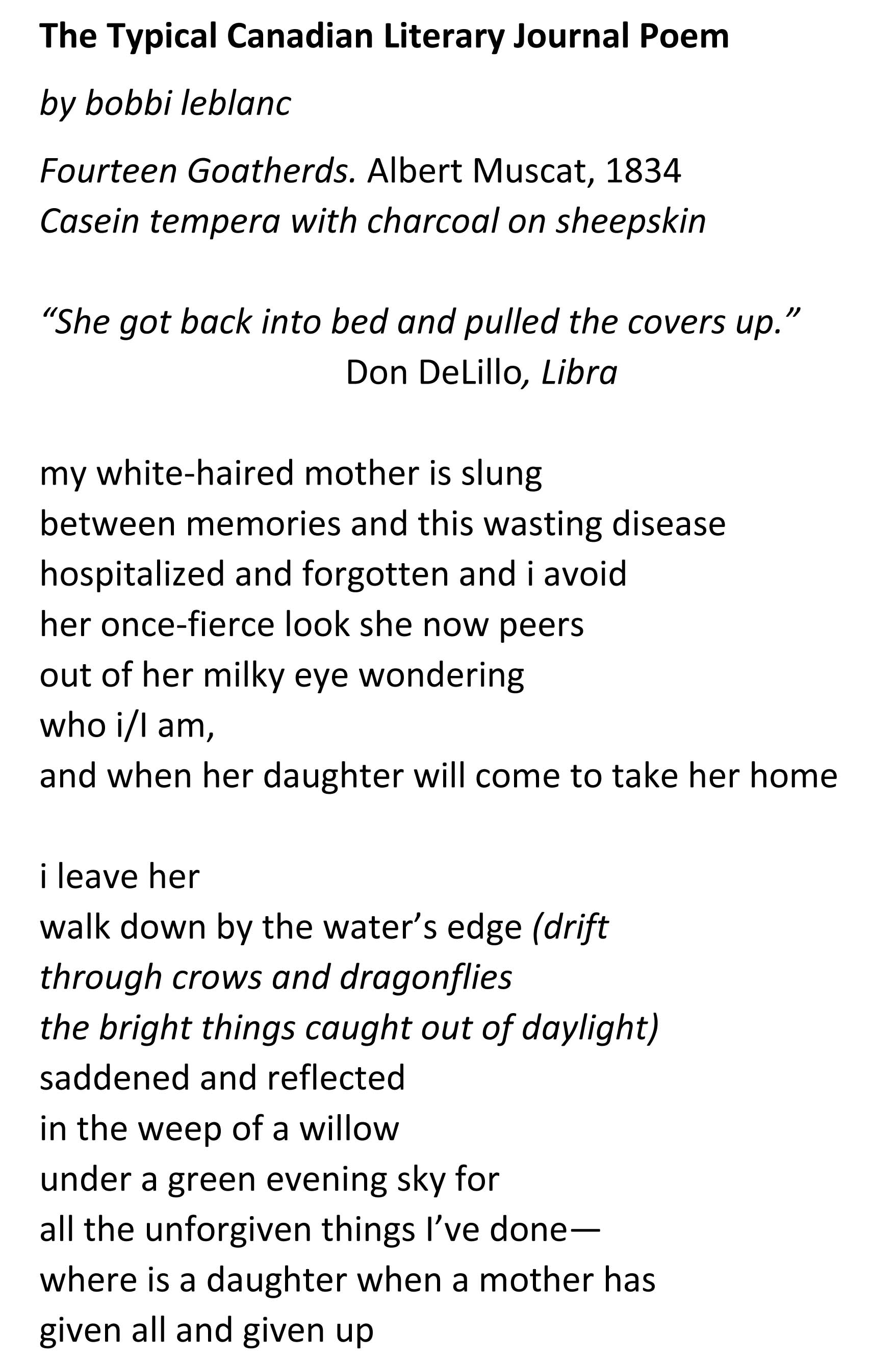
Given that we had to deal with hundreds of submissions, it was frustrating. Our 2004 spring issue was the “fun” issue, so as a lark, and to do much the same thing that Ekman did in the ballet Cacti, we (the editorial board) collectively wrote a poem that parodied all these affectations. We published it as “The Typical Canadian Literary Journal Poem” by a fictitious poet called bobbi le blanc (Notice: non-gender, possibly French and/or English and all lowercase name.). It was a hoot. But in the fun, like the ballet Cacti, there was that same heads up to those who forget to open their minds and let the muse be original.

It was a long poem with many numbered parts (of course), but just to give you a taste, here are the first two stanzas. Enjoy a giggle. The Typical Canadian Literary Journal Poem


Can You Use Parody?

Interestingly, parody is a great way to loosen up the mind and your writing. Try taking something you’re editing and rewriting it in the same style of a well-known writer, say, Ernest Hemingway (simple, direct and plain prose) or William Shakespeare (image-rich, iambic pentameter, 16th-century prose) or Margaret Atwood (precise, ironic and witty). When you are finished, consider how  your own work is different. What makes your style, your voice, unique? 

The Guilt of Reading

The Guilt of Reading

On the radio the other day, someone was talking about getting “unplugged” to read paper books. As a writer, and a reader, my ears pricked up.

The person on the radio explained that she usually reads on her phone, but when she does, she is also plugged in to message alerts and Facebook notifications etc. and doesn’t really give the reading her full attention. But what stops her from reading paper books, she said, was dealing with the guilt of being unplugged.

eye glasses on open bookFeeling Guilty?

I wonder what’s happened to our priorities when it feels wrong to be unplugged from the digitally connected world. For pleasure or to grow our minds, what is the problem with reading a book?

Writers need to read. No question. And they need to read widely. Yet her statement about guilt had a certain ring to it.

I’m not constantly plugged in digitally (to which frustrated friends and associates who labour to get hold of me will attest). So I don’t feel any guilt about being unplugged.

But, I have to admit, I do feel guilty about taking time to read.

When I plan my day, reading is seldom, if ever, on the list as an option. I do read. Usually around one fiction book every three weeks and non-fiction in between, but that reading is reserved for before bed or with my morning coffee — a luxury or a reward for an otherwise productive day.

Admittedly, if I get to the point in a novel when the book won’t allow itself to be put down, then I might spend the morning, or stay up late and finish it. And occasionally, I will “allow” myself the luxury of a day with a book. But I do feel guilty when I do that. I feel guilty about all the things I should have done with that time in the same way as I would admonish myself for playing computer solitaire.

do what you loveReading is not a luxury

It’s time, I believe, for giving my head a good shake. Reading, especially for a writer, is not a luxury. It is as necessary as writing or editing.

And I’m not just talking reading as research. Reading other writers is hugely important. It’s important to see what my contemporaries are doing. What’s winning prizes. It’s important to read as a writer. I have a notebook next to my bed where I make notes about things I want to remember or revisit. I list every book I read and the author and date. I keep notes like: Page 57 – good child’s perspective on death.

So if reading is so necessary a part of my writing life, why the guilt?

My brain seems to find it acceptable to read a book on plot or the latest copy of Quill and Quire to stay abreast of what’s happening in the writing world. It’s reading for pure pleasure that seems somehow different.  Hmmmm…

For me, I think it’s time to move all reading into the “acceptable past-time category”. It’s time to ditch the guilt. It’s time to head over to Goodreads and pick my next book!

9 Tips for Writing Steamy Scenes

9 Tips for Writing Steamy Scenes

Gwynn Scheltema. 

It’s February, the month for Valentines and all things romantic: love and…sex.

When I have to face writing sex scenes, I sometimes feel like I’m getting undressed in public. I feel like my mother is watching; like everyone will think I do all the things I describe. Do you ever feel that way?

Get over it.

Check out these 9 tips to help you.

Sex is emotion in motion.
~ Mae West

1. Don’t be afraid to write outside your own experience.

Research and write just as you would for any situation you haven’t experienced personally. Read sex scenes by other authors and note which resonate with you. Ask yourself why. I just finished reading Marissa Campbell’s Book, Avelynn. She expertly handles a full range of sexual encounters, from that first romantic kiss to attempted rape and a great deal in between.

2. Treat a sex scene like any action scene.

Have a reason to include it that involves advancing the plot or illuminating character, or developing a relationship.

3. Make your characters human.

Keep your characters human, flawed people, not a larger-than-life Adonis or Aphrodite. While romance has an element of wish fulfillment about it, if you make it so like a fairy tale, some readers won’t believe it.

4. Keep the sex real.

Sex is not always spectacular; it can be boring, mundane, or unsatisfying too. And it doesn’t always have to be completed. Interrupted sex can be quite a tease.

5. Get the timing right.

Don’t let things get hot and heavy in the most unlikely of moments and places in your plot. Don’t shove sex in because it’s been four chapters since the last tryst. Remember tip #2.

6. Get the choreography right.

Not just on a physically level, but on an emotional level too. Physically, make sure your transitions let us know if someone goes from standing to lying, or from facing to spooned. More importantly, let us know their emotional reactions and changes. The physical act by itself is just porn.

7. Be careful of metaphor and simile.

Clichés about stars exploding will only undermine what you are trying to do. Find fresh and appropriate comparisons and don’t hide behind them to avoid being explicit or to add drama. And remember that sex involves all five senses. Use them!

8. Use the correct terms and don’t be offensive.

Research if you have to. If euphemisms pepper your scene, you’ll leave the reader giggling or cringing. Also be aware of the accepted sexual practices of your genre and age group and stay in those boundaries.

9. Keep the scene brief.

Sometimes less is more. Subtle hints are often more effective than graphic description. Give readers enough to satisfy the moment, but leave them wanting more.

Have fun with itkiss

 Remember how you felt when you first discovered that French kissing involved touching tongues? As a teen, did you practise on your arm or the mirror? What about your first kiss?

 Kisses come in so many forms: passionate, wet, teasing, rough, slow… In 50 words or less, write about a kiss—fun, steamy, chaste…. Post it in the comments below.


[By the way…for a great workshop on characters, check out Ruth’s Character Master Class on March 5.]

Tasting the Page:  Beyond the Five Senses

Tasting the Page: Beyond the Five Senses

With Gwynn Scheltema

In this one-day workshop:

  • challenge your reader’s perceptions and assumptions
  • deepen your powers of description
  • learn new descriptive techniques to give greater weight to your narrative voice.
  • master how to add description without slowing the narrative.

Don’t let your fiction be left on the plate. Prepare it gourmet style and your readers will beg for more.

Have fun experimenting with creative writing exercises that make your writing live. We’ll munch our way through a smorgasbord of fiction foods from image and emphasis, to movement, theme, and syntax.

Come prepared to go new places and try new things.

As past participants have said, “You provoked me into thinking of new ways of approaching my writing,” and “Your exercises were great—inspiring, short, but effective. You let us try lots of different things.”

Watch Your Language AND From Inspiration to Publication

Watch Your Language AND From Inspiration to Publication

Gwynn Scheltema and Ruth E. Walker are at the Ontario Writers’ Conference.

Gwynn is offering an advanced class: Watch Your Language. Dialect, foreign languages, accents and other linguistic touches provide diversity and authenticity to dialogue. Gwynn will help participants avoid character stereotypes so that what is being said is not overshadowed by how it’s being said. Gwynn’s popular workshops at the OWC are consistently highly rated and fully booked.

Ruth’s beginner workshop From Inspiration to Publication invites new writers to play with words through hands-on exercises and fun activities. Participants will risk a little and try on different forms of creative writing. Useful handouts offer tips on submitting material to the right market. Ruth will also serve as a Blue Pencil Mentor, offering helpful feedback in one-on-one discussions with writers about their manuscripts.

Gwynn and Ruth have been at the OWC since it launched, facilitating workshops, mentoring writers and enjoying the many speakers and learning opportunities that a comprehensive conference like this has to offer.

To register, visit the Ontario Writers’ Conference.

One-on-one Feedback

One-on-one Feedback

September 10. Gwynn Scheltema and Ruth E. Walker are offering the Canadian Authors’ Association, Niagara Branch, a special extra on September 10, 2016. After the 2-hour morning workshop, Finding the Muse and Kindling Your Creative Fire, this dynamic team of creative writing instructors will conduct half-hour one-on-one feedback sessions.

Sessions include:

  • written feedback from both Gwynn and from Ruth on up to 10 manuscript pages [**see below]
  • a one-on-one session with either Gwynn or Ruth to discuss the feedback
  • an opportunity to ask questions, discuss writing plans and potential markets

Interested participants must:

  • email up to 10 manuscript pages in advance to info@writescape.ca
  • provide material and payment no later than September 5

Gwynn’s and Ruth’s feedback sessions are a featured cornerstone of their annual writers’ retreat, Spring Thaw. Skilled editors, they excel at finding a writer’s strengths and offering insights to specific areas that can benefit from further development. Because they are also writers, they understand that the best feedback needs to be specific and constructive.

Maximum of 12 participants.

Fee: $30 + HST includes written feedback from both Gwynn and Ruth

$30.00 CAA Niagara Feedback

Once you select Add To Cart, your shopping cart appears in the right-hand column of this page. You don’t need a PayPal account to use this secure payment method. You will need a credit card.

$3.90 HST will be added by PayPal at the checkout.

**Standard manuscript page:

  • double spaced
  • 12 point font – Calibri, Arial or TNR
  • 1 inch margins all round
  • paginated
  • name and title in header on each page


Just Write! at Glentula

Just Write! at Glentula

Three or Five days to Just Write!

If you want a retreat that won’t break the budget, try this three- or five-day getaway at Glentula on the shores of Lake Seymour just over an hour east of Durham.

Montage with words -- The many lovely faces of Glentula

Be inspired

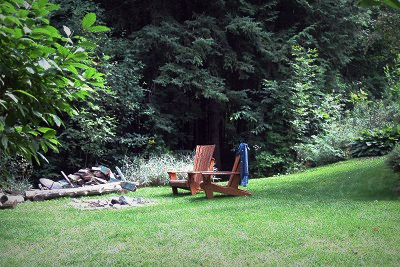
Nestled in the forest, on the shores of Lake Seymour, Glentula offers peace and inspiration. Five acres of forest and walking trails, streams and lake, gardens, gazebos and secret hideaways. And inside, a bright workroom, book-lined study, or your own private room give plenty of options to write in.

Be supported

Gwynn is onsite and ready to support your writing. She is available for consultation and chats each afternoon. After-dinner readings give participants an opportunity for group feedback. Optional warm-up writing sessions and activities are available each morning.

Be comfortable

Glentula is a private cottage home with single and double occupancy rooms. All your meals and snacks are provided. This intimate retreat is open to a maximum of five participants: 3 single room (double or queen beds), 1 double occupancy (twin beds). Registration includes accommodations, meals and all-day access to beverages and snacks.

Your Just Write at Glentula retreat program includes:

DAY ONE:

  • 10:00 am: Arrive and settle in; explore the grounds, or start your writing right away.
  • 11:00 am: Introductory session to meet your fellow writers, and find out what’s on offer. Warm up your pen with a few creative writing exercise and sharing.
  • 12:30 pm: self-serve lunch in the dining room: hot soup or crockpot fare, breads, cheese, salads, fruit & cookies
  • Afternoon: Private writing time. Explore situation-themed prompts drawing inspiration from the woods and the lake available at “Inspiration Stations.”
  • 5:30 pm: Cottage-style BBQ dinner (dine al fresco, weather permitting); Group readings, feedback and discussion or writerly activities.

DAY TWO:

  • 7  to 9 am: Self-serve breakfast: hot or cold cereal, fruit and juice, yoghurt,eggs, toast, muffins and bagels.
  • 9:30 am: Warm-up writing prompts and freefall, followed by silent writing time.
  • 12:30 pm: self-serve lunch
  • Afternoon: free time to write or relax. Situation-themed prompts drawing inspiration from the woods and the lake available at “Inspiration Stations.” Gwynn available for one-on-one discussion of your writing project.
  • Evening: sit down, three-course dinner. Group readings (at the campfire, weather permitting), feedback and discussion or writerly activities.

DAY THREE:

  • 7  to 9 am: Self-serve breakfast
  • 9:30 am: Warm-up writing prompts and freefall, followed by silent writing time.
  • 12:30 pm: self-serve lunch
  • Afternoon: free time to write or relax. Situation-themed prompts drawing inspiration from the woods and the lake available at “Inspiration Stations.” Gwynn available for one-on-one discussion of your writing project.
  • 4 pm:  Closing session.

Next dates available:  Summer 2018. Contact info@writescape.ca 

Registration:

3 Days: $385

5 Days: $545

PLEASE NOTE: When you hit the “Add to Cart” button, the PayPal order will show up at the top of the column to the right. To be taken to PayPal to finish your purchase, click on the yellow PayPal button. You can use a credit card on the PayPal site – you do not have to have a PayPal account.

HST will be charged at checkout. HST # 821104853RT0001

Getting There:

Glentula is at 101 Morningside Drive, Havelock, ON. Click here for directions.

Continue reading

On-demand Workshops

On-demand Workshops

Gather your group. Pick your topic and your date. And we’ll bring Writescape to you.

From beginning writer to seasoned professional, we’ll customize sessions to suit your programming themes and audience needs. Choose from Writescape’s Workshop Catalogue 2016 to help you and your colleagues hone writing craft and develop new skills and techniques.

“I came away with an understanding that will stick with me … great handouts and examples.”

From two-hour evening sessions to week-long programming, you tell us what you need and when you need it. Writescape will supply professional workshop leaders, hands-on exercises and practical handouts, and a creative, supportive atmosphere for an excellent learning experience.writing-828911_960_720

“…a safe place to be vulnerable with my writing and to risk trying something new.”

Writescape facilitators have delivered workshops and presentations across the Greater Toronto Area, as well as Ottawa Region, Durham Region, and Northumberland, Kawartha, Haliburton, Muskoka, Simcoe and Niagara regions, Southwestern Ontario and into the U.S.

startup-594090_1920 (1)Step 1: talk to your group or colleagues about what you need

Step 2: choose your program from our Workshop Catalogue 2016

Step 3: contact:
info@writescape.ca
905-728-7823
leave a comment

We focus on your needs and deliver inspiration, expertise and support. We make it happen.