

Ruth E. Walker
As a writing coach and editor, I often remind writers to trust your reader. This is not reserved for those new to the craft. Even writers with published work under their belt will slip into the world of telling when they should be nudging.
Show vs nudge
We writers hear it all the time: show don’t tell. It’s great advice and it means to write so that you keep readers engaged. Show is all part of a writer’s essential toolkit of Active instead of (ho-hum) passive writing:
- use active verbs instead of adverbs
- watch for info-packed sentences and unnecessary description
- keep characters reacting physically
- remove repetition (words, phrases, actions) unless it is important to the story/character
- avoid clichés and stereotypes—surprise your reader (and yourself)
 But it’s not exactly what I mean with “nudge.” I mean something even more subtle, more layered. Something that moves your writing up the ladder. Something that echoes subconsciously for readers.
For example
Imagine you are writing a book about a teenager who is a soccer star. Alexia has all the usual teen angst of being confident and insecure. Everyone tells her she defends the net like a world cup pro, that The Beautiful Game will be her ticket to success. But Alexia fears that she’s only a soccer star on her high school team and will be revealed as ordinary when she joins the provincial all-stars.
 But what is your story really about? The desire to be a soccer star is just what Alexia thinks she wants. What she really wants is for her mother coaching soccer in Europe to come back home and show that her own daughter is more important than her mother’s career.
That deep longing that Alexia won’t even admit to herself is your ticket to “nudge.”
Avoid the Hammer
My Writescape colleague Gwynn often refers to tell as a Hammer (as in, hitting your reader over the head and saying, “Hey reader, are you getting this?”) Like me, she sees missed opportunities for subtle hints or when the supposed hint is as obvious as…well—a hammer to the forehead.
Back to Alexia’s longing. We could have her write in her diary: I miss my mother. I wish she’d come home. Nope. Hammer.
We could have her watch the other mothers cheer for her teammates and wipe wistful tears from her eyes. Nope. Hammer with a Sentimental Whack.
We could have sit with her best friend and talk about it:
“Why are you so upset Alexia?”
“Well Pat, I really miss my mother. With her over in Europe coaching that semi-pro team I just feel so alone here. I don’t have any grandparents or other family except Dad. And he’s busy all the time and really, I think they’re separated and just not telling me. The seasons over there are longer than ours here and I want her to come back before my season ends, to see me play just once.”
Nope. More than a Hammer, this exchange also qualifies as an As You Know Bob moment, where a writer has their character say things the person listening would already know but wants to make sure the reader has all the important information. All. Of. It.
This is a prime example of not trusting the reader to either have already figured it out OR (and this is just as important) have the patience to piece it together as the story moves forward.
Don’t poke your reader in the eye
Let’s go back to Alexia’s longing. Would you give her a mother figure in the new coach of the provincial team? That would be kind of obvious. Besides, Alexia needs to learn about the complications of mothering and find a way to connect with her absent mother.
One way to do this is to make Alexia be a mother-figure. A pet perhaps? Too unlikely. Maybe a new teammate who is even more insecure than Alexia and she nurtures her along? Too obvious and lacking in energy.
 What if the provincial team requirement is a certain amount of volunteer work? What if the winter before she leaves for training camp she gets stuck with 6 weeks coaching at an inner city community centre. Despite her initial frustrations and lack of empathy, she forms attachments. And then finally, she has to leave for training camp before “the big game/event” of the community centre. She has to choose between her soccer career and the “support your team” mantra she kept telling her young charges.
Maybe all this helps Alexia see her mother in a different light—the pull between family and career that many women struggle with. Maybe this isn’t the most subtle nudge to keep Alexia’s longing a constant theme. But the point here is that I was nudging you to consider ways in which you can adjust a story—pare it, shape it—and eventually move it into thoughtful territory that nudges readers into deeper engagement with your writing.
It’s actually one of the highest compliments you can give a reader: I trust you to understand what my story is about. And frankly, it’s a lot more interesting to write without a hammer in your back pocket. And, as you know Bob, it’s something I encourage writers to remember.
DID YOU KNOW
 Gwynn and Ruth are great writing coaches. It’s been their pleasure to work with writers of all kinds and at all levels. At the next Writescape retreat, Spring Thaw, they get to kick off the retreat with some one-on-one consultation with the writers there. Plus they both provide written feedback for work submitted in advance.
Support. Clear and constructive feedback. And the care and feeding of the writer’s soul that comes at all Writescape retreats. April 20 for 3 days or extend your pen for 5 days.

 1. Get the action going
 4. Keep your actions strong; beware the “-ly” adverb
 We default to the sense of sight. Try replacing visual details with ones of another sense.
 Identify any “writer’s tic” that you know you have. Phrases, descriptions, gestures and so on, rapidly lose their energy when they are overused or placed too closely together.
 Is it color or colour? Are they good neighbours or good neighbors? Writing for American readers, Australian readers or British readers? Incorrect spelling won’t please your publisher. Make sure your software is defaulted to the “right” English.

 Start with an open mind and playful attitude. Mind mapping is a “brain dump.” Expect that many of the ideas you produce will not be useful. That’s not important. You can harvest the valuable nuggets later.
 Begin with one central keyword or concept in the centre of the page. Starting in the middle of the page gives the creative right brain a head start, as our non-creative left brain is used to starting in the upper left-hand corner.
 Keep your hand moving. If ideas slow down, take your hand back to the central concept and begin a new branch. Draw empty lines, and your brain will move to fill them automatically; or inject more energy with a different colour pen.

 The phrase DOCTORS OFFICE has me curious. I follow the branch back towards the centre, trying to work out what PINK and SUGAR have to do with it. Then it hits me… when I was a child, our doctor used to hand out tiny cylindrical candies that smelled like scented geraniums. I realize that I haven’t seen them in decades. What other sweeties from that era are no longer around? Hmmm….. Another article? A scene for my novel? A short story? Things are brewing now.
 The perfect spot to be creative – and mind map to your heart’s content – is at
 The writing critique group I belong to understands this perfectly. We meet every two weeks and at the end of each meeting we all set a writing goal for the next two weeks only. We each set our own goal depending on what we are working on at the time and what is happening in our lives.
 When I’m trying to avoid that “frog”, I play solitaire, disappear into social media or sort the kitchen junk drawer or….. I’m sure you have equally pointless—and time consuming—avoidance tactics.
 Now this may seem contradictory to the “eat the frog” principle, but getting through your to-do list and achieving your goals begins with making your bed.
 So there you have it.
 Recently, I had the privilege of participating in Indie Author Day at the Pickering Central Library. Sponsored by the PineRidge Arts Council, its purpose was to bring independent and micro-published authors together under a single roof to share ideas and lamentations about this journey we call writing.
 Most of the speakers at Indie Author Day touched on the fact that indie books have a hard time finding a home in libraries and book stores large and small. There is a very good reason for this. Curated decisions at macro and micro levels are always informed by history and convention. What worked last year will continue to work in subsequent years until new factors change the conversation.
 But times are changing and Indie authors in the digital age are in a unique position to pioneer the next wave by reaching where they could not before. Heavy oak doors barred, locked and guarded by agents and executives fall away when the author, published or not, has access to millions of readers via Internet platforms. Promoting in the safety and comfort of one’s home is the best place to start building the profile that grows the brand.
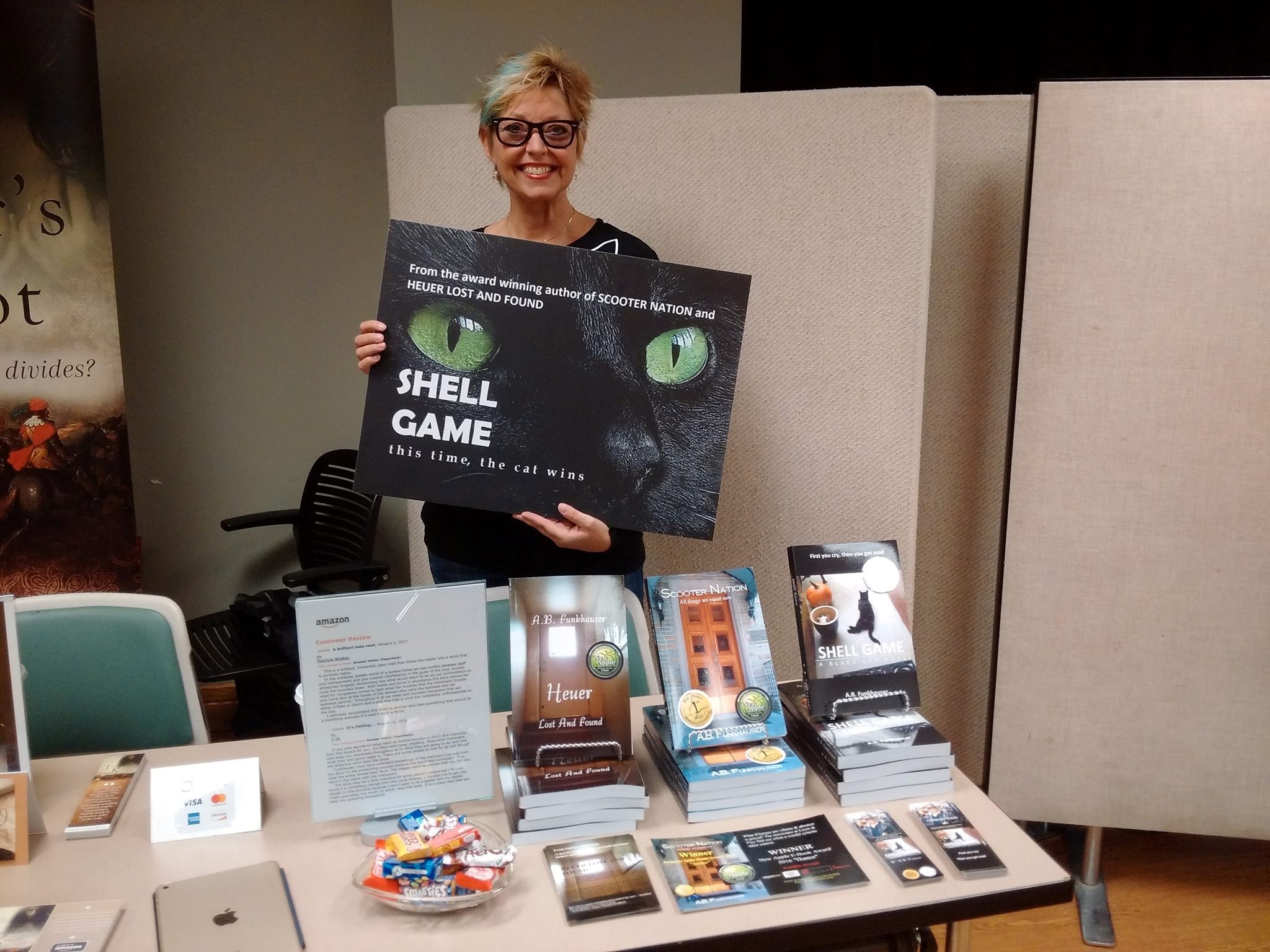 Like a politician with a constituency, independent authors need followers as a first step to developing “cred” for the words they write. As I explained more than once on Indie Author Day, we can write the best novel, screenplay, short story or poem, but no one will know if we do not get out there and let people know.
 Publishing models in the Indie world present many formulas. My publisher says “seven years or five books” before anything happens. Whatever is served up, writers should not be discouraged. Time is an opportunity not just to write, but to build brand and the followers who support and advance it.
 Toronto born
 Whenever I travel, I visit gardens; I seek them out in concrete-jungle cities and have a vast one of my own. My mother and grandmother taught me to create landscapes that worked with nature, not against it. They taught me how to create a green space with soul. And I realized as I looked at this tiny urban gem on my walk, that creating a garden that has a heart is very much like writing.
 We all have big writing dreams: maybe the next best seller, perhaps an award or earning enough to live on. But on any given day, don’t worry about what seems unattainable. Work with what you have.
 Not everything we write is worth keeping, but often you write a really good scene or stanza that just doesn’t fit with the piece or poem you’re working on. It might even be one of your proverbial “darlings.”
 But you’ll find that you get more out of your writing community when you contribute: give of your time, your expertise and your encouragement and support. We all have high and low times as writers and whether you need someone to help you with a practical plot problem, to celebrate a success or just give you a kick in the pants to submit or get writing, your writing tribe are the best people to do it. But, offer the same to other writers. I know that over the years, I’ve learned more about the craft by talking to fellow writers and giving feedback to others than from any book.
 Without planning and fertilizing, weeding and maintaining, gardens wither or become something else you have no use for. Your writing, like any art form, is the same. You wouldn’t expect to play the piano well without practising regularly. Writing is no different. Write, write and write some more. Plan writing time into your schedule. Fertilize your craft with workshops, reading and communing with fellow writers. Weed out all your negative attitudes about not being good enough. And fill your creative well often.
 I also like the books I read to be set in exotic places, in other cultures, and affected by political or natural turmoil that I am never likely to be faced with. I like to learn about other customs and occupations.
  The first one:
 The next:
  And the third:
  Who knows, you may discover a new genre that really speaks to you. Perhaps that coming-of-age story you’ve been struggling with as an historical romance might be better reworked as a dystopian YA. But you have to read some dystopian YA to find out.


 Initially, it doesn’t matter. When you begin your first draft, story is key and the story will land in the genre it fits best. But once that draft is done, knowing your genre is important. You’ll need to know so you can fine tune your manuscript and pitch it to the right agent or publisher.
 Let’s take the crime/mystery genre as an example and the typical “dead body”. In a cosy mystery, your readers will expect to spend a few chapters meeting the inhabitants of a cosy community and getting to know the protagonist and her friends before the “dead body” is discovered. The actual killing will be off stage. In a police procedural mystery, the “dead body” is there by the end of chapter one. Readers may even witness the murder. It will be important to follow real police investigative and forensic procedures.
 1. Prepare a book jacket blurb
 With your book jacket blurb in hand, you have your main dominant story thread. Use that main thread to define the main genre. For instance, if your book involves a mystery and a romance, is the dominant story thread a classic “who done it” with a bit of romance thrown in for character growth? (mystery) Or is it really about a relationship blossoming between two people who happen to be solving a mystery together? (romance)
 Nail down the age group your book is aimed at: children, young adult, new adult or adult. If your manuscript appeals to more than one group, you have an age cross-over. (Think Harry Potter (children/adult) or Hunger Games (YA/adult).)
 One way to do this is to have two windows open, one on Amazon and the other on Goodreads. Read the blurb on Goodreads and then search the book on Amazon to see its classification.
 “Yes, Virginia, there really is a National Punctuation Day!”


 The use of humour reminded me of a poetry book I had as a child called
  //
// //
// //
//
 The willow’s music is like a soprano
 Whatever you want to say,