Beta Readers & You

Beta Readers & You

Ruth E. Walker

The writer in the attic garret, a single candle barely illuminating the page, the scratchscratchscratch of the pen crossing the paper. Is this your idea of the writer’s lonely life?

Well, not this writer. Yes, the act of writing is solitary. And some of us do isolate ourselves for short periods of uninterrupted time. Sometimes, even with a candle or two. But eventually, even the most private of writers needs to surface and find readers. Because, with few exceptions, that is what writers crave: a connection to others through the writing.

At a recent workshop, one writer asked the others if they wrote with an audience in mind. The answers were as varied as the participants. Some start out with an “ideal reader” in their head; some brought in the idea of a reader later on, the second or third edit, for example. But we all agreed that eventually we work with the concept of someone actually looking at our words.

An agent. An editor. Readers.

So you have the final draft of your manuscript. Seeking publication and submitting our work is a challenge at best and often, it borders on terrifying. Surely there’s a simple way to feel more confident when you press the SEND button.

I belong to a fairly intense critique group: Critical ms. That intrepid bunch has saved my writerly bacon many times as they gave feedback on chapters and scenes every few weeks. And over the past summer, they all read my final draft manuscript. I know I’m lucky to have them; critique groups rarely look at the complete work.

So what if you don’t have a Critical ms in your life? You have the manuscript in hand, hoping to catch a publisher’s attention. And you want feedback from readers. Here’s where beta readers come in. They are not copy editors or proofreaders. Instead, they will read that entire manuscript and give you a reader’s response.

How to find beta readers

Beta readers often read your work for no charge. But some charge a fee. Decide in advance how you will ask for the favour or if you will pay experienced beta readers for the service. If you decide on paid readers, make sure you ask for and get recommendations on their past performance.

Connect with beta readers through networking, word-of-mouth opportunities and social media:

  • Workshops and conferences for writers are great places to meet other writers working at the craft, just like you. They can be your beta readers or connect you with their beta readers.
  • Offer to be a beta reader: give and you can receive. Besides, a wise writer learns from reading others’ writing.
  • Tell friends and family members you are looking for beta readers (proceed with caution: feedback from people you know and care about can be more emotionally energized than you realize.)
  • Connect through writing blogs, reader/fan-fiction websites, social media such as Instagram, Twitter, LinkedIn and Facebook. You can let others know you want beta readers through these platforms.
  • Be open to readers who are unfamiliar with your genre or topic. They might ask questions and see things that others gloss over when they read your work.

How to treat a beta reader

Once you find a beta reader or two, let them know what you expect. And give them the tools they need to do that.

  1. Don’t offer a rough manuscript to beta readers:
    • A polished manuscript is properly formatted: page numbers, chapter headings/numbers, 2-inch margins, double-spacing and indented paragraphs.
    • Work hard yourself first to ensure few typos, grammar glitches and logic slips
    • Imagine your beta readers talking with others: I just read this really confusing book. I couldn’t make sense of the timelines and the characters were just so flat…
    • Ask yourself: Is this draft complete and ready for readers?
  2. Present your manuscript professionally:
    • Have your polished draft ready in both electronic and hard copy formats.
    • Some want to read it more “book style” — 2 pages per sheet, landscape format; some want it in manuscript format (see point #1)
    • If they want a hard copy, be prepared to print it: don’t expect them to pay for the printing.
    • Ask your reader: How do you want to read this?
  3. Give your readers guidance:
    • Offer at least a cover page, outlining what you are looking for, such as: plot glitches, slow sections, any confusions, characters that don’t connect with the reader, etc.
    • Prepare a checklist if that is simpler for you and your reader, but leave lots of room for comments and questions.
    • Encourage your reader: I welcome any and all criticisms and suggestions, and appreciate your time in reading my book. Don’t worry about hurting my feelings.
  4. Use beta readers to help with your query or marketing:
    • You can include positive comments from your readers in your query letter. But keep it really brief and professional: Beta readers offered excellent feedback that helped refine the final draft.
    • If you’re self-publishing, a snippet of praise on the back cover or inside can help sell your book.
    • Example: A fast-paced and exciting thriller… A timeless love story that kept me reading to the end…
  5. Say thank you:
    • Send a personal note following up after they give you their feedback.
    • When your book is published, it may be appropriate to thank your readers inside.
    • Ask: I’d like to recognize your help. Can I mention your name in my acknowledgement page?

Remember: A beta reader is not there to feed your ego. Don’t take the comments personally. Perhaps you don’t agree; reading is subjective, after all. But always say thank you, nonetheless.

And if you are getting comments or questions from more than one reader on the same topic, perhaps you need to rethink your opinion. This just might save you from having an editor or agent ask you the very same questions.

DID YOU KNOW?
Mark Coker

Mark Coker of Smashwords, the highly successful e-book distributor, has a few things to say about beta readers. He and his wife used a specific process for their novel Boob Tube to ensure their beta readers had the right tools to respond. He shared some great tips in Publishers Weekly online.

Do you use beta readers? Let us know about your experience.

An Altered Life

An Altered Life

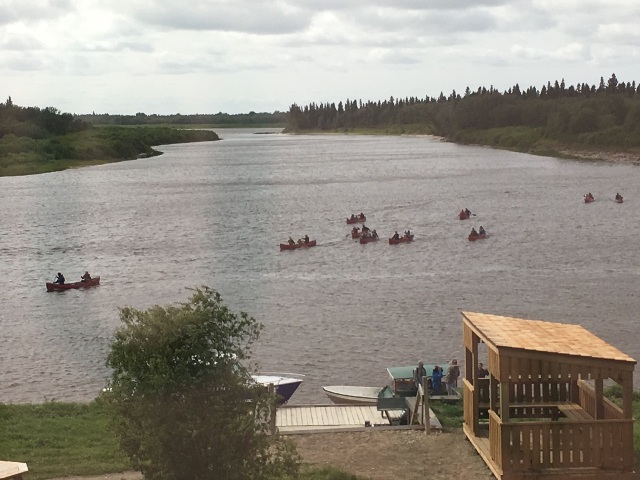
I’ve been to a place where all rivers run north, flowing up to the Arctic. I’ve travelled eight hours by car and then five hours by train to reach a place of six seasons: summer, fall, river freeze up, winter, ice break up and spring. I sat in a wide-bottomed freighter canoe, ferried to where the Moose River empties into the salted waters of James Bay.

Thanks to the kind invitation of the Ontario Writers’ Conference, I came to Moose Factory last month to teach a workshop. It was the first Moose Factory Writers’ Retreat, the brainchild of Jean-Pierre Chabot and the MoCreebec Eeyoud Council of the Cree Nation. I hope it is just the beginning of many more arts-related gatherings.

Imagine taking a workshop in the dining room of the Cree Village Eco Lodge, where the soaring wood-lined structure carries both traditional and modern cultural touches. The natural influences—stone, wood, light—affected every moment of our time in that room.

I’ll never be the same writer. There is an energy in Moose Factory unlike anything I’ve experienced. It is the place. And it is the people.

The Place

Moose Factory is where high school students don’t wait for their yellow buses, they cluster by the shore for water taxis (and during freeze up and break up, they climb aboard helicopters to cross the Moose River, and in winter, drive over on the ice road.) Here, school starts early to allow students time off for the all-important goose hunt each fall.

Here, the bright blue sky is big because the land is flat and the treeline marks the horizon with stunted dark spikes of black spruce. A place where walkways are scarce and no roads are paved, where the province’s Highway Traffic Act is powerless and a taxi ride across town is a flat rate.

I enjoyed fabulous bannock burgers at John T’s Wachay Wagon and great fish and chips at the Treeline Diner next to the Northern Store. At GG’s Ace Hardware, you can buy anything. And I mean anything. From ammunition, bagged candy and condoms to groceries, vacuum cleaners and christening outfits.

Compact, neatly maintained bungalows line many of the roads, like any other subdivision in southern Ontario. Except for spruce log tee-pee frames in backyards, and the occasional wildlife that wander through: an unfortunate moose, lingering tree-climbing bear cubs and the ever-present cheeky red squirrels enrich the stories around backyard campfires.

The People

Where to begin? It would take several blog posts to give you a reasonable sense of the generosity and attention I received from Moose Factory residents. When I say attention, I don’t mean fawning admiration or special treatment. I mean people who are present. With you. In the room. It’s remarkable.

It made for a great workshop. I never worked so hard or felt as satisfied at the end of a session as I did in Moose Factory. Our coffee house event the next day was a community celebration of poetry, song, art and prose. The Big Dipper is now also a furred fisher that sacrificed everything to return water to the land. A section of an old freighter canoe, a canvas for the beautiful art of John Reuben, will soon hang on my cottage wall.

But let me tell you story. I was on this trip with Naomi Mesbur and Barbara Hunt of the Ontario Writers’ Conference. Along with Durham Region writers, Erin Thomas and Adele Simmons, we were treated to many amazing moments by the people of Moose Factory.

When The Past Became Present

photo: Hjvannes
On one of our several wanderings, Norm, a workshop attendee, former Cree chief and teacher, and now minister, took us into St. Thomas’ Anglican Church. Built in 1885 by the Hudson’s Bay Company, it needs to be restored before it can be used again. St. Thomas’ is an impressive structure, the huge timbers and curved wooden ceiling reflecting the skill of HBC shipbuilders. The massive bell was removed from the cupola and waits silent and still, just inside the entrance. Stained glass windows were also removed and sealed in wooden boxes until their return to the original frames.

We all knew we were being offered a privileged glimpse into this locked and vacant building.

Norm has faith that this historic church will be restored. He asked us to take a seat in the dusty pews. He told us of how the front pews were reserved for management and staff of the Hudson’s Bay Company. The Cree worshippers were kept in the back pews. Norm said, despite all the things his people have endured over the years, they never lost their faith. Just outside, next to the river, they once camped close by.

And then Norm shared something I will never forget. He sang a morning hymn. In Cree. The same hymn sung many mornings by the long ago people camped by the river, the church just steps away. Norm’s words and music soared above and through us as we sat in those pews. Just as they must have done in the 1800s and 1900s, as the mist lifted from the river and the sun coloured the tips of the treeline.

Moose Factory is rich in contradictions. Wi-Fi in the Eco Lodge. Pot holes on the roads that could swallow your shoes. While waiting for my first taste of bannock at the Wachay Wagon, I chatted with members of a movie crew. They were filming author Joseph Boyden‘s Through Black Spruce. They were easy to spot among the locals. More than their big city attire, they carried a kind of out-of-place vibe as they clustered together.

I understood that awkwardness. I, too, felt like I’d fallen through the rabbit hole after stepping onto the Eco Lodge dock. I certainly hope that movie crew allowed the magic of the people and the place to move into their hearts. Like them, I was motivated to come for artistic reasons—my next writing project will explore my ancestral connections to Canada’s fur trade. I hoped for some inspiration.

What I came away with was so much richer. Meegwetch.

DID YOU KNOW?

Writescape picks its retreat locations carefully. We’ve always chosen settings that are flavoured by the natural world. We look for landscapes that inspire with lakeside sunsets or sunrises. Trees, gardens and winding paths offer gifts to the perceptive writer. Quiet corners, comfortable, well-appointed rooms and healthy foods nourish bodies and imaginations.

Join us on November 3 to 5 at Fern Resort on Lake Couchiching for Turning Leaves. Our guest author Vicki Delany looks forward to chatting on Friday evening and delivering a Saturday morning workshop. With more than 20 books to her credit, Vicki has so much to offer participants. This retreat is suitable for writers at all levels.

Seven Tips for Finding Inspiration

Seven Tips for Finding Inspiration

Gwynn and Ruth are on vacation for the next couple of weeks. So we’re bringing back a couple of our favourite Top Drawer topics to share with new readers and to nudge long-time followers. This week is Ruth’s May 2016 post on finding inspiration. So get out there this summer and give your muse a change of scenery too.

Ruth E. Walker

I recently delivered a workshop at a writers’ conference: From Inspiration to Publication. In 2.5 hours, I was supposed to shine a light on the path almost every writer dreams about: being published. Frankly, this path can never be illuminated in such a short time. In fact, I could plug in a dozen klieg lamps and have an infinite amount of workshop time, and I’d still leave the bulk of that path in shadows.

No two writers have identical pathstunnel-237656_640

shrine-1031662_640That’s because for each writer, the path to publication is individual and endless. And it is filled with missed opportunities, wrong turns and dead ends. But for successful writers “publication” is not a single event. It is a series of acceptances, right turns and new paths that keep them inspired through all the rejections and disappointments.

Successful writers keep shining their headlights down that path because they know two things:

  1. getting published should not be a one-time goal, and
  2. they only need to shine their light forward to keep going

signs-416444_640For even the best writers, it is a frustrating journey.

It’s beyond discouraging to repeatedly receive rejections. So how to keep your muse motivated? Finding and then holding on to your inspiration can be key to keeping your light shining down the writer’s path.

So let’s get started.

  1. Leave your comfort zone behind: a change of place, space or pace can allow inspiration to sneak up and surprise you; if you can’t change your environment (travel or try out writing in a coffee shop, for example) give freefall writing a try (timed writing with no editing, no stopping, no internal editor allowed.) You’ll be amazed with what happens when you let yourself go to follow the energy.
  2. Visit a used bookstore and browse: old book titles, names of authors, a line from a book and even the smell of old paper can trigger ideas.
  3. Find contests with deadlines: a contest theme can trigger plenty of writing or, even better, remind you that you have a story on file to fit that theme!
  4. People watch with a notepad: keep to reportage (just the facts) to record the behaviour, clothing, dialogue that passes by. Pull it out and flip to a random page when you need to nudge your muse.
  5. Visit graveyards and museums: imagine the stories behind all those dates and names (old gravestones and small local museums can be especially intriguing.)
  6. Read outside your interests: essay collections, science journals, biographies, and so on will let you tap into a rich vein of interesting topics.
  7. Get out into nature and leave technology behind. If the landscape doesn’t trigger your muse, being in the open air with only scenery to distract you just might be the space your creativity needs to surface.

Inspiration for writing can come from so many places that I could keep writing this post for weeks. But what these tips all have in common is encouragement to explore. Writers are the adventurers on the open seas of life: we travel in our imaginations and write all about it. If you keep your light pointed into the distance then you should always be ready to find your stories.

About Freefall Writingtourism-776587_640

Freefall writing was first coined as “Mitchell’s Messy Method” by W.O. Mitchell (Who Has Seen the Wind) when he taught creative writing at university. It became “freefall” over time. There are variations used by many creative writing teachers, but when Gwynn or I lead a freefall, these are our main points:

  • Be present (meditation before you start is helpful) and follow the energy
  • Write what comes up
  • Use the senses — taste, touch, smell, sound and sight
  • Be specific — not “the car” but “the fire engine red two-door convertible”
  • Keep writing even if all you can start to write is: I can’t write. This is dumb. Why am I doing this? –eventually, the tension will trigger new energy for you to follow
  • Resist the editor — don’t stop to “fix” things
  • Go Fearward — W.O. Mitchell’s best advice ever

Freefall prompt and exercise: Set your timer for 20 minutes. Close your eyes and allow yourself to be quiet and still. Count backwards slowly to zero from fifteen. When you get to zero, start your freefall writing with this opening sentence:

The door opened and I stepped inside.


A Poet’s Gift: Patience

A Poet’s Gift: Patience

Ruth E. Walker

Ingrid Ruthig

At a Spring Thaw retreat, one participant spent much of her time squirreled away in her room, papers spread across her bed, editor’s pen in hand. Poet and artist Ingrid Ruthig was completely focused on her manuscript and surfaced occasionally for meals and evening chats.

After the retreat, Ingrid continued to refine her manuscript. A poetry collection is meant to be far more than the sum of its parts. Not only does each poem have to stand on its own, but there needs to be an cohesive “whole” that pulls together the entire work and leaves readers changed.

As poet Emily Dickinson would have it: If I feel physically as if the top of my head were taken off, I know that is poetry.

Right on, Emily.

Eventually, Ingrid’s manuscript was accepted by Canadian publisher Fitzhenry & Whiteside. And the collection, This Being, was launched in 2016. And then, just last month, Ingrid was awarded the Gerald Lampert Memorial Award. This League of Canadian Poets’ prize recognizes the best first book of poetry published in Canada, and This Being fits that bill completely.

We are thrilled for Ingrid. She’s an artist on many levels and brings an architect’s precision into everything she does: from curating collected works and shepherding insightful essays on Canadian poets, to designing exquisite chapbooks of her poetry and textwork, to preparing solo shows of her outstanding art — all of it, perfected before she releases it to the public.

So what drives a poet — this poet, in particular — to be committed to exactitude? And what happens to that clear direction when creativity pushes its inevitable way in? A recent interview on her publisher’s website intrigued us, so we’re sharing it with you today…

Congratulations, Ingrid. What was your initial reaction on hearing that your first collection of poetry,This Being, was awarded the League of Canadian Poets’ Gerald Lampert Memorial Award?

I punched the air and whoohoo’d! And I knew for a fact, then, that patience can pay off.

You worked many years as an architect and have written a fair deal of criticism. How has this affected your writing of poems?

It is all related, I suppose, but it’s not easy to measure or describe – it’s a way of thinking, of approaching the task at hand, which is to order and resolve something that is, at first glance or in a sense, chaotic. By inclination and training, I’m used to connecting dots – I notice things on a number of levels and begin to sort, align, or discard them, paying as much attention to detail as context. Then I set out in one direction, following clues, trying to keep sight of the big picture or the intended plan, hoping I will arrive at some kind of resolution. Sooner or later the creative process takes over, and I have to give in to it. Without that willingness to relinquish a measure of control, there would be no discovery. And it’s at this stage that writing poems veers away from kinship with raising a building off paper and up out of the ground. In architecture, surprises are usually costly and unhappy ones!

The opening poem in the collection is “Ten Mile Point”, which starts at a stop on a journey – Manitoulin Island – with car doors flung open and “water far as you can see.” But as you turn the reader back to land, with its gift shop and model tepee and our commercialized habits we’re led to something gently epiphanous, that we are somehow standing at a brink. Why did you choose this poem to start the collection?  (Click here to see the poem Ten Mile Point.)

Although the poem was written much earlier than others in the collection, it seems even more timely now. It’s a recognition of the most important moment – always and ever the present moment, because we can’t go back and change what has passed, and the future is impossible to grasp. So, here we are, teetering on the edge of a precipice, surrounded by all this apparently endless beauty which also sustains us, but rather than pay attention, we let ourselves be distracted by the shiny stuff. The land’s continuance, and ours as well, hinges on the choices we make from here on in, individually and collectively. This piece set the right tone for what follows – an invitation to the reader to look around and see where we’re standing at this moment in time. To see how we change, and can change. Hopefully in time.

In terms of change and its possibilities, what can you tell us about the title, This Being?

A title, in my view, is like a key that unlocks the door of the book. This one rose slowly to the surface and insisted on staying put. Those two words brought together weave a mystery, and the meaning remains fluid. While it points at humans as beings, it also points to the act of being, of understanding we’re only able to exist in the present, and there’s no living in the past or future. So much about us, about our habits, doesn’t change. Nevertheless we remain fluid as we move from moment to moment. In fact, we’re always changing. And in those small, sometimes imperceptible alterations lies the possibility that we might yet become something better.

Is that the ultimate goal of poetry, to help us become something better?   

W.H. Auden, who is quoted excessively from his tribute poem to Yeats, wrote, “poetry makes nothing happen.” Of those who read poetry, many, including me, will disagree – it can strike a chord and resonate long after the book is closed; it reveals things we’ve become blind to; it settles or unsettles by mirroring shared human experience; it stirs thought and emotion. It changes the reader. If we look again at Auden’s poem, it goes on to say “it survives, / A way of happening, a mouth.” Maybe that’s as close to an answer as any. A poem offers a different way of being. It’s an open mouth providing a way to speak and the words for what’s next to impossible to say, even if it’s only a trace of what we really mean. Yet, we keep trying.

DID YOU KNOW?

Revered American renaissance poet Emily Dickinson (1830 to 1886) was known for her reclusiveness, remaining much of her later years in her bedroom and refusing most visitors. Maybe the reception her poems received from publishers contributed to her solitary lifestyle.

Fewer than a dozen of her nearly 1,800 poems were published in her lifetime. That’s probably because nobody really knew what to do with her poetry at the time. The ones that got published were edited to fit what constituted “true poetry” at the time (you know: pure end rhymes, regular stanzas, no darn dashes…)

She probably just gave up in frustration. And can you blame her?

What would Emily make of how her poetry is viewed today? Her work is studied in schools and universities throughout the United States and beyond, and you can’t pick up a decent anthology of English language poetry without a Dickinson poem or two in there. The renowned critic, Harold Bloom, cites Dickinson as one of 26 central writers of Western civilization. Her poems and her strange, solitary life have inspired music, plays and feature films.

Is there a lesson here? Emily Dickinson wrote her poetry, her way. The world wasn’t ready. Eventually, the world woke up. Patience, as Ingrid Ruthig notes, can pay off.

The lesson for you: stay true to your creative vision and your voice. Hope that others get it but if they don’t, that doesn’t mean it isn’t exactly what the world needs.

Editor Etiquette Starts with You

Editor Etiquette Starts with You

Ruth E. Walker

Last week, I wrote about the role of an editor when working on your manuscript. Editors France Peck and Sherry Hinman shared some ideas on the qualities of an editor that writers should look for.

But what about your role? Do writers have any responsibility in this delicate dance between what you thought you’d written and what the editor discovered?

Yup. And it doesn’t include arguing every little point you think the editor missed or misunderstood. I was once in a critique group with a writer who argued every bit of feedback offered by his colleagues. He felt he was arguing others’ “opinions”. He argued even when those opinions were clearly shared by the majority (“All the characters sound the same in dialogue”; “The pacing is slow in the beginning.”; “Who is the protagonist?”, “What’s at stake for the protagonist?” etc., etc.) No one, apparently, understood his work.

I remember thinking, Oh dear. How will he ever work with an editor? To the best of my knowledge, he hasn’t yet.

Does an editor need to like your manuscript?

Nope. But an editor should understand and support the heart of your manuscript — what you want your manuscript to do, who to reach, etc. A good editor values your intent. And a good editor will let you know if liking your story matters to how they work on it.

Some years ago, I edited a self-help book for men by an American writer. I totally understood his intent and applauded him for it. But in the editing, I discovered that he was quoting some facts and figures that didn’t quite add up. I asked him for his sources. He had none.

So I sent him back to the drawing board and he returned with new facts and figures that did add up. With sources. Reliable sources that offered even better support to his thesis.

I didn’t entirely agree with his thesis. But his heart was in the right place. And I was pleased I could help him enhance his message with solid facts.

Is there any benefit to self-editing if you’re hiring an editor?

So, think of it this way: Would you hand in an essay for marks that you haven’t checked for errors? Of course not. So why would you treat your writing like something that doesn’t really matter? Own your words, writer. And make them the best possible.

There are so many things a writer can do to self-edit a draft manuscript. Here’s a partial list:

  • Use proper manuscript format: double-space, 1-inch margins, pagination
  • Read your work aloud; your ear will catch errors your eyes will often miss
  • Use a ruler to separate sentences for a line-by-line reading; look intensely at each line
  • Try the FIND feature in word processing to look for problem words/phrases; frequent misspellings, typos, etc.
  • Use FIND again to find passive verbs (was/is/were, etc.); replace with active verbs when you can
  • Pay attention to your known “issues”; for me, it’s numbers and I always have to triple check

Why would an editor want to work with you?

Consider my former writing critique colleague. Working well with an editor means you need to actually consider the editor’s notes. Obviously, spelling errors, typos, awkward phrasing — these are clear areas that need fixing. But what about that comment that the spectacular chapter with the choreographed hand-to-hand combat scene is…too long!?! And, in fact, may be unnecessary to the plot. Well, what does that editor know about a great romance with a combat twist anyway?

Step away from the “no” and think for a minute. The editor may have something. Or not.

I had an editor suggest that I had the Canadian army being gassed in WWI too early in the war. I went back to my notes. Nope. My research supported my scene: April 22 – 24,1915. But how I handled it was wrong. I got defensive. Rather like a “know-it-all”, in fact. That editor was hired by an agent to review/recommend my novel. The agent ended up rejecting my manuscript.

Was it because the book wasn’t for her or was it because I was a bit of a jerk with the editor? I’ll never know. But it was something I’ve always remembered and have always worked hard at not reacting to critique but instead, listening, considering and then responding as appropriate.

Good editors are a writer’s gift

I will always thank George Down of The Book Band who edited my novel Living Underground. He was patient with a first-time author, giving me both phone time and endless emails to answer questions or clarify comments. He was encouraging in a quiet and consistent way. And he was so helpful with issues around the German language and culture that helped strengthen my character, Sigmund.

And I will ever be grateful to Peter Carver of Red Deer Press for his wonderful comments on the early draft of my current WIP: The Last Battlewipe. His reading and feedback of my manuscript was part of the first prize I won at the 2014 Muskoka Novel Marathon for my Young Adult novel. Peter’s questions and comments have been a beacon as I’ve worked to make my crazy illogical planet make some kind of sense.

In last week’s post, both Frances Peck and Sherry Hinman noted the importance of the relationship between the writer and editor. By respecting each other’s expertise we create an excellent balance.

When I edit others, I am committed to honouring the words. Technically, I am looking for errors and logic glitches, dropped threads and underdeveloped plots and characters. But emotionally, I’m looking to enhance the words and bring the story’s heart out to where readers can see and feel it too.

It’s only through a relationship with the writer that this editor can get a sense of that heart. And that’s the best part of any editing assignment.

Did You Know?

The first point in self-editing Ruth refers to is proper manuscript format. Is it the same for all manuscripts? Not by a long shot. A manuscript for a poetry collection is not the same as for a non-fiction or fiction manuscript.

Writer’s Digest has a great resource for fiction manuscripts, defining some basic standards. These standards can be applied to non-fiction manuscripts as well. With poetry, the form of the poem is not meant to conform to standard paragraphing, for obvious reasons. But the importance of proofreading and clean copy applies to everyone.

Watch for an upcoming post on manuscript format.

Seeing the Forest AND the Trees

Seeing the Forest AND the Trees

Ruth E. Walker

Jacob took one look at our dying tree and agreed, it had to come down.

As cottagers, we’re always in that delicate balance between celebrating the beauty of nature and needing to keep it manageable. On two acres of riverside property, we have a lovely mix of conifers (majestic white pine, balsam, spruce and fir trees) and deciduous (delicate birch, maples, black cherry, poplar, beech and a few I-Don’t-Know-Whats.) Safety is always a consideration, as in “If that 30′ spruce fell on the cottage, it wouldn’t be pretty.”

So bringing in Jacob Outram and his tree service was the right thing to do. The spruce had to go.

Jacob wasn’t finished. He listened to us and our concerns about another tree. And then, like the certified arborist he is, Jacob walked the property.

“This will need trimming on one side so if it falls, the weight is away from the building.” Check.

“One half of this birch is dead. It’s next to the gazebo. The dead part has to go.” Check.

“Those branches are over the roof. Winter snow weighs them down, right?” Check.

“This one is losing its needles on the lower branches from lack of light. Trim here and it will be fine.” Check.

By the time he was finished, our one dead tree wasn’t the only one slated for removal or trimming. And as he pointed out the issue with each one, I thought how is it he saw so much of what we didn’t? Then one second later, I thought, Jacob is my tree editor!

Trim Trees, Tighten Text

Think about it. We love our forest (manuscript) so much and look at it so often that we failed to notice pressing issues (spelling, grammar, plot, pacing) and future issues (reader expectations, marketability) that Jacob (editor) saw with his fresh eyes and professional experience. His assessment (feedback) gave us insights to our surrounding forest. And while we will pay for his expertise and work, I don’t begrudge a cent of it. We’ll sleep better at night.

A good editor does for your manuscript what a good arborist is doing for my cottage property. We found Jacob through recommendations. But how do you know when an editor is the right one for you?

Expert Advice

I asked professional editor Frances Peck of West Coast Editorial Associates in B.C. about qualities of a good editor.

“For many people, the qualities that first spring to mind are things like meticulousness and perfectionism, being detail-oriented and able to memorize spellings and grammar rules, having the kind of eye that jumps to the error on the page. While those are certainly desirable qualities for the copyeditors and proofreaders of the world, they carry with them the sharp, unpleasant whiff of negativity.

Good editors must recognize the risks of being forever in critique-and-correction mode, and must balance that orientation with healthy doses of understanding, patience, diplomacy and—yes—empathy.

In the Editors Canada document Professional Editorial Standards, the “hard” skills and practices for each level are always accompanied by softer skills related to communication and judgment. All the knowledge and critical skills in the world won’t help an editor who takes an “I’m right and you’re wrong” approach to a project. We must be collaborators, not antagonists.

The editor as midwife has become a favourite metaphor in Canadian editing circles. We are there to advise and prepare, to smooth and reassure, to massage and adjust, so that authors can deliver the healthiest, most nearly perfect offspring that they’re capable of producing.”

Frances gave a Writescape workshop a few years ago on editing and it was a smashing success. It might be a good time to invite her back.

Editing Skills Checklist

Next, I turned to a local colleague and professional editor, Sherry Hinman of The Write Angle, for her opinion on what skills a good editor needs. Sherry works with a variety of writers and corporate clients, and she says:

Editing skills do relate to the kind of job an editor is working on. No matter what the task, there are Seven Must Haves for any editor:

  1. Author/Editor relationship: The connection between you and the editor should feel respectful and collaborative. (This one’s #1 for good reason.)
  2. Knowledge of the process: The editor should have a good understanding of the steps involved in editing your project, and preferably beyond that.
  3. Style guides: The editor should have access to a variety of style guides and know how to use them.
  4. Technology: The editor should be able to explain what program(s) will be used to edit your project (editing is almost always done on screen) and how you will exchange versions of your document.
  5. Types of editing: The editor should be able to speak easily about the different types of editing (though not necessarily offer services in them all) and to describe what each type includes.
  6. Understanding of your needs: The editor should know what type(s) of editing your project requires and either offer to edit your work or suggest you seek an editor that offers that type of editing.
  7. References: The editor should be prepared to provide references, preferably from clients with similar projects.

So writer, now you have some ideas about what to expect from a professional editor and what you need to look for. But have you thought about what you, as the writer, need to offer an editor?

Hold that thought. I’ll be exploring your role in all that next week.

Did You Know?

Writescape’s Ruth E. Walker and Gwynn Scheltema have happily served as editors for both fiction and non-fiction writers. They honed their editing skills as senior editors/writers for the Ontario government and as founding editors for the Canadian literary journal, LICHEN Arts & Letters Preview

It’s been their pleasure to work with writers at all stages of the editing process: from a general reader’s report and feedback to copyediting, and intensive, substantive editing. They are also excellent coaches for writers who need support on their way to a polished manuscript.

Both Gwynn and Ruth benefited from having an excellent editor at various times in their writing lives.

A Boy, His Words, His Way

A Boy, His Words, His Way

Ruth E. Walker.

This time last year, I wrote about my annual experience at Durham Integrated Arts Camp, an 8-day arts-infused camp for Grades 7 – 12 students. Run by my local school board, DIAC is held at a private camp fairly close to my cottage.

I love going there. I teach an elective “Creative Words” where my students are encouraged to leave behind grammar and spelling worries and just focus on writing their words, their way. I tell them, “This is school but our focus together is on being creative with words. Exploring the craft of writing. Stretching our pens into richer territory as writers. Not worrying about the three-point paragraph.”

Daily Wordplay

I had 54 students split over three periods — and each day, we played with words. Exercises, experimentation and sharing work with each other. Partnered or in small groups, they would read selected excerpts to one another. I wanted them to gain confidence in reading their work aloud and offering each other feedback.

Every day, we ended with at least one timed freefall writing exercise. Freefall, originated by the great W.O. Mitchell (Mitchell’s Messy Method), means they follow the energy, don’t stop writing, don’t fix anything and even if they can’t think of what to write, that is exactly what they write.

I can’t think of what to write. I don’t know why Ruth is making me do this. I can’t stand it when people make me do stuff like this. Just like when…

And before they know it, they’re writing about something that catches their imagination. It’s great to watch them drop deeper and deeper into the zone of writing in freefall.

The Challenge

But there was one student who caught my attention.

Day One, he came into our old workshop building and sat himself as far as possible from all the others. Arms crossed, hood up and over his head and cowl raised to cover his mouth was a clear signal to the rest of us: I am not comfortable. And I’m not at all sure about this.

I’ve met this boy before. Well, not him exactly, but others who seemed like him. As a visiting artist at an alternative high school, many students would greet me in just this way. I was hopeful that my eventual success with them would help me here.

During the first freefall, I saw that he wrote very little. So I asked him quietly if I could help. “I can’t write without paying attention to grammar and spelling. It matters to me,” he said.

Spelling and grammar matter?!? I could have kissed him right there and then. But besides getting me fired for being completely inappropriate, it would have freaked him out. So I said “Write in whatever way works for you. I say it doesn’t matter about spelling and grammar to free people up but if it matters to you, then go ahead, pay attention to it. Remember: your words, your way.”

Day Two. Hood and cowl off. Still sitting separate but not as far away. Seems to be writing more.

Day Three. He comes into class, smiling over something someone had just said to him. Sits next to another student. I thought to myself, when this boy smiles, the room lights up. Cliché, I know. But it is exactly what I thought. Because it was true.

And here’s the best part of this day. It came time for sharing. By now, a few students volunteer to read to the whole room.

And he raises his hand. “I’ll read,” he says. Stands. Speaks his truth as captured on the page by his pen. Three seconds of silence as he sits back down and the room erupts in table thumping and cheers, and so many comments, we ran overtime. And his smile? Surely the glow illuminated the whole camp.

His Art, His Way

That glorious moment. That alone would have been enough to fuel my workshopping heart for years to come. But it was at Talent Night on Day Four that I learned as strong as his voice is on the page, there is another art that will claim his soul.

Imagine. A full set of drums, glistening red sides, gleaming cymbals and so on, on an otherwise bare stage. And my grammar-and-spelling camper sits at those drums, illuminated by the single spotlight. Nearly 450 campers in the audience, along with various instructors and staff. I recall thinking to myself “Oh, he drums. Hmm. That explains the excellent rhythm in his reading…”

The background music starts up. Something jazzy, if I recall. A moment spent thinking, well, isn’t this a nice surprise — he likes music with some depth, maturity…and then his drumsticks dive into the call and answer of the music. And the music, quite frankly, ceases to matter.

Have you ever seen Gene Krupa or Buddy Rich battle it out at the drums? Were you mesmerized by the 2014 film “Whiplash”? Have you felt the magic of TorQ Percussion vibrate into your bones?

Well, you may then have an inkling of what we experienced in that auditorium. His sticks flew, so fast, so hard, so exquisitely staccato that when one splintered off, part of it cartwheeling into the air, the cheers rose to the ceiling and came back down again. He didn’t stop for a nanosecond. His joy. His passion. His complete immersion in the zone was for us to watch and marvel at. This was no Grade 8 boy taking his first tentative steps on stage. This was a musician on the path to mastery and we were his witnesses.

The spontaneous standing ovation from his peers invited another glorious smile. More than acceptance, all of us in that auditorium were connected with the artist and he knew it. Many of us know what we saw that night. Years from now, we can say we were there when…

And how does this creative writing teacher feel about a young man’s clear gift as a writer being second fiddle to his drum kit? Fantastic. Who know what other gifts he’s harbouring? I’ll be back next year to see what I can discover.

Did You Know?

So many artists didn’t start out knowing they were meant to work in a particular medium. Or they were obligated to follow family footsteps while their hearts really belonged elsewhere. And some artists have more than one career.

The great American poet, William Carlos Williams was, for much of his life, Chief of Pediatrics at Passaic General Hospital. Vincent van Gogh tried being a missionary, teacher and art dealer before he discovered art school at age 27; ten years later, he committed suicide but left behind a remarkable legacy of iconic art.

Some writers take time to achieve publication. Nobel Prize winner Toni Morrison (The Bluest Eye) and ahead-of-her-time rule-breaker George Eliot  (a.k.a. Mary Anne Evans) both published their first books at age 40. Much beloved Dr. Seuss (a.k.a. Theodore Geisel) was 33 when his first children’s book arrived on the shelves.

And some writers take a long time to find their voice. Anna Sewell was 57 years old when her first and only novel, Black Beauty was published. She died the following year but lived long enough to see the book’s initial success.

Whether you’re a teenager with a brilliant writing career mapped out or nearing retirement and thinking about that novel you always wanted to write, remember this great advice I got from an agent recently. “Age doesn’t matter very much in the publishing world. It’s the quality and marketability of the writing that matters.”

A Play’s the Thing

A Play’s the Thing

Ruth E. Walker

Recently, a writing colleague asked for my help. She was excited about an upcoming playwriting opportunity. My friend is a gifted emerging writer. And she enjoys theatre productions. She knew I’d written a few plays and had some of them produced, so she asked for advice.

The following is based on some of that advice. And, of course, I offer it with the proviso that I am not a full-time playwright. It’s one of the forms I’ve explored and learned from — and will expect to continue to learn from in the years ahead. So here’s just a few points to ponder when thinking about writing a play.

Just actors talking, right?

It’s easy to fall into the trap of it’s just dialogue, right? Because it is and it isn’t.

Think “poetry” when you are writing a play. A poem is an economy of language that expresses far more that the words on the page. Less is more. White space is as loud as a sentence. Meaning builds, word by word, until the end is reached and you return to the beginning with a new understanding.

A play operates in a similar manner.

Not one word wasted. Not one word that doesn’t build on the next and combine to offer layers, possibilities, surprises. And here’s the most important word in that last sentence. Offers. An excellent play offers directors, actors and set, costume, sound and lighting designers room. Room to be creative. To interpret. To “play” with the words. To develop their own vision of what those words can create on the stage.

Consider Come From Away, the international smash hit born out of the sacrifice and kindness of remote Gander, Newfoundland in caring for planeloads of strangers during the 9/11 crisis. The dialogue in that fast-paced musical took the actual words of residents and 7,000 passengers to build a compelling human drama. Was it every word from every interview? Nope. Just a very few that left room for a minimalist stage to support a talented troupe of actors playing multiple roles.

Brilliant. I’d see it again if I could get tickets.

Pay attention to the classics

I still remember seeing Anton Chekhov‘s The Cherry Orchard many years ago. A “simple family drama” with light comedic twists becomes an critical examination of the classes. It is profound. It is also a lot of talk, talk and more talk. And there is repetition. Has Lopakhin, the former peasant now merchant, proposed to the now impoverished family’s adopted daughter, Varya? How can the family’s beloved estate, especially the cherry orchard, be saved?

Repetition is deadly. Except when it matters. And in this play, the repetition underscores the lack of will and clear thinking that defeats the formerly wealthy family. Along the way, it builds a tension in the audience. In our heads, we’re yelling at the fools on the stage. And powerless to do anything but watch the progress of social change.

Remember the smoking gun

Chekhov’s quote is often paraphrased in writing classes.

Remove everything that has no relevance to the story. If you say in the first chapter that there is a rifle hanging on the wall, in the second or third chapter it absolutely must go off. If it’s not going to be fired, it shouldn’t be hanging there.

He takes this approach in his plays as well. When you read them, his scripts can appear dense with heavy monologues. But look closer. Give your imagination room to see the bigger picture that Chekhov’s developing.

The Bard in the 21st Century

Many of William Shakespeare‘s plays, on the other hand, are full of fast-paced intrigue, action and character complexities. Swordfights, battlefields and royal processions are on stage. No wonder over 420 films have explored The Bard’s greatest plays. But check out some of the intimate stage productions at Ontario’s Stratford Festival. Minimalist staging makes for modern connections.

 Durham Region-born Driftwood Theatre Group revels in non-traditional outdoor settings as they travel throughout southern Ontario. Remarkably, they can recreate Verona in a barnyard or Venice in an urban park. And show audiences that Shakespeare is as relevant today as he was centuries ago.

 From the darkest of hearts to innocent-sweet, Shakespeare’s characters talk, talk, talk. But, like Chekhov, Shakespeare gives room throughout his dialogue for contemporary directors and actors to imagine something remarkable: a way to bring classical theatre to modern audiences.

Quick Tips for modern playwrights
  • Limit your stage direction only to what is integral to the play’s meaning and plot
  • Create characters that represent your themes and fit the plot
  • A play is not a movie script — there are no camera angles or editing rooms, just the stage
  • Start in action; scene by scene, keep upping the stakes
  • Read aloud for timing
  • Challenge yourself — go for the unexpected and inspire your muse

Here are some resources you might find useful as you hone your playwrighting craft:

An article in The Guardian is ostensibly about technical aspects but there are subtle, important bits there about expectations.

Playwright/screenwriter Jonathan Dorf has some basic tips designed for kids, but truly useful for any age and they’re not just about format.

And the Playwrights Centre has great tips based on scripts they’ve had submitted. Learn how to get directors and producers interested in reading your work.

DID YOU KNOW

William Shakespeare’s birth date is presumed to be April 23, three days before his baptism on April 26, 1564. Coincidentally, that’s the same date as the day he died, April 23, 1616. He wrote 14 comedies, 11 histories, 12 tragedies and hundreds of poems. His work continues to be studied in thousands of schools, colleges and universities. His plays have been translated into many languages, including French, German, Punjabi, Welsh, Polish, Catalan, Danish, Tagalog and Latin, and are produced worldwide.

Not bad for 52 years on this planet.

Deadlines: Motivator or Barrier?

Deadlines: Motivator or Barrier?

Ruth E. Walker

Discovering Douglas Adams and The Hitchhiker’s Guide to the Galaxy was a thrill. Oh, the combination: wit, satire and science fiction comedy. As a young-ish mother of four, the escape was delicious.

And lately, I’ve enjoyed getting reacquainted with his wacky worldview in the television series Dirk Gently’s Holisitic Detective Agency. But all that is an aside (which is one of things I loved about reading Douglas Adams — the incredible digressions…but then I also enjoy Monty Python.)

What I most admire about Douglas Adams is how often his words (either from his books or otherwise) remain so smart and relevant. Here’s a gem from a speech “Parrots, the universe and everything” at the University of California in May 2001. It was just days before his untimely death at age 49:

We don’t have to save the world. The world is big enough to look after itself. What we have to be concerned about is whether or not the world we live in will be capable of sustaining us in it.

And here’s my favourite because it fits my writing world:

I love deadlines. I love the whooshing noise they make as they go by. 

Yes indeed. So today, I have no less than two writing deadlines. First, I need to finish THIS post and get it proofread and ready to launch by midnight. And second, long before midnight, I need to send the last four chapters of my novel to my critique group.

Time Management?

Look at that. My “midnight” deadline is secondary to my “long before midnight” deadline. Well, that must be because my last four chapters are ready to go.

Nope. They are “mostly” ready (Python-esque description, yes?) I’m still agonizing over plot decisions I’ve made. I’m unsure if I’ve overwritten the final few scenes, that I’ve gone for “big” when “intimate” might better serve the story.

Yes. Of course I hear you. Isn’t that what my critique group is for? To offer feedback on the writing? So what is my problem?

It’s the deadlines that are killing me and my creativity today. Add into the mix some background on another deadline, one that I’ve missed. In the past couple of years, I’ve been at a few writing conferences. At those conferences, there were optional pitch sessions with literary agents. I started with the idea that I could use those sessions as a chance to practise a real pitch for when the book is done.

So I paid attention to the questions the agents asked. I noticed what got their interest in the written query and writing sample and what put them on snooze. And I practised being comfortable sitting across from someone who might have a profound effect on my writing career. Believe me, I need that practise.

True confession

I can stand at the front of a room and deliver a workshop with passion and confidence. But offer up that compelling elevator pitch? Describe my book and its themes in 25 words or less? Open my mouth and not jam my foot directly into it?

Something terrible happens to me when I’m talking about my novel to agents and editors. My brain leaves the room. So practise is necessary, in my case.

Last September, I was at a pitch session with a well-known literary agent. I didn’t even have to open my mouth before she let me know how much she enjoyed my writing sample. In seconds, I went from Nervous Nellie to author. We had a great meeting and I imagined how lovely it would be have this woman as my agent. She asked to see the full manuscript in November. “Of course,” I said. I was only a month or so from penning “The End” so that timing was a perfect fit.

I had a deadline. I had strong interest from an agent. And a manuscript so close to being done, I could taste it. What could go wrong?

The Douglas Adams effect

Whoosh. That deadline went by so fast, I barely heard it. Sure, I have a lot of reasons that the book languished, unfinished. But I suspect that a big part of the missed deadline is related to my lack of confidence in writing the darn thing. That’s not a logical reason. Feedback from agents and editors in my practice sessions, along with my excellent (and tough) critique group’s comments, confirms that the writing is strong and the story original and engaging.

But when are we logical beings? When does our passion for our craft translate into efficiency and organization? In my case, it often doesn’t. Remember those digressions I love? Squirrel! And I’m madly off in several directions, forgetting the original goal.

Nonetheless, I’ve made it to the end of this post so that is one deadline met. As long as no squirrels pass my window and the house remains relatively quiet, I should also manage to meet the next one. And as to that November 2016 so-important-I-shouldn’t-let-it-whoosh-by deadline? I can only hope that literary agent is okay working with authors for whom deadlines are sometimes counter-productive. And that she’ll like the novel well enough to sign me.

I’ll keep you posted.

Did You Know:

You’ve got lots of time before registration deadline for Turning Leaves, our annual fall retreat. But don’t let that stop you from signing up. The first four writers who sign up get a special bonus: a suite room with a lake view. Still waiting for the deadline to creep up on you? With this year’s guest author Vicki Delany ready to share secrets on how she’s one of Canada’s top mystery writers, we expect a full house. Don’t be disappointed. November 3, 4 & 5.

A (Fairly) Sure End

A (Fairly) Sure End

Ruth E. Walker

How do you know when you have written it? You know, that elusive perfect ending? That Thelma and Louise, Ebeneezer Scrooge, Harry Potter finish that completes the character arcs, ties up all the loose ends and leaves you longing for more but knowing that it’s all over?

Darned if I know.

Well, that’s not exactly true. I have some ideas, most of them gleaned from novels, stories and even poems that I’ve loved over the years. I also have some words of wisdom on the subject from other writers. And maybe, between them and me, you might glean some good ideas that you can use to help with finding a satisfactory ending to your work.

Paulo Coelho, Brazilian writer and philosopher offered me a clue: “It is always important to know when something has reached its end. Closing circles, shutting doors, finishing chapters, it doesn’t matter what we call it; what matters is to leave in the past those moments in life that are over.” (The Zahir) I needed to be ready to leave my novel as if I were leaving the past of my own life: imperfect but inevitable. That led me back to my ingredient list.

Check your ingredient list

In a previous post (Write the Elusive End), I suggested that you need at least one of three essential ingredients for good endings. Either:

  • Change (either your POV character or in the reader themselves);
  • Inevitibility (sure, surprise me but that surprise MUST make sense); or,
  • Tragedy (don’t fear an unhappy ending if it seems right)

I also noted that I had written/sketched out three distinctly different endings. All three had change and inevitability and one was full of tragedy.

I liked all three. So which one is the best one?

I went back to the beginning

An overarching theme in my current WIP is duality. I fretted about the ending until I finally accepted that I am writing a duology. Not a trilogy. Instead, a two-book series.

I know that each book must stand on its own, so I still needed that “perfect” ending. However, I now must ensure that I have planted sufficient treasures in the current narrative that will leave room for readers to achieve their ah-ha moments. And hints that will logically support my plans for the second book.

Accordingly, I’ve been editing.

Surprisingly, many clues were already in my manuscript and I just had to refine here and there. And some of the connections to the second book naturally flow from the ending as I continue to work on it. I just didn’t know it until recently.

Consider your passions

I’m profoundly interested in why people do things. Motivation, yes. But what else is in place to push people into horrific actions? And is there room for forgiveness? Redemption? If so, what must be in place for that to occur?

My character has to undergo a huge arc. From mindless killing machine to a compassionate deep thinker. And I have to show that arc to my readers so that they will know, without question, that she is not the same character as the killer on page one.

My readers will not be satisfied with a neat bow or happy ending. And my narrative will fall flat if I try to be kind to the characters I’ve grown to care about. So there must be tragedy. And there must be self-sacrifice. And there must be a choice to be made with only two options, neither of them immediately happy ones.

When I accepted that, I knew what had to happen at the end. So, I’ve been busy and by the end of this month, I will be writing those two words on my manuscript. The. End.

And then back to a new manuscript while I wait for feedback from my beta readers. Because, as Frank L. Baum said in The Marvelous Land of Oz “Everything has to come to an end, sometime.”  Of course, this is rather ironic given that Baum wrote 15 more Oz books after that one.

I can only hope to live so long.

DID YOU KNOW

Writescape is on the move this June when Ruth and Dorothea Helms travel to Haliburton County to offer Write to Win, their popular workshop on the art and skill of entering and winning writing contests. These two skilled presenters are writing contest judges, contest administrators and contest winners. It’s a full day of insider tips, resources, hands-on exercises and creative activities. Saturday June 17 at the Minden Library. Come prepared to write and win. Details.