Writing Plan Meets Real Life

Writing Plan Meets Real Life

Just a few short days ago, at Spring Thaw 2017, a group of writers tucked themselves away in cozy cottages on the shores of Rice Lake. It’s what Writescape loves about our retreats: the creative energy that comes to writers when the natural world helps them dive deep into their words.

We also know that keeping that energy alive becomes a challenge when bags are packed and the road home is inevitable. So our retreats include built-in tools to help with the transition back to reality. A themed companion workbook offers pages of prompts and inspiration during the retreat and continues that role as needed. A wrap-up session is designed to ease the goodbyes and help with ideas, commitments and plans to “keep the words coming.”

About those plans. They can be general intentions or itemized lists and firmly set timelines. But then reality rears its own set of lists and timelines. Writescape retreat alumnus April Hoeller left Spring Thaw with firm plans that came to a halt the day after returning home. She shared what happened on her blog “What I’m thinking today,” and how she took a roadblock and turned it into a bridge back to her writing. With her permission, we reprint it here:

Guest blogger: April Hoeller
Monday Moanings – May 1, 2017

It’s raining.
It’s pouring.
This old scribe is…

Well, what is she up to on this first day of May?

Get out your smallest violins because I’ve got on a pair of whiney pants for this Monday Moaning.

What, pray tell, is the point of having a plan, a specific, measurable, achievable, realistic, time-based strategy for getting things done, when something as simple as a telephone call can render it so irrelevant so quickly?  Let me be clear – nobody died or was diagnosed with cancer, or lost a job. World War III has not broken out, though that has been a haunting concern of mine for a few weeks now (a whole other blog!). There is nothing tragically wrong. My world is still turning at a great clip but it’s just not doing so according to my plan.

I arrived home last Tuesday afternoon from an amazing writing retreat.

The most productive retreat ever
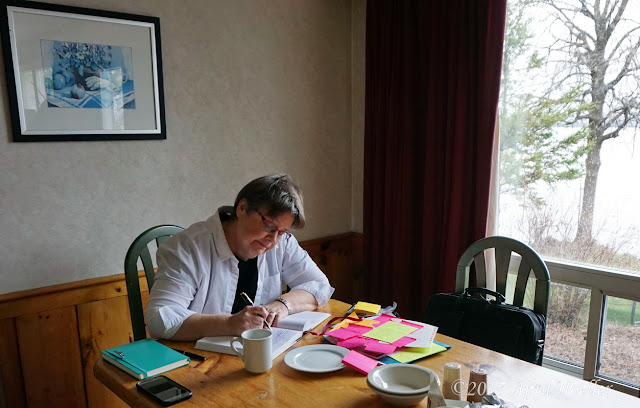
I found the doorway into a section of the memoir that I’ve been struggling to get a grip on for months. I not only plotted out my way through it, I also committed some 5000 words to paper, half of the chapters. Woot! Woot!

I am indebted to Ruth Walker and Gwynn Scheltema, the dynamic duo of Writescape, for their encouragement, companionship, and occasional goading.
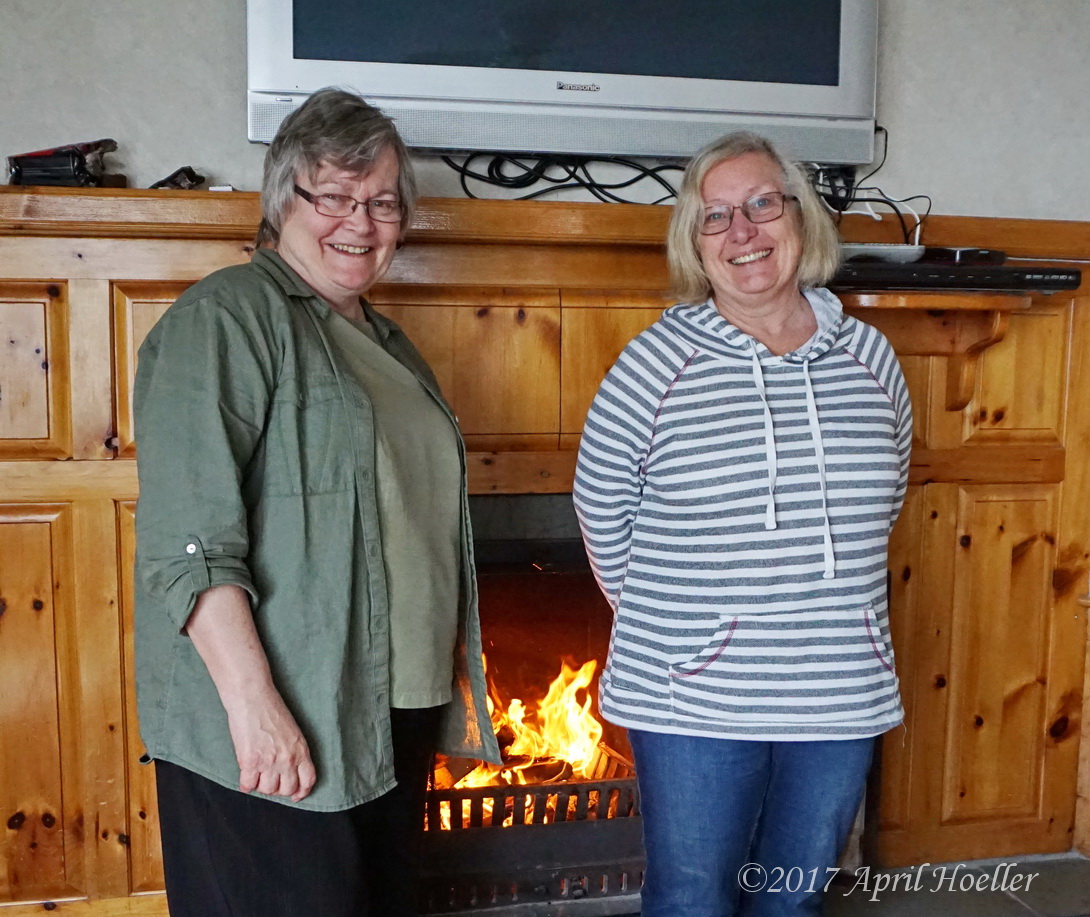
… and a good sense of fun too!
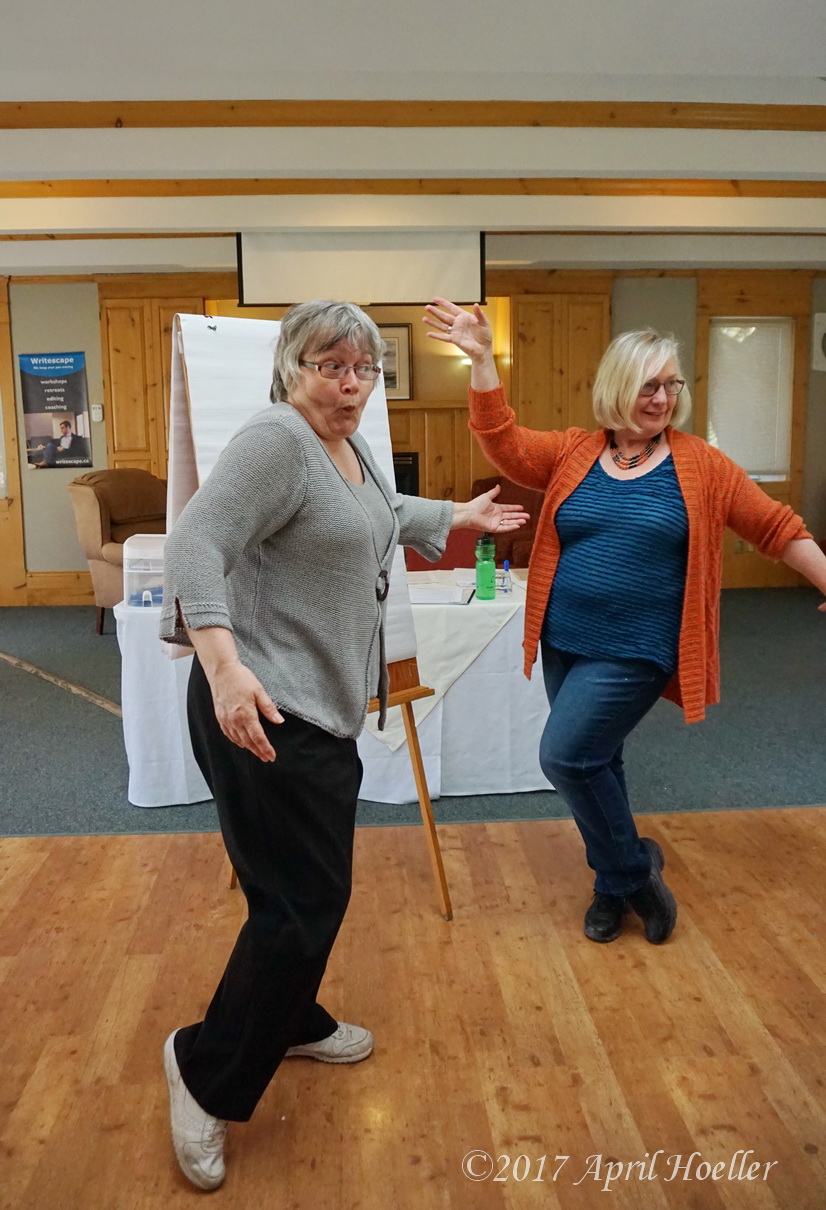
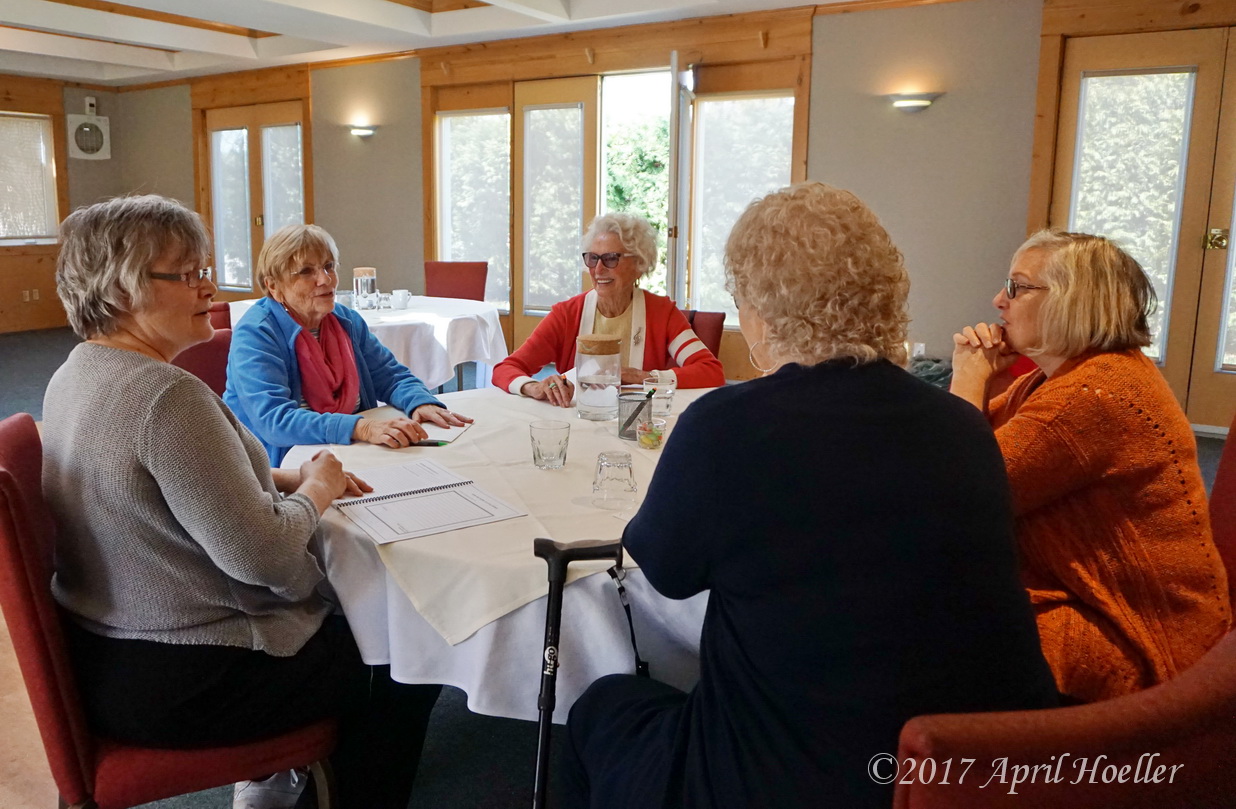
Indispensable to the retreat is the energy and inspiration that blossoms when a group of writers gets together for a weekend. Good conversations, suggestions, laughter and affirmations abound. A big thank you to all of you!
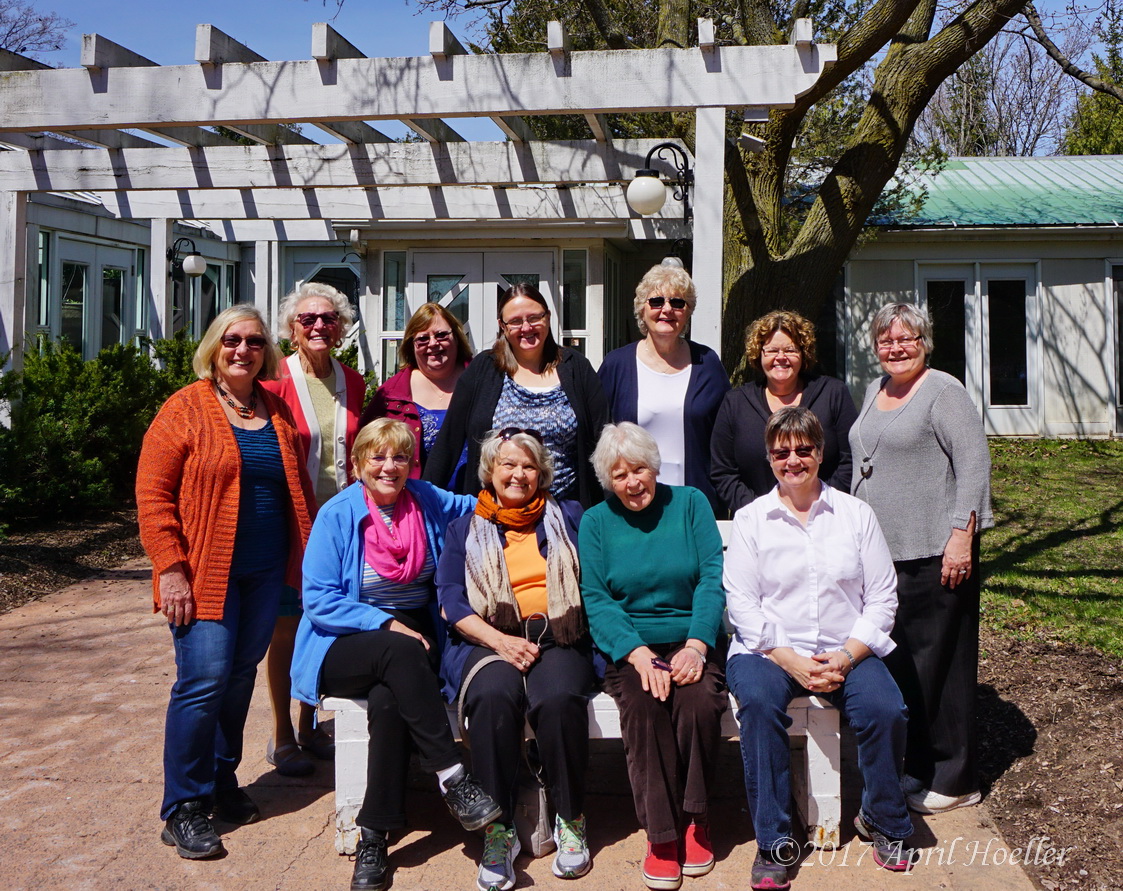


Homecoming

I arrived home all fired up, ready to move forward at good pace. I had a plan too – always an important part of a retreat. So there I sat Wednesday at the harvest table in my kitchen with pens, paper, and mind ready, at 1 pm – right on schedule. And then the phone rang.

I ignored it, letting my guy answer it, while I put pen to paper. A whole sentence emerged. With great satisfaction, I tapped a period at the end. The next sentence was spoken by my husband.
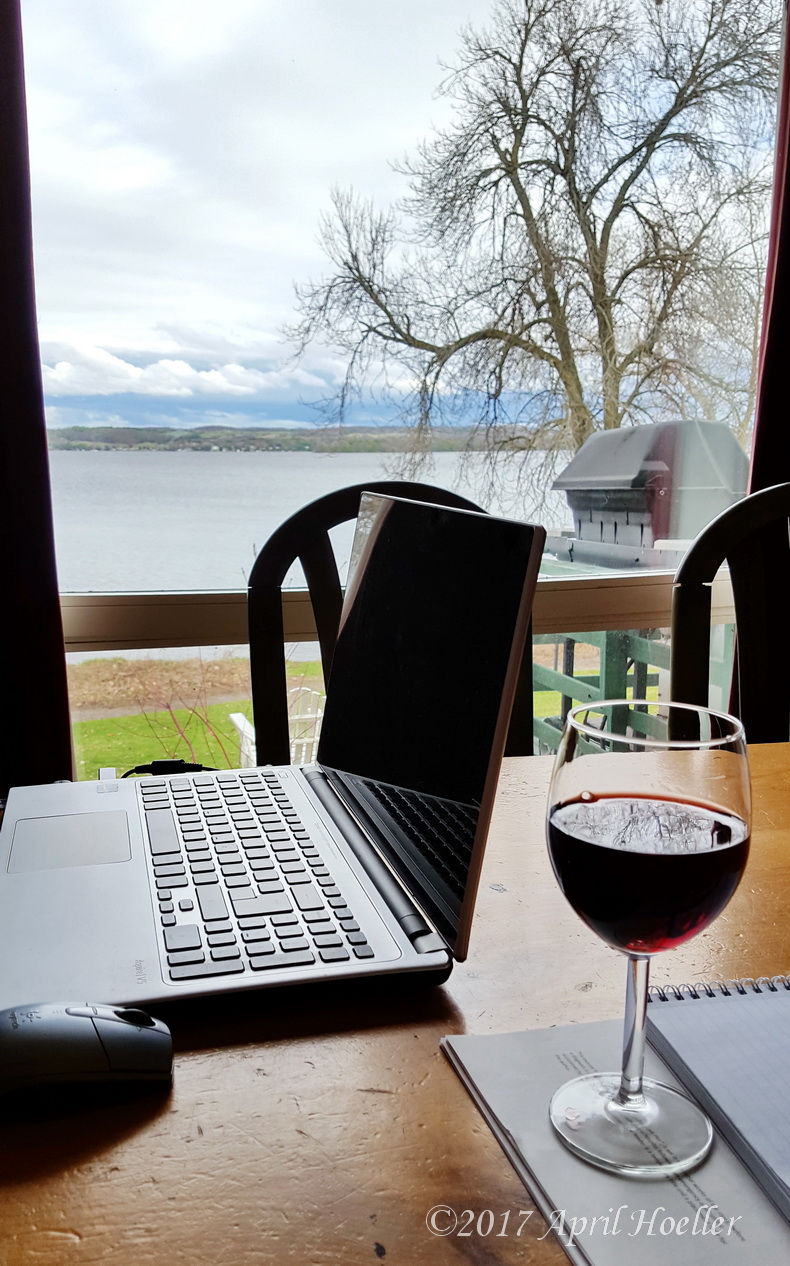
“They want to start work on the solarium next week.”

I capped my pen and closed the book. No words have been written since. The solarium construction was not scheduled to begin until the end of June. Nowhere in my plans for the coming week, or even the coming month was there any reference to “The Solarium.” But the contractor had a cancellation and our name rose to the top.  We have been able to put them off for two weeks – because we’ve got prep work to do, none of which was on our radar – until last Wednesday.


What’s a writer to do?

This is not a derailment. It’s just a layby in a siding to let a construction train through.

So, throw off those whiney pants.

Make another plan to write my way between, around, over, through the interruptions.

Just think, in a few weeks I’ll have another writing space!

Cheers!

Did You Know?

You can read more of April Hoeller’s words on writing, travel and life at What I’m thinking today, her online blog.

Thanks, April, for reminding all of us that while life may happen (and it always does) we can find ways to keep close our writing goals. A writer needs to be ready to return to the page. Writing time is precious. Don’t waste it.

Writescape retreats are held spring, summer and fall, and deliver inspiration and support for writers.



Recipe for a Writing Grant

Recipe for a Writing Grant

Ruth E. Walker

Gwynn and I know firsthand what a thrill it is when someone validates us as writers. When you are told that you’ve won an award, a scholarship or a grant for your creative work, it’s not just about the money. Don’t get me wrong. For almost all of us, the “starving artist” is not a metaphor. It’s a hard reality.

Winning an award or grant is more than an income boost, however. It shows the world that others place worth on your craft. And it validates you as a working writer, one who is submitting their work for evaluation. That you are willing to risk the opinion of strangers.

So it gives us great pleasure to participate in an annual scholarship program with The Writers’ Community of Durham Region. WCDR is a 300+-member networking organization for writers of all types and levels. Heather O’Connor and I have been members for years and Gwynn was there at their very first meeting in the 90s. We all know that education is a prime focus for this non-profit group.

2017 Essay Prompt

When we were approached a few years ago to be part of their annual WCDR scholarship program we said Yes! Writescape funds a $150 scholarship.

Applicants must be members of WCDR, they must complete an online form to outline their background and budget details on their writing project/plans and, most importantly, craft a compelling essay inspired by a writing prompt. All applications are judged on their practical, logical content as well as how their passion is conveyed in responding to the prompt.

Our $150 support is not tied to taking any of our workshops or retreats. Writescape has no part in the adjudication process. We aren’t on any of the judging panels, we see none of the applications or essays, and only learn the name of the recipient a day or so before the award is announced.

A prize-winning event

It’s always been wonderful to attend the award breakfast and to hand out the prize. But this year was especially delightful for me. I’ve known the winner for twenty years. I also know he was the originator of the WCDR scholarship program and willingly volunteers his business acumen and well-honed technology skills to support the group and individual members.

In short, Rich Helms a good guy.

Rich Helms is not, however, a poet. Nor does he write mysteries or thrillers or historical romance novels. His excellent resource book Book Trailer 101 coaches writers on making their own book trailers. And if you want to understand Amazon SimpleDB, Rich co-wrote a guidebook on that as well. So I was curious and asked Rich if I could see his application and essay. What technological advance was Rich taking on this time? He willingly shared his application. Turns out, Rich reaches back to the early days of civilization for his latest topic.

Rich is baking bread. And he’s writing about it.

In his background notes, Rich shows his logical side. “…40 years in computer research and development, where I took complex ideas and turned them into marketable products.” and lays out his plan “The next thing I want to tackle is how to write a recipe – an area in which I have no expertise.”

But baking bread is his passion. Does his essay reveal any passion?

“When I retired from the company I once owned, I spent a month living by the ocean. Every day, my dog, Margaret, and I would walk the shore, then stop and fish. My all-consuming thought was, what now?

I’m a computer nerd who bakes bread and writes about it, and I’m not afraid to describe bread baking as a sensuous experience. I revel in the feeling of kneading dough into a boule of smooth, elastic food that is alive and growing. I breathe deeply the smell of the flour and yeast fermenting, breaking down the starches as well as the tantalizing aromas of caramelizing sugars…”

“…Thinking back to my walks by the ocean with Margaret …when I returned each day, our footprints were gone. Only pictures on my phone proved that we had walked the shore. The sand looked clean, and all traces of the day before were removed. What remained was a clean slate beckoning us to start the walk again.

This all makes me think about my journey with breadbaking. The traces of the journey disappear; time washes them away. But what survives are the writing, the stories, the recipes and what I learn along the way. As I move forward, I am excited to knead a deeper element of writing into the mix.”

Yup. I’d say the passion is there. And a wonderful depth and elegance to Rich’s writing that I’d not seen before.

A worthwhile gift to writers

We know that every writer who has received the Writescape scholarship has appreciated the support and used the money to deepen their craft or expand their skills into new areas. This time, it’s especially nice for us to know the recipient. And I can add that I have tasted Rich’s breads: a superb cheese loaf and dinner rolls that engaged the senses and deliciously filled the belly.

This ancient craft is even older than written language. I’ll be looking for Rich’s recipe book but in the meantime, I’ll settle for an occasional taste from the hearth. Yum!

DID YOU KNOW

Writescape offers Get That Grant, a fabulous one-day workshop on the art and skill of applying for writing grants and scholarships. Participants have a pretty good track record, and we can happily boast that Rich Helms is only the latest success story from taking the workshop this past February. Heather O’Connor offers her workshop yearly in Durham Region as well as “on demand” for groups and organizations that express interest. Email info@writescape.ca for details.

Write Beyond the Boundaries

Write Beyond the Boundaries

Ruth E. Walker.

Earlier this month, I attended a cottage-country film festival in the Village of Haliburton, catching the last three of five films on offer. There were no red carpets, no star-studded galas.  And the sole  “paparazzo” was equipped with a nifty cell phone. Nonetheless, it was a life-changing moment for this writer. I gained a deeper understanding of three vital pieces of any creative enterprise.

Perspective


Perception


Persistence

But first some background

Doc(k) Day is a documentary film festival, organized by THOSE OTHER MOVIES Haliburton, a non-profit organization run by volunteers. It’s part of the Film Circuit, a division of the Toronto International Film Festival (TIFF) and has brought some fabulous festival films to the Haliburton Highlands.

I love TIFF and attend one screening a year in Toronto with my friend Heidi. A film festival with Heidi is often an adventure, so much so that I blogged about it on my own website. There was a bit less excitement at Doc(k) Day, but no less a moving experience.

The three documentaries I managed to attend were excellent. Directed by Emanuel Hoss-Desmarais, and created and narrated by Lawrence Gunther, What Lies Below is a remarkable film about the interconnectedness of the world’s waterways and how so many of us are blind to what is happening to an ecosystem we can’t see. All the more moving when you learn that documentarian Gunther has been blind since childhood.

Garry Beitel’s In Pursuit of Peace explores the world of peacekeeping in the 21st century and how Canadians are still filling that role despite our political shift to combatants instead of peacekeepers. It’s an excellent, and often daunting, glimpse into the challenges of conflict resolution in our fractured world. Nonetheless, I was left feeling optimistic.

Perspective.  Perception.  Persistence.

Cameraperson from Kirsten Johnson, renowned documentary filmmaker and cinematographer (Citizenfour, Fahrenheit 9/11) was in a class unto its own. Breaking boundaries of documentary film-making, Johnson gives the audience access to a kind of filmic memoir. From her personal catalogue of outtakes, side projects and shot set-ups, she marries highly personal film sequences with scenes in post-Serbian-war Bosnia, a day-in-the-life of a Nigerian midwife, a Brooklyn boxing match and several other fascinating snippets of people, places and events.

At first, we never rest long in any one place, and it is a challenge to make connections between the disparate scenes. But eventually, the struggle lessens as the camera’s eye guides us to understanding. We return to familiar scenes and people, hear their words, learn their fears, comprehend their circumstances. And the energy of the whole begins to take shape.

At least, it did for me. Judging by the audience reception, the film moved many others to new perspectives. But we had to slow down our process. We needed to allow our perception to make room for different, for strange, for fresh. And we had to be persistent in giving the film time to take us there.

A writer can learn from film

Here is where the writer in me was doing an internal dance for joy. What if I took that same approach with the book I plan to start writing this summer? Slow down the process. Make room for different ways to explore and take in the research. Allow “strange and fresh” room to take hold of my imagination. Be persistent in this slow-cooking process of inspiration. Let the shape of the thing that I will eventually write find its own way into my mind.

I’m used to chasing after my ideas. To following my characters on their journeys. To setting out with a question as my launch pad. Instead, I’m going to let the question come to me. Maybe it won’t even be a question. Maybe it will be something I’ll perceive for the first time. Some new perspective on an old idea. Or a persistent voice whispering in my ear.

Disparate scenes from the past might mingle with today. Like Kirsten Johnson, maybe I’ll find a new way of storytelling. I’ll keep you posted. In the meantime, let me know if a film has ever spoken to you as a writer the way Cameraperson did for me.

DID YOU KNOW

Our website holds an archive of all our blog posts. You’ll find useful tips, interesting insights and practical advice from the Writescape Team and a few guest bloggers. And don’t forget to visit our retreats and workshops section to discover what’s coming up with Writescape. You’re always welcome to Escape to write with Writescape.

Writing Contests: One.Oh-oh.One

Writing Contests: One.Oh-oh.One

Ruth E. Walker.

It’s been my pleasure (mostly) to serve as a judge on a number of writing competitions. I’ve also been both a first-tier and second-tier reader, helping to cull the entries down by eliminating entries with problems. And I’ve been a final judge for regional, national and international writing contests, choosing winners from 15 or 20 of those final top entries. Each and every time, it’s been a thrill to read creative work that made me feel “as if the top of my head were taken off” (to quote Emily Dickenson.)

I wish I could say it is true for all contest entries. But it is not.

Take this past week. A national organization of professional writers asked me to be a second-tier reader. This means I read stories that had already been reviewed and moved forward by a group of first readers who eliminated others. This should mean I would be reading stories that were pretty darn good. I was looking forward to making my notes.

All the entries I read had a great story idea. But not all of them were great stories. Not even pretty darn good.

For this contest, I am only one of several second-tier readers who are also reading 14 entries. So I’m not reading all the entries that reached the second tier — I’m only reading a fraction of them. But of my 14 entries, there were only 6 that I would have recommended as a first-tier reader.

The other 8 all had problems in terms of technique and execution. Here are just four of the many issues I encountered in the stories I scored in the bottom 8:

Don’t tell me, show me. This is a familiar refrain from creative writing instructors. But what do we mean by that? It’s more than the difference between I feel cold versus I shiver and rub my arms, although that is a good beginning. It is equally an issue if the writer shows us something — The cold crept under my flesh and into my lungs and then in the next line continues to tell us about it: It was below zero and I felt so cold.

The need to tell, especially after a show, is a sign of a writer who doesn’t trust themselves or their readers. Does this mean that every line needs to be a show versus a tell? No. But any story that relies on tell is a story that soon bores its readers.


Description is great. But if you have to hit your reader over the head with a hammer to ensure they are “getting the picture”…well, it’s soon painful. Definition of Adverbitis: excessive use of adverbs, especially when a great verb is the better choice: swiftly ran = raced/rushed/galloped — any of those three options create great visuals. The same goes with unnecessary adverbs: hurriedly, loudly, slowly…crept slowly = crept carries the whole image. I mean, can you ever creep fast? And how about plummeted swiftly? Ever seen anything plummet slowly?

And a quick note on adjectives. Use them, sure. But think before you dip your creative paintbrush three times too many: A charming, vivacious redheaded librarian is way too much for any brain to unpack and visualize. Stick to the essential descriptions of your character or the setting — leave room for your reader to fill in the rest.

Passive writing: boring, boring and more boring. Be ruthless in seeking out and eliminating passive writing wherever you can. Look for the “to be” construction: was, is, were, has/had been, will/would be…etc. You can’t avoid passive verbs but they should not dominate the page. The same goes for passive sentence construction, where the object of an action becomes the subject of a sentence: The writing group was disturbed by the brass band. (passive) The brass band disturbed the writing group. (active)

Proofread. And proofread again. Best not to write your entry six hours ahead of the deadline because chances are you will miss mistakes. Put the story in a drawer for at least a day, longer if you can. Then use a ruler to focus your eye on a line-by-line check for errors or omissions. Why does this matter? One of the top three entries I read this week was tied, in my mind, with two others for first place. But it wasn’t error-free. So while I loved it, it made it easier for me to place it lower than the other two that didn’t contain errors.

Writing contests give writers an excellent opportunity to submit their work. Unlike the slush pile, writers know someone will actually read their entry. To be a finalist or to win is a validation of your craft and I can say it’s one of the best moments for any writer. I know because I’ve had that fantastic feeling many times in my writing career. It’s one I want every writer to experience and it’s why I wrote this post.

Quick Tips
Before pressing SEND:

  1. Telling us a story is not as interesting or engaging as showing us a story
  2. Lots of adverbs and plenty of adjectives are signs of a writer who doesn’t trust themselves or readers
  3. Passive writing is boring and often unnecessary
  4. Spelling mistakes and typos affect how a judge reads your entry
  5. A great story idea may get you past first-tier readers but 1, 2, 3 or 4 will not get you to the final judge
Did You Know?

Not only is Ruth E. Walker a sought-after judge for writing competitions, she has organized and run writing competitions for fiction and poetry. And Ruth’s fiction, poetry and non-fiction work has also won or placed in dozens of writing contests. Along with contest judge and award-winner, Dorothea Helms (a.k.a. The Writing Fairy), Ruth facilitates Write to Win, a full-day workshop devoted to entering and winning writing contests.

On June 17, Ruth and Dorothea will take Write to Win to Minden in the Haliburton Highlands. With writing, it’s all a contest where the judge can be your next literary agent or publisher. Why don’t you join them. Sign up here.

The Power of Colour

The Power of Colour

Ruth E. Walker.

St. Patrick’s Day is coming, and we can expect lots of green glitter, shamrocks and dyed beer. It’s a time where just about everybody declares a connection to the Emerald Isle, real or otherwise. On March 17, we are green with envy for anyone who really is Irish. But is it easy being green? Just ask Kermit. Or any seasick passenger.

Colour associations are like gold to the knowledgeable writer and when used in subtle ways, bring added depth to text. Figurative language–using words or expressions that mean something different from the literal interpretation– is a useful skill for all writers. And colour is a power tool that works brilliantly with figurative language. But don’t splash colour willy nilly into your writing. The link between colours and ideas relies on many factors to reach your readers’ imaginations.

Get red for your readers

Think of the colour red. Basic association leads us to all things bloody. Red is life, as in lifeblood. Red is love, beating-heart, romantic love captured in a red Valentine. Red is hot, as in fire. Red is also danger: stop signs and red flags. And it is anger, as in flushed cheeks. And what about those red flushed cheeks? They can mean shame. And arousal. Or the aftermath of a brisk winter walk.

See what is happening here? Red on its own has common associations and it also has branches. Once you throw “people” into the mix, our associations get increasingly complex with lots of room for error and misdirection. So it is up to writers to set the stage for meaning.

Here’s a simple sentence of description:

He hesitated outside the room, his cheeks reddened.

Is “He” embarrassed? Turned on? Frostbitten? Angry? The reader will never know if you haven’t put into place all the right ingredients. And is it necessary to say “reddened”? Why not imply red cheeks and allow the reader to imagine or even experience the colour?

Same colour…different tones

Here are three different takes of the same scene with some tweaking for changing emotions:

Fury:

Paulo hesitated just outside the door, gripping the handle so hard he was sure he could crush it. She was hiding on the other side. He felt colour ignite the skin of his face. Good. Let his fury be the first and last thing she sees.


Arousal:

Paulo hesitated just outside the door, gripping the round knob so hard he was sure it would catch fire under his touch. She was hiding on the other side. He felt heat rise over his face. Good. Let his passion be the first thing she sees.

Shame:

Paulo hesitated just outside the door, gripping the handle so tight he was sure he could break it and keep him outside forever. She was hiding on the other side. His cheeks burned. Good. Let his shame be the first thing she sees.

Remember: Preparing context  is important. And using imagery to support the emotional context helps guide your reader to understanding.


A rainbow is global but symbolism is another story

Another part to using colour in your descriptions is to remember colours hold different meanings for different cultures. Western brides would be unlikely to wear red to their wedding. But in many Eastern cultures, red symbolizes the colour of celebration, good fortune and a long life.

That’s why using colours is so dangerous to writers. You need to be clear about what you intend for the colour’s meaning, but subtle enough that you’re not hitting your reader over the head with a hammer. (As an aside, my three examples earlier are exaggerated for effect. I’m sure you could be more subtle than those attempts.)

Christina Wang explores colour in an interesting article for Shutterstock, the stock-photo company: Symbolism of Colour and Colour Meanings Around the World. And you can look further into the whole idea of imagery, symbolism and meaning. Head to the library and discover how symbolism is analyzed in psychology, art, religion and dreams.

There are only two kinds of people in the world, the Irish and those who wish they were

As for me, I’ll be putting on the green this Friday. I can truly claim some Irish lineage, admittedly mixed in with English, Scottish and Norman flavours.

Nonetheless, on St. Paddy’s Day, I’ll be wishing a leprechaun or two might happen by with all the colours of the rainbow to inspire creativity and a quick pen to record it with. Because for writers, that’s a true pot of gold.


Did you know:

The luck of the Irish may be with you. There’s still a couple of spots left in our writers’ retreat on April 21 – 23. Join Gwynn Scheltema and Ruth E. Walker at Emhirst’s Resort for feedback on your manuscript and one-on-one consultation. Enjoy dedicated time to write, the camaraderie of other like-minded folks and inspiring lakeside vistas. All-inclusive means you just need your writing project, jammies and a change of clothes. Writescape takes care of all the rest at Spring Thaw 2017.

Plotting a Search for Structure

Plotting a Search for Structure

Ruth E. Walker

At my critique group last night, we did a bit of dissection on the plot of a member’s novel in progress. Sounds scary, doesn’t it?

Here’s a bit of background. One of our members has a great story for middle grade readers. It has lots of elements that the age group enjoys:

  • a relatable POV character with a problem to solve
  • some simmering tension with a member of the opposite sex
  • a science fiction backdrop that is fun and fantastical
  • a school full of goofy rules, and
  • a dastardly villain bent on stopping our POV character dead in his tracks

All the right ingredients. But the novel wasn’t quite working the way the writer hoped it would. So he continued to work on the story and recently sent us a revised synopsis.

Our role, as with all submissions, was to look at the synopsis, mark up the copy with questions and notes, and bring it to the session for discussion. Questions and detailed notes are important but the discussion in our critique group is widely considered the true gold of membership.

Our critique group collectively has some wide-ranging skill sets and expertise. This we all bring to the table. But a couple of us (not me!) are exceptional in the plot department. One, in particular, often brings visual aids, related reading and notes from research and workshops.

Last night, I suspect Christopher Vogler’s ears were burning. And the meeting room’s white board was a colourful palette of ideas and plot points.

How it worked for one writer:

Our two-hour session focused on reviewing our colleague’s current plot structure as outlined in his synopsis and getting to the heart of his story.

It was brilliant. Dividing the basic plot into three main acts and then placing the existing story into that structure allowed the writer to consider changes that simplified areas of the story. Some parts were more complex than they needed to be. At least one character needed to be shipped to the Island of Unwanted Characters.  And some goals needed to be adjusted.

The writer had some significant ah-ha! moments. He left the meeting with a renewed sense of where he wanted his story to go. What started out like a last-ditch revision became the groundwork for a new vision and plenty of possiblities.

And, as a side benefit, I found it all immensely helpful in looking at my own work in progress.

The basics of the Three-Act Structure:

Act I sets the stage, introduces the POV character with a problem(s) to overcome and the inciting incident.

Act II is the meat of the matter and has its own moment of crisis in the mid-point. As our colleague explained, “It’s like in the Wizard of Oz where they reach the Wizard, and Dorothy thinks he’ll send her home. But no. First they have to complete this impossible task: kill the Wicked Witch of the West.

So using Dorothy and Wizard, Act II is divided into two sections: Act II a (following the yellow brick road to see the Wizard) and Act II b (kill the witch before she kills Dorothy, Toto and her three companions)

And then, of course, Act III. This final act has the crushing disappointment of learning the wizard is not all-powerful after all, quickly followed by a joyful realization that everyone had what they needed all along, the journey home and most important, the POV character’s completed arc of understanding or change. (There’s no place like home…)

Can this approach work for you?

So, looking at your plot, are there areas in your story that you think could use a bit of tightening up? Could a three-act structure overview give you clues about needed changes? Or does it confirm that you have all the necessary ducks in a row? Good for you if that’s the case!

A word of caution. My critique group example is just a simplified version of one approach to looking at plot. Screenwriter and script consultant, Christopher Vogler, has a popular book The Writer’s Journey: Mythic Structure for Writers (which, strangely enough, had a cameo in our session yesterday.) Vogler’s 407-page book is only one of the many great resources for writers on structure and storytelling.

Have you struggled with structure? What did you do to help you get past the challenge of plotting? If you have suggestions, let us know what resources and approaches you recommend for other writers.

Romancing the Villain: A Writer’s Love Story

Romancing the Villain: A Writer’s Love Story

Ruth E. Walker

It’s true. We all love a really good villain. Providing, of course, that they’re between the covers of a good book or kept safe inside a movie or television screen. That’s the other side of our love affair: we control where and when we spend time with those villains. Writers know that if we want readers to root for the hero, we need to create a good bad guy. Here are some points to consider.

The hero/villain bond

Moriarty and Sherlock Holmes. Shere Khan and Mowgli. The White Witch and Aslan. A villain is the counterpoint, the mirror, the connection to the dark side of our hero.

Voldemort would just be an ugly, nasty, nameless whozits without Harry Potter. With young Harry in our hearts and minds, He Who Cannot Be Named notches up the terror-meter. And when he finally shows up, he sets fire to the page. Harry’s emotions catch fire too, and not always with good result. That’s important. For Harry, the villain is part of his journey, and all good heroes have flaws that villains love to exploit.

But we don’t just need the villain to serve as the foil for our hero. The most interesting villains come with baggage and struggles of their own. And generally, they don’t even KNOW they are villains.

(I see dead people…all the time. And they don’t know they’re dead.)

Well, unlike the ghosts in The Sixth Sense, most villains do know what they’re up to. But in their own story, they’re the hero. George R.R. Martin said:  A villain is a hero of the other side.

King Joffrey, anyone?

Author Stephen King has created many memorable twisted characters and sometimes, they start out as the hero of the story — Carrie, for example. Villains in King’s hands are much more than stereotypical bad guys. Monsters are real, and ghosts are real too. They live inside us, and sometimes, they win. Indeed, Mr. King. Indeed.

What does your villain want?

Your villain is more than window dressing. When you write them, do you consider their life story? What about their childhood disappointments? Their losses? Their fears? The source of their desire for world domination?

Maybe Iago secretly reads romance novels to learn to be less awkward in lovemaking. Maybe The White Witch just wants Narnia to stay a frozen wasteland because she’s afraid of growing old.

Just like your story’s hero, your villain needs goals. Readers may not need to know all about the “inciting incident” that sets your villain on the road to bad deeds. But as the writer, you need to know your villain’s motivations.

To support a good plot, the villain’s goals should be contrary to your hero’s goals, or at the least, interfere with your hero’s ability to achieve them. Energy and tension come from those conflicts. The greater they are, the stronger the plot, so your villain better not be feeble. Think of it this way: a weak villain makes for a weak plot.

How complex is your villain?

Compelling characters resonate with your reader. They trigger emotions. Villains hold our attention when they are three-dimensional and we believe they exist.

Your villain may only have a walk-on part to trigger the inciting incident for your hero, but that villain still needs to be believable. And one part of making villains believable is to ensure they believe in themselves.

Consider Javert in Hugo’s Les Miserables. An intelligent man of principles, he relentlessly pursues justice, but without an ounce of compassion. We believe in him because he believes completely in his truth. Actor Jack Gleeson, who plays maniacal King Joffrey in the Game of Thrones television series puts it this way: Both villains and heroes need to have a steadfast belief in themselves.

How well does your villain fit with your story?

This one can be a tricky question. Simply making a character “evil” and “heartless” doesn’t mean that character will fit the story you are telling. As already noted, you can look to your hero to find some of the right kind of villain qualities. But you also have to consider time and place.

A story set in medieval times can have a villain who is chivalrous and noble but has no hesitation in running a broadsword into child’s heart to make a point. That same twisted knight may not fit so easily in a contemporary horror novel.

Take a close look at the story you are writing. Is your villain the best antagonist you can create, or is there room to refine your “baddie”? Up his sympathy factor? Lose some of her stereotypical nasty behaviour? Since I started to write this article, I’ve had some ideas that will send me back to my own in-progress novel. Again.

But that’s okay. I like my villain and hopefully, you will too.

DID YOU KNOW?

Villains, Vendettas and Vagabonds is a one-day workshop Ruth facilitates for writers. She’ll be in Niagara-on-the-Lake in September sharing insights and ideas on creating great “bad” in fiction. The workshop is part of the NOTL Writers’ Circle programming for 2017.

She’ll also be offering this workshop in Durham Region this fall. Stay tuned for details.

Submissions: Why We Chose It

Submissions: Why We Chose It

Ruth E. Walker.

I subscribe to the Kenyon Review‘s newsletter, a literary journal out of Kenyon College in Ohio. I enjoy reading “Why We Chose It.” This feature explores some of the reasons why Kenyon Review selected a particular piece to publish in their journal.

Here’s an excerpt of Kirsten Reach’s post about “He Comes to Feed the Horses”, a short story by Mary Terrier:

Our interns were the first to cull this from our submission pile; we had no connection to Mary Terrier before. Within a few paragraphs, I think you’ll find yourself listening closely to the voice she’s found in this tough, nameless narrator. “By the time I was desperate enough to call hospice, you were already pretty far gone,” she says, addressing her late husband. Henry can hardly manage to get a straw into his mouth, and nurses have taken up residence in their house. She needs help, but she hates the help. The bathroom is too small to fit even the two of them, and each body that enters their home seems out-of-place.

Sounds like a good story to me. But it isn’t a new story, is it? So why did Kirsten and the interns pick this one?

Like every magazine that publishes short stories, we get a few dozen stories about unhappy marriages or spouses handling end-of-life care in every submission period...As an editor, you’re looking for an author with style, and a caretaker who makes you care deeply about this story, in the vein of Alice Munro’s “A Bear Came Over the Mountain,” or Helen Garner’s The Spare Room.

Style. Caretaker. How do those two connect? And why do they matter?

Style:

No one writes like you. When you are writing, your words land on the page in the style that belongs to your voice. For a lot of writing, such a corporate writing, you refine your style to fit with expectations. Your own voice is usually restricted in those forms of writing.

Fiction, however, allows you much more freedom to explore how your style works. You can refine your style by editing out weaknesses or even developing them into a strength. For example, relying on too much description slows the pace and you lose your reader. But at a crucial point in your story, perhaps an extended, detailed description is just what you need to bring focus on something vital. Dust off that urge to overwrite and use it to the story’s advantage.

Caretaker:

What does Kirsten Reach mean when she calls a writer a caretaker?

From 1999 to 2008, Gwynn and I were fiction editors for the literary journal LICHEN Arts & Letters Preview. Along with Mark Medley, we had some vigorous discussions championing stories to be included in upcoming issues. Limited journal space combined with hundreds of submissions made our work a challenge. We never referred to a writer as a “caretaker” for their story. But we could tell when a story was finely crafted.

I remember one story in particular. In Volume 8-2, Brian Reynolds’ “First Goose” is told in reverse, slipping back from a dreadful tragedy, hour by hour and layer by layer, peeling away the emotions of a adolescent First Nation boy on the cusp of adulthood.

The caretaker, Reynolds, could have written the story in ordinary linear fashion. Instead, he chose to give us the devastation before forcing us on the backward journey to see how the man rose out of the boy. It was cruel and wonderful because it was completely contrary to expectations. The inescapable ending haunted the reader through every hour revealed.

Do all editors look for a “caretaker”? I don’t know. What I do know is that at our 2016 fall retreat, literary agent Hilary McMahon of Westwood Creative Artists shared what she looks for in submissions. “Really great skill with language, that goes without saying.” And then she added something. “And an original voice telling a really unique story.” Hilary was talking about style and about the craft.

What’s Your Style?

Are you a caretaker for your writing? Before you press SEND on that submission, step back and take a close look at your work.

  • is your voice loud and clear in the style?
  • are you using your style in the best possible way?
  • have you taken care to ensure your story is being told in an original manner?
  • is there another way to lay it out so that readers (and editors) are surprised or intrigued?

Some writers benefit from a writing coach or editor to help take their work to the next level. For other writers, growth comes from paying attention to feedback in a critique group or workshop setting. In all cases, it helps to read other people’s work, especially those stories chosen for a prestigious literary journal.

You can read Kirsten Reach’s full post here. And I encourage you to follow the link and read the excerpt. Mary Terrier has, indeed, been a caretaker with style.

Writing through Hard Times

Writing through Hard Times

Ruth E. Walker

When we were looking at the focus for The Top Drawer for December of 2016, we thought it would be good to highlight positive, uplifting topics. For too long, we thought, the world’s been listening to a lot of negative words and ideas. Let’s keep it optimistic and encouraging. Set the tone!

So we celebrated the delightful and inspired writing spaces of Noelle Bickle and Heather Tucker. Creative writing teacher Dorothea Helms (a.k.a. The Writing Fairy) made us smile about the tough realities of humour writing. And we ended the year with some easy-to-accomplish writerly resolutions for 2017.


Cue fireworks and happy music…wha-?


For 2017, we wanted to continue that positive vibe. But world events are impossible to ignore. Negative politics and incomprehensible behaviours are being analyzed in every form of media, social or otherwise. Protests are erupting worldwide like pre-holiday pop-up shops.

Frankly, with a son, daughter-in-law and grandchildren in Texas, it’s difficult for me to look away. Not even the keening call of my nearly finished novel is pulling me from the news. Indeed, on Sunday night, the horrific attack in Ste. Foy, Québec, brought me to my knees.


As a writer, what can I do to work through this deep foreboding in my heart? Sure, I marched in the Women’s March (in Texas, no less.) In actions and in words posted on my personal social media, I share my support for thoughtful discourse, equality and empathy. I believe in social justice.

Writing strategies for challenging times


I am also a creative writing teacher, and dedicated to sharing ideas on technique, craft and inspiration. Indeed, Gwynn Scheltema and I started Writescape to encourage and support writers, and that isn’t going to change.

So what can we writers do when the world sucks away our energy?  As part of our “2016 positive words” theme, Gwynn brought constructive ideas about what we writers can do when writing is just not possible. Her Art of Noticing is one way to work through emotional fatigue and rekindle your muse.

I find physical exercise is also helpful. I’ll be at the gym tonight, pedalling off steam and worry, and trying not to look at the latest headlines scrolling past on the overhead TVs. I hope that when I come back home, my manuscript will forgive my lapse of the past couple of days and allow me back into my characters’ lives.

All writers (because writers are also people) have found themselves without the will to think and to express themselves creatively. So I turn to four wonderful writers for their words of wisdom.

Advice for writers from beloved best-selling authors:


Poet, civil rights activist and beautiful thinker, Maya Angelou said: What I try to do is write. I may write for two weeks ‘the cat sat on the mat, that is that, not a rat.’ And it might be just the most boring and awful stuff. But I try. When I’m writing, I write. And then it’s as if the muse is convinced that I’m serious and says, ‘Okay. Okay. I’ll come.’


Novelist Jack London offers up some tough love for writers who are distracted or down in the dumps: You can’t wait for inspiration. You have to go after it with a club.


Poet, novelist and so-very-wise Margaret Atwood advises us to face our reality and use it to make true our writing: The darkness is really out there. It’s not something that’s in my head, just. It’s in my work because it’s in the world.

And I’ll end with some words from the great science fiction writer who first spoke to my adolescent heart from the shelves of my public school library, Ray Bradbury: You must stay drunk on writing so reality cannot destroy you.


There you go writers:

  • seduce your muse by not giving up
  • chase down inspiration like a Palaeolithic hunter
  • remember you’re a writer and awful is necessary even in fiction, and
  • whatever you do, don’t let reality take you down.

How are you coping? Comments please:

Let us know if world events are simply background noise and not distracting you. Or If you’re struggling with staying focused these days, share some tips or ideas on how to write through it all.

Check out more Top Drawer posts in our blog archive

Write The Elusive End

Write The Elusive End

Ruth E. Walker

Oh, the love affair of writing the novel. The first blush of an idea. The rising heat as you pound out page after page of an unfolding story. You don’t want it to stop.

You constantly think about your novel, about your characters, your plot, your wonderful, endless possibilities… Until you find yourself without an ending.

Yeah, End-less: Your sense of dread when you need to finish your novel but there is no ending in sight.

Or End-less: Your sense of disappointment with an ENDing that is LESS than satisfying.

Poet and playwright Y.B. Yeats referred to the ending of a poem like a “click”:

The correction of prose, because it has no fixed laws, is endless, a poem comes right with a click like a closing box. (1935 letter to Lady Dorothy Wellesley)

While I might argue with him that prose indeed has many fixed laws for its “correction”, I’ve always liked Yeats’s idea of a “click like a closing box.” In my opinion, not just poetry needs to possess that “click” at the end.

No matter the issue, if you come to the end of your novel with a whimper instead of a bang, or at the least, the lovely satisfying “click”…your readers will be unhappy. And nobody wants unhappy readers.But if you’ve written a great beginning, do you need to give the same focus to the end? Prolific crime novelist Mickey Spillane said:

Your first chapter sells your book. Your last chapter sells your next book.

Click

Spillane’s not talking about sequels. A wise writer remembers that a disappointing or weak ending will undo all the joy your reader got at the beginning.

So what inspired this post? I’m working on the ending of my novel. I have three written (or at least, sketched out.) One tragic. One that leaves room for a sequel. And one that ends more positively. I’m undecided but I feel that I’m getting closer to the right ending. To help me work through the possibilities, I did some exploring on what a good ending needs. I’m sharing some highlights here:

A good ending needs:

To show change
  • Growth/change in your POV character is a common expectation for readers. But you could have a POV character who is “static” and remains unchanged right to the end. In that case, your reader must somehow be changed, have a new/deeper understanding of the impact of that character’s lack of change.
To be inevitable
  • This is not the same as predictable; no reader wants an ending that has been hinted at in every chapter since page one. And no reader wants deus ex machina endings with the ‘gods’ suddenly appearing and fixing everything.

To read something brilliantly written with an inevitable yet often unexpected ending, check out any of Alice Munro’s stories. I can re-read one of her stories and still get that yummy satisfaction from an inevitable, but often surprising, end. Munro’s “Dance of the Happy Shades”, about an uncomfortable children’s piano recital, has a masterful and quietly profound ending.

Not to be afraid to be unhappy
  • Who doesn’t want a happy ending? But if Romeo and Juliet ran off and lived to a ripe old age, how memorable would that be? Theirs was an “inevitable”, if tragic, ending. We may want a happy ending, but our lives (and some good stories) don’t always comply. And really, they are often better stories if the ending is not all rainbows and sugar plums.

In sum, a good ending needs to be satisfying for the reader…and for the writer. Whether it is a “click” at the end, or a sunset being ridden into with the future uncertain, a good ending needs to make sense. But how do you know if you’ve written the right ending?

In a later post in The Top Drawer, we’ll explore techniques and tips for knowing when you’ve achieved the best possible “The End.” Hopefully, by then, I’ll have found mine.

Did you know:

From endings come new beginnings. Writers in Ontario (and beyond) learned at the Ontario Writers’ Conference that it would be the last such gathering. Gwynn, Heather and I were so sad to hear that. We’d been at every OWC since its launch in 2006. But then the OWC announced an exciting new start. It wasn’t ending after all, just changing format and exploring how to offer writers its signature networking and education opportunities in new and exciting ways.

While it retools, OWC is still holding its monthly Story Starters contest, using images to spark the imaginations of writers. There are prizes to be won and bragging rights to add to your bio, so check out Rich Helms’ quirky and fun image and enter.