Are We Born Creative?

Are We Born Creative?

Gwynn Scheltema

When I looked at the perfect little face of my new born granddaughter, Elle Irene, I saw my son in her blue almond eyes. I saw my daughter-in-law in her pretty bow mouth. And as I played with her extraordinarily long fingers, I wondered if the old wives tale that long fingers were portents of being a creative was true.

There are a lot of artistically creative people in my family. My son is a fine artist and graphic designer; I am a writer, dabble in visual arts and spent years as a ballet dancer; my mother is a commercial artist by profession and our house was hung with her oil, pastel, watercolour and pencils pieces. But here’s the kicker. My artist mother is in fact my step mother. My biological siblings are not noticeably artistic. So was I born artistically creative, thus passing on creative genes to my son and possibly my granddaughter, or did the artistic and imaginative environment I grew up in and tried to create for my own children nurture creativity? The old nature vs. nurture maxim.

Nature vs. Nurture

 Picasso said, “Every child is an artist. The problem is how to remain an artist once he grows up.” Ursula LeGuin said, “The creative adult is the child who has survived.”

I believe that both statements speak to the uninhibited ability of children to express themselves. The older we get the more our actions are governed by social expectation, by self-assessment, by perceived judgement by others and by personal emotional baggage. Sometimes that frees us. Sometimes it restricts us. Whatever the outcome, that aspect of being creative is a learned attitude, a product of our environment and experience. It’s “nurture” at work.

But I think those quotes are also saying that we all are born with ability to be “childishly creative.” That we are “naturally” creative. Science backs it up:

Brain hemisphere specialization

Our two brain hemispheres are joined by a bundle of fibres called the corpus callosum. A study at the Department of Neurology and Neuroscience at Cornell University discovered that the brains of artistically creative individuals had a smaller corpus callosum. This, according to the study, allows each side of the brain to develop its own specialization.

Enhanced hemispheric specialization “benefits the incubation of ideas that are critical for the divergent-thinking component of creativity, and it is the momentary inhibition of this hemispheric independence that accounts for the illumination that is part of the innovative stage of creativity.”

In the genes

Another study from the University of Helsinki looked at musical creativity. They found the presence of a particular gene family involved in “plasticity”: the ability of the brain to reorganize itself by breaking and forming new connections between cells.

The team also noticed increased creativity in subjects with duplicate DNA strands affecting the processing of a neurotransmitter called serotonin. Elevated serotonin levels in the brain increase connectivity in the posterior cingulate cortex of the brain, an area that communicates with other brain networks, and is involved with memory retrieval.

The verdict

 So in the end, it seems we all can be creative, but we have to make sure we encourage and preserve that child’s ability to let loose without reservation and judgement. We have to nurture our natural abilities.

One of the best writing books about being creative I’ve read (and read again and again) is The Artists Way by Julia Cameron. She has worked with many creatives over the years and her book is a wonderful aid to finding your own creative self and nurturing it back to its full potential.

My creative granddaughter

 So has my granddaughter “inherited” creativity? I hope so, but I’m not going to sit back and assume so. I’ll be reading to her and telling stories, singing, doing crafts and playing music and anything else I can to help her along. I will encourage curiosity, confidence and flexible thinking and most of all, imagination.

Here are a few links with suggestions on encouraging creativity in children. Why not treat your own inner child to some fun too…


DID YOU KNOW

Escape to write… is one way to nurture your creative self. Registration is now open for Writescape’s Turning Leaves 2017 retreat at Fern Resort on Lake Couchiching. November 3, 4 and 5, 2017.


Deadlines: Motivator or Barrier?

Deadlines: Motivator or Barrier?

Ruth E. Walker

Discovering Douglas Adams and The Hitchhiker’s Guide to the Galaxy was a thrill. Oh, the combination: wit, satire and science fiction comedy. As a young-ish mother of four, the escape was delicious.

And lately, I’ve enjoyed getting reacquainted with his wacky worldview in the television series Dirk Gently’s Holisitic Detective Agency. But all that is an aside (which is one of things I loved about reading Douglas Adams — the incredible digressions…but then I also enjoy Monty Python.)

What I most admire about Douglas Adams is how often his words (either from his books or otherwise) remain so smart and relevant. Here’s a gem from a speech “Parrots, the universe and everything” at the University of California in May 2001. It was just days before his untimely death at age 49:

We don’t have to save the world. The world is big enough to look after itself. What we have to be concerned about is whether or not the world we live in will be capable of sustaining us in it.

And here’s my favourite because it fits my writing world:

I love deadlines. I love the whooshing noise they make as they go by. 

Yes indeed. So today, I have no less than two writing deadlines. First, I need to finish THIS post and get it proofread and ready to launch by midnight. And second, long before midnight, I need to send the last four chapters of my novel to my critique group.

Time Management?

Look at that. My “midnight” deadline is secondary to my “long before midnight” deadline. Well, that must be because my last four chapters are ready to go.

Nope. They are “mostly” ready (Python-esque description, yes?) I’m still agonizing over plot decisions I’ve made. I’m unsure if I’ve overwritten the final few scenes, that I’ve gone for “big” when “intimate” might better serve the story.

Yes. Of course I hear you. Isn’t that what my critique group is for? To offer feedback on the writing? So what is my problem?

It’s the deadlines that are killing me and my creativity today. Add into the mix some background on another deadline, one that I’ve missed. In the past couple of years, I’ve been at a few writing conferences. At those conferences, there were optional pitch sessions with literary agents. I started with the idea that I could use those sessions as a chance to practise a real pitch for when the book is done.

So I paid attention to the questions the agents asked. I noticed what got their interest in the written query and writing sample and what put them on snooze. And I practised being comfortable sitting across from someone who might have a profound effect on my writing career. Believe me, I need that practise.

True confession

I can stand at the front of a room and deliver a workshop with passion and confidence. But offer up that compelling elevator pitch? Describe my book and its themes in 25 words or less? Open my mouth and not jam my foot directly into it?

Something terrible happens to me when I’m talking about my novel to agents and editors. My brain leaves the room. So practise is necessary, in my case.

Last September, I was at a pitch session with a well-known literary agent. I didn’t even have to open my mouth before she let me know how much she enjoyed my writing sample. In seconds, I went from Nervous Nellie to author. We had a great meeting and I imagined how lovely it would be have this woman as my agent. She asked to see the full manuscript in November. “Of course,” I said. I was only a month or so from penning “The End” so that timing was a perfect fit.

I had a deadline. I had strong interest from an agent. And a manuscript so close to being done, I could taste it. What could go wrong?

The Douglas Adams effect

Whoosh. That deadline went by so fast, I barely heard it. Sure, I have a lot of reasons that the book languished, unfinished. But I suspect that a big part of the missed deadline is related to my lack of confidence in writing the darn thing. That’s not a logical reason. Feedback from agents and editors in my practice sessions, along with my excellent (and tough) critique group’s comments, confirms that the writing is strong and the story original and engaging.

But when are we logical beings? When does our passion for our craft translate into efficiency and organization? In my case, it often doesn’t. Remember those digressions I love? Squirrel! And I’m madly off in several directions, forgetting the original goal.

Nonetheless, I’ve made it to the end of this post so that is one deadline met. As long as no squirrels pass my window and the house remains relatively quiet, I should also manage to meet the next one. And as to that November 2016 so-important-I-shouldn’t-let-it-whoosh-by deadline? I can only hope that literary agent is okay working with authors for whom deadlines are sometimes counter-productive. And that she’ll like the novel well enough to sign me.

I’ll keep you posted.

Did You Know:

You’ve got lots of time before registration deadline for Turning Leaves, our annual fall retreat. But don’t let that stop you from signing up. The first four writers who sign up get a special bonus: a suite room with a lake view. Still waiting for the deadline to creep up on you? With this year’s guest author Vicki Delany ready to share secrets on how she’s one of Canada’s top mystery writers, we expect a full house. Don’t be disappointed. November 3, 4 & 5.

Recipe for a Writing Grant

Recipe for a Writing Grant

Ruth E. Walker

Gwynn and I know firsthand what a thrill it is when someone validates us as writers. When you are told that you’ve won an award, a scholarship or a grant for your creative work, it’s not just about the money. Don’t get me wrong. For almost all of us, the “starving artist” is not a metaphor. It’s a hard reality.

Winning an award or grant is more than an income boost, however. It shows the world that others place worth on your craft. And it validates you as a working writer, one who is submitting their work for evaluation. That you are willing to risk the opinion of strangers.

So it gives us great pleasure to participate in an annual scholarship program with The Writers’ Community of Durham Region. WCDR is a 300+-member networking organization for writers of all types and levels. Heather O’Connor and I have been members for years and Gwynn was there at their very first meeting in the 90s. We all know that education is a prime focus for this non-profit group.

2017 Essay Prompt

When we were approached a few years ago to be part of their annual WCDR scholarship program we said Yes! Writescape funds a $150 scholarship.

Applicants must be members of WCDR, they must complete an online form to outline their background and budget details on their writing project/plans and, most importantly, craft a compelling essay inspired by a writing prompt. All applications are judged on their practical, logical content as well as how their passion is conveyed in responding to the prompt.

Our $150 support is not tied to taking any of our workshops or retreats. Writescape has no part in the adjudication process. We aren’t on any of the judging panels, we see none of the applications or essays, and only learn the name of the recipient a day or so before the award is announced.

A prize-winning event

It’s always been wonderful to attend the award breakfast and to hand out the prize. But this year was especially delightful for me. I’ve known the winner for twenty years. I also know he was the originator of the WCDR scholarship program and willingly volunteers his business acumen and well-honed technology skills to support the group and individual members.

In short, Rich Helms a good guy.

Rich Helms is not, however, a poet. Nor does he write mysteries or thrillers or historical romance novels. His excellent resource book Book Trailer 101 coaches writers on making their own book trailers. And if you want to understand Amazon SimpleDB, Rich co-wrote a guidebook on that as well. So I was curious and asked Rich if I could see his application and essay. What technological advance was Rich taking on this time? He willingly shared his application. Turns out, Rich reaches back to the early days of civilization for his latest topic.

Rich is baking bread. And he’s writing about it.

In his background notes, Rich shows his logical side. “…40 years in computer research and development, where I took complex ideas and turned them into marketable products.” and lays out his plan “The next thing I want to tackle is how to write a recipe – an area in which I have no expertise.”

But baking bread is his passion. Does his essay reveal any passion?

“When I retired from the company I once owned, I spent a month living by the ocean. Every day, my dog, Margaret, and I would walk the shore, then stop and fish. My all-consuming thought was, what now?

I’m a computer nerd who bakes bread and writes about it, and I’m not afraid to describe bread baking as a sensuous experience. I revel in the feeling of kneading dough into a boule of smooth, elastic food that is alive and growing. I breathe deeply the smell of the flour and yeast fermenting, breaking down the starches as well as the tantalizing aromas of caramelizing sugars…”

“…Thinking back to my walks by the ocean with Margaret …when I returned each day, our footprints were gone. Only pictures on my phone proved that we had walked the shore. The sand looked clean, and all traces of the day before were removed. What remained was a clean slate beckoning us to start the walk again.

This all makes me think about my journey with breadbaking. The traces of the journey disappear; time washes them away. But what survives are the writing, the stories, the recipes and what I learn along the way. As I move forward, I am excited to knead a deeper element of writing into the mix.”

Yup. I’d say the passion is there. And a wonderful depth and elegance to Rich’s writing that I’d not seen before.

A worthwhile gift to writers

We know that every writer who has received the Writescape scholarship has appreciated the support and used the money to deepen their craft or expand their skills into new areas. This time, it’s especially nice for us to know the recipient. And I can add that I have tasted Rich’s breads: a superb cheese loaf and dinner rolls that engaged the senses and deliciously filled the belly.

This ancient craft is even older than written language. I’ll be looking for Rich’s recipe book but in the meantime, I’ll settle for an occasional taste from the hearth. Yum!

DID YOU KNOW

Writescape offers Get That Grant, a fabulous one-day workshop on the art and skill of applying for writing grants and scholarships. Participants have a pretty good track record, and we can happily boast that Rich Helms is only the latest success story from taking the workshop this past February. Heather O’Connor offers her workshop yearly in Durham Region as well as “on demand” for groups and organizations that express interest. Email info@writescape.ca for details.

The Power of Colour

The Power of Colour

Ruth E. Walker.

St. Patrick’s Day is coming, and we can expect lots of green glitter, shamrocks and dyed beer. It’s a time where just about everybody declares a connection to the Emerald Isle, real or otherwise. On March 17, we are green with envy for anyone who really is Irish. But is it easy being green? Just ask Kermit. Or any seasick passenger.

Colour associations are like gold to the knowledgeable writer and when used in subtle ways, bring added depth to text. Figurative language–using words or expressions that mean something different from the literal interpretation– is a useful skill for all writers. And colour is a power tool that works brilliantly with figurative language. But don’t splash colour willy nilly into your writing. The link between colours and ideas relies on many factors to reach your readers’ imaginations.

Get red for your readers

Think of the colour red. Basic association leads us to all things bloody. Red is life, as in lifeblood. Red is love, beating-heart, romantic love captured in a red Valentine. Red is hot, as in fire. Red is also danger: stop signs and red flags. And it is anger, as in flushed cheeks. And what about those red flushed cheeks? They can mean shame. And arousal. Or the aftermath of a brisk winter walk.

See what is happening here? Red on its own has common associations and it also has branches. Once you throw “people” into the mix, our associations get increasingly complex with lots of room for error and misdirection. So it is up to writers to set the stage for meaning.

Here’s a simple sentence of description:

He hesitated outside the room, his cheeks reddened.

Is “He” embarrassed? Turned on? Frostbitten? Angry? The reader will never know if you haven’t put into place all the right ingredients. And is it necessary to say “reddened”? Why not imply red cheeks and allow the reader to imagine or even experience the colour?

Same colour…different tones

Here are three different takes of the same scene with some tweaking for changing emotions:

Fury:

Paulo hesitated just outside the door, gripping the handle so hard he was sure he could crush it. She was hiding on the other side. He felt colour ignite the skin of his face. Good. Let his fury be the first and last thing she sees.


Arousal:

Paulo hesitated just outside the door, gripping the round knob so hard he was sure it would catch fire under his touch. She was hiding on the other side. He felt heat rise over his face. Good. Let his passion be the first thing she sees.

Shame:

Paulo hesitated just outside the door, gripping the handle so tight he was sure he could break it and keep him outside forever. She was hiding on the other side. His cheeks burned. Good. Let his shame be the first thing she sees.

Remember: Preparing context  is important. And using imagery to support the emotional context helps guide your reader to understanding.


A rainbow is global but symbolism is another story

Another part to using colour in your descriptions is to remember colours hold different meanings for different cultures. Western brides would be unlikely to wear red to their wedding. But in many Eastern cultures, red symbolizes the colour of celebration, good fortune and a long life.

That’s why using colours is so dangerous to writers. You need to be clear about what you intend for the colour’s meaning, but subtle enough that you’re not hitting your reader over the head with a hammer. (As an aside, my three examples earlier are exaggerated for effect. I’m sure you could be more subtle than those attempts.)

Christina Wang explores colour in an interesting article for Shutterstock, the stock-photo company: Symbolism of Colour and Colour Meanings Around the World. And you can look further into the whole idea of imagery, symbolism and meaning. Head to the library and discover how symbolism is analyzed in psychology, art, religion and dreams.

There are only two kinds of people in the world, the Irish and those who wish they were

As for me, I’ll be putting on the green this Friday. I can truly claim some Irish lineage, admittedly mixed in with English, Scottish and Norman flavours.

Nonetheless, on St. Paddy’s Day, I’ll be wishing a leprechaun or two might happen by with all the colours of the rainbow to inspire creativity and a quick pen to record it with. Because for writers, that’s a true pot of gold.


Did you know:

The luck of the Irish may be with you. There’s still a couple of spots left in our writers’ retreat on April 21 – 23. Join Gwynn Scheltema and Ruth E. Walker at Emhirst’s Resort for feedback on your manuscript and one-on-one consultation. Enjoy dedicated time to write, the camaraderie of other like-minded folks and inspiring lakeside vistas. All-inclusive means you just need your writing project, jammies and a change of clothes. Writescape takes care of all the rest at Spring Thaw 2017.

The 13,000 Km Workshop

The 13,000 Km Workshop

Gwynn Scheltema

While caring for my post-operative mom in Zimbabwe this winter, I signed up for a creative writing class. Although it was an introductory class, I knew that coming away with just one new skill or “ah ha” moment that moves my writing forward would make the day worthwhile.  Besides, I needed to do something that would get my head (and pen) back into writing.

The facilitator was John Eppel, an award-winning poet and novelist, and newly retired English teacher. I didn’t know his work, and with no Internet connections available to me, I arrived without expectation. There were sixteen of us in the group, seated on dining room chairs gathered in a circle in his living room. We were all ages, and a good mix of men and women. I relaxed. This all felt comfortable and familiar.

In his introduction, I learned that John was primarily a poet, and had been raised in a small mining town not too far from my own home town of Bulawayo. Like me he had been through the Rhodesian civil war of the 60s and 70s, but unlike me, he had remained in Zimbabwe, teaching English at a private school and for South African Universities. He told us that the day would be spent not “learning how to write”, but learning about the power of words. Perfect! I love words. Today I would be a happy word-wallowing hippo.

And the day delivered—in spades. There were many “ah ha” moments. Here’s one about paradox:

“Philosophy gives up at paradox, but that’s where poetry begins.”

Poetry begins? A paradox is a situation, person or thing that seems to combine absurd or contradictory elements that prove to be true. I liked John’s explanation that dual meanings in words allow room for reader interpretation, and the wobble in logic makes the reader stop and think about what is written, even if only at a subconscious level.

He’s right. Take this line from D.H. Lawrence’s poem “Mountain Lion.”

….blue is the balsam, water sounds still unfrozen, and the trail is evident…

If water “sounds still” there is no noise, but if it is “still unfrozen” is must be running and therefore making a sound. A paradox, but one for me that now suggests new sounds, perhaps the creak of ice forming, or pop of a bubble trapped in the forming ice.

Image paradox

Now stretch that concept to an image (a cluster of words to which one or more of our senses respond.)

Image paradoxes, like word paradoxes, merge opposites. In the well-loved poem by Robert Frost, “Stopping by Woods on a Snowy Evening,” an image that has always intrigued me is in the line:

…Of easy wind and downy flake.

I realize now that image is a paradox. What is a “downy flake”? “Downy” suggests soft and warm (life), yet “flake” suggests stone-sharp and cold (death). By using opposing words together, the image attempts to evoke a simultaneous experience of living and dying—which, (not coincidentally) is the theme of the whole poem.

Symbol Paradoxes

But John Eppel took it a step further. He introduced me to symbol paradoxes. First he explained: “A symbol is an image with a more fixed connotation than other images.” We all recognize a white dove as a symbol of peace or a red rose as a symbol for romantic love. Symbolic images gain even more power when they are used in an opposing way.”

A unicorn is a symbol of purity and also, paradoxically, of lust. In the play, “The Glass Menagerie”, the glass unicorn represents fragile Laura’s lust for self-absorbed Jim and also her lack of sexual experience. The breaking of the glass unicorn becomes a symbol for Laura’s failed attempt at seduction.


Heady stuff for sure, but it fired up our discussion over lunch. We all agreed that it was freeing and motivating. I couldn’t take home the Zimbabwe summer sunshine, but that day exploring paradoxes on the other side of the world travelled home with me. Now, I’m inspired to drag out some of my poems that “aren’t quite there” and see if working in a few paradoxes might make them sing.

 DID YOU KNOW?

Spring Thaw, our upcoming retreat, is the perfect opportunity to play with paradoxes in your writing, and focus on your work in progress and receive feedback from two skilled editors. Join us for three days or five on the shores of Rice Lake for an all-inclusive escape to write.


The Art of Noticing

The Art of Noticing

Gwynn Scheltema

Lately I haven’t been writing much. For once I have a valid reason. I’ll spare you the details, but essentially, because of a family crisis, I find myself back at my childhood home in Zimbabwe with little to no time to myself and definitely no emotional energy to be creative.

I decided that I should at least do a bit of journaling, and record what is happening and how I felt about the situation I find myself in, but I’m too close to it right now, and too focused on what needs doing to write even that. My friend and business partner Ruth, in her wisdom, suggested that I just be aware of the five senses while I am here. Store up the smells and sounds and tastes of Africa where my novel is set.

It was a good idea. I had noticed, for instance, that when I arrived in the last week of October the Jacaranda trees were in full and splendid bloom. They only bloom like this for about a week, and if you are lucky enough to witness it, you can find yourself travelling under a canopy of trumpet-shaped lilac blossoms—no green leaves yet, just blossoms— each blossom bunch a nodding head of delicate beauty. Then one gusty wind storm or a thrashing afternoon thundershower and they fall en masse, carpeting the ground in lilac for one glorious day until they are trampled underfoot into a bruised mess. I knew this about Jacarandas. I’d grown up with them. But in my memory, I had one important detail wrong. I always thought this happened in September!

flying-white-antsIt’s also the time for flying white ants. I thought I knew all about them too. After all, as kids we used to catch and cook them on a fire till they were crispy and edible. (Yes, people, the fad move to eating insects is definitely not revolutionary.) What I had never noticed, however, was that once they lost their wings (a natural occurrence) they seek each other out on the ground and form a train of wingless bodies head to toe. To what end, I have yet to discover.

So, I told myself, maybe forget trying to advance the novel for now and concentrate on noticing with a writer’s eye. Australian writer, Paddy O’Reilly,  says, “Deep and focused attention makes the old new. It recognizes connections between things we thought were unrelated. It throws light on hidden parts of ourselves and others. The attention we pay to the world pays us back as writers.”

It’s advice I give to participants in my creative get-a-ways at Glentula. It takes time and focus and a willingness to really look and see what really is and not what you think is or should be. There is an art to noticing.

So how can you develop your writer’s eye and learn to really notice?

  1. Practise, practise, practise

cafe-845527_640Whenever you are out and about, pay attention. In cafés, in waiting rooms, at the supermarket or on a lonely country road. Notice with all the senses. I listen in on conversations at Tim Hortons, or between the cashier and the shopper, moms at baseball games and GO train passengers. I notice the words and phrases they use, the topics they discuss and the reactions of those around them.

I often travel by car long distances on the same road and have challenged myself to notice different things on different trips. One trip, I may focus on what grows in ditches. Or what yellow things occur naturally in nature. What birds sit on fences or what a roadkill really looks like. I feel the fabrics in a fabric store or smell the flowers in public gardens. How do you describe the taste of coffee?

  1. Look for incongruitiesleaves-1380761_640

How is the thing you are observing different from other things of its kind? Why is it different? What’s missing? What’s extra? Why are all the kids at the crosswalk wearing coats except one? Why does only one apartment in a high-rise have a balcony flower box? Can you think of a story behind that observation?

  1. The same thing can be different

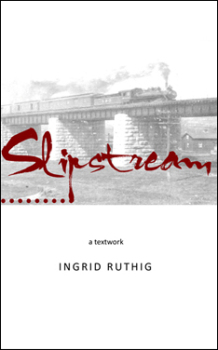
Microsoft Word - Artist's Book Cover in total.docMy good friend, Ingrid Ruthig taught me an important lesson about observation: the same thing can be different. The basis of her book Slipstream was a scene observed out of a window every hour on the hour for eighteen hours.

Try describing the same thing at different times of the day, different seasons. Notice what cell phone covers women or young people choose over older men. Don’t just notice a colleague’s scarf, notice how it is tied today versus yesterday. What colour is the asphalt when it rains versus a sunny day? What colour is snow? (it’s seldom white).

  1. Read people

Don’t just look at people in general, look for specifics: what makes them stand out or blend in. What actions and body language do they use to exude confidence or jealousy or nervousness? What can you deduce from how they dress or wear their hair or hats? If a couple looks unhappy, businesslike or best friends, can you identify what made you come to that conclusion? What is it about someone that makes you uneasy or willing to open your heart to them?

  1. Challenge your powers of description

How many ways can you describe something? What is it like? How many different similes can you come up with? How would your characters describe it? My husband and I try to find different names for the kinds of moons we see: wolf moon, rain moon, wishing moon… Do you always resort to sense of sight? Do you consider light and temperature, texture and mood?

piet-my-vrou

So what have I noticed today? I’ve noticed the three-note call of the piet-my-vrou bird is the first birdsong of the morning. That the pods of the weeping boer bean tree hang like fruit bats. That the blue-green iridescent loerie bird that flew overhead has red underwings, and the bark of the fever tree is yellow.fever-tree

That my sister’s dachshund dog is so portly that when he sleeps his legs stick out straight like roadkill. That the tortoise in the garden can devour half a watermelon in twenty minutes, and that my mother’s hair is the colour of history: iron, copper, silver and gold.

flower-15249_640And I’m waiting to see if, like the lilac Jacarandas, the red flamboyant trees will lose their blossoms in the storm that is now brewing on the horizon.

What did you notice lately?

Writing Room Worthy

Writing Room Worthy

Noelle Bickle

holding-hands-858005_640Four months after my mother’s death, I vowed her tireless efforts to inspire belief in my dreams and evoke courage in my endeavours would not die with her. As much as I’d always credited her as my biggest cheerleader, I hadn’t fully realized that my mother served as advocate for how I valued myself. She lifted my ego when it wilted—always reminding me that success was in the intention and enthusiasm to make good things happen—in both art and life.

I was determined to honour her by letting go of insecurities and self-doubt, but first I had to alter how I valued myself as a woman and artist. She always encouraged my individuality, creativity and connection with others. She applauded unusual concepts and imaginings. Losing my mother quite literally brought me to my knees, but it took those first four months to understand I was also grieving the loss of her ongoing reassurance.

I needed serious personal and creative recalibration, so I started exploring worth and how it impacts every aspect of a woman’s life. After almost a year of not writing or reading—a self-induced boycott of the fuel that had always fed me—I had a non-fiction book idea that sparked passion in both the intention and enthusiasm to make good things happen, and so it took hold.

An elusive life-write balance

A work of non-fiction was a first for me and a stray from the fiction I spent years practising. I was knee-deep now in reading, researching and workshopping—on worth itself and on the business of writing book proposals. As much as it motivated me, it also overwhelmed. I tried to carve out more hours at night, sandwiched with a short stint of writing in the morning before work. I’d sit at my kitchen table and plug away, but I felt scattered. Notepads landed on every flat space in the house, my kitchen whiteboard filled with workshop concepts alongside grocery lists. I didn’t want to lose my drive but I was starting to feel uninspired.

After a meeting with my writing critique group, one of the members came over for tea. I wanted her opinion on my recently assembled art-gallery-style wall in my bedroom—had I gone too far with the floor-to-ceiling display? I value Jessica’s opinion in many things—but she has super-human powers in organization, and each room in her century home looks like a gorgeous magazine spread.
laundry-basket

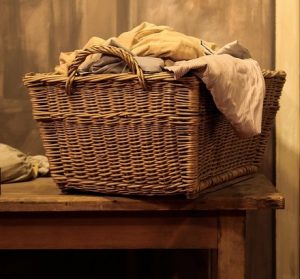
We spent just five minutes in my bedroom with few suggestions–not because she didn’t have a laundry list of further ideas, but because Jessica was far more interested in the spare bedroom across the hall. She asked what I used it for, and I sheepishly explained away the baskets of to-be-folded laundry, and a mass of odds and ends stockpiled in the corner.

My excuse—I wasn’t using it for anything else and could quickly shove things in closets if someone were to sleepover. She wasn’t interested in excuses; she was perplexed why I hadn’t utilized the room as a creative space for myself.

I didn’t have a reason. Frankly, I’d never had a creative space to write, and although I’d spent time dreaming of “She-Sheds” or one day owning a home with a grand studio space, I didn’t think to use this or any other spot in my home to carve out as my own, because I didn’t put stock in the fact that I deserved a space of my own.

I had excuses why it wouldn’t work—I might need the room, I didn’t have a writing desk, and I couldn’t afford to buy anything to make a great creative space. Jessica balked, and said if nothing else, throw an old table in there—all a writer really needs—in order to have a spot to write. A place to hide from regular life and to simply write. It was sage advice.

A writing room for under $100

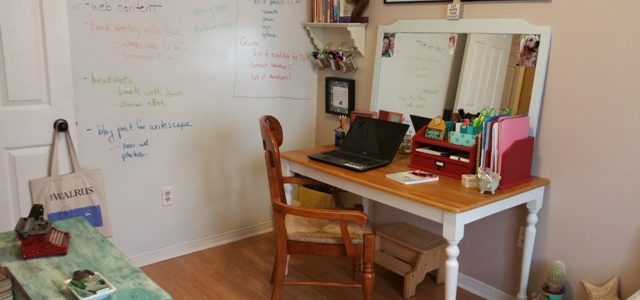
My writing room—as it stands—cost me under $100. It would have cost me nothing, but I envied the floor-to-ceiling chalkboard Jessica had in her writing room, and wanted one too. I decided on whiteboard paint instead, an easy choice more suited to me. I could use a multitude of rainbow-coloured markers, with far less mess than the chalk powder would leave on my floor. The whiteboard paint was $40; I needed two cans. The marker kit was $10. Voila – a fun mind-mapping canvas. Next item, I scavenged an old bedside table from a neighbour on garbage day. Short of tightening the legs which were a bit wobbly, it was a great wood piece. I painted that baby up pretty nice thanks to dollar store paints and examples on Pinterest. Cost me nothing.
20161125_124217-resizeEvery other item in my writing room was already in my house. A 25-year old kitchen table previously stored unassembled in my basement serves as my writing desk. Every piece hanging on the wall, on my desk or a shelf was pulled from other rooms in my home – often hidden or tucked away, not being seen or enjoyed. I tore apart a journal that was filled with inspirational quotes and filled old frames that sat in my closet. I took an old shelf, three bucket-style herb planters that were under my kitchen sink, added some twine with a glue gun and bam—my whiteboard markers had a home.

I didn’t need to make it pretty—I could have had the desk alone—but I like pretty. I also like (almost) free. My room satisfies both. There is something about the space I created for myself—it gives me exactly what I need. Each item gives me joy, calm, or creative zeal.

Constant inspiration
2015-09-28-noelle-her-mom-resizeI have only three photographs in the room—all adorn the mirror which runs the length of my writing desk (placed there so I can keep an eye on myself—one look and I can see if I’m working or playing, focused or distracted—it’s a clever trick, actually). The first photograph is of me and my mother, Norma, laughing. She always told me I was good enough, inspired me to dream big, and laughed at almost everything I said. I glance up at that photo when:

  • I’m deep in doubt and need a boost of confidence to believe in myself
  • I need the strength to just keep swimming
  • I need a helpful reminder to stop excessive late night munching while I write (thanks, Mom…you’re right, sugar only keeps me up later!)
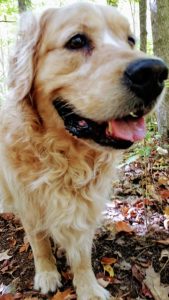
maalik-resizedThe second photograph is of my Maalik. Before he died just this November, my 9-year-old golden retriever spent hours at my feet under my writing desk, or lounged on the bed beside the desk, watching me spin in creative chaos. I would talk aloud as I mind-mapped on the whiteboard, or practised and timed pieces for readings or presentations. He would simply watch attentively and smile on cue. He was my first audience for every piece I ever wrote. He thought anything I wrote or said was brilliant, even when it wasn’t. I glance at his picture when:

  • I need to feel like I made a difference
  • I need calm
  • I need to feel like I do indeed have something worth saying


The last photograph is me, aged 4. I’m dolled up in a bright fuchsia kilt my mother brought from a visit back home to England. I’m positioned in front of her rose garden, my stick straight hair curled at the ends—an effort to make me look less unruly for the picture she’d send back home to family. At first glance, I look darling. At second glance, the jig is up. My hand is deep in my pocket, fingers waving out the bottom of the hem as a friendly cross-continent hello to family I’d never met. I’m grinning ear to ear, cheeky thing that I was. But somehow that is what how I endeared myself to my mother. She was that same age when she came across oceans to Canada, a very small girl on a very large boat. She was quiet and serious, intelligent and well behaved, but very timid. I was wild and rambunctious, often naughty and always playful.
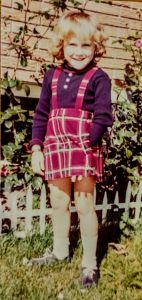
20161125-noelle-age-4-resizeAs little girls, we were very different. However, Mom loved books all her life—both as an escape and as a window to the world she lived in. That she passed on to me, an undeniable effort to make her children aware of the enormous impact of words. I can’t remember a time without books and all forms of writing as a main source of information, enlightenment and entertainment. I glance at that photograph when I need to remind myself:

  • that my strengths often come from being a whirling dervish
  • that life is supposed to be fun
  • that going pant-less has its perks

Over a few months, I’ve made little changes to my writing room, but it remains a creative space only—no bills, no school reports, no work outside artistic measures. I enter the room and get right to work. I don’t have to prepare or clear away the overflow of everyday life. When I leave my writing room, I become regular-life me and get to the daily grind. But in that 8×8 room, I find harmony and am inspired to create.

More than a place to work

Though a little disappointed that I didn’t give myself the gift of a creative space in the more than ten years that I’d been writing fiction, it is gratifying that I’ve finally invested in my work and am honouring my artistic self. I take myself and my craft more seriously because of it. I won’t ever land myself in a home again without somewhere to create that is mine and mine alone.
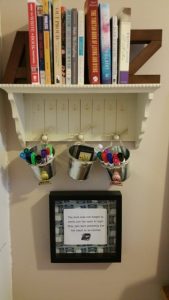
20161125_151622It doesn’t have to look like an office or a studio. I know a writer who literally created a space under her stairs—but it was hers. It doesn’t have to be magazine spread perfect, or be something to boast about. It is less about the space and all about the sanctuary.

Invest in yourself. Give yourself a sacred space to create. Whether you aim to be a published author or a lover who simply writes poetry to your muse. Regardless of whether you aim to be commissioned at an art gallery or someone who fills their own home with paintings rendered on dollar store canvases.

No matter what your creative goal is, don’t wait until you’ve reached what you deem as success to take your craft seriously. Be it a basement, a bedroom, a she-shed, or under the stairs—you are worth making room for.

Did you know:

Noelle is a writer, workshop facilitator, researcher and worth cultivator. She is currently exploring worth and morphing a non-fiction book idea into a women’s movement. Aiming to promote a nationwide surge in the well-being of Canadian women, Worth Cultivating: a women’s movement examines the commonality of women’s struggle to value themselves, and examines how each individual woman can recognize, cultivate and sustain self-worth.

Let’s prepare for a worth-cultivation movement. I guarantee—you are worth it.”  www.worthcultivating.com.

Noelle is represented by the extraordinary Carly Watters, VP and Senior Literary Agent of P.S. Literary Agency.


Sharpening your creative edge

Sharpening your creative edge

Gwynn Scheltema

This weekend, Ruth and I spent a few hours with a motivated and talented group of writers in St. Catharines. Some were beginners, some seasoned professionals, but all of them dived in and challenged themselves and took creative risks. It was thoroughly energizing.

boots on rail lineWriting is, for the most part, a solitary act. Sometimes lonely, sometimes blissfully peaceful. But I find that too much alone time as a writer is not always good. Yes, I might get more written, but it can also sometimes skew my writing perspective.

I can get rooted in bad writing habits, forgetting to use fundamental writing skills I have used before. My writing challenges can start to feel insurmountable. Or I can relax into my writing comfort zone and stop taking risks…dulling my creative edge.

Being with other writers this weekend, feeling that energy that emerges when writers get together, reminded me that I need to build that into my writing life. I also need to hone my creative edge by deliberately taking regular creative risks.

So how can you take regular creative risks and re-energize?

Give voice to non-POV characterseyes-141363_640

Write a scene from a non-POV character‘s perspective. This reminds you that each character has their own motivations. You don’t have to use the piece you write, but in the act of writing it, that character may give you insights about your regular POV character or about the events in the scene. Perhaps there are even connections to other characters you were missing.

Approach description differently

addict-84430_640Challenge yourself to use visual description sparingly, and increase the use of the other senses instead. Try also to limit scene description to just two or three details. (And make sure that the details are ones that the characters would naturally notice and not just things the author wants the reader to notice.)


Use prompts

Using prompts forces you to come at things from different entry points. They stimulate memories and experiences that can be adapted to fiction and can be a springboard to new ideas. Here are three links to get you started.

Freefall writestamp-895380_640

Freefall writing is one of the best and most satisfying ways I know to stay ahead of your internal editor and left analytical brain and give your right creative brain and your subconscious a chance to surface. By writing without stopping for a set time, and having no expectations of what will be written is extremely freeing, and time and time again I’ve seen wonderful writing emerge from the practice.

Get together with other writers
Dining at Turning Leaves

Even if you have a wonderful writing space at home, getting together with other writers to write is a different and energizing experience. I live next to a lake, but look forward to going on retreat whenever I can. It allows me to “leave the world behind” for a short while and concentrate on being creative. Being with a group of people who understand the writing world is invaluable and seeing others around me writing motivates me to write too. Try it. Join Ruth and me at our annual fall retreat Turning Leaves 2016 this November.


Been there: Using real-world settings in fiction

Been there: Using real-world settings in fiction

Gwynn Scheltema

I’m always fascinated by the worlds that writers create for fantasy and sci-fi novels. I think I’m fascinated by the sheer complexity of creating an entire culture from its laws and religion to its people, plants and landscape.

But basing our stories in the “real world” we all know (or think we know), can be just as complex.

Keeping facts straight.

krzywy-las-641507_640Using real settings—real towns or cities, real street names, real landmarks— can seem easy because you have everything created already. You don’t have to invent culture, landmarks or names. If you mention the CN Tower or Westminster Abbey, you need only give a few details, and readers can fill in the rest.


Provided you get it right.

You can be sure that if you get it “wrong”, someone’s going to tell you. Or your reader will be aware that you made a mistake once, and be on the alert in case you do it again, so now there is a subconscious element of distrust as they read. At the very least, it will kick them out of the narrative momentarily.building-72225_640

Your Impressions

Sure, you can control facts to a large degree with good research and careful editing, but what you can’t control is readers’ reactions to your perceptions of real places. If, like facts, readers think that you got the impression “wrong”, it will be noticed, and have the same effect as getting facts wrong. If, as a narrator, you describe a particular real neighbourhood as “dangerous”, or “upcoming” or “ugly”, that might be your interpretation, but your reader may not agree. Your perceptions of real places are valid, but so are your readers’impressions of the same place.

So what can you do?

Impressions vs. facts

As you write be aware which setting details are facts and which are opinions. Characters only should express all the impressions or opinions. Characters in this instance include the narrator in a first person story. In sections of exposition, stick to facts. This is a good rule of thumb for any details actually, not just for setting. Essentially, setting opinions expressed through exposition become “author intrusion” and open that door for “getting it wrong”.

Manipulating impressions

The moment you move impressions of real places to the realm of character, you have the opportunity to manipulate setting to support other elements like character development and theme.

By choosing to focus on the details the character notices in a setting and what they think and how they feel about it, says as much about the character as the setting. Characters usually notice the things that align with their emotional state and with their level of understanding. You can set or heighten mood and sneak in details that will be important to plot or speak to theme.

midway-game-983385_640

Think of a child and his mother entering a fairground. The child is likely feeling excited and looking forward to fun, so will notice details that are colourful, fun and energizing: whirling rides, flags and balloons, stalls full of prizes to be won. The mother might be jaded by years of attending fairgrounds, aware of potential danger and cost. She will notice questionable people, machinery that looks or souman-1283576_1280nds dangerous and the crush of crowds that make it hard for her to keep track of her child.

Another manipulation is to purposely describe factual details “wrong” to establish an unreliable character.

Fiction and reality fusion

Perhaps the best way to use real settings is to create a fictional piece within the real one. A fictional town in real Northern Ontario. A fictional bar in Paris. You still get the advantages of the “real world” settings, but not the disadvantages. Your fictional component should be similar enough for believability, but you have the freedom to create your own “impressions”’ of the place. You get to decide if the place is “dangerous”, or “upcoming” or “ugly”, and your readers will believe you.


Permission To Write, Ma’am? Granted!

Permission To Write, Ma’am? Granted!

20160606_091236Imagine a sprawling kids’ camp tucked into 60+ acres of hills and trees edging a clear lake. This Ontario cottage-country paradise has everything a kid could want.

Water sports. Mountain bikes. Pine cabins. Sports fields.

Pottery studio. Dance studio with a sprung floor. Professional performance theatre.

Pottery? Dance? Performance? At a kids’ camp?

You betcha. For decades, the Durham District School Board has transformed Camp White Pine into the Durham Integrated Arts Camp (DIAC). Like magic, the arts-focused Haliburton summer camp becomes an annual arts fest for Durham Region students and this year, 350 teens soaked it all in.

Senior and junior concert bands. Jazz bands. Ensembles. Songwriting. Drumming. Dancing and movement. Music theatre. Black light theatre. Improv.

Drawing. Painting. Pottery. Printmaking. Textile arts. Sculpture…

And creative writing.

Liberated voices

I’ve recently returned home from teaching Creative Words, an elective program for the Grades 7 to 12 students at DIAC. I had 35 students spread over 3 classes. It was spectacular, challenging, surprising and gratifying.

On day one, I told them “Creative Words is not about spelling. It’s not about grammar. It’s about your words, your way.” I don’t think they believed me at first but it didn’t take long for them to discover the joy of freefall writing, the depth that writing gets to when you use all five senses, and the value of “owning your words.”

I led the class in much the same way as I facilitate my adult workshops. The students were surprised when I said “no censorship” but then I reminded them that they still must respect each other and the words on the page. Every word has to be there for a reason, not just shock value.

By mid-week, students were clamouring for “more freefall” and willingly trying whatever crazy exercise I had them experiment with. I knew things were going to be okay when students charged into the studio declaring “I love this class!” And frankly, so did I.

“Trying on” words

Creative Words students used their own work in their culminating project, aptly called “Wear Your Words.” Selecting an excerpt from a piece they created — poems, stories, anthems– they wrote them on T-shirts. Some students had just a few words. A couple had pages’ worth of words. Several added images. And some chose to let their words stand alone. At the week’s-end celebration, a few bravely read their work in front of other campers, and three participated in a poetry slam. Most of the students wore their T-shirts to the celebration, and so did I.

20160609_11393620160609_16084520160610_14535620160609_091957

I was immensely proud of my Creative Words students. All of them took risks. All of them wrote every day.

There were a few tears as we wrapped up. Some of those tears were mine because it is really an honour to be among young people who are exploring their narrative voice. For most of them, my workshop was the first time they had feedback from a professional writer. It’s an intense few days of exploration, discovery and acceptance. But encouraged to express their words, their way, they found their voice.

I didn’t discover my narrative voice until I was nearly 40. So I’m happy these young writers didn’t have to wait that long.

School with a difference 

DIAC-2016DIAC is a temporary school, complete with a principal, administrative staff and teachers. Granted, some of the teachers are on mountain bikes or in canoes, and some of us (me, for example) are guest instructors without teaching degrees, but it is school nonetheless. We take attendance. We have rules. But we also have fun. Best of all, we encourage students to explore their creative selves, to see themselves and the world in relation to arts and culture. And to celebrate all that it means. Because, after all, to an artist at heart, it means a lot.