The value of keeping random ideas.

The value of keeping random ideas.


Gwynn Scheltema

Ever write a story that seemed to go nowhere? Ever thought of a brilliant opening line, but never wrote the story? Ever found a line that you thought might make good dialogue, or a line in a poem, or the premise of an entire novel and lost it?

lights-1254298_640Rummaging around in discarded ideas will invariably turn up something unexpected, surprising, fun or usable.
That’s not to say that every word you write is gold – saleable gold – and that none of it should go to waste. But ideas don’t always come at a time when you are ready for them, and if you have no way to revisit them, then even the good ideas will go to waste.

Increase your wheat-to-chaff ratio with an Ideas File and pop them in there. Actually, have several ideas files:

Ideas Files
  • hard costory basketpy file folder: for ideas scribbled on napkins and other scrap bits.
  • computer file for the same. Make sure you develop a way to easily navigate through them. Naming each one “good idea” won’t be too helpful when you have 400 “good ideas.” Make use of “version” and “date” options if you have very similar drafts of an unfinished story:
    • horrornovel_v2_2016
    • babypoetryRev3March
    • trilogy_idea3


Personal coding systemcolored-pencils-168392_640

Create a personal coding system to mark up journals or notebooks for easy browsing retrieval. I use coloured highlighters: I underline or asterisk possible poetry ideas with yellow, novel snippets with blue, non-fiction article ideas with green, etc.

Other people’s ideas

Expand the concept to ideas beyond your own writing

  • In another hard copy folder keep cuttings from newspapers and magazines, old letters or theatre tickets or postcards or photos. Expand to new subfolders as ideas begin to consolidate.
  • In computer folders, keep ideas suggested by blog posts, or anything internet related, including email copy. Be sure to include URLs if you want to reference later.
  • Create a Pinterest board. This is especially useful in the early stages of a novel. Pin pictures of faces, buildings, landscapes, objects, or anything that stirs up ideas or cements a visual for you. Here is one I started for my MG novel.
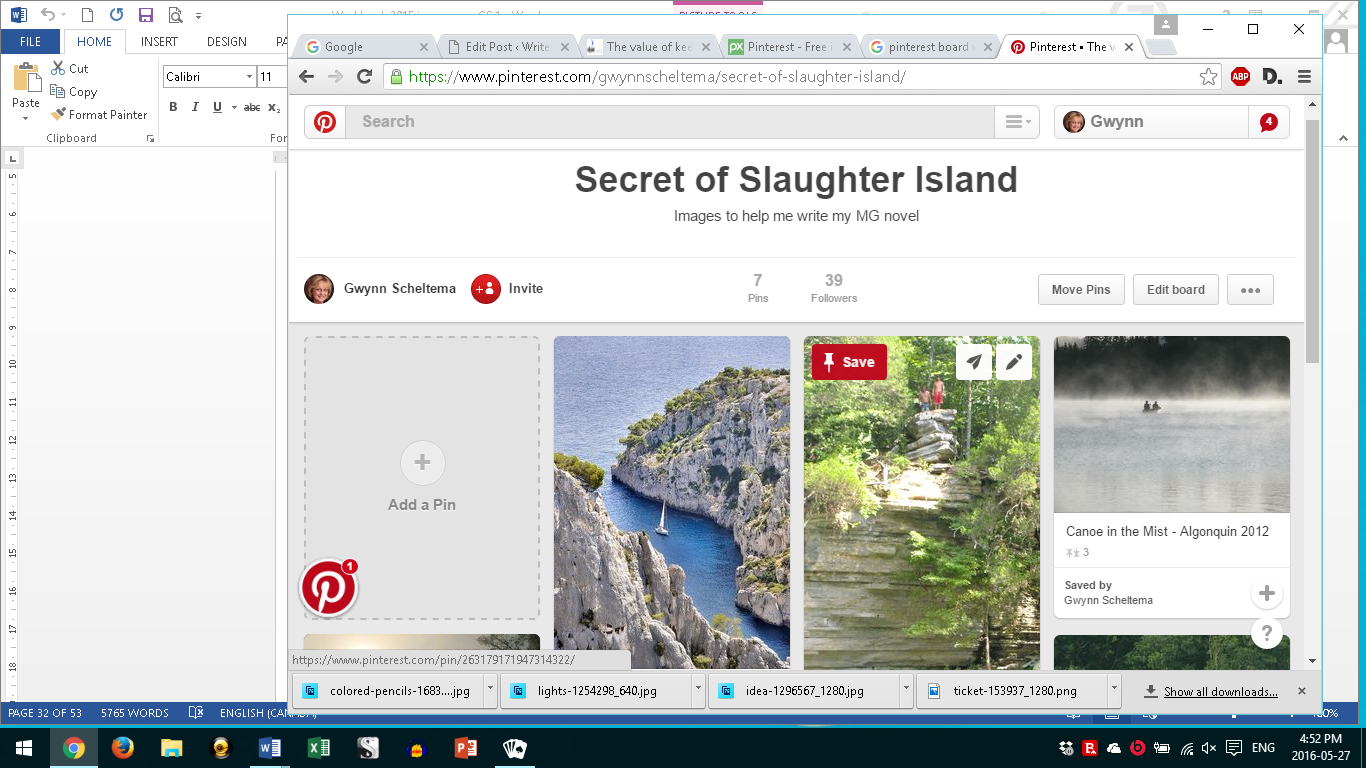
pintrest board

Of course, having all these ideas is pointless if you don’t do something with them.

Here is a creative exercise to try:

Take these twold bicycleo random pictures and write a scene that will somehow link them together.ticket-153937_1280
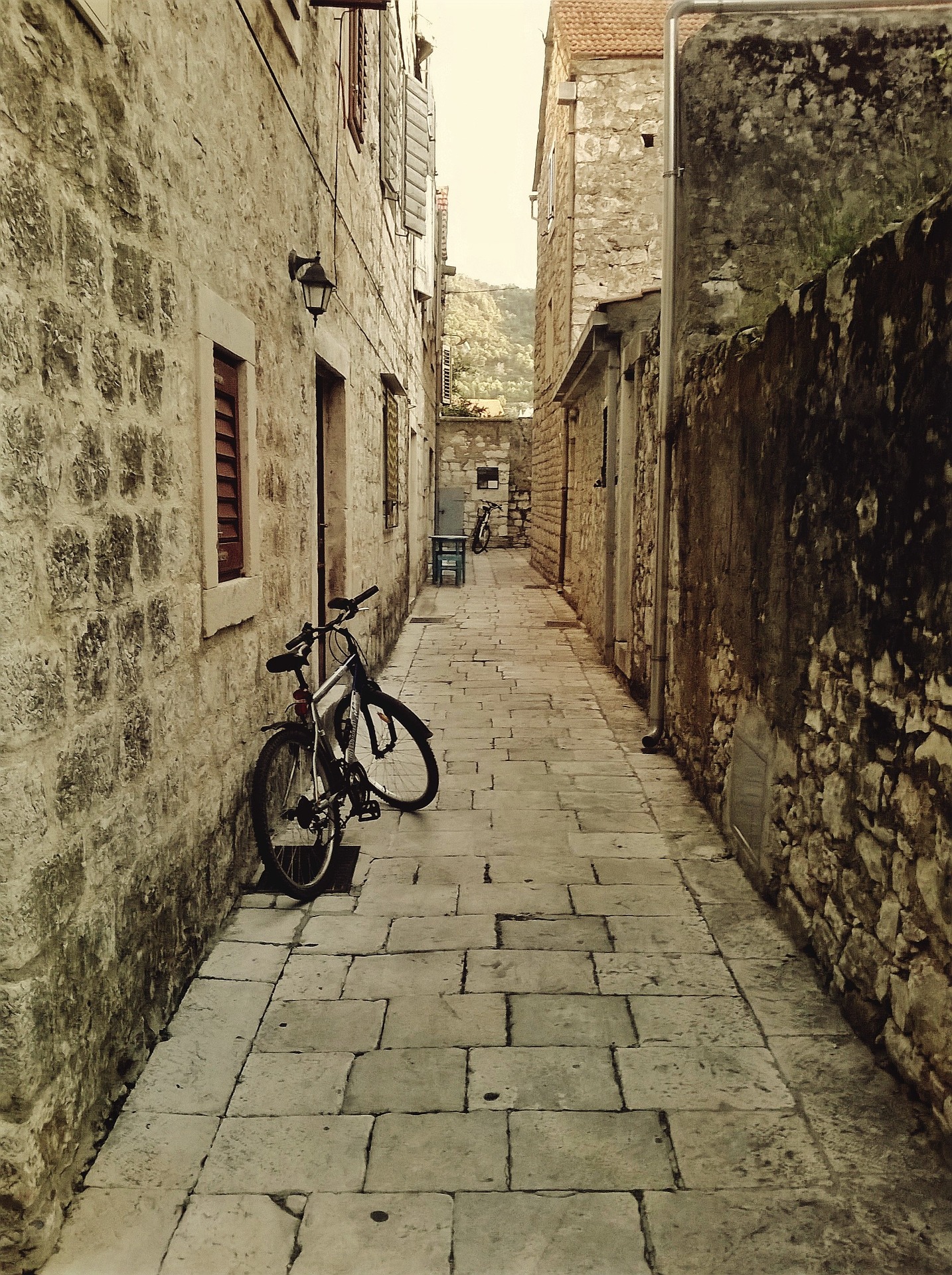


When pairing ideas, don’t worry if they seemingly have nothing in common when you begin– that is the point of the exercise. The struggle of creating the link is what gets your brain going.


The Unoriginal World of bobbi leblanc

The Unoriginal World of bobbi leblanc

Gwynn Scheltema

I was reminded about poetry when I went to the ballet this week. And not necessarily what you may expect…expressions of beauty through pattern or escape to a lyrical world (although that certainly happened).

No, I was reminded about the quest for meaning in art and the effect of succumbing to fads and affectations.

The Quest for Meaning

The National Ballet’s mixed winter program began with two offerings of classic Balanchine choreography: The Four Temperaments and Rubies. As the knowledgeable and always eloquent creative Director and Principal Ballet Master, Lindsay Fischer reminded us in the pre-performance talk, Balanchine choreographed always with the music uppermost in his mind. He didn’t start out with an idea he wanted to express. Instead, he listened to the music and let the music suggest the movement.ruby-1254568_960_720

When you listen to a symphony, you don’t spend that time wondering what it means. You let it transport you and enjoy the way it makes you feel. Balanchine’s ballets are like symphonies. You enjoy them for the emotions they stir in you, for the beauty in the patterns that delight you, for the surprises that please you when you least expect them to.

Good poetry is like that too: the music of the words and rhythms, the surprise of juxtapositions and turning points, the satisfaction of found mutual experience and ah-ha moments. And the delight of images that make you feel like you see what the poet sees. To paraphrase Chekov, poems that allow the reader to experience the moon by seeing “the glint of light on broken glass”.

And always emotion. It’s not necessary to read poetry looking for meaning. Allow the images to evoke whatever emotion or memory they do for you. There is no right or wrong reaction to what is written. Like a symphony, or a Balanchine ballet, let the poem transport you and move you.


Fads, Trends and Affectationscactus-659128_960_720

The final offering was a new work by Swedish choreographer Alexander Ekman called Cacti. At first it was disturbing, confusing, but it didn’t take long to become comical, in fact, hilarious.

It poked fun at all the trendy things we’ve seen on stage and in dance competitions: androgynous dancers; bizarre props that seem to be symbolic but aren’t; weird, intrusive (and often annoying) lighting and stage sets; contorted body positions and music that isn’t sure what rhythms or mood it’s going for.

In short, it was using conventions and trends that others had been using, in fact, overusing. And did it result in “art”? Was it trying too hard to be “art”?  What resulted was a parody of art.

In this case, the choreographer was going for that and succeeded brilliantly. But it was a heads up to those who forget to open their minds and let the muse be original.

It took me back tofun issue 2004 when Ruth and I were on the editorial board for the literary journal LICHEN Arts & Letters Preview. Submissions of poetry went through a “fad” at that time, where everything was lowercase, even the pronoun I, and the poet’s name. Poems were made up of numbered parts, had words in italics, parentheses and were often divided by slashes. And all of them (it seemed) started with a quote from someone else or notes on what inspired the poem. That’s not to say that these devices cannot be used; there are some very fine poems with one or more of these elements in them. But what we were seeing was random, put in there without meaning or context because the poet had seen it elsewhere and was imitating without understanding why it was like that in the first place. That’s the pretentious part.
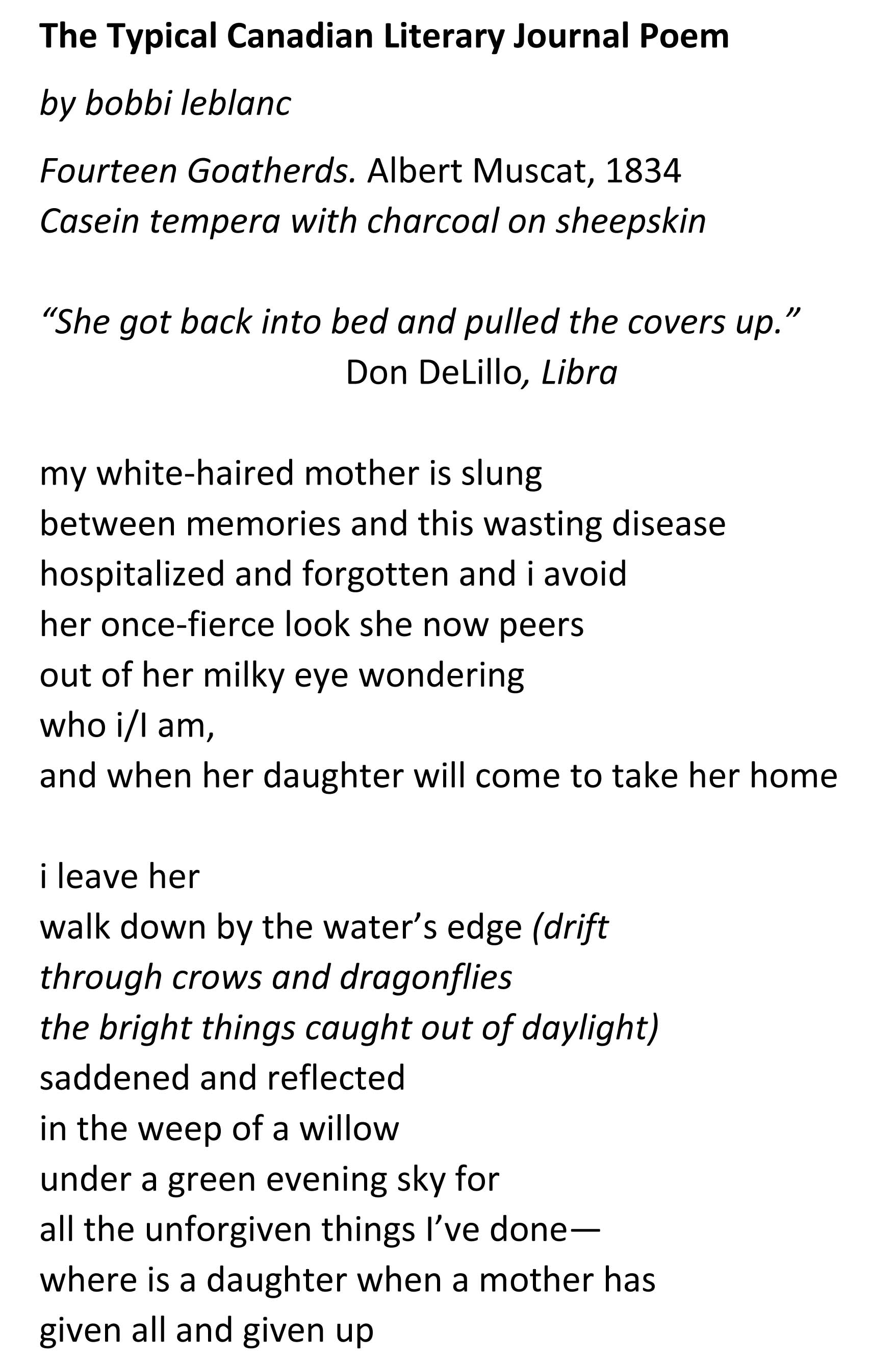
Given that we had to deal with hundreds of submissions, it was frustrating. Our 2004 spring issue was the “fun” issue, so as a lark, and to do much the same thing that Ekman did in the ballet Cacti, we (the editorial board) collectively wrote a poem that parodied all these affectations. We published it as “The Typical Canadian Literary Journal Poem” by a fictitious poet called bobbi le blanc (Notice: non-gender, possibly French and/or English and all lowercase name.). It was a hoot. But in the fun, like the ballet Cacti, there was that same heads up to those who forget to open their minds and let the muse be original.

It was a long poem with many numbered parts (of course), but just to give you a taste, here are the first two stanzas. Enjoy a giggle. The Typical Canadian Literary Journal Poem


Can You Use Parody?

Interestingly, parody is a great way to loosen up the mind and your writing. Try taking something you’re editing and rewriting it in the same style of a well-known writer, say, Ernest Hemingway (simple, direct and plain prose) or William Shakespeare (image-rich, iambic pentameter, 16th-century prose) or Margaret Atwood (precise, ironic and witty). When you are finished, consider how  your own work is different. What makes your style, your voice, unique? 

Tasting the Page:  Beyond the Five Senses

Tasting the Page: Beyond the Five Senses

With Gwynn Scheltema

In this one-day workshop:

  • challenge your reader’s perceptions and assumptions
  • deepen your powers of description
  • learn new descriptive techniques to give greater weight to your narrative voice.
  • master how to add description without slowing the narrative.

Don’t let your fiction be left on the plate. Prepare it gourmet style and your readers will beg for more.

Have fun experimenting with creative writing exercises that make your writing live. We’ll munch our way through a smorgasbord of fiction foods from image and emphasis, to movement, theme, and syntax.

Come prepared to go new places and try new things.

As past participants have said, “You provoked me into thinking of new ways of approaching my writing,” and “Your exercises were great—inspiring, short, but effective. You let us try lots of different things.”

Turning Leaves 2017

Turning Leaves 2017

November 3 – 5, 2017

Vicki Delany: One woman crime wave comes to Turning Leaves

With more than 20 books to her credit, Vicki Delany is a fearless full-time writer, tackling the adult, reluctant reader and YA markets with her mysteries, suspense novels and police procedural titles. Past Chair of Crime Writers of Canada, Vicki is also a member of Capital Crime Writers and Sisters in Crime. She writes as Vicki Delany and Eva Gates.

Enjoy a Friday evening fireside chat with Vicki and a Saturday morning workshop where more than the secrets of writing a great mystery will be revealed. All stories need a mystery at their heart.

Here’s a brief excerpt from her author’s bio: In 2007, Vicki took early retirement from her job as a systems analyst with a major bank and sold her house in Oakville, Ontario.  At that time In the Shadow of the Glacier, the first book in a police procedural series set in the British Columbia Interior was published. After travelling around North America for a year with her dog, Shenzi, she bought a home in bucolic, rural Prince Edward County, Ontario, where she rarely wears a watch and can write whenever she feels like it.

Interview with Vicki

Turning Leaves 2017 brochure

REGISTRATION IS NOW OPEN

A $250 non-refundable deposit will secure your place in this retreat. 

At Turning Leaves, we build a retreat for the writer and the writing:

  • workshops to fire up your pen
  • creativity and group sessions to inspire you
  • private, uninterrupted writing time in cottage country setting
  • tailor your retreat to suit your needs
Chatting over dinner in the Heritage Dining Room


Turning Leaves 2016 with Hilary McMahon

Meals and accommodations:

  • lakeview dining in the Heritage Dining Room
  • private or shared accommodation in Fern’s Fireside Inn
  • rooms have wood-burning fireplace, fridge, free WiFi
  • Fern Resort is 90 minutes from Toronto in a quiet bay on beautiful Lake Couchiching

Resort amenities:

  • indoor pool, Jacuzzi, steam room, sauna
  • exercise room
  • nature trails, outdoor jogging track
  • spa treatments (by appointment, extra charge)
  • onsite pub (additional charge)

Fees 

  • Lakeview Room Single Occupancy $875
  • Landview Room Single Occupancy $845
  • Landview Room Double Occupancy $775
  • Day Rate $475

Discounts

  • Retreat alumni $30
  • Members of writing organizations $30

REGISTER NOW A $250 non-refundable deposit will secure your place in Turning Leaves 2017

PLEASE NOTE: When you hit the “Add to Cart” button, the PayPal order will show up at the top of the column to the right. To be taken to the secure PayPal to finish your purchase, click on the yellow PayPal button. You can use a credit card on the PayPal site – you do not have to have a PayPal account.

Questions? info@writescape.ca


Just Write! at Glentula

Just Write! at Glentula

Three or Five days to Just Write!

If you want a retreat that won’t break the budget, try this three- or five-day getaway at Glentula on the shores of Lake Seymour just over an hour east of Durham.

Montage with words -- The many lovely faces of Glentula

Be inspired

Nestled in the forest, on the shores of Lake Seymour, Glentula offers peace and inspiration. Five acres of forest and walking trails, streams and lake, gardens, gazebos and secret hideaways. And inside, a bright workroom, book-lined study, or your own private room give plenty of options to write in.

Be supported

Gwynn is onsite and ready to support your writing. She is available for consultation and chats each afternoon. After-dinner readings give participants an opportunity for group feedback. Optional warm-up writing sessions and activities are available each morning.

Be comfortable

Glentula is a private cottage home with single and double occupancy rooms. All your meals and snacks are provided. This intimate retreat is open to a maximum of five participants: 3 single room (double or queen beds), 1 double occupancy (twin beds). Registration includes accommodations, meals and all-day access to beverages and snacks.

Your Just Write at Glentula retreat program includes:

DAY ONE:

  • 10:00 am: Arrive and settle in; explore the grounds, or start your writing right away.
  • 11:00 am: Introductory session to meet your fellow writers, and find out what’s on offer. Warm up your pen with a few creative writing exercise and sharing.
  • 12:30 pm: self-serve lunch in the dining room: hot soup or crockpot fare, breads, cheese, salads, fruit & cookies
  • Afternoon: Private writing time. Explore situation-themed prompts drawing inspiration from the woods and the lake available at “Inspiration Stations.”
  • 5:30 pm: Cottage-style BBQ dinner (dine al fresco, weather permitting); Group readings, feedback and discussion or writerly activities.

DAY TWO:

  • 7  to 9 am: Self-serve breakfast: hot or cold cereal, fruit and juice, yoghurt,eggs, toast, muffins and bagels.
  • 9:30 am: Warm-up writing prompts and freefall, followed by silent writing time.
  • 12:30 pm: self-serve lunch
  • Afternoon: free time to write or relax. Situation-themed prompts drawing inspiration from the woods and the lake available at “Inspiration Stations.” Gwynn available for one-on-one discussion of your writing project.
  • Evening: sit down, three-course dinner. Group readings (at the campfire, weather permitting), feedback and discussion or writerly activities.

DAY THREE:

  • 7  to 9 am: Self-serve breakfast
  • 9:30 am: Warm-up writing prompts and freefall, followed by silent writing time.
  • 12:30 pm: self-serve lunch
  • Afternoon: free time to write or relax. Situation-themed prompts drawing inspiration from the woods and the lake available at “Inspiration Stations.” Gwynn available for one-on-one discussion of your writing project.
  • 4 pm:  Closing session.

Next dates available:  Summer 2018. Contact info@writescape.ca 

Registration:

3 Days: $385

5 Days: $545

PLEASE NOTE: When you hit the “Add to Cart” button, the PayPal order will show up at the top of the column to the right. To be taken to PayPal to finish your purchase, click on the yellow PayPal button. You can use a credit card on the PayPal site – you do not have to have a PayPal account.

HST will be charged at checkout. HST # 821104853RT0001

Getting There:

Glentula is at 101 Morningside Drive, Havelock, ON. Click here for directions.

Continue reading

On-demand Workshops

On-demand Workshops

Gather your group. Pick your topic and your date. And we’ll bring Writescape to you.

From beginning writer to seasoned professional, we’ll customize sessions to suit your programming themes and audience needs. Choose from Writescape’s Workshop Catalogue 2016 to help you and your colleagues hone writing craft and develop new skills and techniques.

“I came away with an understanding that will stick with me … great handouts and examples.”

From two-hour evening sessions to week-long programming, you tell us what you need and when you need it. Writescape will supply professional workshop leaders, hands-on exercises and practical handouts, and a creative, supportive atmosphere for an excellent learning experience.writing-828911_960_720

“…a safe place to be vulnerable with my writing and to risk trying something new.”

Writescape facilitators have delivered workshops and presentations across the Greater Toronto Area, as well as Ottawa Region, Durham Region, and Northumberland, Kawartha, Haliburton, Muskoka, Simcoe and Niagara regions, Southwestern Ontario and into the U.S.

startup-594090_1920 (1)Step 1: talk to your group or colleagues about what you need

Step 2: choose your program from our Workshop Catalogue 2016

Step 3: contact:
info@writescape.ca
905-728-7823
leave a comment

We focus on your needs and deliver inspiration, expertise and support. We make it happen.

Custom Retreats

Custom Retreats

Your Retreat, Your Way

Does your writing group want a private, customized retreat where…

  • writing and workshopping space is provided
  • a peaceful, natural setting will encourage your muse to create
  • all meals are catered
  • a 24-hour beverage station is available
  • a professional writer and editor is on hand for support
  • customized programming can be provided
  • rates are budget friendly

From weekend get-a-ways to week-long retreats, you tell us what you need and when you need it. Writescape will work with you to make it happen. Contact us at info@writescape.ca; 705-778-5139 or leave a comment below.

Writescape’s custom Just Write! retreats are held at Glentula on the shores of Lake Seymour just over an hour east of Durham Region. Bookings can be made in all seasons. Gwynn and Don and the two house cats will be happy to welcome you.

Montage with words -- The many lovely faces of Glentula

Be inspired

Nestled in the forest, on the shores of Lake Seymour, Glentula offers peace and inspiration. Five acres of forest and walking trails, steams and lake, gardens, gazebos and secret hideaways. And inside, a bright workroom, book-lined study, or your own private room give plenty of options to write in.

Be supported

Gwynn is onsite and ready to support your writing.  After-dinner campfire readings give participants an opportunity for group feedback. Optional warm-up writing sessions and activities can be arranged.

Be comfortable

Glentula is a private cottage home with single and double occupancy rooms. All your meals and snacks are provided. This intimate retreat space accommodates five to eight participants. Registration includes accommodations, meals and all-day access to beverages and snacks.

Getting There:

Glentula is at 101 Morningside Drive, Havelock, ON. Click here for directions.

Continue reading