Write The Elusive End

Write The Elusive End

Ruth E. Walker

Oh, the love affair of writing the novel. The first blush of an idea. The rising heat as you pound out page after page of an unfolding story. You don’t want it to stop.

You constantly think about your novel, about your characters, your plot, your wonderful, endless possibilities… Until you find yourself without an ending.

Yeah, End-less: Your sense of dread when you need to finish your novel but there is no ending in sight.

Or End-less: Your sense of disappointment with an ENDing that is LESS than satisfying.

Poet and playwright Y.B. Yeats referred to the ending of a poem like a “click”:

The correction of prose, because it has no fixed laws, is endless, a poem comes right with a click like a closing box. (1935 letter to Lady Dorothy Wellesley)

While I might argue with him that prose indeed has many fixed laws for its “correction”, I’ve always liked Yeats’s idea of a “click like a closing box.” In my opinion, not just poetry needs to possess that “click” at the end.

No matter the issue, if you come to the end of your novel with a whimper instead of a bang, or at the least, the lovely satisfying “click”…your readers will be unhappy. And nobody wants unhappy readers.But if you’ve written a great beginning, do you need to give the same focus to the end? Prolific crime novelist Mickey Spillane said:

Your first chapter sells your book. Your last chapter sells your next book.

Click

Spillane’s not talking about sequels. A wise writer remembers that a disappointing or weak ending will undo all the joy your reader got at the beginning.

So what inspired this post? I’m working on the ending of my novel. I have three written (or at least, sketched out.) One tragic. One that leaves room for a sequel. And one that ends more positively. I’m undecided but I feel that I’m getting closer to the right ending. To help me work through the possibilities, I did some exploring on what a good ending needs. I’m sharing some highlights here:

A good ending needs:

To show change
  • Growth/change in your POV character is a common expectation for readers. But you could have a POV character who is “static” and remains unchanged right to the end. In that case, your reader must somehow be changed, have a new/deeper understanding of the impact of that character’s lack of change.
To be inevitable
  • This is not the same as predictable; no reader wants an ending that has been hinted at in every chapter since page one. And no reader wants deus ex machina endings with the ‘gods’ suddenly appearing and fixing everything.

To read something brilliantly written with an inevitable yet often unexpected ending, check out any of Alice Munro’s stories. I can re-read one of her stories and still get that yummy satisfaction from an inevitable, but often surprising, end. Munro’s “Dance of the Happy Shades”, about an uncomfortable children’s piano recital, has a masterful and quietly profound ending.

Not to be afraid to be unhappy
  • Who doesn’t want a happy ending? But if Romeo and Juliet ran off and lived to a ripe old age, how memorable would that be? Theirs was an “inevitable”, if tragic, ending. We may want a happy ending, but our lives (and some good stories) don’t always comply. And really, they are often better stories if the ending is not all rainbows and sugar plums.

In sum, a good ending needs to be satisfying for the reader…and for the writer. Whether it is a “click” at the end, or a sunset being ridden into with the future uncertain, a good ending needs to make sense. But how do you know if you’ve written the right ending?

In a later post in The Top Drawer, we’ll explore techniques and tips for knowing when you’ve achieved the best possible “The End.” Hopefully, by then, I’ll have found mine.

Did you know:

From endings come new beginnings. Writers in Ontario (and beyond) learned at the Ontario Writers’ Conference that it would be the last such gathering. Gwynn, Heather and I were so sad to hear that. We’d been at every OWC since its launch in 2006. But then the OWC announced an exciting new start. It wasn’t ending after all, just changing format and exploring how to offer writers its signature networking and education opportunities in new and exciting ways.

While it retools, OWC is still holding its monthly Story Starters contest, using images to spark the imaginations of writers. There are prizes to be won and bragging rights to add to your bio, so check out Rich Helms’ quirky and fun image and enter.


Writing Positively and Successfully in 2017

Writing Positively and Successfully in 2017

Gwynn Scheltema

We are all familiar with setting New Year’s resolutions, or resetting the same goals we set last year and didn’t achieve. So what other positive things can we do to motivate ourselves to move forward?

Switch to a positive perspective

Never underestimate the power of positive thought. Someone once said that if you think your glass is always half full, then pour it into a smaller glass and quit whining. What they mean is: stop complaining; learn to see things from a new, more positive perspective. Don’t focus on what you haven’t achieved, but celebrate what you’ve accomplished. Don’t bemoan what you can’t do, but feel proud of what you have learned and mastered already. Self-confidence is half the battle.

Document progress and small successes

Pat yourself on the back often. My good friend, Ingrid Ruthig, introduced me to the habit of keeping a document file on my computer desktop called “Things I’ve Done in 201_” (add your own year). In it, I record every small accomplishment as it happens.

I include a record of submissions that I send out —whether they come to fruition or not— because even the act of submitting is a positive and motivating step for any writer. I list writing events I attend. I list open mic opportunities, readings, interviews or panels I participate in. I paste copy from encouraging emails about my work. I record the completion or start of writing projects, or even segments within writing projects— “finished Chapter 3!”. I record workshops attended or given, and retreats and writer’s breakfasts. I fill in the dots on the calendar for every B.I.C session I complete.

As the list grows I get a satisfying sense of what I’m doing to further my writing journey or project—or a self-kick-in-the-pants if there haven’t been any recent entries.

At the end of the year I have a real record of accomplishments and areas that need focus. I also have a decent record to refer to when completing my tax returns or updating my writing resume— but that’s another blog.

Have elastic expectations

Seeing where you were a year ago and where you are today can be revealing. Priorities and goals can change over the course of the year. Projects can fizzle or get sidelined by new projects (and life) unimagined at the start of the year, and that is not necessarily a bad thing. Just because something on your goal list doesn’t get completed doesn’t mean you’ve failed. Reflect on what you’ve learned. Adjust and move on. Go with the flow.

If you like to set goals, perhaps plan to start with short-term (monthly, quarterly) goals. Make some targets easy to complete to keep you motivated. Display them somewhere to nudge yourself and stay on track.

Also balance that with longer-term (2-year, 5-year, lifetime) goals where you reach for the stars so you have something to aspire to and something for your subconscious to envision. They say that the first step to actualization is visualization.

Strive for balance

Achieving writing goals is all very well, but if they are achieved at the expense of your health or your family relationships and other important aspects of life, then perhaps you need to reconsider your life balance.  As Ruth said in her blog, make time to not write. Take time to live. Take time to indulge in growth through retreats, conferences, workshops or just hanging out with writerly friends. Take time to notice. Take time to read. Take time to exercise. Take time to love.

Above all, be kind to yourself. Look for the good in everything. Enjoy the writing journey you’ve chosen for yourself. Enjoy life. Be positive and you’ll get there.

Here’s to your positive and successful 2017.

Six Simple Resolutions for Writers

Six Simple Resolutions for Writers

Ruth E. Walker

Resolutions can be hard to keep. Often, it’s because the resolutions we make are either too complex or too unrealistic.

And sometimes, it’s too hard to even choose a resolution. Should I resolve to submit my novel this year? And should it go to an editor or agent first? And should I resolve to start writing the sequel to that novel or maybe I should wait to hear from the publisher first?

Don’t worry. Gwynn and I are here to help. We kept it simple for you. And we kept it doable.

Here are six resolutions designed to enhance your creative skills in the coming new year. And bonus! You only need to choose one for New Year’s Eve:

#1 Resolve to devote one day exclusively to the craft

Think about it. Just one day. C’mon, you can do it. Pack a lunch and head to the library. Or stay home, unplug the phone and the Internet, and spend the day writing. Maybe you can pretend it’s a snow day. Or maybe you can book a one-day escape at a hotel or B&B, or check out Gwynn’s writing getaways at her Northumberland home on Lake Seymour.

Consider what the word “craft” means: In Old English (pre-900 CE) cræft meant strength. Giving yourself a full day to focus on the art and skill of your craft can only strengthen your words on the page. No matter what option you choose, make sure you schedule your day devoted to writing. And then make sure you show up, as scheduled.

#2 Resolve to write while travelling

We didn’t say “write a book” when travelling. We only suggested that you remember to write when on a journey. “Writing” can be a restaurant napkin with a snippet of overheard conversation recorded next to the smudge of hot sauce. “Writing” can be jot notes on a map or guidebook: stopped here and ate weird-tasting burgers at Fast Eddy’s Eatery. Nobody got sick.

The point is that there are all kinds of ways to “write” while travelling. You’re creative. In 2017, see what you can do to write while travelling.

#3 Resolve to write something different from your “usual”

Step away from the familiar and head down the rabbit hole. If your passion is fiction, go for non-fiction or poetry. If your comfort zone is poetry, try your hand at playwriting. If non-fiction is your go-to, start a graphic novel. Science fiction writers, take the time to meet romance. Mystery writers, shake hands with erotica.

There’s a strange chemistry that happens when you shake up your pen and at the very least, you’ll return to your writing nest with some fresh ideas. And maybe you might find that trying something new opened up a whole new “writer” in you.

#4 Resolve to read something different from your “usual”

This one is easy. You don’t even have to choose a book. How about a bodybuilding handbook or an article in a finance magazine? Or a graphic novel, or modern play, or a children’s board book? Or a corporation’s annual report, or a technical how-to manual.

The object of this resolution is to teach your eyes to see what you might have skimmed over in your own work. What made this particular piece of writing publishable? Where is the strength in the writing? Who is the reader or audience? And why do they need this publication? What changes, if any, might you make to improve it?

This analytical approach might prove useful in your own writing. At the very least, you introduce your eyes to a way of writing or to content that is not what you normally choose to read. An excellent exercise to expand your writing horizons.

#5 Resolve to devote at least one day to NOT writing

A counterintuitive resolution? Actually, this is a great resolution for those who have trouble leaving their desk, or pen, or computer. It’s great to be a devoted writer, one who writes every day without fail, one who will forgo lunch if a plot point needs adjustments or a character is sitting a bit too flat on the page.

Nonetheless, a daily writer might be surprised what might happen when you give up just one day of working at the craft. The tension of staying away from the writing could fire up your pen in ways you hadn’t imagined. The “day after” may be something you choose to indulge in from time to time. At the very least, it’s a worthwhile experiment for the relentless writer to try out.

#6 Resolve to pay attention. Yup. Maybe you think that you already do this just fine. But we’d like to suggest two different approaches in case there’s one you’ve not yet tried:

Be objective: I attended an Andrew Pyper workshop where he suggested that paying attention without judgement is a great way to discover characters and ideas. I think he called it “writers’ reportage.” Take a seat in a public space and people watch. Simply record the facts of what you see. No emotion. No subjective consideration. e.g.: Young woman in red halter top and white shorts pushing dark blue stroller without a baby inside. Man in yellow hat and biker jacket runs up library steps and goes inside then exits almost immediately.

Be subjective: Gwynn Scheltema suggested that there are benefits to being subjective when noticing, and that it really is a kind of art. Her “Art of Noticing” was posted to The Top Drawer a couple of weeks ago. Gwynn nudges you to bring the five senses into your observations. Can you describe the taste of coffee? Did you hear what your fellow passengers discussed on the bus? And what is the colour of snow, exactly?

No matter which approach you take to your paying attention, both Andrew and Gwynn remind writers that there is writer’s gold in observations. So take the time to mine some for yourself in 2017.

Happy New Year! May your muse stay close, may your imagination be ever ready to receive and may your pen never run out of ink.

The Formula for Funny

The Formula for Funny

Dorothea Helms, a.k.a. The Writing Fairy

Picture it: 1999, an eager freelance writer sells an article to a national magazine about women having clothing custom tailored. She is euphoric when the editor asks for a sidebar piece on women having bras custom fitted. “Of course,” the writer says. “No problem.”vintage-1823596_640

I was that writer, and I was soon to learn an important—and funny—lesson about the writing life.

Now folks, this was before the Internet and search engines were running full steam. We still dialed 411 for information or thumbed through cumbersome phone books with Yellow Pages sections. And remember, for a national magazine, a writer has to do national research. Finding resources in Toronto was no problem back then, but the rest of the country…well, the challenge was set.

A funny thing happened on the way to research

purchasing-1673734_640Through one of my bespoke clothing connections, I found out about a store in Montreal that did custom fitting of bras. So, I called and asked for the store manager, whose name was Savine. I expected someone with a francophone accent, but in fact, Savine sounded like Natasha from the Rocky and Bullwinkle show. So, read her comments with a Russian accent, okay?

Here’s how the conversation went:

ME:    Savine, I’m researching an article on women having bras custom fitted.

SAVINE:      OH, you are going to write about women having the bras custom fitted. That is wonderful, because YOU KNOW, 80 percent of the women in Canada, they wearing the wrong size bra!

(NOTE: I have to interject here what went through my mind at that moment, which was—where did she get that statistic? And did people from StatsCan go around the country measuring women’s boobs and comparing them to their bra sizes? But I digress.)

ME:         Savine, are you telling me that 80 percent of women in Canada are wearing the wrong size bra?

SAVINE:        YES, 80 percent of the women in Canada, they wearing the wrong size bra. YOU, for example. YOU wearing the wrong size bra.

I looked down at my chest and was amazed that she was likely right.

So why am I telling you this story? Because I think, or at least I hope, you laughed at Savine’s comment. This little story contains the TWO things something must have to be considered funny: a basis in reality and surprise.

Surprise!

human-773712_640Although that’s a simplistic formula, it’s also true. Think about anything you have found funny in the past, and note the presence of both of these elements. The basis of reality in my Savine story is the fact that few women know how to choose the right size bra, and most of us have histories of buying too-small or too-large garments that remain at the bottom of our lingerie drawers for years. The surprise is when Savine makes that call on my bra over the phone.

When I teach humour writing, I tell my students that you can’t make up stuff that’s funnier than real life. Some comics make a living by simply pointing out reality. Take George Carlin’s rant about being asked if he was ready to get “on” the plane, when he preferred to get “in” it … Or Stephen Wright’s claim that he has an extensive seashell collection he keeps on beaches around the world. Canadian-born actress, writer and comedian Catherine O’Hara of Second City and “Schitt’s Creek” fame says she believes her success comes from being truthful.

Keep in mind, too, that everything is funnier in threes. Think of the jokes you know, and you’ll realize that many punch lines come after two set-up lines. An example is Lily Tomlin’s leap from pointing out that olive oil comes from olives and corn oil comes from corn, to asking where baby oil comes from.

The Power of Cliché

I always say that all writing helps other writing. For example, did you know that ad writers and humour writers use some of the same techniques? A major challenge for ad writers is to get people’s attention with an ad headline. One common technique they and humour-writers share is reforming clichés. People EXPECT the cliché to be the same, but by changing it or reforming it in some way, the phrase can become funny.radiator-mascot-171428_640

Consider the double entendre. A sign on a radiator repair shop reads: “A good place to take a leak.”

colorful-1836348_640Or think about taking a cliché literally. A major big-box store did an ad for picture frames with the headline “Hang around the house.”

lee-jung-min-decoration-1090766_640There are also funny take-offs on clichés. I once wrote humorous fortune cookies for a women entrepreneur group. One fortune I came up with was “Let a smile be your umbrella, and you’ll be toothless by retirement.”

Recipes for funny

It may seem strange to think of comedy writers using formulas, but we do from time to time, to get those creative juices flowing. Do some research and you’ll discover more techniques for injecting humour into your writing. Check out Writers Digest‘s website for several articles on humour writing. I also recommend any of Emmy award-winning Gene Perret’s books But remember that above all, a basis in reality and the element of surprise are necessary to make something funny.

Now I have to go, because my bra is pinching at the sides.

Read more from Dorothea Helms, a.k.a. The Writing Fairy, at www.thewritingfairy.com

Did you know

Dorothea and Ruth Walker designed Write to Win, a full-day immersion in the art and skill of entering writing contests. And yes, humour often plays a part in their tag-team teaching style but they are deadly serious about helping writers get to First Place. Look for this workshop spring 2017.

Check out Writescape’s catalogue for all our workshops and programs.

Gift: A writer’s space

Gift: A writer’s space

Heather Tucker

In my family, gifts, for all occasions, were organized by Mom. But once, only once that I can remember, my father gave me a gift. Just from him to me. A desk. A writer’s desk. I loved it. I cherished it. I lost it.


Twelve years ago, when I started writing my husband gave me his office, a little 8X10 ft space that inspires and focuses me.
When I started writing 12 years ago, my husband gave me his office, an 8X10 ft space that inspires and focuses me.

First, let me tell you about the desk. “One of the most celebrated artists of the 20th century” (a biographer’s words, not mine) owned this desk. It was given to my dad because he was one of the most helpful people of the 20th century (my words).

Cubbyholes, secret compartments and the marvelous contents of its drawers—skeleton keys, strange coins, mysterious photographs, war ribbons and the clincher, a silk robe, sheer as a summer scarf—had me convinced the desk’s previous owner was Nancy Drew.

Heather at five
Heather at five

Growing up, we (the desk and I) spent a lot of time together in the attic. A blissful escape from the bickering chaos downstairs. Beneath that desk, I was an explorer, an archaeologist, a Jewish girl… Sitting at it, I was a teacher, a president, an inventor…

Colour and whimsy are like espresso for this writer. Does anyone know the best way to hang pictures on the ceiling?
Colour and whimsy are like espresso for this writer. Anyone know the best way to hang pictures on the ceiling?


May 1979, my dad backed his truck into my driveway. Under a stained tarp was the desk. Piece by piece, he brought it in, reassembling it in my tiny house. The surfaces were newly sanded. Once sticky drawers opened with ease. The roll-top slid in its track (something it hadn’t done since a certain Sea Hunt misadventure.)

My dad said, “Um… a wedding present.” The desk said, All those years when you felt invisible, he saw you and he thinks you’re special.

Two years later, a chair, a single boot and dust occupied the space where the desk had been. So, you wonder, how does one lose such a precious thing? Fire? Flood? A muscled thief? Nope. A toxic tangle of family dynamics, as layered and complex as a soap opera. Details of The Mysterious Case of the Missing Desk, I will leave to your imagination.

~ Oh, the things I've picked from imaginary pockets!
~ Oh, the things I’ve picked from imaginary pockets!

The subjective experience, I’ve left with a few therapists. But, I have to admit, the storyteller in me delights in the whole shimmery shitty thing. Why? Because the bitter-sweetness of it seasons my writing. For the writer, every experience, the divine and hellish, horrors and hallelujahs are a gift.

A few years back, I was introduced at a conference as an expert in grief and loss. I know, right? Kind of a crappy field to be deemed an expert.

At that time in my life I was transitioning from nursing to writing, seeing life less through the clinician’s lens and more through a writer’s eye. My presentation was on resilience and I began by saying that, happily, I saw myself as more of an expert on redeeming grief and loss. That’s what a writer can do, isn’t it? Detangle and reweave hopeless messes into hero tales.

bdt_2016-12-06-16-43-07_0091-on1-2-2-resizedSomeone I loved once gave me

a box full of darkness.

It took me years to understand

that this, too, was a gift. 

(The Uses of Sorrow, Thirst by Mary Oliver.)

I love Mary Oliver’s poetry. Admittedly, a box full of ‘dark chocolates’ would be nicer, but it just doesn’t have quite the delicious possibilities for the writer as a box…of darkness.

I face this wall when I work on my laptop. It both delights and organizes me.

Don’t get me wrong, I’m not a fan of receiving big boxes of poop, but I do see the fertilizer in it. If I open it up and use it, I might grow an idea, or a story or something as big as hope. I’ve never met a loss that didn’t have a treasure inside for a writer.

I walk. Preferably in the woods or by water. For me it’s more effective than Prozac or alcohol. And I’m a collector of feathers and stones, shells and sticks… I fill my pockets, bring them home and add them to the shelves in my office.

Some remind me of a loss, others, a gratitude. Most do both, like a broken shell showing its pearly centre or a fractured rock revealing amethyst inside. I painted my shelves and wall black because it makes my treasures sparkle. Much like how a writer uses dark threads to startle the reader with light.

I’ve always been a storyteller. It’s how I made sense of internal and external chaos. More importantly, it was how I found my way through loss, to joy and laughter, creativity and playfulness, gratitude and hope…  But a writer? Even in the attic, sitting at that wonderful desk, I never dreamed I could be that.

May 2016, my desk came back to me. I sensed my dad saying, "Um... a writing present. You know, I did always think you were special."
May 2016, my desk came back to me. I sensed my dad saying, “Um… a writing present. You know, I did always think you were special.”

Well, you just never know what is waiting on the other side of a box of darkness. Be brave and open it up. It could be a truck backing into your drive. A bittersweet conspiracy of tragedy and serendipity bringing you a gift.

Did you know:

Heather Tucker‘s first novel The Clay Girl was launched by ECW Press to critical acclaim in October 2016. It’s on the verge of a third printing and is available in bookstores in Canada and the U.S. Heather and her imaginary friends can be found in Ajax and north Kawarthas.

Win a signed copy of The Clay Girl! Tell us about a gift you received that made a difference in your creative life. Maybe it was a journal. Maybe it was an honest critique. Maybe it was some quality you inherited or learned from a mentor. Our lives are full of gifts. Tell us about yours in the comment section. Writescape will randomly select by draw from all comments received up to and including December 23.

The Art of Noticing

The Art of Noticing

Gwynn Scheltema

Lately I haven’t been writing much. For once I have a valid reason. I’ll spare you the details, but essentially, because of a family crisis, I find myself back at my childhood home in Zimbabwe with little to no time to myself and definitely no emotional energy to be creative.

I decided that I should at least do a bit of journaling, and record what is happening and how I felt about the situation I find myself in, but I’m too close to it right now, and too focused on what needs doing to write even that. My friend and business partner Ruth, in her wisdom, suggested that I just be aware of the five senses while I am here. Store up the smells and sounds and tastes of Africa where my novel is set.

It was a good idea. I had noticed, for instance, that when I arrived in the last week of October the Jacaranda trees were in full and splendid bloom. They only bloom like this for about a week, and if you are lucky enough to witness it, you can find yourself travelling under a canopy of trumpet-shaped lilac blossoms—no green leaves yet, just blossoms— each blossom bunch a nodding head of delicate beauty. Then one gusty wind storm or a thrashing afternoon thundershower and they fall en masse, carpeting the ground in lilac for one glorious day until they are trampled underfoot into a bruised mess. I knew this about Jacarandas. I’d grown up with them. But in my memory, I had one important detail wrong. I always thought this happened in September!

flying-white-antsIt’s also the time for flying white ants. I thought I knew all about them too. After all, as kids we used to catch and cook them on a fire till they were crispy and edible. (Yes, people, the fad move to eating insects is definitely not revolutionary.) What I had never noticed, however, was that once they lost their wings (a natural occurrence) they seek each other out on the ground and form a train of wingless bodies head to toe. To what end, I have yet to discover.

So, I told myself, maybe forget trying to advance the novel for now and concentrate on noticing with a writer’s eye. Australian writer, Paddy O’Reilly,  says, “Deep and focused attention makes the old new. It recognizes connections between things we thought were unrelated. It throws light on hidden parts of ourselves and others. The attention we pay to the world pays us back as writers.”

It’s advice I give to participants in my creative get-a-ways at Glentula. It takes time and focus and a willingness to really look and see what really is and not what you think is or should be. There is an art to noticing.

So how can you develop your writer’s eye and learn to really notice?

  1. Practise, practise, practise

cafe-845527_640Whenever you are out and about, pay attention. In cafés, in waiting rooms, at the supermarket or on a lonely country road. Notice with all the senses. I listen in on conversations at Tim Hortons, or between the cashier and the shopper, moms at baseball games and GO train passengers. I notice the words and phrases they use, the topics they discuss and the reactions of those around them.

I often travel by car long distances on the same road and have challenged myself to notice different things on different trips. One trip, I may focus on what grows in ditches. Or what yellow things occur naturally in nature. What birds sit on fences or what a roadkill really looks like. I feel the fabrics in a fabric store or smell the flowers in public gardens. How do you describe the taste of coffee?

  1. Look for incongruitiesleaves-1380761_640

How is the thing you are observing different from other things of its kind? Why is it different? What’s missing? What’s extra? Why are all the kids at the crosswalk wearing coats except one? Why does only one apartment in a high-rise have a balcony flower box? Can you think of a story behind that observation?

  1. The same thing can be different

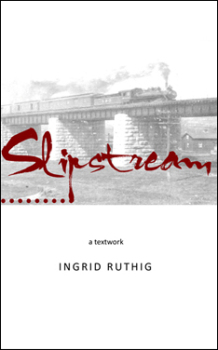
Microsoft Word - Artist's Book Cover in total.docMy good friend, Ingrid Ruthig taught me an important lesson about observation: the same thing can be different. The basis of her book Slipstream was a scene observed out of a window every hour on the hour for eighteen hours.

Try describing the same thing at different times of the day, different seasons. Notice what cell phone covers women or young people choose over older men. Don’t just notice a colleague’s scarf, notice how it is tied today versus yesterday. What colour is the asphalt when it rains versus a sunny day? What colour is snow? (it’s seldom white).

  1. Read people

Don’t just look at people in general, look for specifics: what makes them stand out or blend in. What actions and body language do they use to exude confidence or jealousy or nervousness? What can you deduce from how they dress or wear their hair or hats? If a couple looks unhappy, businesslike or best friends, can you identify what made you come to that conclusion? What is it about someone that makes you uneasy or willing to open your heart to them?

  1. Challenge your powers of description

How many ways can you describe something? What is it like? How many different similes can you come up with? How would your characters describe it? My husband and I try to find different names for the kinds of moons we see: wolf moon, rain moon, wishing moon… Do you always resort to sense of sight? Do you consider light and temperature, texture and mood?

piet-my-vrou

So what have I noticed today? I’ve noticed the three-note call of the piet-my-vrou bird is the first birdsong of the morning. That the pods of the weeping boer bean tree hang like fruit bats. That the blue-green iridescent loerie bird that flew overhead has red underwings, and the bark of the fever tree is yellow.fever-tree

That my sister’s dachshund dog is so portly that when he sleeps his legs stick out straight like roadkill. That the tortoise in the garden can devour half a watermelon in twenty minutes, and that my mother’s hair is the colour of history: iron, copper, silver and gold.

flower-15249_640And I’m waiting to see if, like the lilac Jacarandas, the red flamboyant trees will lose their blossoms in the storm that is now brewing on the horizon.

What did you notice lately?

Writing Room Worthy

Writing Room Worthy

Noelle Bickle

holding-hands-858005_640Four months after my mother’s death, I vowed her tireless efforts to inspire belief in my dreams and evoke courage in my endeavours would not die with her. As much as I’d always credited her as my biggest cheerleader, I hadn’t fully realized that my mother served as advocate for how I valued myself. She lifted my ego when it wilted—always reminding me that success was in the intention and enthusiasm to make good things happen—in both art and life.

I was determined to honour her by letting go of insecurities and self-doubt, but first I had to alter how I valued myself as a woman and artist. She always encouraged my individuality, creativity and connection with others. She applauded unusual concepts and imaginings. Losing my mother quite literally brought me to my knees, but it took those first four months to understand I was also grieving the loss of her ongoing reassurance.

I needed serious personal and creative recalibration, so I started exploring worth and how it impacts every aspect of a woman’s life. After almost a year of not writing or reading—a self-induced boycott of the fuel that had always fed me—I had a non-fiction book idea that sparked passion in both the intention and enthusiasm to make good things happen, and so it took hold.

An elusive life-write balance

A work of non-fiction was a first for me and a stray from the fiction I spent years practising. I was knee-deep now in reading, researching and workshopping—on worth itself and on the business of writing book proposals. As much as it motivated me, it also overwhelmed. I tried to carve out more hours at night, sandwiched with a short stint of writing in the morning before work. I’d sit at my kitchen table and plug away, but I felt scattered. Notepads landed on every flat space in the house, my kitchen whiteboard filled with workshop concepts alongside grocery lists. I didn’t want to lose my drive but I was starting to feel uninspired.

After a meeting with my writing critique group, one of the members came over for tea. I wanted her opinion on my recently assembled art-gallery-style wall in my bedroom—had I gone too far with the floor-to-ceiling display? I value Jessica’s opinion in many things—but she has super-human powers in organization, and each room in her century home looks like a gorgeous magazine spread.
laundry-basket

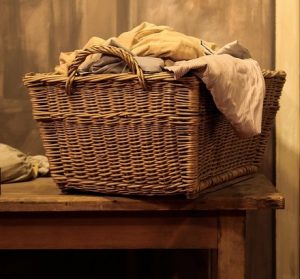
We spent just five minutes in my bedroom with few suggestions–not because she didn’t have a laundry list of further ideas, but because Jessica was far more interested in the spare bedroom across the hall. She asked what I used it for, and I sheepishly explained away the baskets of to-be-folded laundry, and a mass of odds and ends stockpiled in the corner.

My excuse—I wasn’t using it for anything else and could quickly shove things in closets if someone were to sleepover. She wasn’t interested in excuses; she was perplexed why I hadn’t utilized the room as a creative space for myself.

I didn’t have a reason. Frankly, I’d never had a creative space to write, and although I’d spent time dreaming of “She-Sheds” or one day owning a home with a grand studio space, I didn’t think to use this or any other spot in my home to carve out as my own, because I didn’t put stock in the fact that I deserved a space of my own.

I had excuses why it wouldn’t work—I might need the room, I didn’t have a writing desk, and I couldn’t afford to buy anything to make a great creative space. Jessica balked, and said if nothing else, throw an old table in there—all a writer really needs—in order to have a spot to write. A place to hide from regular life and to simply write. It was sage advice.

A writing room for under $100

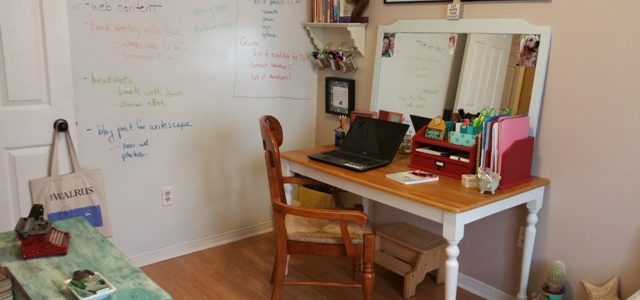
My writing room—as it stands—cost me under $100. It would have cost me nothing, but I envied the floor-to-ceiling chalkboard Jessica had in her writing room, and wanted one too. I decided on whiteboard paint instead, an easy choice more suited to me. I could use a multitude of rainbow-coloured markers, with far less mess than the chalk powder would leave on my floor. The whiteboard paint was $40; I needed two cans. The marker kit was $10. Voila – a fun mind-mapping canvas. Next item, I scavenged an old bedside table from a neighbour on garbage day. Short of tightening the legs which were a bit wobbly, it was a great wood piece. I painted that baby up pretty nice thanks to dollar store paints and examples on Pinterest. Cost me nothing.
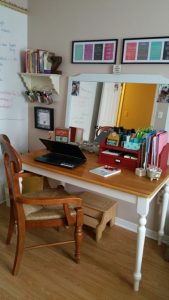
20161125_124217-resizeEvery other item in my writing room was already in my house. A 25-year old kitchen table previously stored unassembled in my basement serves as my writing desk. Every piece hanging on the wall, on my desk or a shelf was pulled from other rooms in my home – often hidden or tucked away, not being seen or enjoyed. I tore apart a journal that was filled with inspirational quotes and filled old frames that sat in my closet. I took an old shelf, three bucket-style herb planters that were under my kitchen sink, added some twine with a glue gun and bam—my whiteboard markers had a home.

I didn’t need to make it pretty—I could have had the desk alone—but I like pretty. I also like (almost) free. My room satisfies both. There is something about the space I created for myself—it gives me exactly what I need. Each item gives me joy, calm, or creative zeal.

Constant inspiration
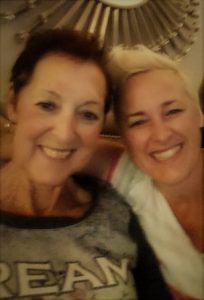
2015-09-28-noelle-her-mom-resizeI have only three photographs in the room—all adorn the mirror which runs the length of my writing desk (placed there so I can keep an eye on myself—one look and I can see if I’m working or playing, focused or distracted—it’s a clever trick, actually). The first photograph is of me and my mother, Norma, laughing. She always told me I was good enough, inspired me to dream big, and laughed at almost everything I said. I glance up at that photo when:

  • I’m deep in doubt and need a boost of confidence to believe in myself
  • I need the strength to just keep swimming
  • I need a helpful reminder to stop excessive late night munching while I write (thanks, Mom…you’re right, sugar only keeps me up later!)
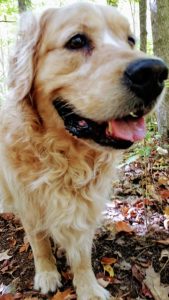
maalik-resizedThe second photograph is of my Maalik. Before he died just this November, my 9-year-old golden retriever spent hours at my feet under my writing desk, or lounged on the bed beside the desk, watching me spin in creative chaos. I would talk aloud as I mind-mapped on the whiteboard, or practised and timed pieces for readings or presentations. He would simply watch attentively and smile on cue. He was my first audience for every piece I ever wrote. He thought anything I wrote or said was brilliant, even when it wasn’t. I glance at his picture when:

  • I need to feel like I made a difference
  • I need calm
  • I need to feel like I do indeed have something worth saying


The last photograph is me, aged 4. I’m dolled up in a bright fuchsia kilt my mother brought from a visit back home to England. I’m positioned in front of her rose garden, my stick straight hair curled at the ends—an effort to make me look less unruly for the picture she’d send back home to family. At first glance, I look darling. At second glance, the jig is up. My hand is deep in my pocket, fingers waving out the bottom of the hem as a friendly cross-continent hello to family I’d never met. I’m grinning ear to ear, cheeky thing that I was. But somehow that is what how I endeared myself to my mother. She was that same age when she came across oceans to Canada, a very small girl on a very large boat. She was quiet and serious, intelligent and well behaved, but very timid. I was wild and rambunctious, often naughty and always playful.
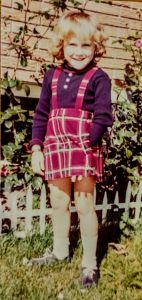
20161125-noelle-age-4-resizeAs little girls, we were very different. However, Mom loved books all her life—both as an escape and as a window to the world she lived in. That she passed on to me, an undeniable effort to make her children aware of the enormous impact of words. I can’t remember a time without books and all forms of writing as a main source of information, enlightenment and entertainment. I glance at that photograph when I need to remind myself:

  • that my strengths often come from being a whirling dervish
  • that life is supposed to be fun
  • that going pant-less has its perks

Over a few months, I’ve made little changes to my writing room, but it remains a creative space only—no bills, no school reports, no work outside artistic measures. I enter the room and get right to work. I don’t have to prepare or clear away the overflow of everyday life. When I leave my writing room, I become regular-life me and get to the daily grind. But in that 8×8 room, I find harmony and am inspired to create.

More than a place to work

Though a little disappointed that I didn’t give myself the gift of a creative space in the more than ten years that I’d been writing fiction, it is gratifying that I’ve finally invested in my work and am honouring my artistic self. I take myself and my craft more seriously because of it. I won’t ever land myself in a home again without somewhere to create that is mine and mine alone.
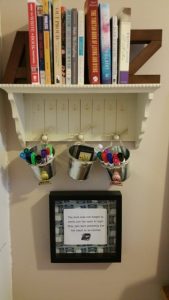
20161125_151622It doesn’t have to look like an office or a studio. I know a writer who literally created a space under her stairs—but it was hers. It doesn’t have to be magazine spread perfect, or be something to boast about. It is less about the space and all about the sanctuary.

Invest in yourself. Give yourself a sacred space to create. Whether you aim to be a published author or a lover who simply writes poetry to your muse. Regardless of whether you aim to be commissioned at an art gallery or someone who fills their own home with paintings rendered on dollar store canvases.

No matter what your creative goal is, don’t wait until you’ve reached what you deem as success to take your craft seriously. Be it a basement, a bedroom, a she-shed, or under the stairs—you are worth making room for.

Did you know:

Noelle is a writer, workshop facilitator, researcher and worth cultivator. She is currently exploring worth and morphing a non-fiction book idea into a women’s movement. Aiming to promote a nationwide surge in the well-being of Canadian women, Worth Cultivating: a women’s movement examines the commonality of women’s struggle to value themselves, and examines how each individual woman can recognize, cultivate and sustain self-worth.

Let’s prepare for a worth-cultivation movement. I guarantee—you are worth it.”  www.worthcultivating.com.

Noelle is represented by the extraordinary Carly Watters, VP and Senior Literary Agent of P.S. Literary Agency.


 

Purple Prose

Purple Prose

Gwynn Scheltema

In a course I teach on effective description, I talk about “purple prose” and invariably I’m asked what that means. To me, purple prose is writing that is so excessive, elaborate or flowery that it calls attention to itself and breaks the flow of the story. It’s usually recognizable by the excessive use of sensory detail.

But hang on…isn’t the use of sensory detail a mark of good writing? Absolutely! Using all the senses and painting with words through simile and metaphor makes for rich, engaging narrative. The operative word in my comment “usually recognizable by the excessive use of sensual detail” is the word “excessive”.

So how do you know what is enough and what is excessive?

Let’s find out by looking at this paragraph of purple prose:profile-461076_640

The pretty young girl sat delicately on the lush green grass under the old gnarled oak tree. The starlings sang excitedly above, and the air was filled with the perfume of wildflowers. Overhead the fluffy white clouds drifted gently, and the sun shone brightly in the blue summer sky. She felt happy. She turned coyly to the boy beside her and said hesitantly in her high sing-song voice, “Would you like a bite of this sweet juicy apple?”

At first glance, it seems to follow the guidelines for “good” writing. We have colour and sound and smells and textures. We have emotion and interaction. But for all that, it sounds amateurish. It’s awkward to read.

Here are five tips to recognize and overcome purple prose:

1 + 1 = ½

The first thing to notice is the proliferation of adjectives. When it comes to adjectives, I always say that “one plus one equals a half”. By that I mean that if you use more than one adjective to describe something, you dilute the effectiveness of each adjective. This happens, because the reader must process both adjectives separately with the noun it describes. The mind must process “the girl is pretty” and then “the girl is young”. It’s too much, and slows the reader down. In this paragraph, there are seven instances of this. (Can you find them?)words-1034410_640

Instead use just one adjective and if possible choose a stronger noun to convey the other descriptor. “Pretty young girl” could become “pretty teenager”. “Lush green grass” doesn’t need the word “green”, because “lush” says it all. Likewise, you wouldn’t expect a summer sky to be anything but blue.

Kill “descriptor” adverbs.

Note I said “descriptor” adverbs (my own label, by the way). I don’t condemn all adverbs. Adverbs like daily and often have a role to play in showing, time and frequency etc. by answering the questions of when? and how? It’s the ones that answer the question: in what way? that cause the problem. In our sample paragraph, “sat delicately” is a case in point. It’s much stronger and easier for the reader to process, if you ditch the adverb altogether and strengthen the verb to “perched” or “poised”. The starlings might “chatter” or “chirp” or “chorus” rather than “sing excitedly”. You could use a phrase like “the girl curled her legs under her”.

Swap out cliché.

A cliché is a descriptive phrase that once was a great way to describe something but which has been so over-used that it no longer has any effect on the reader except to draw attention to itself and pull the reader out of the narrative. This sample uses the cliché “fluffy white clouds”.dragonflies-1431304_640

It would be simple to say, “Find another way to describe the clouds,” and that would be valid, but I think it goes deeper than that. I believe that you should swap out cliché with details that are not already supplied automatically by the reader. If you mention a summer day, most people will automatically imagine blue skies, hot sun and fluffy white clouds. Pump up your writing by supplying a detail they may not imagine and therefore will notice, say, “a pair of tangled dragon flies”. Not only does this give a unique detail to the scene, it can also do double duty in mirroring or echoing the story thread of these two young people alone together.

Show Don’t Tell

Yes, I know, you’ve heard it before, but it’s true. This entire paragraph is tell. The reader is being told what everything looks like and what the characters are doing and how they are feeling. We are observers only, not participants in the story. We can only guess at the character’s thoughts and motivations.

This piece would be stronger if we saw at least some of the scene through the eyes and thoughts of one of the characters. That way, we get a feel for how the character feels, and this is heightened by descriptive details that the character would notice in that emotional state. Make the characters real. Give them names and thoughts and gestures.

To recognize “tell” look for places where emotions are named: “She felt happy”. Ask yourself: What does happy look like in this situation? What would she be thinking at this moment? What body language might she use? What sensory details would she notice?

Alice watched two dragonflies flit in a tangled dance near Robbie’s red face—whether from the summer heat or embarrassment, she couldn’t tell.

So what?

No matter how powerful the description, it has to have a purpose. Don’t describe for the sake of it, just to paint a setting. Always have a second purpose. As I said in my post Been There, use brief, targeted description to create atmosphere, to mirror emotion, to illuminate character or advance plot.

So let’s have another crack at the sample paragraph:

apple-1228374_640Alice curled her legs under her and lowered herself to the lush grass as close to Robbie as she could manage without startling him and breathed in the sweet smell of crushed wildflowers. Robbie closed his eyes and settled back against the ancient oak, folding his farmer-tanned arms behind his head. She watched two dragonflies flit in a tangled dance near Robbie’s red face—whether from the summer heat or embarrassment, she couldn’t tell. She hoped it was the latter. What now? Should she say something? But what? Above the chattering starlings seemed to egg her on. She reached into the picnic basket, swallowed hard and said in a voice she barely recognized as her own, “Want a bite of my apple?”

 Better?

Have a go yourself. How else could this paragraph be written? Paste your version in the comments below.

Agent Reality Check: 5 Top Things We Learned

Agent Reality Check: 5 Top Things We Learned

Ruth E. Walker

At our annual fall retreat, Turning Leaves, we always invite a special guest to offer a workshop and hold a fireside Q&A session. Usually, we ask an author to join us and our writers have been delighted by the insights and inspiration from our generous guests.

This year, we thought we’d try something different. We invited literary agent Hilary McMahon, Vice-president of Westwood Creative Artists. Come join us, we said.

hilarys-workshop-resizedAnd join us, she did.dinner-resized

From Friday dinner to Sunday breakfast, Hilary was a full participant. She delivered a wonderful Friday evening chat on the role and challenges of the agent and gave a great Saturday workshop on preparing compelling query letters.

We’re happy to share a few tips from the many she offered throughout the weekend:

1  Do your research:

Visit the agency website to get details on each agent’s submission guidelines, and the correct spelling of the agency name and the agent’s name. Pay attention to each agent’s information. You don’t want to send a query about your fabulous fantasy sci-fi steampunk graphic novel to an agent who only is seeking nonfiction manuscripts.

Go to book launches or read the acknowledgment pages of books similar to yours to find out who the agents are who represent those writers. See “Be strategic” at the end of this post.

2  Be professional:

Dear agent — you are writing to a person with whom you hope to have an important relationship, so use their name. But remember that this is a professional relationship, so no first names here. And get that name right. Hilary’s has been sent queries with another agent’s name in the salutation…a copy-and-paste oopsie!

Submit a clean query and clean sample in manuscript format without any typos or grammatical errors. Hilary was clear: it all affects how the agent views your manuscript in comparison with the 500+ others received that year. No agent will ask for the full manuscript if your query doesn’t demonstrate you can write well and convey the flavour of your style. And for the same reason, your writing has to be the best possible writing you can submit. See “Be ready”…

business-19148_640Last, but not least, daily follow-up calls and emails will likely ring warning bells for any agent — it’s annoying and the sign of someone very, very needy. Sure, you’re on pins and needles waiting, but give the agent some time to get to your query.

But Hilary says that if you have a valid reason for a follow-up email, by all means fire away. Valid reason? If you receive a writing award or grant, follow up. If you have a short story coming out in a literary magazine or national publication, follow up. In short, if you have important writing news, follow up. An agent will want to know.

3  Be ready:

It’s a competition and most agents receive hundreds and even thousands of queries each year. Of those, a few dozen get chosen to submit their work. Of those few, even fewer get picked for a second or even third read. Of those, one or two may get a contract. So when an agent asks for your full manuscript, you want to have something that’s polished and ready to submit.

4  Be realistic

A contract with an agent does not equal a contract with a publisher. Agents don’t earn a penny until you do, so naturally a good agent will be working hard to secure the best possible publishing deal. But it’s a tough climate right now, especially for fiction. Hilary talked about having manuscripts that she absolutely loved but nonetheless, couldn’t land a publisher that felt the same. But she offered hope when she recounted the story of one writer. She couldn’t land a home for the writer’s first manuscript but secured a publisher for the next one.

5  Be strategic

system-954972_640An agent can represent a writer for many years. Like a marriage, it is an important kind of partnership, so you want that relationship to be strong and effective. You want an agent who really likes (loves!) your manuscript, and believes in you and your creative ability. Someone you can work with.

So, this is more than just “Do your research.”  Think carefully about who you send your query to. A top literary agent would be a great coup but you will be competing for attention with international bestselling authors. Would an intermediate-level agent have more room and time to focus on developing your career? What about a new agent? They might be even more high-energy on your behalf…but does that agent have the contacts in the publishing field? And the same goes for the agent’s agency.

We know that landing an agent is a goal of most writers, so isn’t the point to get one? Of course. But our weekend with Hilary McMahon gave us plenty to think about and we all left with at least this one piece of advice. The point may be to get an agent, but an even better point is to work at getting the right agent…at least the right agent for you.

Did you know…

Registration is now open for Spring Thaw 2017, our all-inclusive retreat at Elmhirst’s Resort on Rice Lake in Ontario, April 21 to 23, or 21 to 25. Receive feedback from both Gwynn Scheltema and Ruth E. Walker on 10 ms pages submitted in advance, as well as one-on-one consultation on your writing project.

writing-427527_1920Morning warm-up exercises and follow-up private discussions in the afternoon offer support when and if you need it.

Private room accommodations in cozy lakeside cottages: wood-burning fireplaces and full kitchens stocked for in-cottage breakfasts. Join the group for lunch or take it back to your cottage if you’re on a roll. Relax in the casually elegant dining room for candlelight dinners.

Stay for 3 days or Extend Your Pen for 5 days. Either way, you escape to write…with Writescape.


Lights, Action…TV interview primer

Lights, Action…TV interview primer

Ruth with Tom Taylor on Readers & Writers, Rogers TV

Ruth E. Walker

I used to imagine what it would be like to be interviewed for TV. I knew I’d be nervous. And I still am…each time. But being prepared in advance was my key to surviving and appearing calm.

There are differences between a live and taped production, (in a taped show, you can make horrible mistakes and they can edit them out…usually) but the basics for both scenarios are the same.

Look good

You are pretty much on your own for hair, makeup and wardrobe. So choose your “look” well in advance.

charlie-chaplin-898308_640Dress to keep the attention on the conversation. Avoid plaids or busy stripes/polka dots. Lots of fringes. Clunky, dangling jewellery. Super shiny fabrics. Clothing gaps (think too tight, too short, too low cut) or baggy outfits. (and fellas, if you think I’m just talking to women here, think again…)

Shine your shoes. Maybe the camera won’t pick them up but good heavens, everyone in the studio, including the host, will see those mud-spattered runners.

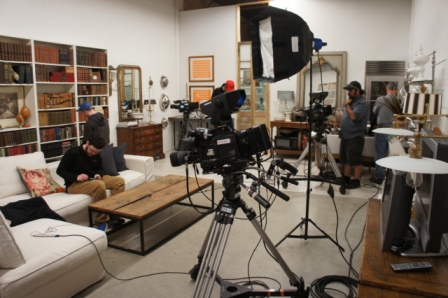
On the Telling Stories set with host Jules Carlysle

You will likely be wired for sound. Commonly, a lavalier microphone clips onto your clothes somewhere around your upper chest. The wire hides inside your clothes and the transmitter (a small box unit) is clipped somewhere on your back, out of view. Easy peasy if you wear a suit jacket or sweater. Remember, production staff need to snake the wire through your clothes.

Take a minute in the washroom when you first arrive at the studio to make sure that cowlick is behaving and any loose hair/dandruff is brushed off your shoulders. Washroom quiet can also help calm your nerves.

We all have certain physical tics—I clench my jaw. These tics intensify when you’re nervous. Practise being relaxed in front of a mirror, hands in your lap or gently active when emphasizing a point. Maintain slow and easy breathing. Bring that attitude into the studio.

Telling Stories host Jules Carlysle & guest poet Ingrid Ruthig

Keep your focus on your interviewer; don’t look around the studio or directly into the camera—even a quick glance away can be distracting. If you need a break, look down at your book on the table or at your hands in your lap.

Yes, I said your book on the table. Remember always to bring it along. And if you have any attractive promotional material, such as an upright banner or portable book display unit, ask in advance if you should bring it to the studio. On Jules Carlysle’s Telling Stories (Rogers TV), a children’s author brought along a colourful display that showcased her series of books for young readers. Effective!

Be professional

Be on time. Better yet, be early.

Television production is costly and a late guest is never appreciated—especially for live TV. But if something happens to delay you, make sure you have the production team’s number to call or text.

Email in advance any important information you want the host(s) and the production team to know and/or promote:

  • your full name and contact info: website address, social media, telephone, etc.
  • date, time and place of next book launch/appearance, etc.
  • bookstores that carry your book
  • the name of your book and publisher

Remember to bring a hard copy of all these details with you, in case

hand-226358_640Say thank you. You are an invited guest to the program, given an opportunity to speak publicly and provided with an audience. Of course you say thank you. If you have book published, give a copy to the host(s).

I still get people recalling various times I’ve been interviewed on TV so be assured the power of on-screen promotion has long legs. All the more reason to appreciate each opportunity.

Know why you are there

You are there to showcase or sell something. So be prepared. Think in terms of images and metaphors—sound bites create quickly recognizable images/ideas in the viewer’s mind.

“My book is a quest story with a modern twist.”

“Writing is easy; it’s the editing that slows me down.”

“When I sold my first story, the kids had to peel me off the ceiling.”

ariadna-oltra-883879_640Most televised shows have a specific focus. Daytime shows are generally informational with an upbeat tone; if there is more than one host, there’s friendly banter and lots of smiles. Feature interviews (single host; often longer interview times) are also themed. An arts-themed show will have an arts-focused audience. A TV program that features historical writers…well, you get the point. Know before you go: what are they looking for? Do your best to provide it.

megaphone-1480342_640Same goes for you. You have a focus: is it selling your latest book? Promoting a diverse body of work? Look for opportunities in the interview to use those practised sound bites:

“Yes, it was a challenge writing the book. That’s why I’m gratified that so many bookstores have “My Book” on their bookshelves.”

See? Sell yourself. Easy peasy.

Did You Know: 

Ruth’s interview with Jules Carlysle will be broadcast on Rogers TV in Durham Region:

Tuesday, November 15 – 1:00pm, 4:00pm

Wednesday, November 16 – 10:30am, 12:30pm, 3:30pm

Thursday, November 17 – 11:30am

If you watch it, see if she managed to look calm or if her nerves betrayed her. Jules is a charming and excellent host and Ruth enjoyed the opportunity very much.