

Gwynn Scheltema
Seems like a simple question, but increasingly these days it can be confusing. Genres not only have subgenres, but subgenres have sub-subgenres: Steampunk is a sub genre of science fiction (or science fantasy) but steampunk itself has sub genres like steamgoth, gaslight romance, clockpunk and dieselpunk.
Then of course, you have the age cross-overs and cross-genres like paranormal romance, crime fantasy, or action comedy.
The mind boggles.
Why does knowing your genre matter?
 Initially, it doesn’t matter. When you begin your first draft, story is key and the story will land in the genre it fits best. But once that draft is done, knowing your genre is important. You’ll need to know so you can fine tune your manuscript and pitch it to the right agent or publisher.
It’s a marketing issue. How many places will your book fit? Knowing your genre shows a better understanding of the market, which can only help your submission. If you don’t know where your book fits, you’re saying you don’t know your target audience.
We all like to think that our book is unique, but the reality is, if we can correctly categorize it, readers can access it and agents and publishers will know immediately whether it potentially fits their market.
Genre and editing
And because knowing genre is a marketing issue, it becomes an editing issue, so you can mould your submission to fit publishing needs and reader expectations.
 Let’s take the crime/mystery genre as an example and the typical “dead body”. In a cosy mystery, your readers will expect to spend a few chapters meeting the inhabitants of a cosy community and getting to know the protagonist and her friends before the “dead body” is discovered. The actual killing will be off stage. In a police procedural mystery, the “dead body” is there by the end of chapter one. Readers may even witness the murder. It will be important to follow real police investigative and forensic procedures.
Some publishers have well-defined expectations that can help tremendously at this editing stage. Harlequin, the world’s largest publisher of romance, provides clear, detailed guidelines on their website for each of their genre imprints, from the word count to the level of sexual content.
So what is my genre?
Genre definitions are constantly changing and evolving, but you have to start somewhere.
 1. Prepare a book jacket blurb
Once the first draft is done, prepare a book jacket blurb (the paragraphs on the back cover that entice readers to buy because they answer the question “What is this book about?”.) Writing the jacket blurb helps to distill the thrust of the story: the conflict, the stakes and the character arc.
It also helps define what genre it is, because it focuses on the main thread of the story.
2. Define the main genre
 With your book jacket blurb in hand, you have your main dominant story thread. Use that main thread to define the main genre. For instance, if your book involves a mystery and a romance, is the dominant story thread a classic “who done it” with a bit of romance thrown in for character growth? (mystery) Or is it really about a relationship blossoming between two people who happen to be solving a mystery together? (romance)
Here’s a list of some of the main genres to get you started:
- Action/Adventure — epic journeys, lots of conflict/pursuit, high stakes, some violence.
- Crime/Mystery — stories that involve solving a crime, usually a murder.
- Fantasy —magic, other worlds, myths and mythological/mystical figures.
- Historical — fictional characters and events in an historical setting
- Horror— stories that invoke dread or fear.
- Thriller/Suspense — harm/danger about to befall a person or group and the attempts to evade the harm/danger, high tension.
- Romance —love/intimacy/relationships.
- Sci-fi —impact of technology, aliens, science-related alternative worlds, often futuristic
- Women’s fiction — stories about women experiencing emotional growth
Once you have your main genre, you can explore subgenres. This link on the definition and characteristics of the main genres is worth looking into.
3. Define your reader
 Nail down the age group your book is aimed at: children, young adult, new adult or adult. If your manuscript appeals to more than one group, you have an age cross-over. (Think Harry Potter (children/adult) or Hunger Games (YA/adult).)
Imagine your ideal reader. If you were that reader looking for your book, where would you look? Again, focus on the main narrative thread. Is your ideal reader looking for a romance with a bit of mystery thrown in, or are they problem solvers who like mysteries and might like some relationship stuff thrown in?
Ask your beta readers where they would expect to find your book. Ask your critique group. Tell other writers your blurb and then ask them, “What section of a bookstore would you look in to find my book?”
4. Visit a book store
Go to a bricks & mortar bookstore or hop on the Net. Identify half a dozen books similar to yours and find where they are shelved. Go to Goodreads and check the Listopia recommendations for your main genre, like “Best Science Fiction.” That will lead you to the sub-genres like “Best Steampunk Books.” Read the blurbs on the back covers. Does your book jacket blurb follow a similar pitch?
 One way to do this is to have two windows open, one on Amazon and the other on Goodreads. Read the blurb on Goodreads and then search the book on Amazon to see its classification.
I always like the section below the “purchase” button with the phrase “People who bought this also bought….” It’s a great way to find other novels that are categorized the same way. Could your book fit here?
Still not sure?
You’re fine as long as you know your main genre and reader age. Agents will be able to spot a crossover even if you haven’t mentioned it. If your query letter has a good hook and good comparables, the sub-genre will be apparent to them.
However, the time you spend on defining your genre will help you make a better connection between your story and your reader. And your well-crafted blurb will be ready for those moments when someone (maybe an agent or publisher) asks “So what are you writing?”
DID YOU KNOW?
Vicki Delany, our guest at this year’s fall retreat, Turning Leaves 2017, writes in several subgenres of the crime/mystery genre. As Eva Gates she writes the cosy Lighthouse series, and as Vicki Delany she writes a Police Procedural series featuring Constable Molly Smith.






 “Yes, Virginia, there really is a National Punctuation Day!”


 The use of humour reminded me of a poetry book I had as a child called
  //
// //
// //
//
 The willow’s music is like a soprano
 Whatever you want to say,
 In just ten years, Vicki (also writing as Eva Gates) has more than 20 crime and mystery novels to her credit .
 Mystery novels really do fill the spectrum from light and fluffy to very dark indeed. Something for everyone in fact. Darker crime novels, such as psychological suspense, show the human psyche under pressure.
 At the moment, I’m writing mostly cozy books. Cozies are all about friends and family and community. The tone is much lighter, there is never any real danger to the main characters, and not much in the way of tragedy or angst. Sometimes a little dash of romance, but the friendships are all important. People love these books because they come to love the characters and the town they live in. And the food. Food and books are often important in cozy novels.
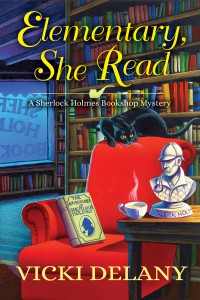 The hig
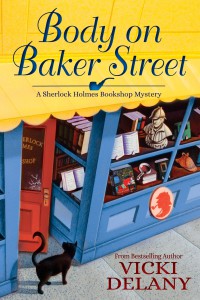 hly perceptive Gemma is the police’s first suspect, so she puts her consummate powers of deduction to work to clear her name, investigating a handsome rare books expert, the dead woman’s suspiciously unmoved son, and a whole family of greedy characters desperate to cash in on their inheritance.
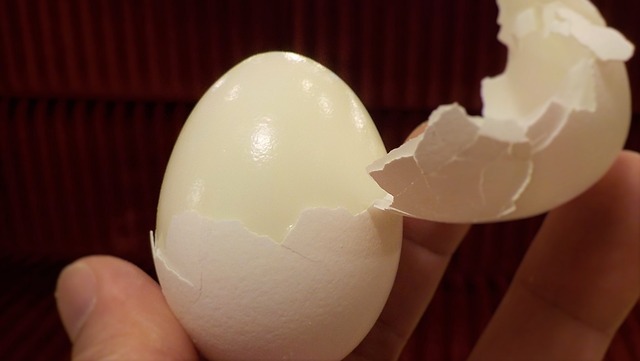 Then it’s time to start to write. I walk into the dining room and stand at my Netbook computer which is on the half-wall between the kitchen and the dining room. As I pass through the kitchen, I put one egg on to boil. (In the summer, I might sit outside on the deck). I always write, standing up, on the Netbook. I read over everything I did the previous day, doing a light edit as I go. I then take my egg into the study and eat it while checking email.





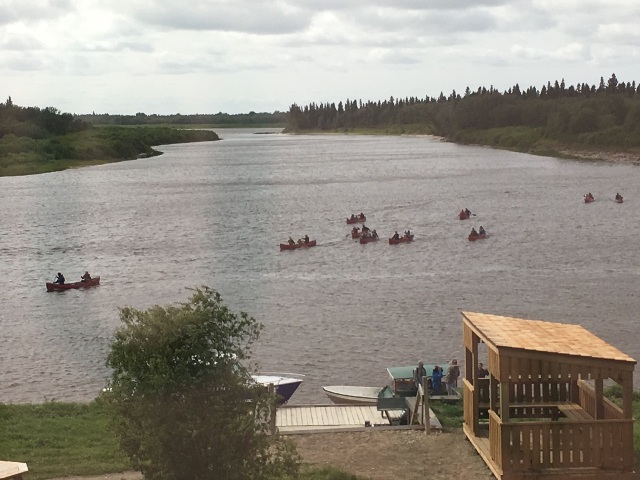


 There are many things you can do on your artist’s date. Because our creative brain is a sensory brain, anything that stimulates the senses or fires up the imagination will work: a walk in the park, making soup, lying on your back and watching clouds, going to a food or music festival. It doesn’t matter as long as you do it mindfully.
 This Crime Writers Festival showcases nine Canadian women authors of crime and mystery. On Friday evening at “The Mysterious Affair,” a table-hopping event introduces each of the authors in turn:
 Often when you begin writing about the subject of the prompt — say swimming in a lake — it can take you somewhere else — say an experience of drowning or crab baskets in Italy or how your father never believed in taking vacations. Go there. Forget the prompt and go where the energy is.
 Switch it up
 Write what you know
  Be specific
 Lists
Lists
 ok
ok  If writing is important to you, it needs to be built into your routine in the same way that you build in any other important activity in your life. If you need to schedule writing time like dental appointments, piano lessons, or hockey practice, do it. Think of writing as your “job” and block out set times like you would if you were going to work.
