Little Libraries

Little Libraries

Gwynn Scheltema

I love libraries. I even have a Pinterest board of book spaces and libraries. But I have a special fondness for little libraries; libraries that make the effort despite situational difficulties or lack of resources.

Perhaps it’s because during my childhood, there was but one small library in town, a long car ride from my rural home. Nonetheless, my parents made the weekly trek every Saturday morning, where I chose my six books for the week (the library max). It didn’t take long to exhaust all the books in the children’s section, so the librarian gave me special permission to borrow books from the adult floor. What a treat!

Little Libraries

I especially love “pop-up libraries” or “little libraries” on people’s front lawns. I love that people have taken the time to make them, to stock them with free books, and to trust that other book lovers will use them. This one at the end of my street is nestled in long grass and the sign inside suggests that you take a book, swap a book or donate a book.

This summer, on a visit to Stratford I noticed that there were several little libraries in one neighbourhood and a closer inspection revealed that they were all connected through LittleFreeLibrary.org and each had a “charter number”. Why an organization, I wondered. Were there rules? Expectations for what I thought were purely random, personal fixtures?


The Little Free Library organization

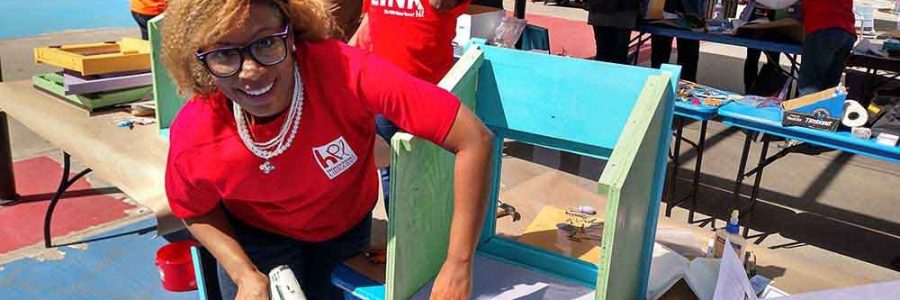
Turns out, there are no “rules”. The organization exists to spread the concept across the world and to support those who want to start a little library. They maintain a world map of registered Little Free Libraries to help people find and share books and donate Little Free Libraries to communities where books are scarce through their Impact Library Program.

If you want to create a Little Free Library, the organization offers free Library building instructions, access to free or discounted books through their partners, and an online store that offers Library kits and pre-built Library models.

A global movement

There are currently more than 75,000 registered Little Free Library book-sharing boxes in 88 countries worldwide.

This funky little mushroom-shaped kids Library is installed at Grant Place Reserve playground in Flinders Park, Australia. The builders of this library say, “Our ‘Reading Spots’ give a fun place for kids to read in an awesome playground! We did some fun community art with the kids when we launched the Library, and we put a fabulous sign up on the fence.”


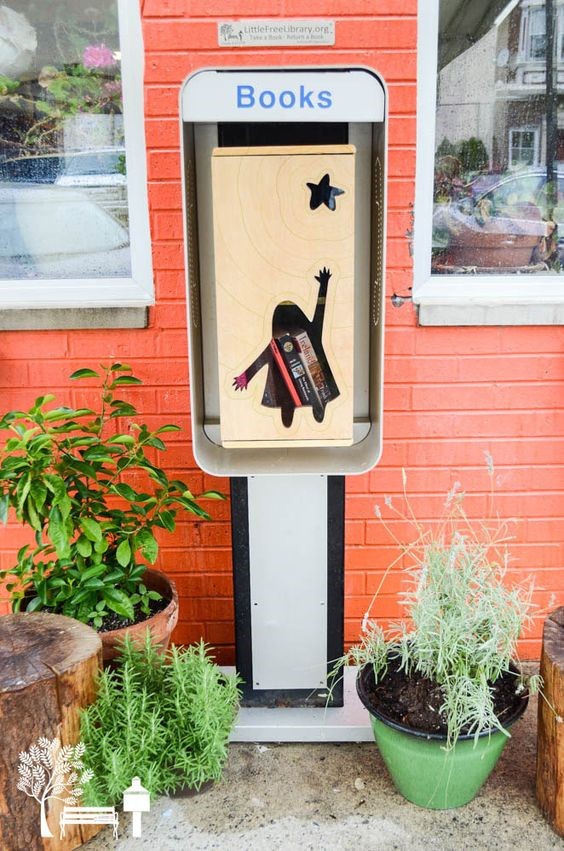
In Philadelphia, Pennsylvania teacher Johnny Buckley felt that abandoned pay phones could take on a new life of storytelling by transforming them into Little Free Libraries for pre-schoolers.


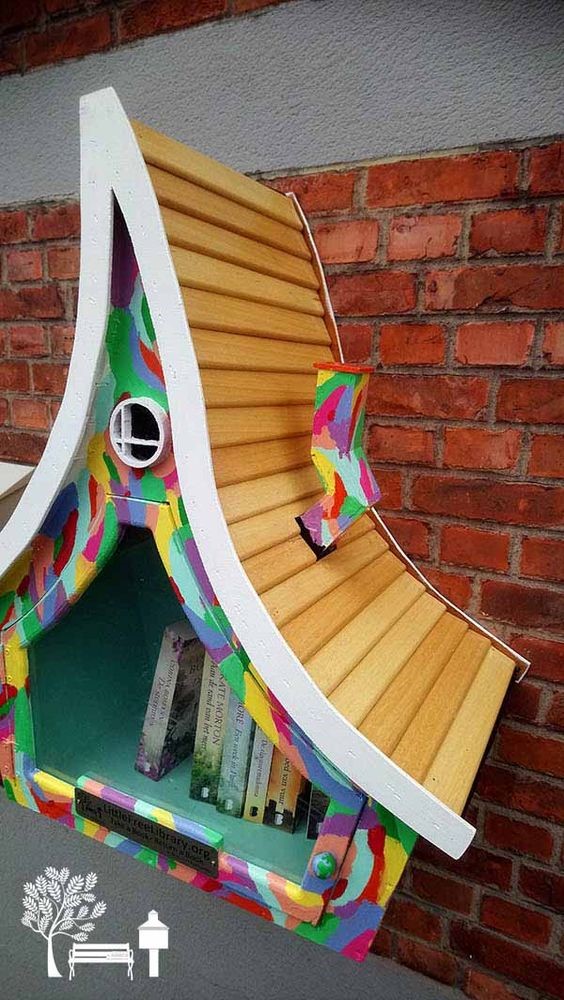
And across the pond in Oostakker, Belgium, the makers of this Little Library say, “The model fits our house perfectly, because our house is a hundred years old and has no straight walls, just like the Library. It has the charm of a place with a soul. It reminds us of our childhood, too, with all the colours.”


 Do it your way.

Of course there are many more unregistered Little Libraries everywhere. If you are considering making a Little Library, how you construct it, the books you stock it with, and whether you do it as an individual or in community doesn’t matter. What matters is that more books become available to more people everywhere.

If you prefer to simply use and enjoy Little Libraries, that’s fine too. Happy reading!


10 effective ways for characters to describe themselves

10 effective ways for characters to describe themselves

It’s Writescape’s 10th anniversary and we have lots of excitement planned for writers in 2018. This installment of 10 on the 10th is the latest in the series of monthly writing tips, advice and inspiration. Think of it as Gwynn and Ruth sitting on your shoulder and nudging you along. Share with your writing colleagues and encourage them to sign up for more.

How do you get readers to know what your main character looks like? Put your character in front of mirror and have them “notice” their almond-shaped eyes and cute dimples? Really? Sure, use that cliché if you want your readers to roll their own eyes and toss your book away.

There are much more effective ways to introduce descriptive qualities for your main character but first you need to make some important decisions.

Start with deciding what, if anything, you need your reader to know. And then get ready to get those important details delivered as soon as possible. Opting to bring in character description at Chapter 9 will only serve to annoy your reader because they will have already imagined what that character looks like. But avoid overloading the first few pages with description. Sprinkle it in, like a mild spice.

Like any good spice, character description should be subtle and give readers a glimpse of a character’s personality, skills, lifestyle, etc. Add to the story with character development or plot points: thick glasses, so does your character miss an important small detail? Long unruly hair covers the embarrassing childhood scar on his forehead?

Here’s ten ways to introduce character description without using a mirror:

1. Outside Observation: use another character to reveal details: All these months working beside you, I never noticed your green eyes. Or: That shade of pink really complements your peaches and cream complexion.


2. Closet Choices: when meeting someone they want to impress (are afraid of/are attracted to) they might think about their appearance and what effect it may have: He looked every bit a CEO. Would my gypsy skirt and Birkenstocks destroy the image I’d built up at the office?

3. Family business: try a comment directed to a family member on how alike or different they are. Sister — you may be lean and mean, but I like to think my ample figure speaks of kindness and warmth.

4. Action Figures: insert description as part of the action that adds to the mood – frantically rummaging through a drawer looking for the perfect sweater for a blind date or methodically polishing shoes before a big event;

5. Get Physical Part 1: choose to be indirect by describing another’s action — Jimmy easily handed me the file from the top shelf. “Here you go, Pintsize,” he said with a grin.

6. Get Physical Part 2: do it indirectly by describing an object: The box might be small but it was way too heavy for me to lift.

7. Use Science: do it by describing what physics allows them to do: With my height, swinging that broadsword through the fool’s neck would be childsplay.

8. Status: use profession/occupation – There was no point in brushing away the flour from my pastry chef uniform. My tailored suit was a stark contrast to the backyard full of jeans and sandals at this bbq.

9. Laughter: joke about it – most of us deprecate ourselves. Sure, I can have a second piece of cake. Especially if I want to add to the spare tire around my belly.

10. Self Aware: acute self-consciousness can be effective — I longed to grin back at him, but pressed my lips together instead. No way he was going to see my gap-tooth smile.

Often, the most powerful description is a trigger for an emotional reaction in your reader. A flaw or peculiarity can evoke empathy, raise questions and/or reveal your character’s humanity. After all, feeling connected is a big reason why we love stories and the characters we meet within them.

Acorns

Acorns

Two-time Governor General Award winner, author of 7 books and our delightful guest author at our 2015 fall retreat, Caroline Pignat shares an epiphany on her creative process. As anyone who was at that retreat can tell you, Caroline was pure inspiration and what she has to say as our guest blogger continues to inspire:

A few years ago, I started collecting acorns on my morning walks. It became a thing to find that perfect seed: that cute little nut capped in its tiny beret. As a kid, I always loved acorns: the look of them, the weight of them, the wonder of holding the promise of an oak in my palm.

Acorns, to me, were like ideas, so full of possibility. I fancied myself some kind of modern mystic (read:  hoarding squirrel) as I collected them in the jar on my desk. They were the perfect metaphor for my creative potential. Still, like most ideas found and treasured as I walked, these little seeds were soon forgotten in the busyness of my days.

Until the maggots

Yes, maggots.

“Umm…why do you have a jar of maggots on your desk?” my young niece asked, in a mix of wonder and disgust. Sure enough, she was right. My poetic potential had become infiltrated with a mass of wriggling, white worms.

Worms!

On my desk!

The horror! I wish I could have given her some inspired response. It’s a science experiment? Novel research? Pets? A snack? Any one of those answers would have been better, I suppose, than admitting that all this time, I did not see what was wriggling before my eyes.

With great dismay and even greater heebie-jeebies, I tossed the lot into the woods behind our house. So much for my profound metaphor.

But now that I think of it, my little acorns taught me another truth. Ideas, like seeds, are not meant to be hoarded. Sure, there is something comforting in filling files and notebooks with ‘what ifs’, plots, and projects. I sure feel productive squirrelling ideas between the covers of my journal.

But then… what?

I have to actually do something with that seed. That creation, invention, process, product, insight, voice — that inspiration — whatever it is, I have to let it go.

Why is that so difficult?

Maybe it’s because I like feeling the weight of its potential in my pocket. I could plant it here. I could plant it there. This could be the next big thing. That sense of could-ness makes me feel all powerful. In seed form, that idea doesn’t have to face the axe of rejection or ridicule. In seed form, perfection is still possible and so I like to hold on to it just a little longer.

But as I learned, nothing good comes from hoarding ideas — and that’s the cold, wriggling truth.

Sowing that idea takes courage. The courage of letting go. The courage to be patient and to trust in hidden growth, when all I see is dirt. Anxiety and doubt threaten to choke all hope, especially during those times when it feels like all I am growing is impatient.

Planting more seeds

And here’s another thing my acorn taught me: I’m an idiot if I think by will or worry I can make it grow any faster or become what it isn’t. I’m finally coming to realize that there is a natural process, cycles and seasons to my creative self. Just as there is a natural process for every seed of an idea.

Of course, I wish each one will sprout into a mighty oak,  but the truth is many will never quite get their moment in the sun. Some will languish in the shadow of someone else’s great idea. And more than I’d like to admit, are just duds destined to rot away.

But, you know what? I’m finally okay with that. I’m starting to realize that even the duds serve a purpose. Often they make the fertile ground for a new premise to flourish.

So to you, maggots, who wriggled your way into my writer’s block and opened my horrified eyes — thank you, I think. Thanks for helping me learn to seek, sow, and let it go knowing there are always more acorns waiting on the path ahead.

About our guest blogger:

Caroline Pignat is a teacher, a two-time Governor General’s Award winner, and a best-selling author of seven novels, including Egghead and Shooter. Known for her lyrical style and varied forms, Pignat explores the cycles and seasons of life through acrostic poems in her latest release and first picture book, Poetree. 

She has written teachers guides for many books including her own novels, EggheadGreener Grass, and The Gospel Truth.  In her upcoming Poetree Activity Guide, Pignat offers resources for nature journalling and poetry with students. Links to these free downloads at  www.carolinepignat.com

Writescape was delighted to host Caroline as our guest author at Turning Leaves 2015. She brought her excellent workshop skills and generous spirit to the writers on retreat with us. This year’s retreat is November 2- 4; there are still a few spots left to join guest author Andrew Pyper and Writescape for another inspiring writers’ weekend.

Photo: Angela Flemming

Copyright Advocacy Update

Copyright Advocacy Update

We writers know the power of words to influence others. I can attest to that working on a political level for fifteen years in the communications field in provincial government. I saw how various letter writing campaigns influenced government ministers to consider, reconsider or revise policy decisions.

We also know that the issue of copyright is so important for all writers and artists, and a simple letter could make all the difference.

Below, we share with you the latest update from Access Copyright, sent out to all Access Copyright members on August 14, about the parliamentary review of the Copyright Act, and how you can help. Please read, share and submit your story to the members of the review committee. It matters for all writers and visual artists…including you!

If you are not sure what the review is all about, read our previous blog Copy that! that explains it all, and the blog on the first update in May.


From the Access Copyright email:

Access Copyright Makes its Submission for the Copyright Act Review

Last month, Access Copyright made its official submission to the Standing Committee on Industry, Science and Technology for the Copyright Act review.

The submission details how creators and publishers have been severely impacted by the actions of the education sector following the passage of the Copyright Modernization Act in 2012 which included the addition of “education” as an allowable purpose under fair dealing.

Our submission makes two key recommendations to parliament.

1. Amend the fair dealing exception to distinguish between individual and institutional copying. We recommend amending the Copyright Act so that fair dealing for the purposes of research, private study and education would not apply to educational institutions in situations where works are “commercially available” by either a rightsholder or collective within a reasonable time and for a reasonable price and may be located with reasonable effort. This would help facilitate teachable moments without adverse consequences to rightsholders, while also bringing Canada in line with models in other countries such as the U.K. and Australia.

2. Take immediate action to harmonize the statutory damages available to collectives as part of the current efforts to reform the Copyright Board of Canada. Doing so will deter infringement, encourage settlement and, in line with one of the key goals of the reform to the Board, “will ensure creators to get paid properly and on line.”

How to get involved in the Copyright Act review

Here are two actions you can quickly take to ensure the momentum that creators and publishers have built in having their concerns heard by policy makers will continue.

Make a submission to the Industry Committee: The Committee welcomes submissions from individuals and businesses. A one-page letter outlining how your income, career or business has been impacted will help reinforce how Canadian creators and publishers have been affected by the 2012 changes to the Act.

Submissions can be filed by email to: indu@parl.gc.ca. We can help as well. Email us at editor@accesscopyright.ca for more details.

Take Action via I Value Canadian Stories: If you haven’t already, please visit IValueCanadianStories.ca to send your letter to the Committee members conducting the Copyright Act review. You can also engage your friends and social-media followers to take part as well.

Every action you take makes a difference.

Important Dates

  • August 31 – The deadline for publisher affiliate to submit a claim for this year’s publisher repertoire payment.
  • November 1 – The deadline for event-grant applications for the Access Copyright Foundation. The application package will be available soon on the Foundation website.
  • November – Payback payments will be distributed to creator affiliates.
  • December – Publisher Repertoire payments will be distributed to publisher affiliates who submitted a claim by August 31.
Back to School: Kids Play?

Back to School: Kids Play?

Ruth E. Walker

Wasn’t it just the other day that all the retail signs announced: Get Ready for Summer!

I just blinked and now what do they say? Get Ready for School!

Once I got over depressing thoughts of our vanishing summer, it got me thinking. Some years back (many years, in fact) I decided it was time to return to school. A high school dropout, I’d left the workforce and a developing career in the human resource profession to stay home with my young family. Getting back into the H.R. game would be tough without a university degree; a sociology or psychology major would be best, I thought.

But I was a bit scared so decided to at least start with something I really liked. English. Books are good. And reading. And talking about books…about reading books…books…

Fast-forward a couple of dozen courses later and somewhat longer years of evening and summer classes at Trent University, Durham Region Campus, and I had my degree. And no, not sociology or psychology.

English. And darn-near a minor in Cultural Studies. Even better: I graduated on the Dean’s List.

What I Learned in School

Study what you enjoy. And be open to stepping beyond what you know you’ll enjoy.

I took an Introduction to Anthropology. In the course catalogue, it all sounded a bit “sciency” but a lot of it focused on the past, so, because I like history, I risked it and I loved it. I even considered changing my major.

During the section with a biology focus, I held a plaster cast finger bone of the famous  “Lucy”, Australopethicus afarensis. Discovered in 1974 in Ethiopia, this hominid’s skeleton is about 3.2 million years old. It blew my mind and created a connection that inspired a thrice-published poem, Lucy’s Bones from Afar.

I didn’t know it at the time, but the next section on archaeology was great grounding for my final course before graduation on Greek and Roman Mythology. And from that course, I found my way to a series of poems and flash fiction, powerful characters and a novel that continues to simmer on the back burner.

Suffice to say that just one course outside of my English Literature comfort zone affected my muse, inspiring characters, poems, themes and plots in much of my future writing. I didn’t stop with Anthropology 101: Cultural Studies, Women’s Studies, Ancient History and yes, even a sociology course or two peppered my learning. By the time I graduated, I’d explored far beyond Shakespeare and sonnets.

Continuing that Education

I’m not suggesting that writers need university courses for success. That choice worked out well for me but not because I started out thinking about a career in literature. And it isn’t the only choice that had a profound impact on my writing.

Over the years, I’ve taken more than one writers’ workshop that inspired new and exciting work from me. I had mentors that gave me new perspectives. And there are many books on writing that took my craft on deep and engaging journeys.

Learning for all of us is on offer from a multitude of options: mentoring, workshops, private retreats, resource books, conferences, and so on. But not all conferences or workshops need to be about “writing.” And not all resource books should follow a familiar or safe path.

Some stretching into the unknown can help you reach new heights. It certainly did for me.

10 Great Books on Writing

10 Great Books on Writing

It’s Writescape’s 10th anniversary and we have lots of excitement planned for writers in 2018. This installment of 10 on the 10th is the latest in the series of monthly writing tips, advice and inspiration. Think of it as Gwynn and Ruth sitting on your shoulder and nudging you along. Share with your writing colleagues and encourage them to sign up for more.

The best advice for writers is to read, and read widely. Dip your toes into styles and genres you don’t normally read and take note of how those writers crafted their work.

But you also need to read books about writing. Writing is a solitary act but it doesn’t have to be an isolated journey. Books that explore the craft and practical considerations of writing are great companions along the writer’s path. This is a list of 10 of the books that helped us at various stages of our writing expeditions.Obviously it is not an exhaustive list, just a toe-dipping exploration.

Writing Down the Bones Natalie Goldberg. Gwynn’s first “writing book”, she’s reread it many times, as well as Goldberg’s other books in a similar vein Wild Mind and The True Secret of Writing. Writing Down the Bones helped Gwynn get her head around being a writer and trusting her muse. Nathalie’s Writing Practice method (like freefall) showed Gwynn how to go deep into her subconscious to find the good stuff.

A Passion for Narrative Jack Hodgins. It’s been around since 1991. And, sure, it’s meant for developing writers. But Ruth won’t ever let it go because it is the book that moved her from writer to WRITER. To quote her: It was like having him on my shoulder, nudging me along as I learned more deeply about the craft with every page I turned.

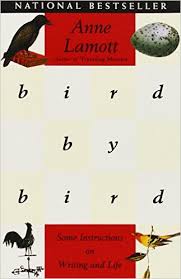
Bird by Bird Anne Lamott helped Gwynn hone her attitude to writing and gain the confidence she needed to really start getting words on paper. Personal anecdotes give advice on everything from writer’s block to finding your voice and the value of writing “shitty first drafts”.

On Writing Stephen King  Ruth loved this one so much she got the basic book, the CD for listening and the large-print version in case her eyes give out. More than a how-to from a master of storytelling and horror of all levels, this book is a fine companion for any writer who loses their way.

Plot versus Character Jeff Gerke. Gwynn writes from setting, then characters, and then tries to fit it all into a plot. This book recognizes both the pantster and plotter and leads them each through processes to a well-balanced novel: memorable characters and a good plot.

The Emotional Craft of Fiction Donald Maass. After taking a workshop with agent and bestselling author, Donald Maas, Ruth was compelled to get his latest book. And it’s a doozy with examples and exercises to sharpen your emotional intelligence as a writer, dig deeper in your scenes and keep readers reading.

The Writer’s Journey Christopher Vogler is Gwynn’s go-to book on story structure. Evolved around the Hero’s journey concept, Vogler adds in what works in story that has come out of myths, fairy tales and movies.

An Introduction to Poetry  X.J. Kennedy and Dana Gioia, ed. — this is one of Ruth’s go-to’s whenever she’s feeling stuck with a poem. It’s a basic college-level textbook but one that’s filled with poems and the thoughts of poets on poetry and life. These are voices of a rich cultural diversity, from ancient times to modernity, all trying to figure out the world and our place in it.

Fruitflesh Gayle Brandeis. While Gwynn also turns repeatedly to An Introduction to Poetry, she also finds this book of stories, meditations and writing exercises a constant inspiration when writing poetry. Brandeis seems to have the power to inspire, challenge and free the sensual.

The Angela Ackerman/Becca Puglisi series (Negative/Positive Trait Thesaurus, etc.) Ruth has the Negative Trait Thesaurus and Gwynn has the Positive Trait Thesaurus (we share) but we’ve spoken with enough writers to know that each book Ackerman and Puglisi puts out has become a practical resource that goes beyond suggesting appropriate body language or emotional responses. Also great for those moments when you’re stuck and need to surprise yourself with your character’s good or bad behaviour.

We’d be remiss if we didn’t make note of our own writing resource book, Inspiration Station. Published in 2010 with Piquant Press it was packed full of prompts and ideas to keep writers’ pens moving. Our first non-fiction publication proved to be a popular handbook as one way to keep the retreat feeling alive long after writers packed up and headed home. It’s been through two printings and is presently sold out, but Inspiration Station has gone back to the revision table and you can look for a new edition and format next year.

Pinterest for Fiction Writers Part 2

Pinterest for Fiction Writers Part 2

Gwynn Scheltema

In Pinterest for Fiction Writers Part 1 we explored how Pinterest can help you as a writer while you are writing. But of course, there is the other side to writing: selling the book! Pinterest can help there too. (Note: If you are not sure what terminology like “boards” and “re-pinning” mean, please read Part 1 first.)

Why consider Pinterest for sales?

According to Omnicore Agency’s January 2018 report:

  • Monthly active Pinterest users numbered 175 million (75 million in the USA.)
  • 93% are women
  • 2 million shopping pins are saved daily
  • Millennials use Pinterest as much as Instagram
  • Pinterest drives more referral traffic to websites than Google+, LinkedIn and YouTube combined.
  • Nearly 85% of Pinterest searches happen on mobile devices

One of the reasons I prefer Pinterest is that what you post is always there, easily found and well-organized. You don’t spend time creating a post that disappears into a long news-feed and may never be seen, like on Facebook and Twitter.

Two kinds of Pinterest accounts

Pinterest offers registration as either a personal user or a business user. Both are free.

A personal account allows you to create boards and pin to them. You can also pin from other people’s boards and send to other people’s boards, social media accounts, and email.

If you have a business account, you can additionally:

  • place links on your website to take people to your page on Pinterest
  • get visitor analytics and what they’re looking at the most
  • use rich pins to let users do special stuff with the content on your website or Pinterest page, and add prices to your images.
The right Pinterest mindset

Pinterest is not a point of sale. It drives people to click through to your website or to Amazon or wherever your point of sale is. It’s great for building an author presence, (see how below) but never lose sight of the fact that your end goal is sales!

But, and it’s a BIG BUT, like all other social media platforms, avoid incessant self-promotion. The immediate goal is for vistors to pin and then to click through.

Pinterest is a quieter, more subtle platform where sales are made indirectly by building trust, loyalty and engagement. On Pinterest you express yourself through images. So if you want to showcase a review of your book you’ll have to make a visual for it.

Also remember that most pins are re-pins, so if you provide original content, pinners will happily spread it for you. Just give them a good visual with a few, repeat few, words that hook them and you’re on your way.

Become a Business Author

I’m a personal pinner and I have over 60 boards covering all my hobbies, dreams, and plans. Some are general: gardening; art; books I recommend. But there are also more personal boards: my daughter’s wedding; things I want to do with the grandkids; travel plans and of course, unpublished book boards.

When selling your book, you don’t want your efforts buried in clutter and you want to be accessible but stay professional.  The best way is to register as a separate author persona with a business account.  Use your name, and simple add “author”: Jane Doe, author. And just like Twitter and Facebook, a decent head shot and succinct profile that sells you and your products is a must. Notice in the author page below that Rachel Thompson has 6,000 followers and 22,100 monthly viewers. Wow!

What boards could I create?

You can still have multiple boards, but keep them associated with the book or you as an author. In a business account, Pinterest allows you to have “featured boards” and “latest pins” that show up when you first go to the Pinterest page.

Remember sales is the goal, so make sure to put links to your sales page/s whenever you can. You can put them in your profile, in the description portion of your images, and add the URL to images you create.

Here are a selection of boards to consider:

Boards about the book
  • The book/s.

Create a separate board for each book you want to sell. Pin pictures of the cover, back page blurb, reviews, and enticements to read excerpts. Link all the images to your sales page and where appropriate put prices on your images. In the image below, notice that Carla Laureano has 8 separate book boards. (She also has her website URL prominently displayed and a URL to a free book in her profile)

  • Behind the book/s

Glimpses into the book in the making: pictures or quotes that inspired your characters, settings etc. (all poached from your initial vision board.) Cover choices that didn’t make the cut. Characters and/or excerpts that didn’t make the book. Story boards, notes.

  • Special offers

Freebies, contests. New book ideas: Invite people to post pictures of what the villain could look like, or what kind of car the protagonist might drive. Give a free book to the winner when the book is done. In the board below, 75 authors collaborate on this board to offer giveaways. The board appears like this on each of their pages.

Boards about the author
  • About the author

You can get personal here or stay all business; it’s up to you. You can cover how you got started writing, your mentors, your writing resume, your future plans, your passions, causes you support, hobbies and views on life.

  • Events

Reading and signing events (use your photos and posters as the visual); conferences, guest posts, speaking engagements, workshops you’re giving; TV, print or radio interviews. Again add links in the description portion of the pin.

  • Fan club

More photos of happy fans holding your book; book club group shots; quotes from fans or fan letters. Tag people using the @ sign in your pin descriptions (tagging in Pinterest works similarly to Facebook.) Plus, other people can pin things to your page (if you allow them to become “contributors” to a particular board), which encourages more sharing and interaction.

  • Behind the scenes

Pictures of you writing, your cork board of favourite inspirational quotes etc,  your waste basket of discarded scenes, the view from your window, your cat lying on your keyboard. Let your public see you as the person behind the book.

Boards that support the content of your book/s
  • Topic boards

If your book features a mental health issue, have a board about that mental health issue; if your books are Georgian romance, boards of all things 18th century would be of interest to your readers.

  • Books you recommend

Can be in your genre only, or anything you recommend. Alternatively, have a board about “reading now” or “my to-be-read list.”

  • Related activities

If you have written a kids book, have companion boards for teachers or parents or libraries.

  • Any other book-related topics

Libraries you love. Book stores you recommend. Books you loved as a child. Quotes from writers ……..

And there’s more

Once you’ve created your Pinterest author account, don’t forget to grow your audience by adding a Pinterest Follow button on your website so people can follow your Pinterest account from your website.

You’ll also need to brush up on some of the technical stuff, all of which could warrant a separate blog post, but there’s plenty of help out there. Here are a few links to get you started.

Of course you can search on Pinterest yourself! Here are three pins I found in a search “selling books”.

Pinterest for Fiction Writers Part 1

Pinterest for Fiction Writers Part 1

Gwynn Scheltema

My favourite procrastination tool is Pinterest, but unlike my next favourite procrastination tool, Solitaire, it actually serves many useful purposes for a writer.

What is Pinterest?

Think of Pinterest as an infinite digital corkboard. On your “corkboard”, you have visual topic collection files called BOARDS for your PINS. Pins are visual web links that take you to the source of the information you are pinning (magazine article, blog, website, youtube video etc.). If you pin someone else’s pin (greatly encouraged) you are RE-PINNING. A person who has a Pinterest account (it’s free) with a collection of boards is called a PINNER.

Pins don’t have to be only informational text.. You can pin pictures, infographics, videos, photos and all kinds of ideas and inspiration. You can make your board public or secret. You can be social or not as you choose. (I choose not.)

Best of all, you can search by topic and define whether you are looking for a pin, a board, or a person. For example, I can search for all pins on “plot”, or all boards on “writing tips” or all people for “mystery author”.

If you download a “pin button” to your browser search toolbar, you can pin from anywhere you go on the internet including your own photos if they are in the cloud.

Novel vision boards

When beginning a novel, I create a board with my novel’s working title and pin images of possible characters, buildings, period dress, geographic details like birds or plants or places. Later I can add research links, newspaper cuttings, quotes, cover ideas, relevant books to read or anything else that might inspire or inform me.

I can even create sections within my board. For my mystery novel “Pyes and Ivy” I have sections for my characters, my town “Riverton” and the B&B where the action takes place “Ivy Lodge”.I find having the visual helps me keep things consistent.

Novel development boards

Of course, not every aspect of your novel has to be on one board. (You are allowed up to 500 boards and 200,000 pins). So let’s say you are working on your villain. You can create a board just for him/her. Get writing tips on writing villains. Get quotes from or about villains. Get ideas for names, motivations, and personality traits.

Rinse and repeat with other characters or setting or events…..

The craft

And when you have characters, you need an arc for them and a story arc too. Pinterest gives you access to loads of free printable worksheets for every aspect of planning your novel. Ditto for articles on “how to…” and “tips on …”


Looking for another way to describe hair colour? Words to use instead of “amazing”. Pinterest has pins for that. Also pins for commonly misused words, when to use what kind of hyphen, and avoiding clichés—including cliché characters.


Motivation

I have a board called “Words to write by”. It’s full of inspirational and kick-in-the-pants quotes. A quick visit there when I’m feeling like my writing is crap or I’m getting nowhere usually gets me going again. And let’s not forget the hundreds of writing prompts—visual and text; story starters and what ifs.

If you like to be social, you can follow other pinners, join group boards or comment on pins. There are even hilarious “Pinterest Fail” pins.


Making money.

Once you have a book to sell there are great ways to sell it on Pinterest. It’s the up and coming social media market place. But that’s a whole other blog. Stay tuned for Pinterest for Fiction Writers Part 2.


If You Read It, They Will Listen

If You Read It, They Will Listen

Ruth E. Walker

A recent invitation to read my work at Tall Pine Tales in Haliburton set me off on a complicated journey. Tall Pine Tales is a collaborative reading series shared by writer organizations in two of Ontario’s cottage communities: Haliburton and Muskoka. Running successfully for the past 5 summers, there are expectations from the audience for this 6th season: plenty of laughter and smiles, along with thoughtful nudges about life’s twists and turns.

For me, an invite to a public reading is an ego-boost (especially useful when my muse opts to dance just out of reach.) It’s an opportunity to share my work with an audience, to feel my words slip among listeners and tempt their interest.

But when I looked at the writing I had on hand, I panicked a bit. I have a rather dark and serious muse, so this was a real challenge. Then I remembered The Perfect Beauty of Yvon Torville, an in-progress manuscript that I plan to return to in 2019.

Choose the right piece
  • think first; read later
    • there’s a big difference between reading your work to a group of colleague writers and reading aloud to an audience that is mostly readers. You need to consider the purpose of the event, the location and the likely audience:
      • indoors or outdoors
      • a library auditorium or a noisy local pub
      • elementary or high school students or adult audience
      • consider the people and the place, then choose: humour, pathos or high-tension drama?
  • pay attention to the tone of the organizers/event
    • I knew that Tall Pine Tales is a charming mix of memoir, humour, children’s authors and local content, so I chose accordingly: Yvon Torville is a revisionist take on an old Breton fairy tale with irony and magic at its heart
Get comfortable
  • practise
    • the more your practise, the more familiar you are with your own work. During readings, you need audience connection…and that means not keeping your eyes fixed firmly on your words. Look up as you read and move your attention throughout the room: help your listeners feel that you are reading to them and not to the podium.
    • the more familiar your are with your reading, the more easily you can govern your pacing. No matter how many times I’ve read publicly, I’m still a bundle of nerves. I channel that nervous energy into my readings and work hard at not rushing through, slowing down and giving emphasis to parts that need it (a lot of character names or unusual settings or a fast-paced scene.)
    • video or record your practice readings to help you hear your intonation, pauses and occasional stumbles. If you don’t want to record yourself, at the least listen carefully as you practise again and again to ensure a smooth and confident delivery
  • reconaissance/research
    • if you aren’t familiar with the location, do what you can to get familiar. Many out-of-town locations can be viewed online (check out the website for the reading event and a list of past readers)
    • ask the organizers: will there be a podium? Does it have a reading light? Is there a microphone? And here’s a really important question: How long do I have to read? (see “Deliver” for more on this one.)
Deliver
  • listen to the other readers
    • not only is it respectful to give your colleagues your full attention, it helps you to gauge the audience. And that helps to prepare you to deliver your work. Even if the audience is not overly receptive, you’ll know you’ll have to step up your game to get their attention.
  • engage your audience
    • if you have practised then you will read clearly and with some variety in your tone and you will be able to at least glance up in their direction. That’s all part of engagement.
  • stick to the time limit.
    • I have been in the audience when readers have gone over their time limit and it’s disrespectful to the organizers, to your colleague writers who keep to their time limit and most especially, to the listeners. No matter how “rivetting” your piece is, don’t do it.
    • At Tall Pine Tales, I cut my reading off at the requested 7-minute mark and then got to hear more than one person call out “No! What happens next?” I won’t have trouble selling them that book, will I?

Accept criticism

  • take stock of success and what still needs work
    • if possible, have someone in the audience you can quietly ask about what worked and what didn’t. At Tall Pine Tales I asked my husband, “So, what do I need to do better next time?” “Nothing,” he replied. But I’m not fooled by that. “C’mon, give it to me.” He let me know that the reading was great but “…next time, give a bit more time to the set up before you read. Tell them a bit about the original fairy tale first.” Bingo. He was right. It was a good reading but would have been even better if they knew why I am compelled to revise this old tale.
    • I like to read my work aloud to an audience, and I’m pretty good at it. But even so, it’s a never-ending journey to refine and improve each time. If I’m lucky, the invitations will continue to arrive and give my muse a kick in the pants just when I need it the most.

      Ruth reads from “Living Underground” in 2012


Out of the box poetry

Out of the box poetry

Gwynn Scheltema

One way I free up my creative mind is to box it in. Sound contradictory? It is, but it works. Forcing my brain into constraints forces it to find new ways out, to connect things that are not normally connected and to reach for ways to use available concepts or images or ideas that aren’t the easy default but something deeper.

Using constraints is not a new concept, and it applies to all creativity, not just writing. Composer Igor Stravinsky described it this way: “The more constraints one imposes, the more one frees oneself of the chains that shackle the spirit… the arbitrariness of the constraint only serves to obtain precision of execution.”

Here are some constraints that I use to start poems. Notice, I say “to start”. Some of these tactics may produce a finished poem, but more often they simple set my mind in a new direction. After that I ignore the constraint and let the new idea lead me where it may.

Anaphora

Anaphora is the repetition of a word or phrase at the beginning of successive phrases, clauses, or lines to create a sonic effect. When the initial writing is done, you can remove the phrase and just work with the images and thoughts you’ve generated.

I find it good to pick a focus, like a place, time, person or experience and use phrases like “On Saturdays…” or “My Aunt Emily…” In London…” etc., as well as general introductions like “I remember…” or “I don’t remember”, I believe…”, “I want…” or “If I could…”

Joe Brainard wrote a book length poem about his life in the 1950s called I Remember. Here is an excerpt:

I remember a piece of old wood with termites running around all over it the termite men found under our front porch.

I remember when one year in Tulsa by some freak of nature we were invaded by millions of grasshoppers for about three or four days. I remember, downtown, whole sidewalk areas of solid grasshoppers.

I remember a shoe store with a big brown x-ray machine that showed up the bones in your feet bright green.

Lipogram

A lipogram is writing that excludes one or more letters. Here is a short poem by Daniel J Webster that excludes the most used letter in the English alphabet: “e”.

Most common of all marks from A to Z,
It’s tyrant to orthography, and smug
That not a thing of worth is said without
Our using it. . . .

Univocalism

A poem using only one vowel. Canadian poet Christian Bok is famous for his collection Eunoia, a collection of five univocal prose poems (which run into many pages each), one for each vowel.

Here is an excerpt from “A”

Hassan Abd al-Hassad, an Agha Khan, basks at an ashram – a Taj Mahal that has grand parks and grass lawns, all as vast as parklands at Alhambra and Valhalla. Hassan can, at a handclap, call a vassal at hand and ask that all staff plan a bacchanal – a gala ball that has what pagan charm small galas lack. Hassan claps, and (tah-dah) an Arab lass at a swank spa can draw a man’s bath and wash a man’s back, as Arab lads fawn and hang, athwart an altar, amaranth garlands as fragrant as attar – a balm that calms all angst. A dwarf can flap a palm branch that fans a fat maharajah. A naphtha lamp can cast a calm warmth.

Opposites

Take a poem you find interesting (your own or someone else’s) and write a line opposite in meaning to each line in the poem. For a bigger stretch, keep to the same form and/or rhyme scheme.

Excerpt from PETALS
by Amy Lowell

Life is a stream
On which we strew
Petal by petal the flower of our heart;
The end lost in dream,
They float past our view,
We only watch their glad, early start.

STONES
by Gwynn Scheltema

Death is earth
On which we pile
Stone by stone the cairn of our mind;
The beginning found in birth
We build up all the while,
Only to miss their sad, final end.

Imitation

Imitate a poem, even incorporating phrases from the original poem. If you use this only as an opening up exercise to find your own thoughts, make sure you eliminate the original poet’s words in your poem. If you keep any of them make sure to acknowledge the original poet.

Excerpt from “PATTERNS” by Amy Lowell

I walk down the garden paths,
And all the daffodils
Are blowing, and the bright blue squills.
I walk down the patterned garden paths
In my stiff, brocaded gown.
With my powdered hair and jewelled fan,
I too am a rare
Pattern. As I wander down
The garden paths.

Imitation exercise:

PATTERNS REPEATED
After Amy Lowell

I walk down the garden-paths,
And all the peonies
Are full and showy, like happy children
I walk down the patterned garden-paths
In my husband’s shadow
With painted smile and high bred manner
I too am a rare
Pattern.  As I wander down
The garden-paths.

 Riffing off a concept

Wallace Stevens wrote a poem called “Thirteen Ways of Looking at a Blackbird” in which each stanza is a mini-poem, but all of them refer to a blackbird in some way, to unite the whole. This is a great way to start writing a poem. Think of 13 (or 14 or 16 ) ways of looking at anything: sunsets; lovers; baking apple pie; train journeys…..


First and Last

Here, take two lines at random from any text. Make it truly random by getting someone else to pick them. One line becomes the first and one the last line of your poem. When you’re done, remove the borrowed lines.

Poet John Hewitt recommends this tactic because “…it gives you something to start from. If you know what your last line has to be, you start to think of ways that you can get there. If you know that you have to write a poem about the constellation Orion, you go out and stare at the stars. You are no longer dealing with a blank page. You know that at least one of those words is going to be “Orion”. That’s a place you can start from.”

And one more thing

It is important to realize a constraint is a tool. It helps bring focus to a poem. You won’t always want restraints, but when you are stuck, a constraint is a good way to get the words flowing again.

Last word

Gilbert Sorrentino, poet, novelist, critic and professor says “Generative Devices are consciously selected, preconceived structures, forms, limitations, constraints, developed by the writer before the act of writing. The writing is then made according to the “laws” set in place by the chosen constraint. Paradoxically, these constraints permit the writer a remarkable freedom. They also serve to destroy the much-cherished myth of “inspiration,” and its idiot brother, “writer’s block.”