Weddings and Writers

Weddings and Writers

Ruth E. Walker

Later this week, I’ll watch my youngest child get married to his beautiful bride. I’ll likely cry a bit — happy tears. And I’ll be relieved that my son is the last one of our children to choose a life partner. That’s it for now, until the grandchildren start the cycle all over again.

Many mothers of the groom will tell you our role has challenges: Will the rehearsal dinner menu be a nice complement to the wedding themes or a mish-mash of wrong choices? Will my dress be appropriate and not clash with the mother of the bride’s chosen colour and style? Will I remember all the names of the large wedding party, their partners and great-aunt whoozits from out West?

For a writer, there are even greater challenges that come with this territory. For example, my husband and I have written speeches together for all the other kids’ weddings. While we rarely write anything together, this one task seems to go quite well. Over four decades of marriage helps with that one. So, no, that’s a challenge but it’s one we manage to pull off. It helps that we love all our kids’ partner choices.

No, this is a different kind of challenge for me. It’s the mother and son song that is making me run around in a conflicted tizzy. I do love to dance. I’m not very good at it and likely show up in a few party videos as the one who doesn’t quite get the beat or the moves but looks happy while she’s messing it up. No. It’s not the dance itself — it’s the song choice that’s so difficult.

Lots to choose from

If you Google “mother and son wedding songs” you’ll get over 8 million hits. And links to hundreds of sites that list the “top” mother and son dances, from country to rock to contemporary to traditional and variations thereof. YouTube is a treasure trove of music videos for this one important dance. One bride website lists 40 Best Mother-Son Dance Songs. So, with so much to choose from, how can this be a problem?

I’m a complete sucker for the sentimental yet charming film, Love, Actually. I tear up at the great airport love-in montage at the end as the Beach Boys sing their hit, “God Only Knows.”

A song about love — all kinds of love. So logical choice, right?

Not the melody; it’s the lyrics

Let’s get real people. I’m a writer. So while I may love the overall sentiment of a song and enjoy a beautiful melody, the words matter. Let’s consider “God Only Knows” — great lines likes God only knows what I’d be without you — so true. Most of the grey hairs on my head can be traced back to life with children, the youngest perhaps accounting for more than all the others put together. But the opening line on that Beach Boys song stopped me cold: I may not always love you.. Nope. Not that song. Because I will always love him.

Surely, with 39 other songs, I will find the perfect song.

“Forever Young” sung by Rod Stewart. Are you going to drop the bomb or not? Bomb? I don’t think so.

“Because You Loved Me” sung by Celine Dion. I’ll be forever thankful baby/You’re the one who held me up/Never let me fall…  Just who are the lyrics meant for — mother or son?

“I Say a Little Prayer” sung by Aretha Franklin. While combing my hair now/And wondering what dress to wear now/I say a little prayer for you… 

As much as I love my son, I don’t stand before the mirror every day and think of him.  Obsessive mama, I’m not.

Who picks these songs, anyway?

Oh the songs I’ve listened to. Some are so sickly sentimental, I need a glass of water to dilute the sugar. Some stretch the boundaries of rhyme and rhythm to excruciating levels. And some make no sense at all. And speaking of “combing my hair and choosing my dress,” exactly what lyrically challenged person thought “Wonderful Tonight” sung by Eric Clapton is an ideal mother-son wedding dance song? How about that last stanza:

It’s time to go home now and I’ve got an aching head
So I give her the car keys and she helps me to bed
And then I tell her, as I turn out the light
I say, “My darling, you were wonderful tonight
Oh my darling, you were wonderful tonight

Good grief. My son’s bride won’t have to worry that Mommy is driving him home after the reception, putting him to bed while he calls me “My darling.” Nope. Not this mama.

So you see my challenge? I can’t tune out the words because they matter. Words mean something. Right now, I’m waffling between two different songs, the sentimental but lyrically true song, The Man You Have Become sung by Molly Pasutti and the sweetly upbeat 93 Million Miles sung by Jason Mraz.

Of course, my son may have some ideas on the song choice. In fact, he’s written a few lovely songs himself. But remember those grey hairs? It will likely be just before the reception before he manages to tell me what those ideas might be. Ah well. I will always love him no matter what song we dance to.

Which brings me to a song I hope we will dance to: “Love is All You Need” by The Beatles. Because, if I had one thing to tell him, it’s this: Love is all you need. Love for yourself. Love for your family. Love for the world and its inhabitants. Remember love my son, especially at times when it is the furthest thing from your mind. It will bring you back to what really matters.
 

10 Ways to End a Story

10 Ways to End a Story

It’s Writescape’s 10th anniversary and we have lots of excitement planned for writers in 2018. This installment of 10 on the 10th is the latest in the series of monthly writing tips, advice and inspiration. Think of it as Gwynn and Ruth sitting on your shoulder and nudging you along. Share with your writing colleagues and encourage them to sign up for more.

Last month, we looked at 10 Ways to Start a Story. Let’s flip that around and consider 10 ways to bring it all to a close. For many writers, the ending is as much a challenge as getting those first few words when they begin. And for some writers, it’s even a greater challenge.

But make no mistake. Just as how you start a story is vital, how you finish is equally important. Getting to “The End” can’t disappoint or frustrate your reader — whether you wrap it all in a nice neat bow or leave the reader in contemplation, your ending should work with the whole story. Consider these 10 approaches to see how each one affects the end of any story. We’ve given examples and have done our best to avoid spoilers.

1. Back to the Beginning (Circle or Frame) Mary Shelley’s gothic horror novel, Frankenstein, begins as Dr. Frankenstein is rescued in the Arctic Sea by an obsessed ship captain. The driven doctor recognizes the captain’s obsession, so he shares his story of creating the Frankenstein Monster to warn him how he came to be there, chasing his monsterous creation to the North Pole. An equally creepy modern title to check out for this approach is Fight Club.

2. Implied Ending (Walk into the sunset) Many western genre stories end with the protagonist and companion “riding off into the sunset” and presumably to live and face another day, side by side. This kind of can be a fine example of show, don’t tell. An implied ending can be ambiguous. For example, Patrick deWitt’s The Sisters Brothers offers readers the sound of water in a bathtub to set a kind of closing mood that could be “sorrow or gladness”. Our narrator chooses to think he and his brother are likely safe; the reader is not so certain.

3. Sequel (We’re baaaaack) Oh, there are so many sequels out there — trilogies, series, cross-pollination (think the Marvel Universe), prequels and so on. The good news is that writers who have long, complicated stories (The Lord of the Rings, The Hunger Games) can separate them into connected standalone novels. Remember, however, standalone is key. The end of each of The Lord of the Rings trilogy had to satisfy its readers, while at the same time enticing them to read the next book.

4. Open-ended (Choose your own ending) with Frank R. Stockton’s 1882 story The Lady, or the Tiger, readers must decide at the end what choice the princess makes; will she choose to let her lover be devoured by a tiger or let him live in arms of another woman. It’s a question that has troubled readers for over a century. And not a bad way to get your story to keep your readers thinking. And thinking.

5. Twist (Surprise!) A variation on open-ended conclusions, this approach builds on expectation. Author O. Henry was a master at this form and The Gift of the Magi is one of his most memorable tales when a wife’s and husband’s love and sacrifice at Christmas — surprise! — both negates and honours each of their gifts.

6. Happy Ever After (smiles all ’round) Of course, romance stories are supposed to end in this same way: girl gets guy or girls get guys (as many of Shakespeare’s romance plays end)… romance is all about love.  And there are many forms of love — girl gets girl or guy gets guy — but not all of them sexual. And happy ever after doesn’t need to even centre around a romance. Indeed, once Gretel pushed the witch into the oven, she and Hansel reunite with their remorseful father and live, we are certain, happily ever after.

7. Mirror (architecture echo) It was the worst of times and the best of times, it was the age of wisdom, it was the age of foolishness… Dickens’ A Tale of Two Cities starts off with a 119-word long opening sentence, a description of duality echoing the conflicted chaos of the French Revolution. But he doesn’t end it the same way. He echoes the basic architecture of the opening comparison but with a short and tight finality that makes clear that this is “the end” of the story and of one of the characters. It is a far, far better thing that I do, than I have ever done; it is a far, far better rest that I go to than I have ever known.

8. Lesson (Pay attention and learn) Aesop’s Fables are all written with a moral lesson endings — that fox never gets the grapes and is sure they’re just sour anyways. Many fairy tales also have a moral or a lesson, sometimes it’s just implied like Goldilocks:  Goldie, don’t go in strange houses or Red Riding Hood: Red, don’t talk to strangers and for Pete’s sake, Hansel and Gretel, don’t nibble on strange houses.

9. Reveal (Elementary, my dear Watson) A classic ending for mystery or thriller novels, the protagonist (dogged detective or amateur sleuth or unjustly accused victim) pulls together all the clues, red herrings included, and dissects them one by one. The final clue, the moment of ah-ha, is delivered with a flourish and the reader remarks either, Gosh, I didn’t see that one…or…I knew it! The point you need to remember is to be clever and careful; today’s readers don’t expect Sherlock Holmes’ genius and acute observation skills.

10. Epilogue (Fortune teller reveals all) At the end of Offred’s narration in Margaret Atwood’s The Handmaid’s Tale, it isn’t 100% clear on whether protagonist Offred is being arrested or, as she believes, in the hands of an undercover resistance member on her way to freedom. However, there is an epilogue that helps us decide on that question — and gives us more information about the time in which Offred lived.


No matter how you end your story, remember that it is always a story that the reader wants. A great story will pull your reader along to the end. So a clever and creative ending will make little difference if what comes before it lacks energy, doesn’t have compelling characters or loses its way to reach that ending

And for now, that’s got to be The End.

What’s a snollygoster?

What’s a snollygoster?

Gwynn Scheltema

I love words. I’m addicted to them. I love words that I can roll around in my mouth and feel them roll off my tongue: lugubrious; predilection; vociferous.  Words that tie my tongue in knots: mnemonic; synesthesia. Words that have strange meanings: enchiridion—a book to be carried in the hand. Words that express things hard to describe: petrichor—the pleasant smell that accompanies the first rains after a spell of dry weather. Words that carry sound and music: tinkle; boom; crash. Words that are fun: higgledy; pollywog and snollygoster.

So what is a snollygoster? It’s a political thing, and I found out about it on a TED talk. Yup, I admit I’m addicted to TED talks as much as I am to words.

Who or what is TED?

TED was launched in 1984 as an invitation-only conference to bring together the innovative power of three fields: Technology, Entertainment and Design. It’s grown from a single conference to an annual open event that now includes scientists, philosophers, musicians, business and religious leaders, philanthropists and many others.

The TED website describes itself as: “a nonprofit devoted to spreading ideas, usually in the form of short, powerful talks… from science to business to global issues…in more than 100 languages… we’re building a clearinghouse of free knowledge from the world’s most inspired thinkers.”

TED also believes “passionately in the power of ideas to change attitudes, lives and, ultimately, the world.” And I believe the same about words.

So treat yourself to some summer downtime enjoy these TED talks about words (and finally find out what a snollygoster is).

What’s a snollygoster?

Etymologist Mark Forsyth shares entertaining word-origin stories from British and American history.

Go ahead, make up new words!

Lexicographer Erin McKean encourages the creation of new words to better express what we mean and make more ways to understand one another. She shares 6 ways to make new words in English including compounding and verbing.

Beautiful new words to describe obscure emotions

John Koenig loves words that express unarticulated feelings like lachesism —the hunger for disaster, or sonder—the realization that everyone else’s lives are as complex and unknowable as our own.

What makes a word real?

Who decides if new words like hangry, defriend, and adorkable make it into the dictionary? Language historian Anne Curzan takes a look at the people behind dictionaries and the choices they make.

Lets put the “awe” back in awesome.

Which of the following is awesome: your lunch or the Great Pyramid at Giza? Comedian Jill Shargaa calls for us to save the word awesome for things that truly inspire awe.

The joy of lexicography

Lexicographer Erin McKean looks at the ways today’s print dictionary is poised for transformation.

What we learned from 5 million books

Google Labs’ Ngram Viewer is a database of 5 million books from across centuries. Erez Lieberman Aiden and Jean-Baptiste Michel show us it works.

Just the beginning

Don’t limit yourself to the talks listed here. TED topics such as author talks, writing, creativity, storytelling and more are waiting to inform, entertain and inspire you. Enjoy!


When the Agent Says No

When the Agent Says No

Ruth E. Walker

Last December, I put “The End” onto my science fiction/fantasy Young Adult novel I’d been working on for three years. And then I sent it off to an agent* who’d already enthusiastically read a few of the first pages at a writers conference 18 months earlier.

I’ve met a few agents for one-on-ones at conferences and received encouraging words. But this agent, with a large, well-known Canadian literary agency, she and I connected from the start. My latest draft of my novel has been with her since December but I’ll admit by April, I was ready for rejection. To get it over with, I sent an email asking what the status was. And, to my surprise, she wrote back to say that her colleague at the agency was nearly done reading it and then she’d look it over and get back to me soon.

In the Half-life of The Wait

This could now go only one of two ways: an offer of representation or a rejection, and then I’d move on. At least, that’s what I thought. She’d been super enthusiastic both in our initial meet and greet, and subsequently in email correspondence. I was certain we could work well together.

So I dwelt in the half-life of writers who are waiting to hear back on their submission. You know what that means:

  • I burnt a few offerings to the gods of good fortune
  • I played word games on my tablet to avoid checking my emails several times a day
  • I checked my emails several times a day
  • I forced myself not to imagine having an agent
  • I imagined announcing that at last, I had an agent

Yup. I vacillated between positive thoughts and steeling myself for “no”.

The Reply

Last week, I got the email. It was a no.

But wait. Not just any no. This is the kind of no that tortures all writers. It’s a no with an offer of hope. And frankly, even better than the hope, the email was rich in the kind of feedback from the agency reader that some writers would kill for. The agent’s colleague liked a lot about the novel:

This YA fantasy ms has some great strengths, most notably an empowered and compelling female character at the center of this hero’s quest narrative. Garnet’s backstory is complex and her character development is largely convincing.

I was especially invested in feminist leanings and diversity moral that informs this narrative, though therein lies some concern as well…

Oh-oh. I read on and learned that there were areas that kicked this reader out — parts of the story that moved too close to unsurprising. And I failed to make clear some of the central themes from start to finish, dropped a thread or two and, most grievous error of all: failed to make clear the complicated world I had built. In short, I’d left too many dangly bits.

Don’t you just hate dangly bits?

Back to the Beginning

Fortunately, if a writer has some sense of what those dangly bits are, they can be fixed: cut or tied or connected anew. I have options. I sent back an email to the agent that said as much, thanking her and her colleague for the feedback. It’s gold, I wrote — and it is, because it is concrete feedback on strengths and areas to develop.

So, this summer I’ll be focusing on revisions. Deepening characters, enriching the sense of place and pulling apart the cultural norms of my imagined world with two suns and a feral young female who will change everything. And I’ll be doing it with the agent’s words in the background:

If you find that our concerns below hit home, and you decide to revise [your novel], I’d be happy to consider the work again. Either way, I hope to hear from you again in the future, and will be cheering you on from the sidelines in the meantime.

Yup. Just what a writer needs to dive back into a novel that is nearly there. Wish me luck!

*NOTE: I shared this post with Rachel Letofsky of Cooke McDermid Literary Management and she shared it with her colleagues and especially with Kailey Havelock, Agency Assistant who was the reader of my manuscript. They’re happy to be identified as the agent and agency that this blog post is about. And I’m happy to do just that.

DID YOU KNOW?

There are plenty of opportunities to network, workshop & find the agent of your dreams. For sci-fi/fantasy writers, here’s just a taste:

Science Fiction, Fantasy and Horror Writers gather July 13 to 15, 2018 in Toronto, Ontario, Canada for Ad Astra, a not-for-profit, volunteer-run, weekend-long, science fiction, fantasy and horror event with a focus on authors and other creative professionals.

Fantasy and Horror Writers will travel November 1 to 4, 2018 to Baltimore, Maryland, USA for World Fantasy Convention an annual gathering and reunion of professionals, collectors, and others interested in the field of light and dark fantasy art and literature.

Science Fiction, Fantasy, Gaming, Horror Writers & Good Old Geeks have got together for over 12 years in St. John’s, Newfoundland, Canada for Sci-Fi on The Rock, a downhome celebration of film, literature, graphic arts and cosplay. We missed this April’s event but that gives you plenty of time to plan for 2019.

Writing Pride

Writing Pride

Gwynn Scheltema

June is Pride Month, so Writescape celebrates this week with local LGBTQ YA author Kevin T Craig.  We ask him about his experience as an author and around publishing as a gay author. But first, let’s meet him:

Kevin T. Craig

wp-image-109302426

Kevin is the author of six novels (four young adult and two coming-of-age). The latest are Pride Must Be A Place, Half Dead & Fully Broken and Burn Baby, Burn Baby.

website: https://ktcraig.com/

twitter:@KevinTCraig

1. When David Leviathan wrote Boy Meets Boy in 2003, many school libraries refused to carry it. Have things changed?

Kevin: Things have definitely changed. Librarians across North America are actively seeking to populate their libraries with LGBTQ sections. On Twitter in the YA community, there are often book-drives for LGBTQ library sections. Librarians feel that need to have the books in stock for those who are seeking them. Nothing is more powerful to a high school student than recognizing themselves in the fiction they read. This is true for all marginalized people, not just the LGBTQ community.

2. Of his book The Five Stages of Andrew Brawley, author Shaun David Hutchinson says, “Drew was just gay. None of his many problems revolved around his sexuality. And I wasn’t exactly sure how readers would respond.” Comments?

Kevin: I’m familiar with Shaun and his book. It’s true that he was one of the forerunners with this trend. But I promise you, this is something that agents and publishers are now actively seeking. For a couple of years now, agents have been asking for YA stories where the sexuality of the LGBTQ characters is NOT the story focus. They want books where the LGBTQ characters’ sexuality is simply a part of who they are…not what the story focuses on.

3. What’s something you’ve seen in LGBTQ lit that’s really stuck with you, for better or for worse?

Kevin: For better- People are now able to see themselves represented. I looked for a long time for the book that would have saved me. It simply wasn’t there. Today’s LGBTQ teens have a wide variety of young adult books to choose from in which “their” stories are being told. The mainstreaming of LGBTQ literature is most assuredly saving lives.

For worse- It’s still a little difficult to write an LGBTQ story and not have the expectation that it will include one or all of the following: Romance, Sex, Erotica. But, our stories do not need to have a tunnel-vision focus on sexuality and love life. I came face to face with this frustration recently during a #PitMad event on Twitter. I wrote a literary novel with LGBTQ characters. I had a few likes, but they were all from publishers who only publish gay romance with degrees of sex. I even tagged the novel as literary. They are not yet looking for gay novels that don’t include these things.

4. What are your challenges and triumphs as a gay author?

Kevin: Just to be adding my voice, and to be finding a level of success. I know how barren the field of gay literature used to be. I know how badly the representation was needed. The young adult community went mad this past spring when Love, Simon was released in theatres. A gay teen who just happens to be gay having a sweet romance on the big screen? Not in my day. If I can add my voice to that kind of inclusion, I’m happy to do so.

5. Anything else you’d like to say to the reading/writing world?

Kevin: Just that there is a place for everyone. If you are looking for a book and you can’t find it…it may be time to write it. Chances are, there’s someone else out there looking for it. Literature is an ideal place in which to find ourselves and tackle our differences. To read is to gain understanding.

Your turn

To mark Pride Month, why not add a Canadian LGBTQ novel to your reading list. Read a book by Kevin Craig or choose one from 49th Shelf’s  list of LGBTQ authors and/or LGBTQ issues.  Their list “includes fiction, poetry, memoir, nonfiction, and books for young readers—not to mention books by award-winning authors and some of the most buzzed-about titles of the season.”

To Market, To Market

To Market, To Market

Ruth E. Walker

I recently attended a celebration of local authors in Ontario’s cottage country. Aptly named Kaleidoscope, the book sales event offered a wide range of styles and published works for readers. Intriguing mysteries, fantasies for all ages, beautiful photography collections, wildlife explorations, compelling memoirs and biographies, and children’s picture books filled huge dining tables on two floors of the rustic Wintergreen Maple Syrup and Pancake Barn in Gelert, near Minden.

For readers, Kaleidoscope was a great opportunity to sample works by some of the many writers who call the Haliburton Highlands home. But for writers, it was an even better chance to learn from one another: what kinds of books were being inspired by the rugged natural beauty of the landscape and who are the people behind the titles? And even more important to me, how are those writers sharing their words with each other and their readers?

Even Margaret Atwood has to promote her books

I saw a range of approaches to direct sales of books and each has benefits and pitfalls. Of course, it’s always a personal choice on how one sets up their sales table. And that choice has to suit the writer. Some writers are painfully shy. I can say this because I am exactly that kind of writer. But I’ve put on my “act outgoing” pants so often now that people think I’m an extrovert. Don’t tell anyone — let’s keep it our little secret.

I toughened up my sales approach after a few years of setting up booths at Word on the Street and Eden Mills Writers Festival. I was there with LICHEN, a jewel of a literary journal I’d helped found and edit. Eventually, I learned to accept people walking past our table, avoiding all eye contact. I no longer took it personally when, after talking up a potential buyer, I watched them put the journal back and walk away. And I quietly celebrated those who bought their own copy.

I watched the writers at Kaleidoscope and recognized the many ways we promote our books:

The Quiet Table

This is the simple “here are my books on display” approach. Just the books. Stacked in an attractive display: cover out, at least one in a stand. The writer stands behind/next to the display, ready to chat with anyone with questions. This is a time-honoured marketing approach. Head to any bookstore and you’ll see lots of those display tables. Readers are attracted to quiet displays.

What you need to remember:

  • show the price; if there are specials let visitors know (2 for $xx or BOGO 50% off) Yes, it feels weird but it is part of marketing; most people dislike having to “guess the price”
  • business cards/postcards show readers you’d like to engage, even through an email or note
  • smile and say hello; it can feel unnatural (and really awkward if they ignore you) but you get used to it
  • NOTE: A recent article in Write magazine recommended displaying a question to give visitors a topic to engage with you on: “Ask me about…” — especially effective if your book(s) tackle tough or intriguing subjects that you spent time researching
The Audio-Visual Augmented Table

Video is a remarkable tool for marketing. Just like an illustration in a book, a video attracts passers-by through sound and/or images. It’s easily set up on a laptop or tablet that’s tucked in among the books.

At Kaleidoscope, a writer displayed a video of First Nation drumming scenes to share at his table. He did the following and these were exactly what we fellow writers appreciated:

  • consider your neighbours by watching the volume (but even the fairly low sound attracted visitors from the first floor to climb the stairs and see what was going on the second floor)
  • avoid constant looping to allow your visitors (and those at other tables) time and space in which to chat
  • NOTE: check in advance or arrive early to ensure your electronics are close to a power plug AND watch the cord for any tripping hazard (including for you)
The Multiple Offerings Table

Some readers are attracted to busy tables. And many readers are also writers (and that should not surprise you, writer!) so I make it a point to have material on hand for writers. Sometimes a jar of writing tips to reach in and pick from. Sometimes writing prompts. And, of course, I always have the latest on upcoming Writescape retreats.

  • offer treats or takeaways; even a jar of wrapped candy or bookmark can attract people to your table
  • define your space with a backdrop/tablecloth or banner (especially effective if you can tie it into the book)
  • get creative — for a children’s story about a picnic, use a picnic blanket and display copies of the book in a picnic basket along with picnicky items. If it’s a mystery novel, include a Sherlock Holmes cap and magnifying glass, etc.
  • NOTE: A plastic display stand can hold excerpts of reviews on your books or promote your next reading or event

No matter what kind of salesperson you are, writer, you know that in today’s noisy and crowded marketplace, we need to be prepared to sell our words and find our readership. No matter what, be ready to answer this question: What is your book about? A short one- or two-sentence answer should be on the tip of your tongue.

Like the writing process, marketing your book is a journey. But thankfully, with cooperative sales events like the first-ever Kaleidoscope in the Haliburton Highlands, it’s not a journey we need to take on our own.

DID YOU KNOW
Heather. signing BETTING GAME

Book sales events are just one piece of the marketing pie. Remember that websites and social media can also be a useful tool to introduce readers to your work. Here’s a look at Heather O’Connor’s Top Drawer post on the marketing work she did IN ADVANCE of the launch of her best-selling YA novel, Betting Game.

Invaluable and oh-so-practical advice from a successful author. And, as noted, it’s a journey.

10 Ways to Start a Story

10 Ways to Start a Story

It’s Writescape’s 10th anniversary and we have lots of excitement planned for writers in 2018. This installment of 10 on the 10th is the latest in the series of monthly writing tips, advice and inspiration. Think of it as Gwynn and Ruth sitting on your shoulder and nudging you along. Share with your writing colleagues and encourage them to sign up for more.

Whether it’s the first sentence, the first paragraph, the first page, chapter or act, the beginning of your story must establish time and place, the main players and the normal world they live in. An effective beginning should give enough for the reader to ask questions and care what happens next.

But before you spend hours polishing and perfecting your beginning, please finish your first draft. When you know all about your story, you can more easily choose what will lead your reader into the narrative. And equally important, you’ll have a better sense of the first impression that will best represent your story: its themes, its direction and its heart.

There is no “best way” to begin. Here are 10 ways to consider.

1. In the middle of action  (in medias res)

Starting in the middle of a scene puts readers immediately in the world of the story and sets up reader questions. They’ll read on because they’ll want to know why this is happening, who these people are and what happens next.

Example: Mr. Jones, of the Manor Farm, had locked the hen-houses for the night, but was too drunk to remember to shut the pop-holes. (Animal Farm; George Orwell)

Who is Mr. Jones? Is he always drunk? What are pop-holes? Why are these hen-houses important? Where…..?


2. With the inciting incident

Instead of just any action, make it the event that sets the protagonist off on his narrative journey.

Example: He—for there could be no doubt of his sex, though the fashion of the time did something to disguise it—was in the act of slicing at the head of a Moor which swung from the rafters. (Orlando, Virginia Woolf)

3. Backstory that raises reader questions

Usually it is not a good idea to have backstory early in a story, especially on the first page, but sometimes a short sharp bit of backstory can effectively  set up enough reader questions to hook them in further.

Example: Ten days after the war ended, my sister Laura drove a car off a bridge. (The Blind Assassin; Margaret Atwood)

4. A strong character

A person who is so intriguing, surprising or terrifying that readers must learn more about them. Most often the protagonist, but not always.

Example: I was born twice: first as a baby girl, on a remarkably smogless Detroit day in January 1960; and then again, as a teenage boy, in an emergency room near Petoskey, Michigan, in August of 1974. (Middlesex, Jeffrey Eugenides)


5. Begin with the end or close to the end

Often called a circle device, this method offers the end or climax first and then readers want to go back to the beginning to find out how it all happened.

Example: Many years later, as he faced the firing squad, Colonel Aureliano Buendía was to remember that distant afternoon when his father took him to discover ice. (100 Years of Solitude, Gabriel García Márquez)

6. Setting

“It was a dark and story night…” is touted as one of the worst ways to begin, but many successful stories begin with setting. The secret is to see it through the eyes of the character and have it add to plot or character development or set a mood.

Example: Last night I dreamt I went to Manderley again. It seemed to me I stood by the iron gate leading to the drive, and for a while I could not enter, for the way was barred to me. There was a padlock and a chain upon the gate. I called in my dream to the lodge-keeper, and had no answer, and peering closer through the rusted spokes of the gate I saw that the lodge was uninhabited. (Rebecca, Daphne du Maurier)

7. Unexpected/surprise

Going contrary to expectation always gets attention. Turning paradigms on their heads opens the way for an explanation that readers will stick around to hear.

Example: On a wintry Tuesday afternoon, Dr. Richard W. D’Souza stood in front of a shelf stacked with gallon jugs labeled Artificial Saliva and Pooled Human Saliva, and spoke about the art of killing. (“Breath Mints: A Hot War for America’s Cool Mouths” By Alex Kuczynski New York Times)

8. Truism

A truism is a statement that is so obviously true that it is almost not worth saying, but using one as a start to a story usually implies that the story to follow is about to prove it untrue, or at least comment on it in some way, and so readers are drawn in to see what the “other take” is.


Example: It is a truth universally acknowledged, that a single man in possession of a good fortune must be in want of a wife. (Pride and Prejudice; Jane Austen)


9. Pressing fear, disgust, and other unpleasant buttons

In much the same way that we cannot not look at a train wreck or accident on the highway, people are facinated by situations where they can vicariously experience the unthinkable.

Example: It was a pleasure to burn. It was a special pleasure to see things eaten, to see things blackened and changed. (Fahrenheit 451; Ray Bradbury)

10. Prologue

A prologue establishes context and gives background details, often some earlier story that ties into the main one. Publishers are not keen on prologues, but in the right genres (e.g. epic fantasy) they have a role to play to help the reader understand the world they are launched into, or to set up an image or incident that will be returned to. If you do use a prologue, keep it short.

Goodbye Vanity Press Impression

Goodbye Vanity Press Impression

Ruth E. Walker

I recently heard from a teen writer who was puzzled about self-publishing. She explained that she was on a committee looking at books to recommend to the Forest of Reading summer program at Ontario libraries. She was especially excited about a book from a local writer and presented it to her committee colleagues to review.

The committee agreed the book was really good and moved it forward as a recommended read to the Ontario Library Association (OLA). But my friend was disappointed to receive an email explaining that the book could not be included. The OLA has a policy to only include traditionally published works in that summer program. A novel, no matter how compelling, couldn’t be on the list if it was self-published by the author.

No matter how you feel about self-publishing versus traditionally published books, the OLA’s policy is not out of line with many organizations. And there is a good historical reason for it: vanity presses.

Feeding the Vanity Machine

Not so long ago, some printing companies called themselves publishers. Writers were attracted to those companies that would quickly publish their manuscripts without long waits to hear from an editor and no questions asked. Writers were guaranteed their book would be published…for a fee, of course. But the writers were confident of being able to sell their finished product. And all the money would go to them, not to some agent or publisher. Once they put out a lot of money to the “publisher.”

It seemed like a great idea.

Of course, the inevitable happened to most of those writers. Basements and garages filled up with boxes of books that, once family and friends had been tapped out, couldn’t be sold to strangers.


Not all vanity publications were in vain

There were amazing success stories:  David Chilton’s self-published financial advice book The Wealthy Barber has sold over 2,000,000 copies to date. He even mentored sisters Janet and Greta Podleski, and their Looneyspoons cookbook has sold 850,000 copies to date. Many speakers on the “talk circuits” self-publish companion books that sell very well on the strength of their seminars and workshops.

But they were the exception.

In the past five or so years, the winds have shifted for self-published authors. When Terry Fallis won the 2008 Stephen Leacock Medal for Humour forThe Best Laid Plans, and then the 2011 CBC Canada Reads winner, he raised the profile for self-published authors in Canada. Even The Writers’ Union of Canada now accepts memberships from authors of self-published work (applicants must submit their book for review and it must meet professional standards to be accepted.)

It won’t be long before self-published titles are received everywhere with respect.

Make sure your book deserves respect

So you’ve decided to self-publish. Just because you’ve written a great story doesn’t mean it’s ready to go to press. If you truly respect your own work, you need to give it the time and focus it needs and deserves. If you truly respect your reader, ensure that you’re actually giving your reader a great story in great shape. And if you respect yourself as an author, act like you do.

Hire an editor. No, don’t rely on friends or family for this. A professional and skilled editor will help you refine your manuscript to publishable quality: a logical plot, compelling characters and a clean copy for the proofreader. An editor is not concerned with hurting your ego — an editor wants your book to succeed and if that means giving you tough news, well, that’s what will fix this book and make you an even better writer with the next book.

Hire a proofreader. Here you might have friends or family with this skill but understand a proofreader is not just reading your story and looking for oopsies. A proofreader takes a different approach to an editor. A proofreader is looking for transposed numbers. Of chapter headings in slightly different fonts. Of two similar but different spellings of the same name. The things that trick the eye of even the best editor.

Put it into your publishing budget: $800 to $2000 for editing and proofreading.

Things are changing

I’m an assessment volunteer for the Writers’ Union, reading some the self-published books submitted for membership. Some have been pretty darn good.

However, a few have been sadly in need of an editor. And a layout professional. And proofreader. The main criteria for acceptance is “would this book be comparable to a traditionally published book, with evidence of editing and professional appearance/layout?”

More often than not, the answer is yes. And that is heartening.

It means that those vanity presses are not getting as much business. Instead, we see quality book printers who also offer editing services to various levels. We see self-published books from writers who hire editors and proofreaders on their own. We see co-operative publishing ventures, where the cost and profits are shared by the printer and the author, and include editorial supports. That’s a nice balance of respect and a much better business model instead mass printing from unpolished manuscripts.

The publishing world is ever-shifting. How readers access their books is also ever-shifting just as the line between traditional and self-published books is blurring. Ultimately, readers — like my young friend — will set the pace and tone for choosing between those two approaches. And it seems that as long as a book captures a reader’s heart, it won’t matter how it made its way onto the bookshelf.

DID YOU KNOW?

Writescape self-publishes on a regular basis. At our Spring Thaw and Turning Leaves retreats, we prepare a 35-page workbook to support writers on retreat with inspiration, ideas, prompts, tips and helpful information.

When Gwynn and I published Inspiration Station, our “retreat in a paperback” in 2010, we paid for a quality layout and print product. And you can bet that book was edited, proofed and re-proofed before it came off the press.

It’s sold out right now but plans are in the works to bring it out in an electronic version. Stay tuned.

Update on the Copyright Struggle

Update on the Copyright Struggle

Because we feel that the issue of copyright is so important for all writers, we have chosen to present the latest update on the parliamentary review of the Copyright Act received from Access Copyright in its entirety. This message was sent out to all Access Copyright members on May 25. Please read, share and submit your story to the members of the review committee. It matters for all writers and visual artists…including you!

If you are not sure what the review is all about, read our previous blog Copy that! that explains it all.

Roanie Levy, President & CEO of Access Copyright, appeared before the Standing Committee on Industry, Science and Technology on May 22nd, as part of the ongoing Copyright Act review.Watch Roanie’s appearance before the Industry Committee (it starts at 16:38:00 of the video).

The session was very well received and based on the nature of the questions that were brought forward by members of the committee, it is clear that the committee is beginning to appreciate that creators and publishers have been significantly harmed since the Copyright Modernization Act was passed.

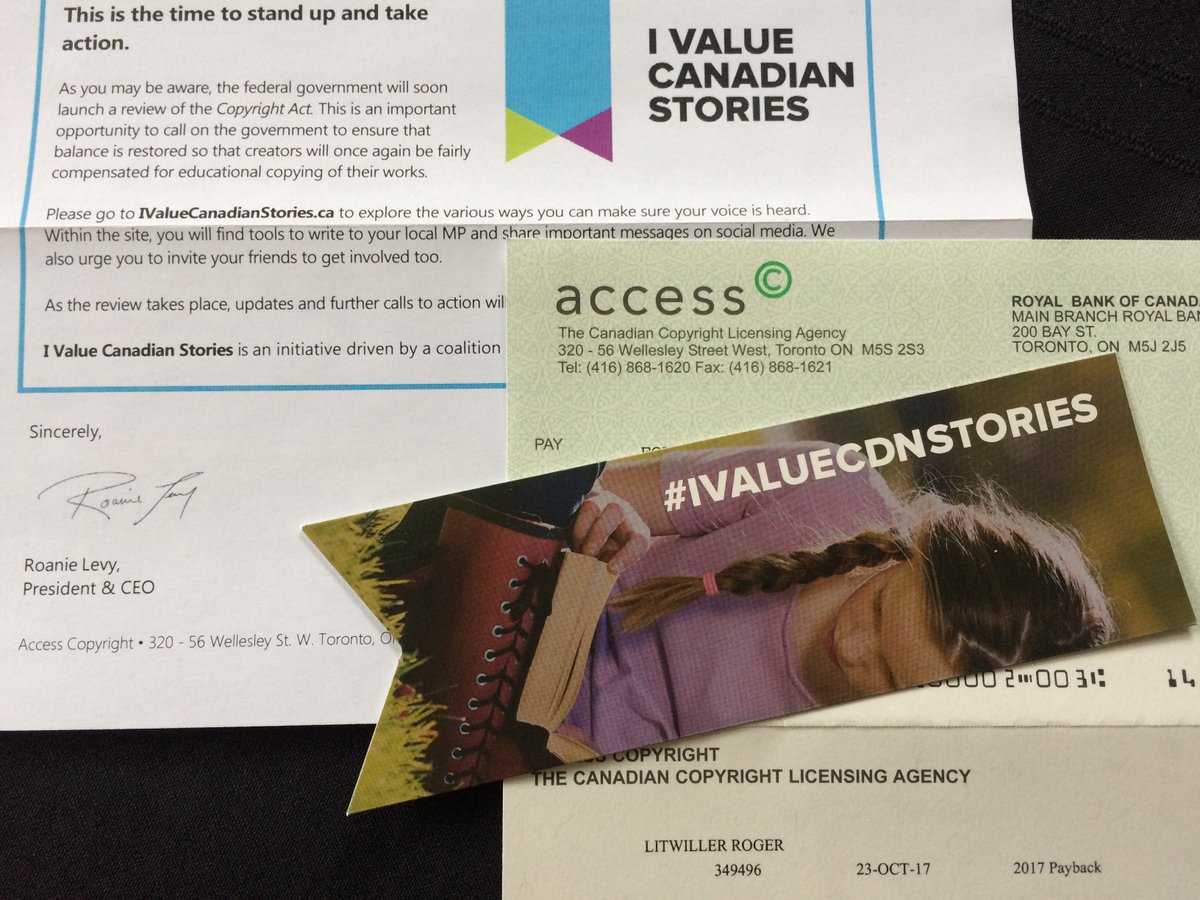
Image result for i value canadian storiesThe outcome of the session is a testament to the hard work that our community has been doing with the INDU Committee. The number of creators and publishers who have shared their personal stories during their recent cross-country tour have made an incredible difference by putting a relatable face to the problem, making it more difficult to ignore.

While this gives us all pause to feel encouraged, it is also critical that we bear down to double up our efforts and keep up the momentum. The opposition is pulling no stops and we can’t afford to either.

Make a submission to the Industry Committee

We encourage everyone to take the time to write a submission to the INDU committee.

Written submissions are meant to be brief and can be as simple as a one-page letter outlining your personal story of impact. They will help to keep reinforcing that Canadian creators and publishers have been hurt economically by 2012 changes to the Copyright Act and that the continued creation of Canadian content is at stake during this review.
 

The House of Commons has prepared detailed guidelines on making a written submission.

Image result for i value canadian storiesHere are some basic things to keep in mind for a submission.

  • Address your submission to the “Members of the Standing Committee on Industry, Science and Technology”
  • As submissions will be posted online, they should not include personal contact information beyond your name.

For the email used to submit your submission (the email will not be posted with your submission):


  • Send to indu@parl.gc.ca.
  • The person reading the emails is Michel Marcotte, the clerk of the Industry Committee. The email should be addressed to him.
  • The email should include your address, email and phone number.
  • We recommend asking for confirmation of receipt of your submission.

EImage result for i value canadian storiesngage Through I Value Canadian Stories

If you haven’t visited IValueCanadianStories.ca recently, new letters directed at the Committee were added in late April so please take a moment to send one today.  You can also get active on social media and encourage your friends to take part.

18 Ways to Choose a Title

18 Ways to Choose a Title

Gwynn Scheltema


Your book title is the first impression your readers get of your novel. It’s the first chance to connect, to inform, to intrigue, and to firmly hook readers. A great title will help readers find, remember and buy your book.

You want your title to be representative of your story, to give an indication of content or theme or genre. You want it to be unique but not confusing. You want it to be memorable and easy to spell. If you are writing a series you’ll want something to tie them together.

On a practical level you need a title short enough to fit on the cover or spine, but long enough to not get lost among other titles in computer searches. Consider how it will fit in URLs, tweets and Pinterest posts, how it will read on digital devices. The current trend seems to be single word titles, but five words or less is a good length to aim for.

Because a title is such an important aspect of your book, choosing one can be tricky and even overwhelming. The choice isn’t necessarily one you need make when you are still drafting the manuscript. If you have one in mind when you begin, by all means make it your working title, but reconsider its suitability again when the book is finished.

 So let’s get started…

What is your story about?

  • The Hunger Games
  • Harry Potter and the Philosopher’s Stone
  • The Adventures of Huckleberry Finn

A memorable image

  • Little House on the Prairie
  • In the Shadow of the Banyan
  • The Girl with the Dragon Tattoo

 Character’s name

  • Carrie
  • Anna Karenina
  • Jane Eyre

 Characters role

  • The Golden Son
  • The Last Emperor
  • My Sister’s Keeper

 When the story happens

  • 1984
  • That Summer in Franklin
  • Midnight in the Garden of Good and Evil

 Where the Story takes place

  • The Colonial Hotel
  • Treasure Island
  • Jurassic Park

 Genre

  • Murder on the Orient Express
  • A Hitchhikers Guide to the Galaxy
  • Dracula

 Metaphors

  • All the Light We Cannot See
  • The Nightingale
  • Three Day Road

 A representative line from the text

  • Cutting for Stone
  • Let’s Not Go to the Dogs Tonight
  • Sweetness in the Belly

 Questions

  • They Shoot Horses, Don’t They?
  • Who Has Seen the Wind?
  • Are You My Mother?

 Go against expectation

  • Fahrenheit 451
  • The Blind Assassin
  • Slumdog Millionaire

 An important symbol or object in the story

  • The Golden Compass
  • The Book of Negroes
  • Harry Potter and the Goblet of Fire

 A Play on words: double meanings, puns

  • Living Underground
  • Lifting the Veil
  • One Flew Over the Cuckoo’s Nest

 A twist on a known phrase

  • The Wife’s Tale
  • Elementary, She Read
  • By Book or by Crook

 Single words 

  • Divergent
  • Room
  • Silk

 Old titles reworked

  • Pride and Prejudice and Zombies
  • Zen and the Art of Faking It
  • Gnomeo and Juliet

 The promise of a story

  • The Handmaid’s Tale
  • The Girl on the Train
  • Gone Girl

 Theme

  • Infidel
  • Pride and Prejudice
  • Greener Grass


There is no ONE right way of choosing a good title. Brainstorm many possible titles, ask family and friends or readers which ones grab them. And when you sign a publishing contract make sure you know who gets to choose the final title.

DID YOU KNOW

When naming Writescape’s annual retreats we chose titles that had double meanings, were metaphors for the act of writing and which evoked a visual image: Spring Thaw and Turning Leaves

Registration is now open for Turning Leaves. We’re celebrating our 10th anniversary in 2018 on November 2 to 4 at Fern Resort near Orillia, Ontario. This all-inclusive retreat includes Friday night fireside chat with our guest, Andrew Pyper, about the writing life and an intense morning workshop with Andrew on Saturday. He’s an award-winning writer, a master of dark and disturbing mysteries and fantasy, and excellent workshop facilitator.

Our limit is 20 participants. A $250 non-refundable deposit will guarantee your spot. We expect there will be a waiting list.