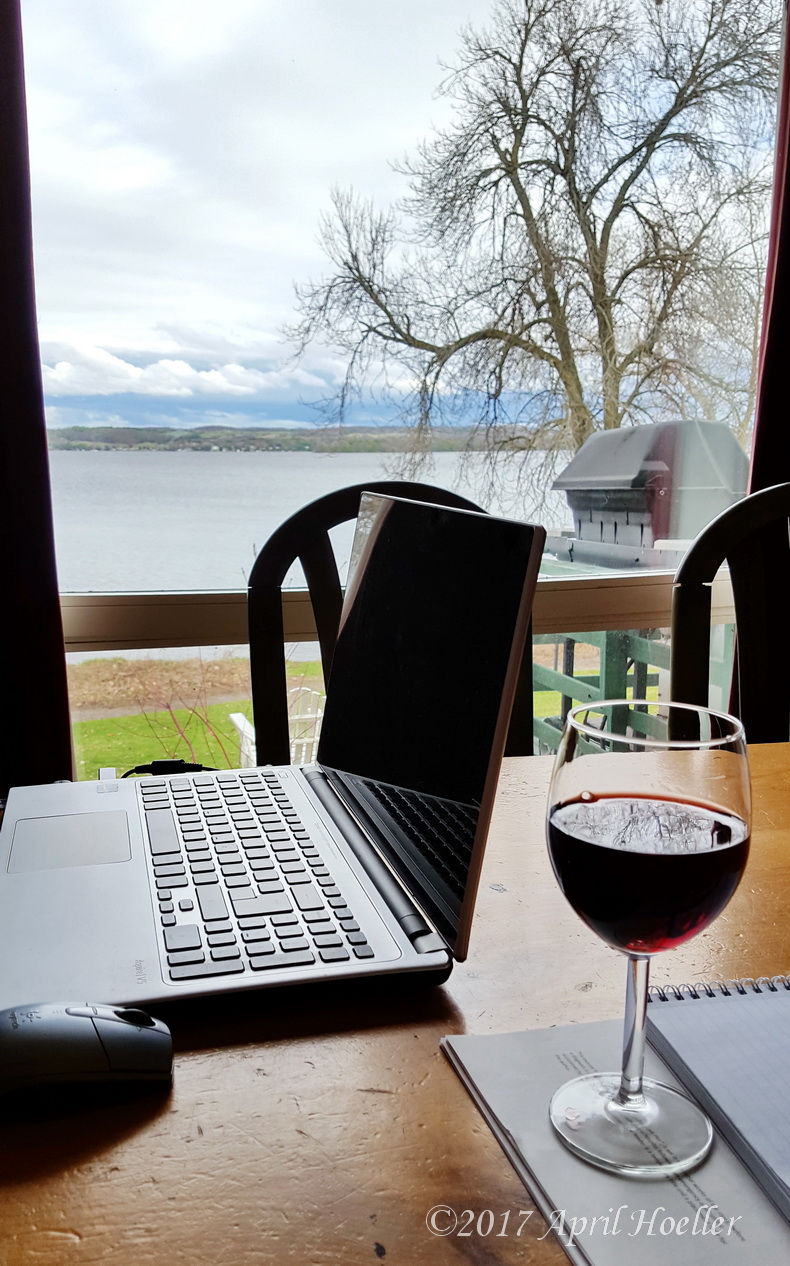
Bronwyn Hannelas, guest post
Open concept is a must in all modern IKEA-catalogue-worthy homes. The glossy photos selling Swedish furniture promise you zen and relaxation. The reality is, unless you are living in a staged home, the open-concept layout likely means you’re being more overwhelmed by constantly looking at your overstuffed abode.
And for some writers, that can be deadly.
When you don’t have an uncluttered space to disappear to, your ability to hunker down and write can be seriously hampered.
Yes, you can write amid household chaos, but on some level you will always be fighting the distraction. It’s something I’ve had to struggle with until I found a solution.
Writer in a small house
Without a basement rec room, our main floor living space does triple duty:
- toddler jungle gym
- adult relaxing space, and
- hubby’s office
Our cozy open concept dining room/living room always contains a lot of noble to-dos. The clean laundry waiting to be folded, the out-grown toys that can be donated or sold, the droopy plant begging for some water, and a thousand other half-finished projects that “will only take a few minutes.” You can’t feel guilty about not writing when you’ve tackled a stack of six months’ worth of unfiled health insurance claims.
But that’s exactly why we need to create a dedicated writing space. It should be a firm barrier against the rest of our lives’ clutter. No bake sale reminder notes or unpaid electricity bills allowed.
For Stephen King, it was the laundry room. For me, it’s the kitchen.
Choose your clutter battles
Even on our messiest kitchen days, we can get that sucker clean in about twenty minutes.Thanks to minimalizing purges and keeping things simpler, the countertops are clear once devoid of dirty dishes. Just don’t peek in the odds and ends drawer that every kitchen seems to harbour. (Editor’s note: That odds & ends drawer image is what inspired Writescape’s weekly blog for writers: The Top Drawer.)
The chairs may not be the comfiest ones in the house, but my kitchen has a good sized — and most importantly — empty writing surface. The best part? There is no sightline to the main living area — a minefield of emotional and physical clutter despite our best efforts. Once the crushed Cheerios and glitter have been swept up, the kitchen feels light and clear, and so does my mind.
 Plus, the kettle is very handy for a cup of tea.
Clear off other distractions
Clutter goes beyond the tangible mammoth expresso machine and stack of Keurig cups eating up half your counter. Better turn off the data on your phone too when you want to have the space to write. The reminder pings of library books to renew and notices of who’s commented on your status go a long way to derail your week’s word count goal.
 If you are fortunate enough to have a dedicated writing space, it’s well worth the time-investment to apply a Marie Kondo approach to that room. In a nutshell, keep only items that you consider beautiful or useful (i.e. research is informing your novel – but really, can’t you just digitalize that and recycle the folders?).
Even tackle that mug of twenty random pens picked up from conferences and hotel stays. Yes, pens are useful. No, you don’t need twenty of them stuffed into a coffee mug with an undecipherable dishwasher-faded logo. We all work best when not distracted and stressed by our things.
Sometimes though, life’s clutter can be a welcome creep into our writing havens. The other night, both kids ended up in the kitchen with me for cups of cocoa after a thunderstorm had them calling for “Ma!” Their presence — a lovely distraction that left sticky cocoa rings and dirty mugs on the table — provided the bones for this post. So, some distraction can give birth to inspiration.
Just make sure the laundry hamper is tucked out of sight. It’s hard to write a bestseller while folding undershirts.
 Bronwyn Hannelas is a blogger at Small House Big City where she writes about her family’s adventures in minimalism.





 1. When David Leviathan wrote
  For worse- It’s still a little difficult to write an LGBTQ story and not have the expectation that it will include one or all of the following: Romance, Sex, Erotica. But, our stories do not need to have a tunnel-vision focus on sexuality and love life. I came face to face with this frustration recently during a #PitMad event on Twitter. I wrote a literary novel with LGBTQ characters. I had a few likes, but they were all from publishers who only publish gay romance with degrees of sex. I even tagged the novel as literary. They are not yet looking for gay novels that don’t include these things.
 To mark Pride Month, why not add a Canadian LGBTQ novel to your reading list. Read a book by Kevin Craig or choose one from


 I live in a tiny granny suite in the southwestern corner of BC, where space is at a premium. I can no longer keep physical archives, and I didn’t have enough empty file storage space on my existing computer. My archive still had to exist in a form that was
 A quick poke through Staples and London Drugs websites unearthed the perfect solution: a hefty 2 terabyte Passport drive that plugs in to a USB port on my computer, and holds LOTS of files. All I needed was a sale and less than $100 to end my space challenge.
 Consistent folder names across the various storage, email, and social media platforms make retrieval much easier. Folder structures work best for me if they are named in the ways that I think, so I created my own. A couple of hours saw my folders labelled and matched on every platform.
 Emails (in individual folders OR across the entire inbox and all sub-folders) are searchable by subject line, content, keyword, date and sender and by some or all of the above in every mail program out there. You just have to learn how. Every email program is slightly different, and not everyone uses my beloved Outlook. For Gmail, I read the search
  Leah Murray operates
 At present I am perusing Penelope Lively’s memoir,
  Lively has always been deeply interested in time, memory and context. “A lifetime is embedded; it does not float free; it is tethered to certain decades, to places, to people…” Though she read history at University, she has had a life-long interest in archeology. Artefacts and the physical evidence of the past which she examined in
  She explores the operation of memory, and how it affects people, in her novels. “You can make lavish use of it, allowing it to direct what happens or simply evoke what has once happened to flesh out a character, or give added meaning to what a person does or thinks. It is the essential secret weapon for a novelist.”
 Then Lively considers the importance of reading and how that has shaped her life. Living, always, in a house full of books, she knows that the “inferno of language” sitting on her shelves, is sorted by the mind; much is discarded, forgotten, but a “significant amount, becomes, that essential part of us—what we know and understand and think about above and beyond our own immediate concerns. It has become the life of the mind.
 In her final chapter, Lively returns to the topic of identity. In picking out six objects she values and which “articulate something of who I am” she gives the reader another look at herself, the interests of a lifetime and how her imagination works.


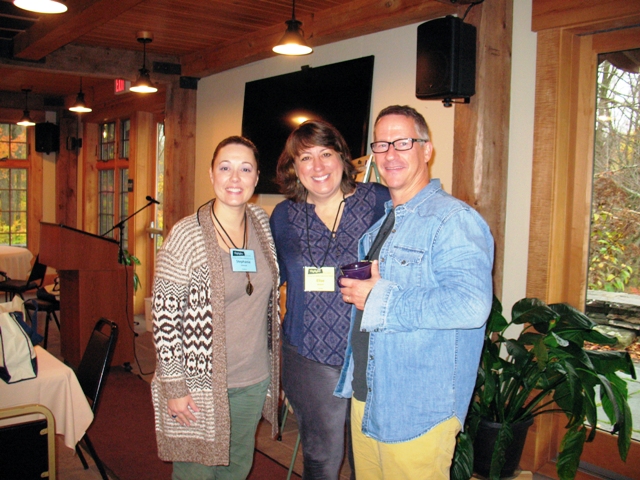


 Recently, I had the privilege of participating in Indie Author Day at the Pickering Central Library. Sponsored by the PineRidge Arts Council, its purpose was to bring independent and micro-published authors together under a single roof to share ideas and lamentations about this journey we call writing.
 Most of the speakers at Indie Author Day touched on the fact that indie books have a hard time finding a home in libraries and book stores large and small. There is a very good reason for this. Curated decisions at macro and micro levels are always informed by history and convention. What worked last year will continue to work in subsequent years until new factors change the conversation.
 But times are changing and Indie authors in the digital age are in a unique position to pioneer the next wave by reaching where they could not before. Heavy oak doors barred, locked and guarded by agents and executives fall away when the author, published or not, has access to millions of readers via Internet platforms. Promoting in the safety and comfort of one’s home is the best place to start building the profile that grows the brand.
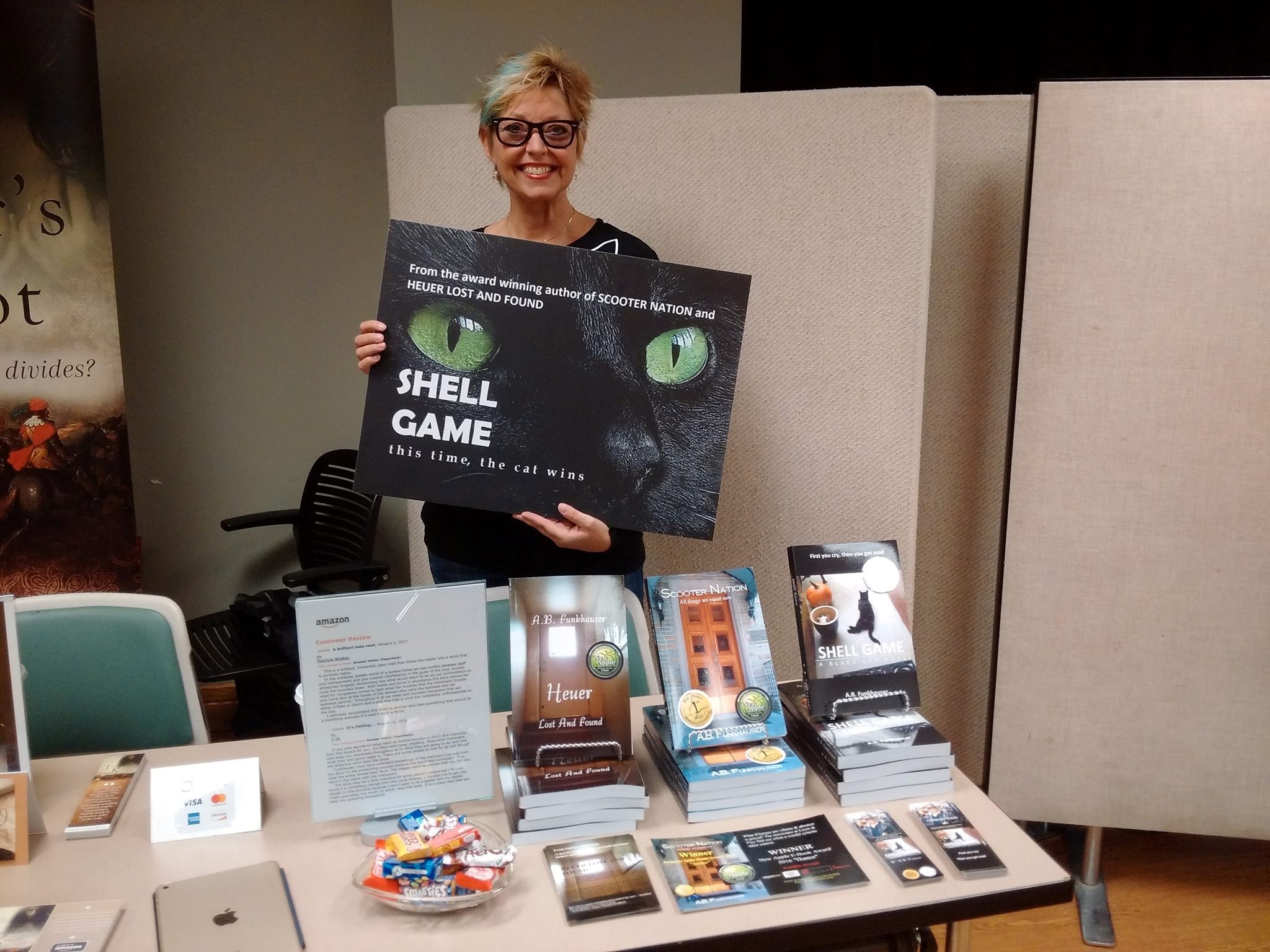 Like a politician with a constituency, independent authors need followers as a first step to developing “cred” for the words they write. As I explained more than once on Indie Author Day, we can write the best novel, screenplay, short story or poem, but no one will know if we do not get out there and let people know.
 Publishing models in the Indie world present many formulas. My publisher says “seven years or five books” before anything happens. Whatever is served up, writers should not be discouraged. Time is an opportunity not just to write, but to build brand and the followers who support and advance it.
 Toronto born
 In just ten years, Vicki (also writing as Eva Gates) has more than 20 crime and mystery novels to her credit .
 Mystery novels really do fill the spectrum from light and fluffy to very dark indeed. Something for everyone in fact. Darker crime novels, such as psychological suspense, show the human psyche under pressure.
 At the moment, I’m writing mostly cozy books. Cozies are all about friends and family and community. The tone is much lighter, there is never any real danger to the main characters, and not much in the way of tragedy or angst. Sometimes a little dash of romance, but the friendships are all important. People love these books because they come to love the characters and the town they live in. And the food. Food and books are often important in cozy novels.
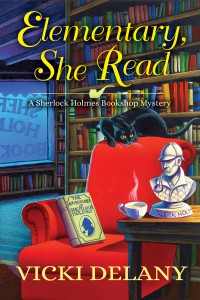 The hig
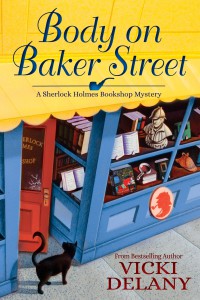 hly perceptive Gemma is the police’s first suspect, so she puts her consummate powers of deduction to work to clear her name, investigating a handsome rare books expert, the dead woman’s suspiciously unmoved son, and a whole family of greedy characters desperate to cash in on their inheritance.
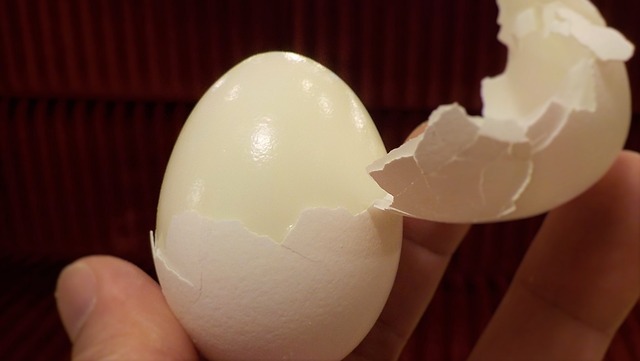 Then it’s time to start to write. I walk into the dining room and stand at my Netbook computer which is on the half-wall between the kitchen and the dining room. As I pass through the kitchen, I put one egg on to boil. (In the summer, I might sit outside on the deck). I always write, standing up, on the Netbook. I read over everything I did the previous day, doing a light edit as I go. I then take my egg into the study and eat it while checking email.


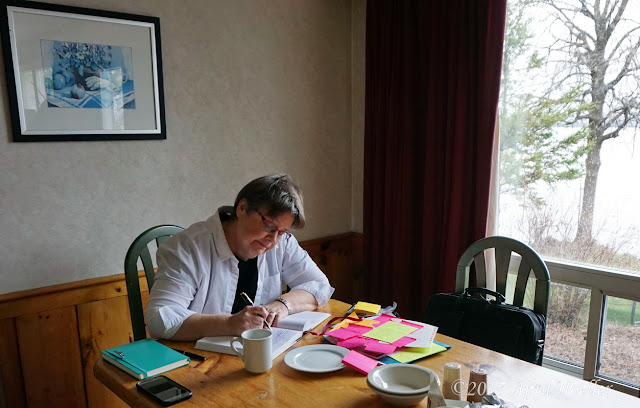 I found the doorway into a section of the memoir that I’ve been struggling to get a grip on for months. I not only plotted out my way through it, I also committed some 5000 words to paper, half of the chapters. Woot! Woot!