

A reader left this comment on one of our recent blog posts: “Great blog! I’ll be saving this to my Digital Idea Archive.” What’s a Digital Idea Archive??? We contacted the reader, Leah Murray from BC, and asked her to explain….
Guest blogger: Leah Murray
Do you sometimes need a new idea to get creative and writing again? I do. But now I know what to do about it, thanks to my Digital Idea Archive Project.
I figured my project needed to be tackled in three parts:
- Find inspirational ideas I want to keep
- Stash ’em someplace safe for future reference
- Find ways to retrieve them after we’ve passed through the ancient mists of time (gulp).
Getting the archive set up was straightforward. Sure, it posed a few questions, but I found the solutions and in the end it was worth the effort.
Find ideas I want to keep
Google’s computerized searches are well up to the work of finding inspiration. If Google could do it online, could I harness that for personal use?
Yes. There’s a handy thing called a Google Alert that will scour the web and bring back whatever it finds about your interests in the form of a daily emailed digest. It took me no time at all to set up Alerts for books, writing tips, photography, farming, small business, and other topics that interested me.

Emailed items turned out to be another piece to the puzzle: if I can see the original text or image that triggered my idea, I can recreate my train of thought in a flash. Getting ideas emailed to me or emailing myself and then archiving those emails appropriately seemed a good way to start. My Google Alerts became part of that
My written work is often triggered by images, so Pinterest was the next stop. There I set up “boards” for books I wanted to read, writing craft, punnies, inspirational artwork/photos, places I want to go, and my perennial interest in self-help/DIY things. Like Google Alerts, Pinterest also sends me a weekly email based on my preferences.

My newest venture is Instagram, a mobile app a lot like Pinterest, but which I find good for sourcing and organizing videos and the people who produce them, like this video on what Instagram can do.
Idea archive part one, check.
Stash ’em someplace safe
 I live in a tiny granny suite in the southwestern corner of BC, where space is at a premium. I can no longer keep physical archives, and I didn’t have enough empty file storage space on my existing computer. My archive still had to exist in a form that was
- accessible with minimal effort,
- human browsable, for when I’m leisurely searching files for a fresh idea or slant on a perennial topic, and
- computer searchable, for when I’m working on a broad topic with lots of disparate notes from different times.
 A quick poke through Staples and London Drugs websites unearthed the perfect solution: a hefty 2 terabyte Passport drive that plugs in to a USB port on my computer, and holds LOTS of files. All I needed was a sale and less than $100 to end my space challenge.
Most mail programs allow you to print your emails to pdf and put them in disk folders, but I’m lazy-fingered and find that inconvenient. Gmail for example: Right-click on any white space in the email you’re looking at, choose Print, and then use the Change button under Destination to select “Save as PDF”. Most recent versions of Windows and Mac OS have this built in – if yours doesn’t, an Adobe Reader download – – will install it for you.
But my emails get sorted into archive folders under my in-box: I just drag and drop them from inbox to mail folder as I’m checking email each morning. I then use Office 365’s Outlook archiving features to put folder structure and emails onto my Passport drive.
All social media platforms have been known to lose links to information, so things I want to keep, I save to my own archive. In Pinterest I just click on the image, then the “Read It” button at the bottom right hand corner of the image, and copy-paste the article into a Word document and store it in an appropriate folder on my computer. LinkedIn lets me copy and paste entire conversations the same way.
 Consistent folder names across the various storage, email, and social media platforms make retrieval much easier. Folder structures work best for me if they are named in the ways that I think, so I created my own. A couple of hours saw my folders labelled and matched on every platform.
I write a LOT about photography and digital imaging, and write poetry, essays, and fiction, so here’s how I organized things.
Occasionally I create a desktop or browser shortcut, aka a bookmark, if I think a topic is a passing fad rather than a long term trend. Bookmarks are easy to create both in Mac and Windows.
For stuff I’ll work on in the next month or two, I save browser bookmarks in folders (yes, you can make – and search – your own folders there too)! ( Chrome does it this way; Firefox this way, )
Idea archive part two, check.
Retrieve ’em when you need ’em.
Getting things back from storage, of course, is key.
 Emails (in individual folders OR across the entire inbox and all sub-folders) are searchable by subject line, content, keyword, date and sender and by some or all of the above in every mail program out there. You just have to learn how. Every email program is slightly different, and not everyone uses my beloved Outlook. For Gmail, I read the search instructions first, learned about search operators next, followed up with a couple of questions in the support chat forum, and I was away to the races.
I then started to learn how to use my File Manager search function to retrieve things. I was astonished to find that my computer has a collection of lovely internal searching systems tucked away in its version of “plain view” – here’s a Windows tutorial on how to find and use those effectively. Macs aren’t wildly different: you use Finder there instead of File Manager, but the principles are identical.
Et voila: one big idea archive, for zero physical space, a few dollars, and a bit of head-scratching.
Digital Idea Archive Challenge conquered!
Meet our guest blogger – Leah Murray
 Leah Murray operates byteSMART Strategies from the Lower Mainland of British Columbia, Canada.
Following a career in the Canadian Forces, Leah opened her first technology support business in Oshawa, Ontario. She closed that business in order to work with scientists in the Research & Development division of an international pharmaceutical company headquartered in Toronto. Several years in rural Ontario developed her passion for small businesses, artisanal, agricultural and otherwise, and today she devotes her energy to helping these enterprises plan, transition and manage their technology.
Today, her raison d’etre is the bringing of technology into the service of the arts, and she writes about it!
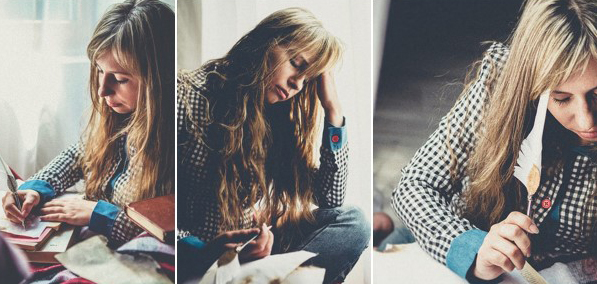
 The writing critique group I belong to understands this perfectly. We meet every two weeks and at the end of each meeting we all set a writing goal for the next two weeks only. We each set our own goal depending on what we are working on at the time and what is happening in our lives.
 When I’m trying to avoid that “frog”, I play solitaire, disappear into social media or sort the kitchen junk drawer or….. I’m sure you have equally pointless—and time consuming—avoidance tactics.
 Now this may seem contradictory to the “eat the frog” principle, but getting through your to-do list and achieving your goals begins with making your bed.
 So there you have it.
 A writing retreat is a great way to focus on your writing projects and goals and registration for Writescape’s
 At present I am perusing Penelope Lively’s memoir,
  Lively has always been deeply interested in time, memory and context. “A lifetime is embedded; it does not float free; it is tethered to certain decades, to places, to people…” Though she read history at University, she has had a life-long interest in archeology. Artefacts and the physical evidence of the past which she examined in
  She explores the operation of memory, and how it affects people, in her novels. “You can make lavish use of it, allowing it to direct what happens or simply evoke what has once happened to flesh out a character, or give added meaning to what a person does or thinks. It is the essential secret weapon for a novelist.”
 Then Lively considers the importance of reading and how that has shaped her life. Living, always, in a house full of books, she knows that the “inferno of language” sitting on her shelves, is sorted by the mind; much is discarded, forgotten, but a “significant amount, becomes, that essential part of us—what we know and understand and think about above and beyond our own immediate concerns. It has become the life of the mind.
 In her final chapter, Lively returns to the topic of identity. In picking out six objects she values and which “articulate something of who I am” she gives the reader another look at herself, the interests of a lifetime and how her imagination works.


 Whenever I travel, I visit gardens; I seek them out in concrete-jungle cities and have a vast one of my own. My mother and grandmother taught me to create landscapes that worked with nature, not against it. They taught me how to create a green space with soul. And I realized as I looked at this tiny urban gem on my walk, that creating a garden that has a heart is very much like writing.
 We all have big writing dreams: maybe the next best seller, perhaps an award or earning enough to live on. But on any given day, don’t worry about what seems unattainable. Work with what you have.
 Not everything we write is worth keeping, but often you write a really good scene or stanza that just doesn’t fit with the piece or poem you’re working on. It might even be one of your proverbial “darlings.”
 But you’ll find that you get more out of your writing community when you contribute: give of your time, your expertise and your encouragement and support. We all have high and low times as writers and whether you need someone to help you with a practical plot problem, to celebrate a success or just give you a kick in the pants to submit or get writing, your writing tribe are the best people to do it. But, offer the same to other writers. I know that over the years, I’ve learned more about the craft by talking to fellow writers and giving feedback to others than from any book.
 Without planning and fertilizing, weeding and maintaining, gardens wither or become something else you have no use for. Your writing, like any art form, is the same. You wouldn’t expect to play the piano well without practising regularly. Writing is no different. Write, write and write some more. Plan writing time into your schedule. Fertilize your craft with workshops, reading and communing with fellow writers. Weed out all your negative attitudes about not being good enough. And fill your creative well often.
 Initially, it doesn’t matter. When you begin your first draft, story is key and the story will land in the genre it fits best. But once that draft is done, knowing your genre is important. You’ll need to know so you can fine tune your manuscript and pitch it to the right agent or publisher.
 Let’s take the crime/mystery genre as an example and the typical “dead body”. In a cosy mystery, your readers will expect to spend a few chapters meeting the inhabitants of a cosy community and getting to know the protagonist and her friends before the “dead body” is discovered. The actual killing will be off stage. In a police procedural mystery, the “dead body” is there by the end of chapter one. Readers may even witness the murder. It will be important to follow real police investigative and forensic procedures.
 1. Prepare a book jacket blurb
 With your book jacket blurb in hand, you have your main dominant story thread. Use that main thread to define the main genre. For instance, if your book involves a mystery and a romance, is the dominant story thread a classic “who done it” with a bit of romance thrown in for character growth? (mystery) Or is it really about a relationship blossoming between two people who happen to be solving a mystery together? (romance)
 Nail down the age group your book is aimed at: children, young adult, new adult or adult. If your manuscript appeals to more than one group, you have an age cross-over. (Think Harry Potter (children/adult) or Hunger Games (YA/adult).)
 One way to do this is to have two windows open, one on Amazon and the other on Goodreads. Read the blurb on Goodreads and then search the book on Amazon to see its classification.
 In just ten years, Vicki (also writing as Eva Gates) has more than 20 crime and mystery novels to her credit .
 Mystery novels really do fill the spectrum from light and fluffy to very dark indeed. Something for everyone in fact. Darker crime novels, such as psychological suspense, show the human psyche under pressure.
 At the moment, I’m writing mostly cozy books. Cozies are all about friends and family and community. The tone is much lighter, there is never any real danger to the main characters, and not much in the way of tragedy or angst. Sometimes a little dash of romance, but the friendships are all important. People love these books because they come to love the characters and the town they live in. And the food. Food and books are often important in cozy novels.
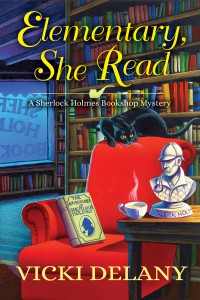 The hig
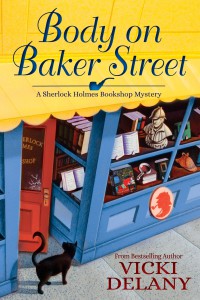 hly perceptive Gemma is the police’s first suspect, so she puts her consummate powers of deduction to work to clear her name, investigating a handsome rare books expert, the dead woman’s suspiciously unmoved son, and a whole family of greedy characters desperate to cash in on their inheritance.
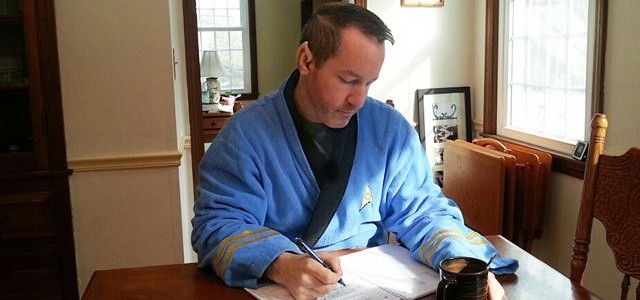
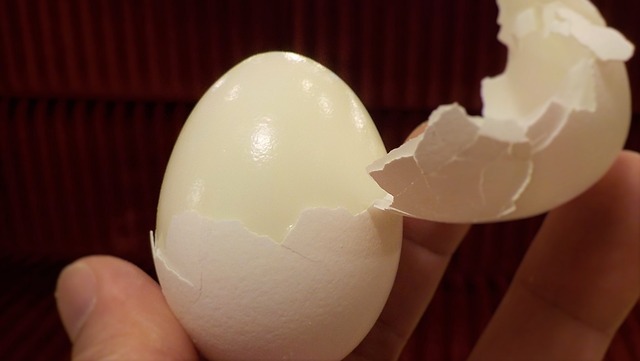 Then it’s time to start to write. I walk into the dining room and stand at my Netbook computer which is on the half-wall between the kitchen and the dining room. As I pass through the kitchen, I put one egg on to boil. (In the summer, I might sit outside on the deck). I always write, standing up, on the Netbook. I read over everything I did the previous day, doing a light edit as I go. I then take my egg into the study and eat it while checking email.
 ok
ok  If writing is important to you, it needs to be built into your routine in the same way that you build in any other important activity in your life. If you need to schedule writing time like dental appointments, piano lessons, or hockey practice, do it. Think of writing as your “job” and block out set times like you would if you were going to work.


 Most readers, even though they may not realize it, read to mirror their own lives. Have they felt that way before? What would they do in a similar situation? How is this situation different from their lives? A story about events of that civil war would be different from an average reader’s life, but would it connect with readers on a human, emotional level? The key to making my story work was to focus not the events the reader couldn’t relate to, but on the emotions the reader could relate to. The emotional mirror.
 “In almost every instance the result is the same,” he says, “The ‘riveting’ piece bores, while the ‘boring’ piece holds interest.”
 As I wrote, I closed my eyes and imagined the scene in my mind. What could I see above, below, to the sides? What people and things were in my periphery? What could I hear, smell, touch, what was the quality of the light, temperature of the air? What emotion was I feeling at each point and what did that emotion look like in gestures, actions and reactions?
  To heighten the feeling of disorientation, of not fitting into a new world, of being out of control, I edited to make the sentence structure disjointed in places, short and fragmented in others and even syntactically out of step at times.


 Don’t fight the writer within. Your best, most authentic stories come from that place deep in you and will resonate with readers when you allow the distilled essence of your life, your experience, your passions and your attitudes come through.