Writing Plan Meets Real Life

Writing Plan Meets Real Life

Just a few short days ago, at Spring Thaw 2017, a group of writers tucked themselves away in cozy cottages on the shores of Rice Lake. It’s what Writescape loves about our retreats: the creative energy that comes to writers when the natural world helps them dive deep into their words.

We also know that keeping that energy alive becomes a challenge when bags are packed and the road home is inevitable. So our retreats include built-in tools to help with the transition back to reality. A themed companion workbook offers pages of prompts and inspiration during the retreat and continues that role as needed. A wrap-up session is designed to ease the goodbyes and help with ideas, commitments and plans to “keep the words coming.”

About those plans. They can be general intentions or itemized lists and firmly set timelines. But then reality rears its own set of lists and timelines. Writescape retreat alumnus April Hoeller left Spring Thaw with firm plans that came to a halt the day after returning home. She shared what happened on her blog “What I’m thinking today,” and how she took a roadblock and turned it into a bridge back to her writing. With her permission, we reprint it here:

Guest blogger: April Hoeller
Monday Moanings – May 1, 2017

It’s raining.
It’s pouring.
This old scribe is…

Well, what is she up to on this first day of May?

Get out your smallest violins because I’ve got on a pair of whiney pants for this Monday Moaning.

What, pray tell, is the point of having a plan, a specific, measurable, achievable, realistic, time-based strategy for getting things done, when something as simple as a telephone call can render it so irrelevant so quickly?  Let me be clear – nobody died or was diagnosed with cancer, or lost a job. World War III has not broken out, though that has been a haunting concern of mine for a few weeks now (a whole other blog!). There is nothing tragically wrong. My world is still turning at a great clip but it’s just not doing so according to my plan.

I arrived home last Tuesday afternoon from an amazing writing retreat.

The most productive retreat ever
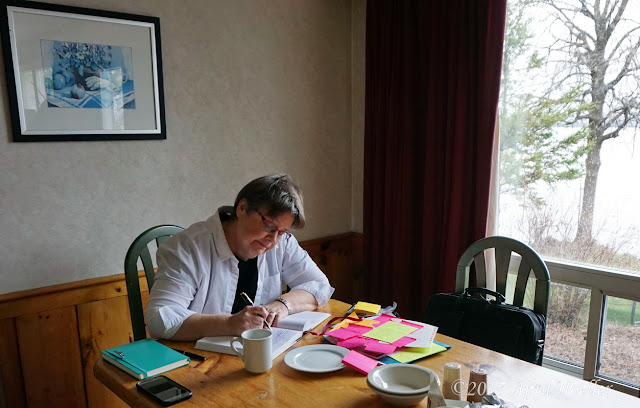
I found the doorway into a section of the memoir that I’ve been struggling to get a grip on for months. I not only plotted out my way through it, I also committed some 5000 words to paper, half of the chapters. Woot! Woot!

I am indebted to Ruth Walker and Gwynn Scheltema, the dynamic duo of Writescape, for their encouragement, companionship, and occasional goading.
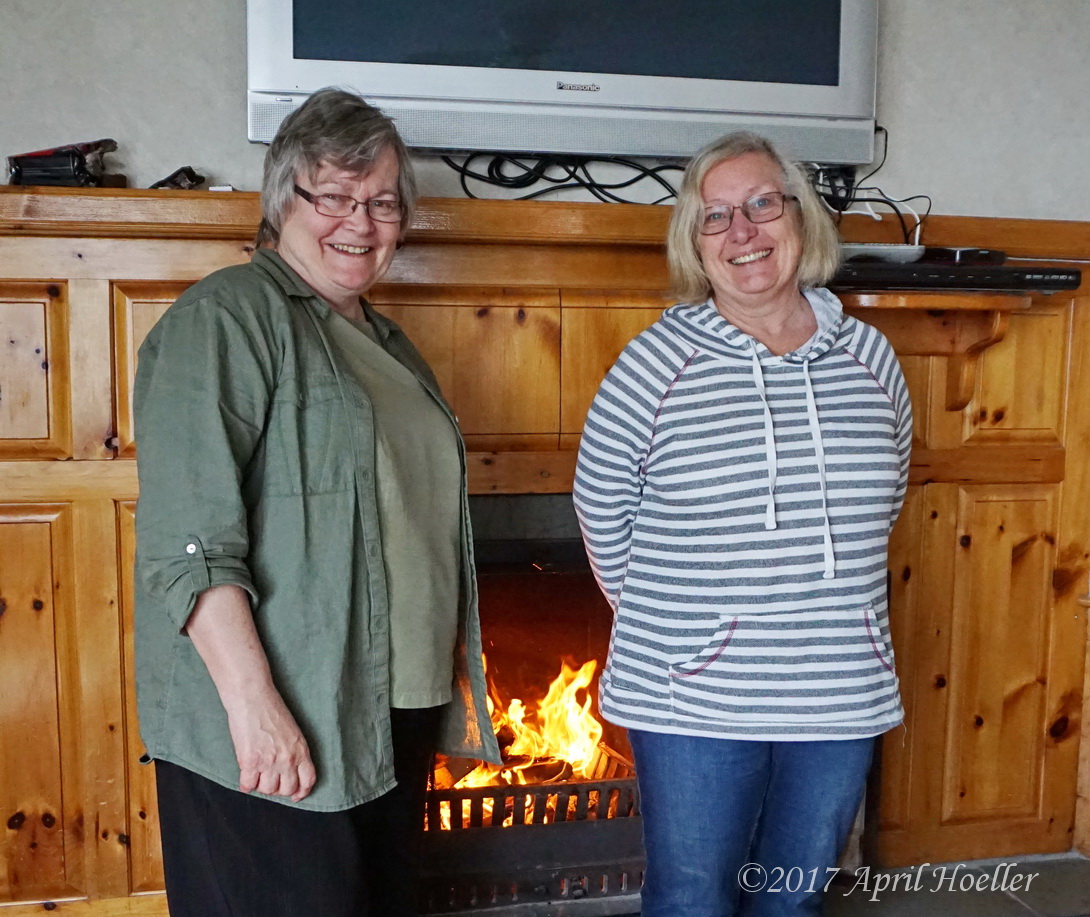
… and a good sense of fun too!
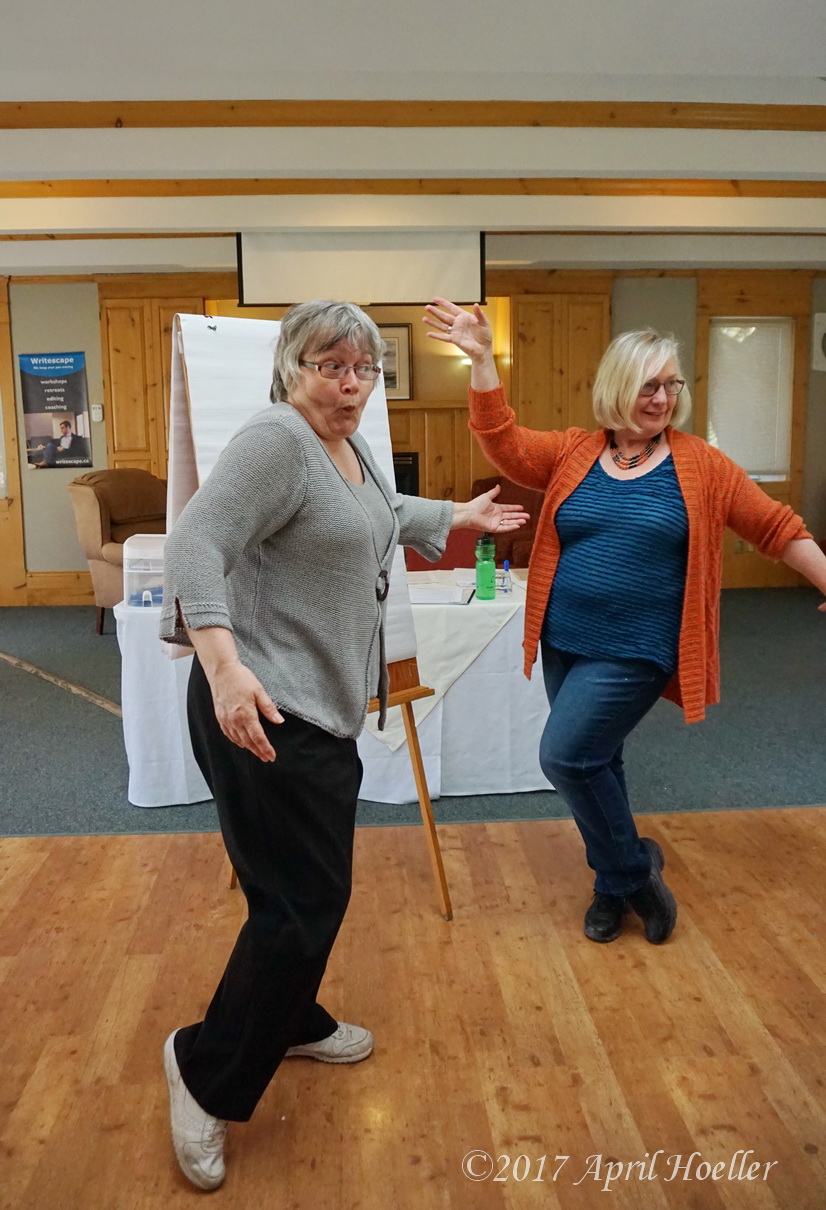
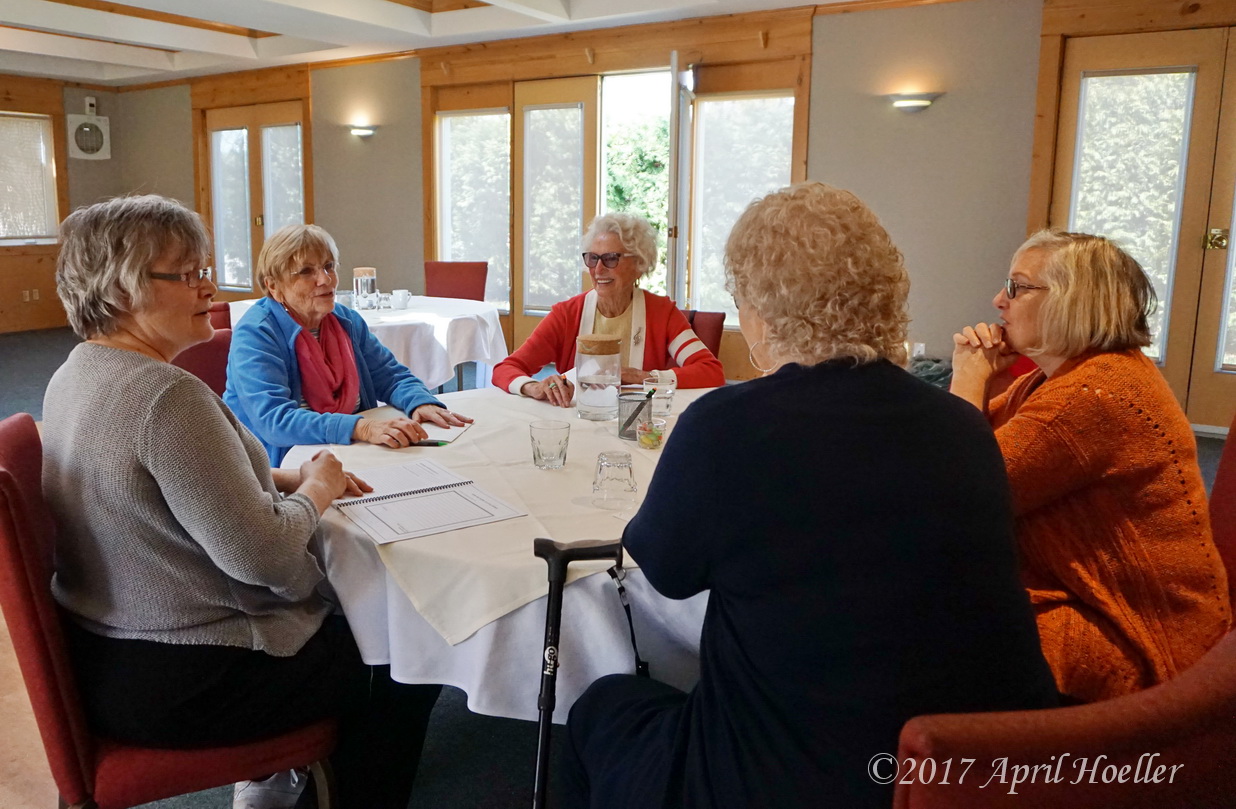
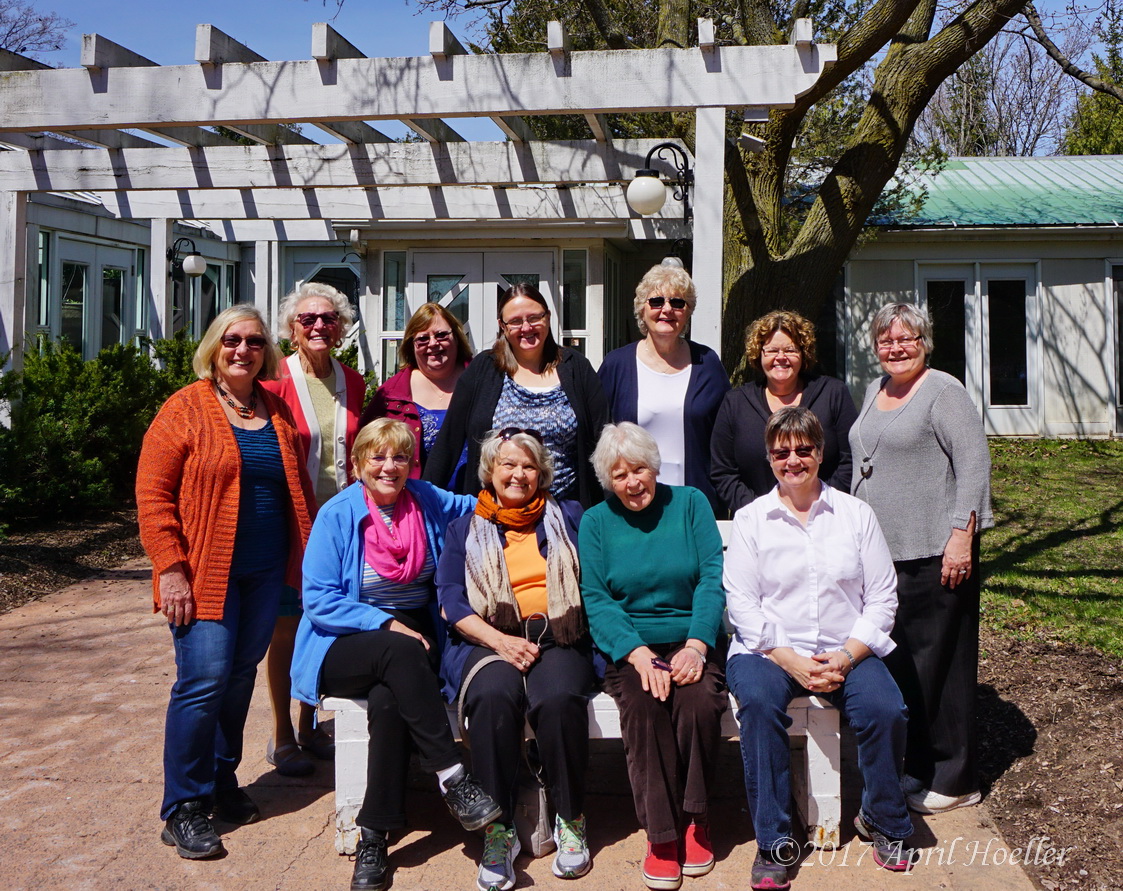
Indispensable to the retreat is the energy and inspiration that blossoms when a group of writers gets together for a weekend. Good conversations, suggestions, laughter and affirmations abound. A big thank you to all of you!


Homecoming

I arrived home all fired up, ready to move forward at good pace. I had a plan too – always an important part of a retreat. So there I sat Wednesday at the harvest table in my kitchen with pens, paper, and mind ready, at 1 pm – right on schedule. And then the phone rang.

I ignored it, letting my guy answer it, while I put pen to paper. A whole sentence emerged. With great satisfaction, I tapped a period at the end. The next sentence was spoken by my husband.
“They want to start work on the solarium next week.”

I capped my pen and closed the book. No words have been written since. The solarium construction was not scheduled to begin until the end of June. Nowhere in my plans for the coming week, or even the coming month was there any reference to “The Solarium.” But the contractor had a cancellation and our name rose to the top.  We have been able to put them off for two weeks – because we’ve got prep work to do, none of which was on our radar – until last Wednesday.


What’s a writer to do?

This is not a derailment. It’s just a layby in a siding to let a construction train through.

So, throw off those whiney pants.

Make another plan to write my way between, around, over, through the interruptions.

Just think, in a few weeks I’ll have another writing space!

Cheers!

Did You Know?

You can read more of April Hoeller’s words on writing, travel and life at What I’m thinking today, her online blog.

Thanks, April, for reminding all of us that while life may happen (and it always does) we can find ways to keep close our writing goals. A writer needs to be ready to return to the page. Writing time is precious. Don’t waste it.

Writescape retreats are held spring, summer and fall, and deliver inspiration and support for writers.


Your Writer’s Voice

Your Writer’s Voice

Gwynn Scheltema

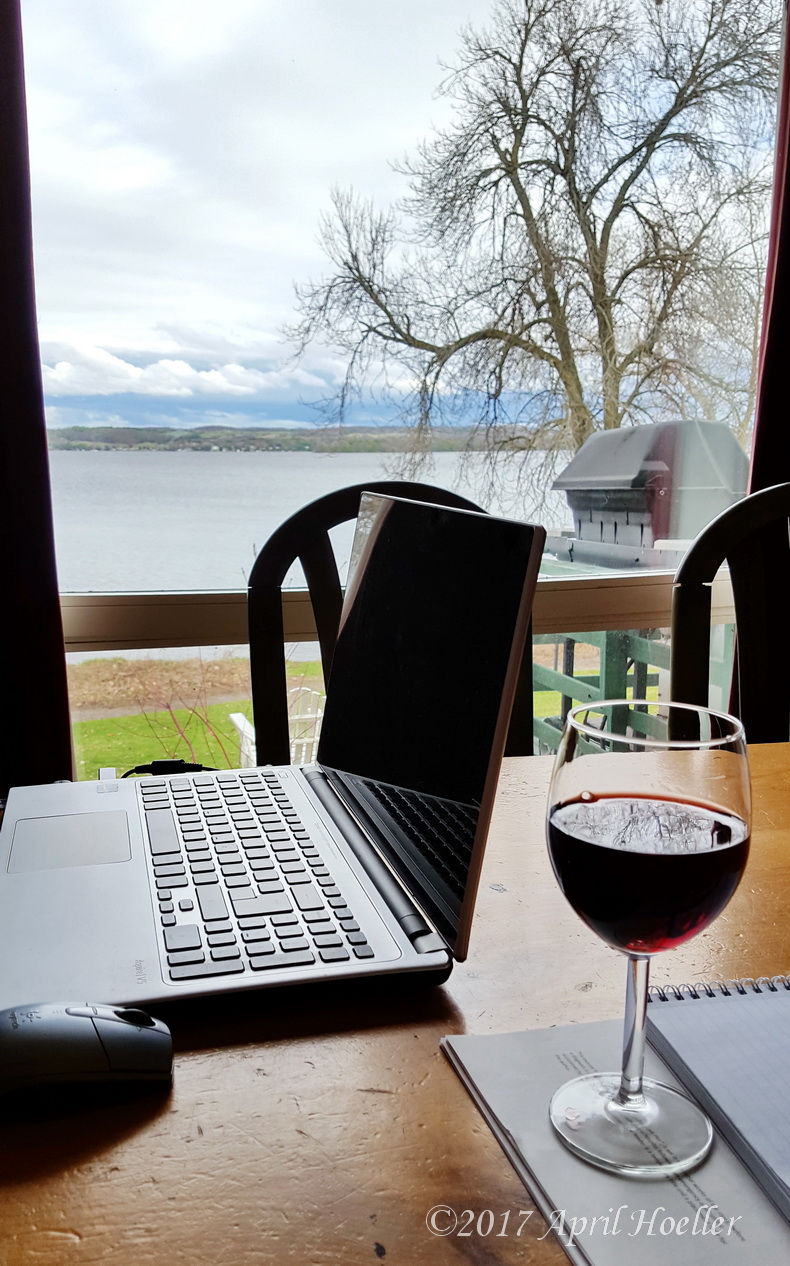
The lake inspires on this beautiful spring day. All around me words spill onto pages, fingers tap-tap on keyboards and there is an electric energy in the room. I’m among people who understand me, the writer.

photo by April Hoeller 2017

I’m here at Writescape’s Spring Thaw 2017.

On Saturday night we shared our work with each other, and as always I was blown away by the stories and the places they took me. And I was struck by the range of voices in the room, each with their own way of telling a story, of painting mood, bringing out emotion, of relaying information. Some voices were a familiar comfortable journey, some a new adventure into story.

But each voice was unique. And I’m not talking character voice here, I’m talking about that elusive quality we call the writer’s or author’s voice. The way readers recognize you as a writer. It’s partly style, partly tone and partly an undefined quality you might call your writer’s personality.

What is your style?

Style is the mechanics of how you write. Do you favour writing in short sassy sentences or long languid, contemplative ones, or something in the middle? Is your default  word choice urban or rural or academic or down to earth? Is your writing spare, with little description or do you use imagery and metaphor with gusto? Style can also be dictated by the market or genre you write in.

What is your tone?

Tone is the attitude of your writing. Do you hit readers between the eyes or are you subtle? Are you passionate, emotional, even evangelistic? Are you formal or friendly or casual? Are you obtuse or matter of fact? Do you teach or argue or merely suggest. Just like style, tone can be influenced by the market you write for.


What is your writing personality?

Your writing personality comes from who you are both as a writer and a human being. It’s molded by what you’ve experienced, the lenses through which you see the world, what you believe in, what inspires you, what influences you, your fears, your loves, your passions, your morals. It’s not dictated by anyone, but it is yours alone.


Why does it matter?

On a practical level, it helps you hone and edit your work. If you default to introspection in your telling of a story, perhaps you might need to up the energy more in places with more dramatization. If you typically create a first draft that races headlong from plot point to plot point, perhaps you need to give the reader a chance to breathe once in a while. And we all have stylistic tics: insistent words, phrases, constructions or images that bubble too often to the surface and which we no longer notice because they are part of us. I know, for instance, that I tend towards longer sentences and use the words “somewhat” and “little” a great deal in a first draft.

But it’s more than that. Recognizing that you have a voice that is uniquely yours is what helps you write authentically. Trying to write what you think you should write, or what others want you to write, often fights with the way you authentically write. We all have those moments when we feel a piece is not quite what we wanted to say. Chances are you’ve written it in something other than your own authentic voice.

Embrace your writer’s voice

Don’t fight the writer within. Your best, most authentic stories come from that place deep in you and will resonate with readers when you allow the distilled essence of your life, your experience, your passions and your attitudes come through.

The more you write, the more distinct and consistent your voice will become. Don’t worry about “finding your voice”. Just write what you are driven to write, in the way you think it is best expressed and send your writing out into the world. Your voice will be there.

DID YOU KNOW

Spring Thaw is just one of the retreats that Writescape offers each year. You can escape for a day of inspiration or settle in for a weekend or more of focused writing. Learn about what you can expect at at Writescape retreat.

Tax tips for writing income

Tax tips for writing income

Gwynn Scheltema

A query arrived in the Writescape’s comments mailbox last week the gist of which was:

I self-published a book in 2015 and sell via Amazon.com. I received a form in the mail (1042-S Foreign Person’s U.S. Source Income Subject to Withholding). My Amazon book sales are pretty paltry (a whopping $277!). Must I report this on my Canadian tax return? 

I answered in a private email, but thought that this question and others related to writing income may be on the minds of many Canadian writers preparing tax returns this time of the year, so below is the answer to this question and a few more tips about reporting writing income to get you started.

One of the many hats I wear, is that of a tax preparer at a local accounting office, which I have done for decades, so I do know a thing or two about filing Canadian taxes. And since 2009, Writescape has periodically offered a workshop on tax tips for writers and artists.

That said, a caveat: The tips offered here are general information only. Your tax situation could be influenced by other factors not dealt with here, so if you are at all in doubt, contact your accountant or follow the links to CRA’s website for more information.

What kinds of income are considered writing income?

  • royalties/ advances for book sales 9print/e-book) from your publisher (T5)
  • independent book sales, print and e-book, (possible foreign income slips )
  • grants, bursaries and residencies (T5 or T4A)
  • school visits and speaker honorariums (possibly a T4A)
  • access copyright royalties (T5)
  • public lending rights payments (PLR) (T4A)
  • freelance earnings (possibly a T4A)
  • workshops, coaching, retreat facilitation ( possibly a T4A)
  • writing contest winnings

How much do I have to make before I have to report writing income?

Canadian taxation works on the honour system. Even if you do not receive a T slip from the entity that paid you, you are obliged to report all your income from all sources worldwide. That includes sales through Amazon, PayPal, eBay and other websites, books sold at craft fairs, honorariums for being a guest speaker, etc.

Where on my return do I report my writing income?

That depends on whether you are, by Canada Revenue Agency’s (CRA) definition, a “hobbyist” or a “writer” operating as a small business. In VERY general terms:

  • a “hobbyist” reports T slip income on the lines instructed by the T slip. Generally, hobbyists do not deduct expenses, although deductions are allowed on some grants and scholarships.
  • a “writer” operating as a small business (with an expectation of profit), reports all income including income on T5s and T4As as part of business income on form T2125. (Be aware you may have to inform CRA by letter that you are doing so, so that they do not think you forgot to report the T slip income.)
  • any T4 income as a writer or editor is employment income and should not be reported as part of a writing business.

What do I do about income from outside Canada?

  • Foreign T slips you may receive include a 1042-S for the US or a SA103S for the UK.
  • Canadian residents must file worldwide income regardless of whether a return is required or not in the foreign country where the income was generated.
  • Double taxation agreements exist between Canada and many countries, e.g. the US. This means that if you paid tax on certain income in the US, you will not be taxed again on that income in Canada. CRA may, however, charge a difference between rates.
  • Foreign income must be reported in Canadian dollars. You can use the exchange rate for the date/s the income was received, or you can use the Bank of Canada average rate for the year.

 Best for last

  • Most contest winnings are considered “prescribed prizes” and are not reportable or taxable. Yeah!!
  • Unlike employment income, writing business income and grants and bursaries can be reduced by expenses paid to generate that income. What expenses? That’s a whole other blog.

Useful links


What’s in a Name?

What’s in a Name?

Gwynn Scheltema

I have a one-syllable name—Gwynn. It’s a fairly common Welsh name although my spelling is a little unusual in that it doesn’t have an “e” on the end. And, no, no-one was drunk on the way to the registry office, or misinformed or forgetful or anything else. The story goes that I don’t have an “e” because my brothers (who got to choose my name) couldn’t decide between Gillian and Lynn so they smooshed it together and added a “w” for easier pronunciation to make Gwynn.

Growing up, I didn’t know this story; I only found out in my twenties. However, my father’s family had emigrated from Wales in the late 1800s and the name means “bright, white, fair, pure, blessed” and I’m blonde, so it’s a good fit. I like it. I like that it’s different. I like that it can’t be shortened. I like that it fits my history.

Names affect the way we feel

How a person or character feels about his or her name can affect what they feel about themselves. I love the way this excerpt from Margaret Atwood’s short story “Hairball” sums up the idea. So much character and back story is packed into the paragraph. Sometimes it is the character’s own view of herself, and sometimes how others see her.

During her childhood, she was a romanticized Katherine, dressed by her misty-eyed, fussy mother in dresses that looked like ruffled pillowcases. By high school, she’d shed the frills and emerged as a bouncy, round-faced Kathy, with gleaming freshly washed hair and enviable teeth, eager to please and no more interesting than a health-food ad. At university she was Kath, blunt and no-bullshit in her Take-Back-the-Night jeans and checked shirt and her bricklayer-style striped denim peaked hat. When she ran away to England, she sliced herself down to Kat. It was economical, street-feline, and pointed as a nail.

What’s behind a name?

Playing with names is a useful and powerful tool to add to your writing toolkit. Names have meanings, ethnic histories, associations with myth and stories, famous people, gods and family ties. Choosing the right name is the key.

Finding out what’s behind a name can be fun (and addictive). The web is full of sites that give the etymology, history and meaning behind names—first names and last names. There are sites for choosing baby names, for seeing the popularity of names over the years and even “character analysis” based on names.

Choosing a name

Devyani Borade blogged in Writer’s Digest about a quirky method to choose character names for fantasy characters: “Eyes closed, I randomly open a dictionary. Then I run a finger down the middle of a column while mentally keeping a beat, and stop at the count of six. (Why six? Because on this occasion, my story has six characters.) “Macamba: (n) Tropical American feather palm having a swollen spiny trunk and edible nuts.” Interesting. I repeat the process and come up with “Tabes: (n) Wasting of the body during a chronic disease.” Ah, just sublime. Then I switch the last letters. Et voila! Tabea Macambs. Pretty exotic, eh?

Names and Personality

I went to Quizony and did a quiz called “What Should Your Name Be?” based on personality. Apparently, my name should be Camilla. The quiz tells me: “Camilla is the name of a legendary female warrior… can make tough decisions… never afraid of taking on responsibilities… always has new ideas and new goals.”

Actually, I like it. And it’s a pretty accurate assessment of me. So it got me thinking about a character I’m working with whose name I’ve changed several times during the writing of my novel. I did the quiz again, only this time I answered the questions as if I was my character, Emily. According to the quiz, her name should be Victoria: “… powerful and forceful… determined… people respect and look up to you.” Hmmm. It fits her. I’ll think on it.

If your character is young, you might like to try a similar site where all the questions are geared to YA.

Over to you

Do you have a character whose name you aren’t quite happy with yet? Perhaps a character that needs naming?  Spend some fun time looking up names, their meanings and histories, their connections and personality traits.  And let readers know in the comments below how you pick names for your characters.

DID YOU KNOW

The name of the Rice Lake resort where we hold our annual Spring Thaw retreat is Elmhirst. It means “the elm-wood hill”, from the Olde English pre 7th Century “elm”, with “hyrst”, wooded hill. Join us there to focus on your work in progress and receive feedback from two skilled editors.  Come for three days or five, April 21 to 25 for an all-inclusive escape to write.

The 13,000 Km Workshop

The 13,000 Km Workshop

Gwynn Scheltema

While caring for my post-operative mom in Zimbabwe this winter, I signed up for a creative writing class. Although it was an introductory class, I knew that coming away with just one new skill or “ah ha” moment that moves my writing forward would make the day worthwhile.  Besides, I needed to do something that would get my head (and pen) back into writing.

The facilitator was John Eppel, an award-winning poet and novelist, and newly retired English teacher. I didn’t know his work, and with no Internet connections available to me, I arrived without expectation. There were sixteen of us in the group, seated on dining room chairs gathered in a circle in his living room. We were all ages, and a good mix of men and women. I relaxed. This all felt comfortable and familiar.

In his introduction, I learned that John was primarily a poet, and had been raised in a small mining town not too far from my own home town of Bulawayo. Like me he had been through the Rhodesian civil war of the 60s and 70s, but unlike me, he had remained in Zimbabwe, teaching English at a private school and for South African Universities. He told us that the day would be spent not “learning how to write”, but learning about the power of words. Perfect! I love words. Today I would be a happy word-wallowing hippo.

And the day delivered—in spades. There were many “ah ha” moments. Here’s one about paradox:

“Philosophy gives up at paradox, but that’s where poetry begins.”

Poetry begins? A paradox is a situation, person or thing that seems to combine absurd or contradictory elements that prove to be true. I liked John’s explanation that dual meanings in words allow room for reader interpretation, and the wobble in logic makes the reader stop and think about what is written, even if only at a subconscious level.

He’s right. Take this line from D.H. Lawrence’s poem “Mountain Lion.”

….blue is the balsam, water sounds still unfrozen, and the trail is evident…

If water “sounds still” there is no noise, but if it is “still unfrozen” is must be running and therefore making a sound. A paradox, but one for me that now suggests new sounds, perhaps the creak of ice forming, or pop of a bubble trapped in the forming ice.

Image paradox

Now stretch that concept to an image (a cluster of words to which one or more of our senses respond.)

Image paradoxes, like word paradoxes, merge opposites. In the well-loved poem by Robert Frost, “Stopping by Woods on a Snowy Evening,” an image that has always intrigued me is in the line:

…Of easy wind and downy flake.

I realize now that image is a paradox. What is a “downy flake”? “Downy” suggests soft and warm (life), yet “flake” suggests stone-sharp and cold (death). By using opposing words together, the image attempts to evoke a simultaneous experience of living and dying—which, (not coincidentally) is the theme of the whole poem.

Symbol Paradoxes

But John Eppel took it a step further. He introduced me to symbol paradoxes. First he explained: “A symbol is an image with a more fixed connotation than other images.” We all recognize a white dove as a symbol of peace or a red rose as a symbol for romantic love. Symbolic images gain even more power when they are used in an opposing way.”

A unicorn is a symbol of purity and also, paradoxically, of lust. In the play, “The Glass Menagerie”, the glass unicorn represents fragile Laura’s lust for self-absorbed Jim and also her lack of sexual experience. The breaking of the glass unicorn becomes a symbol for Laura’s failed attempt at seduction.


Heady stuff for sure, but it fired up our discussion over lunch. We all agreed that it was freeing and motivating. I couldn’t take home the Zimbabwe summer sunshine, but that day exploring paradoxes on the other side of the world travelled home with me. Now, I’m inspired to drag out some of my poems that “aren’t quite there” and see if working in a few paradoxes might make them sing.

 DID YOU KNOW?

Spring Thaw, our upcoming retreat, is the perfect opportunity to play with paradoxes in your writing, and focus on your work in progress and receive feedback from two skilled editors. Join us for three days or five on the shores of Rice Lake for an all-inclusive escape to write.


Writing through Hard Times

Writing through Hard Times

Ruth E. Walker

When we were looking at the focus for The Top Drawer for December of 2016, we thought it would be good to highlight positive, uplifting topics. For too long, we thought, the world’s been listening to a lot of negative words and ideas. Let’s keep it optimistic and encouraging. Set the tone!

So we celebrated the delightful and inspired writing spaces of Noelle Bickle and Heather Tucker. Creative writing teacher Dorothea Helms (a.k.a. The Writing Fairy) made us smile about the tough realities of humour writing. And we ended the year with some easy-to-accomplish writerly resolutions for 2017.


Cue fireworks and happy music…wha-?


For 2017, we wanted to continue that positive vibe. But world events are impossible to ignore. Negative politics and incomprehensible behaviours are being analyzed in every form of media, social or otherwise. Protests are erupting worldwide like pre-holiday pop-up shops.

Frankly, with a son, daughter-in-law and grandchildren in Texas, it’s difficult for me to look away. Not even the keening call of my nearly finished novel is pulling me from the news. Indeed, on Sunday night, the horrific attack in Ste. Foy, Québec, brought me to my knees.


As a writer, what can I do to work through this deep foreboding in my heart? Sure, I marched in the Women’s March (in Texas, no less.) In actions and in words posted on my personal social media, I share my support for thoughtful discourse, equality and empathy. I believe in social justice.

Writing strategies for challenging times


I am also a creative writing teacher, and dedicated to sharing ideas on technique, craft and inspiration. Indeed, Gwynn Scheltema and I started Writescape to encourage and support writers, and that isn’t going to change.

So what can we writers do when the world sucks away our energy?  As part of our “2016 positive words” theme, Gwynn brought constructive ideas about what we writers can do when writing is just not possible. Her Art of Noticing is one way to work through emotional fatigue and rekindle your muse.

I find physical exercise is also helpful. I’ll be at the gym tonight, pedalling off steam and worry, and trying not to look at the latest headlines scrolling past on the overhead TVs. I hope that when I come back home, my manuscript will forgive my lapse of the past couple of days and allow me back into my characters’ lives.

All writers (because writers are also people) have found themselves without the will to think and to express themselves creatively. So I turn to four wonderful writers for their words of wisdom.

Advice for writers from beloved best-selling authors:


Poet, civil rights activist and beautiful thinker, Maya Angelou said: What I try to do is write. I may write for two weeks ‘the cat sat on the mat, that is that, not a rat.’ And it might be just the most boring and awful stuff. But I try. When I’m writing, I write. And then it’s as if the muse is convinced that I’m serious and says, ‘Okay. Okay. I’ll come.’


Novelist Jack London offers up some tough love for writers who are distracted or down in the dumps: You can’t wait for inspiration. You have to go after it with a club.


Poet, novelist and so-very-wise Margaret Atwood advises us to face our reality and use it to make true our writing: The darkness is really out there. It’s not something that’s in my head, just. It’s in my work because it’s in the world.

And I’ll end with some words from the great science fiction writer who first spoke to my adolescent heart from the shelves of my public school library, Ray Bradbury: You must stay drunk on writing so reality cannot destroy you.


There you go writers:

  • seduce your muse by not giving up
  • chase down inspiration like a Palaeolithic hunter
  • remember you’re a writer and awful is necessary even in fiction, and
  • whatever you do, don’t let reality take you down.

How are you coping? Comments please:

Let us know if world events are simply background noise and not distracting you. Or If you’re struggling with staying focused these days, share some tips or ideas on how to write through it all.

Check out more Top Drawer posts in our blog archive

Janus: the god of writing?

Janus: the god of writing?

Gwynn Scheltema

January is believed to be named for the Roman god, Janus. The first month of the Gregorian calendar, January replaced March as the first month of the Roman year, no later than 153 BCE.

As we’ve left behind 2016 and begun 2017, consider that Janus is, among other things, the god of time, beginnings and endings. His two faces look simultaneously to the future and the past.

Janus symbolized change, transition and motion. He presided over the progress of one condition to another, from one vision to another, and young people’s growth to adulthood, transition from savagery to civilization, from rural to urban space, from one universe to another. Janus oversaw the beginning and ending of conflict. As a god of motion, Janus caused actions to start.

He represented time, and was worshipped at planting and harvest, at births and marriages and deaths. He had a role to play in journeys and exchanges, gateways and thresholds.

Doesn’t that sound like a writer? I think writers are a lot like Janus, presiding over our fictional worlds.

So what can we learn from Janus?

Past and Future are connected

At any point in the writing of a story we need to be looking into the past and the future simultaneously. Even though action and plot are moving forward into the future, we need to be aware of our characters’ pasts or back story, because that is what drives all our characters’ quirks and traits and shapes the decisions they make.

The distinction between past back story and present, or future action and plot, is a cornerstone for understanding pacing. The plot and action is what moves the story forward and keeps the pace up (and the reader engaged). The moment you indulge in a flashback (back story; the past), your pacing stands still. Sure we learn things about the characters, but the storyline is momentarily halted. Stay in the past too long, and the reader will lose interest.

That’s not to say that backstory is not important. It is. It is the subconscious motivation that drives the characters’ present actions. The future unfolds according to the events of the past, and witnessing some of the past will help the reader understand why a character acts the way he does.

Beginnings and Endings are connected.

We all know that stories have a beginning, middle and end, but it’s more than that. Like Janus, we need to be aware of the beginning and end simultaneously wherever we are in the writing of the story. Everything is causal. Nothing happens without a reason.

Plotters write their plot beginnings with plot endings in mind. Pantsers freewheel the plot but know their character arc beginning and ending. At any point in the story the reader should feel that there is change afoot, that there is growth and discovery around the corner. Your reader should sense that at the end, it will have been worth the journey, and that the promise given at the beginning has been kept.

Duality in characters

The two-faced Janus reminds us, too, that our characters also have dual aspects. They are at once good and bad. Readers relate to villains who have redeemable qualities. Readers like heroes with flaws. It makes them rounded and believable, not cardboard.

A character arc is a progression from one condition to another: from shy to confident, from intolerant to tolerant, from angry to calm and so on. Cardboard characters have no arc. They are shallow and act without motivation, act only because the author needs them to. If the writer, like Janus, is aware of the character’s past as she writes the action and change of the future, then the character will be more developed. The reader will care what happens to the character and keep turning the page. And that’s what we all want.

So as we write, let’s remember Janus, this January and all year long. Our readers will thank us.

DID YOU KNOW

You can explore your inner Janus this April at Writescape’s Spring Thaw retreat. This all-inclusive getaway at Fern Resort on Rice Lake, Ontario, offers plenty of time to focus on character arcs, plot developments and flashbacks that don’t drag down your story. Gwynn and Ruth are on hand to give you one-on-one feedback on your work in progress. Registration is open now.

Writing Positively and Successfully in 2017

Writing Positively and Successfully in 2017

Gwynn Scheltema

We are all familiar with setting New Year’s resolutions, or resetting the same goals we set last year and didn’t achieve. So what other positive things can we do to motivate ourselves to move forward?

Switch to a positive perspective

Never underestimate the power of positive thought. Someone once said that if you think your glass is always half full, then pour it into a smaller glass and quit whining. What they mean is: stop complaining; learn to see things from a new, more positive perspective. Don’t focus on what you haven’t achieved, but celebrate what you’ve accomplished. Don’t bemoan what you can’t do, but feel proud of what you have learned and mastered already. Self-confidence is half the battle.

Document progress and small successes

Pat yourself on the back often. My good friend, Ingrid Ruthig, introduced me to the habit of keeping a document file on my computer desktop called “Things I’ve Done in 201_” (add your own year). In it, I record every small accomplishment as it happens.

I include a record of submissions that I send out —whether they come to fruition or not— because even the act of submitting is a positive and motivating step for any writer. I list writing events I attend. I list open mic opportunities, readings, interviews or panels I participate in. I paste copy from encouraging emails about my work. I record the completion or start of writing projects, or even segments within writing projects— “finished Chapter 3!”. I record workshops attended or given, and retreats and writer’s breakfasts. I fill in the dots on the calendar for every B.I.C session I complete.

As the list grows I get a satisfying sense of what I’m doing to further my writing journey or project—or a self-kick-in-the-pants if there haven’t been any recent entries.

At the end of the year I have a real record of accomplishments and areas that need focus. I also have a decent record to refer to when completing my tax returns or updating my writing resume— but that’s another blog.

Have elastic expectations

Seeing where you were a year ago and where you are today can be revealing. Priorities and goals can change over the course of the year. Projects can fizzle or get sidelined by new projects (and life) unimagined at the start of the year, and that is not necessarily a bad thing. Just because something on your goal list doesn’t get completed doesn’t mean you’ve failed. Reflect on what you’ve learned. Adjust and move on. Go with the flow.

If you like to set goals, perhaps plan to start with short-term (monthly, quarterly) goals. Make some targets easy to complete to keep you motivated. Display them somewhere to nudge yourself and stay on track.

Also balance that with longer-term (2-year, 5-year, lifetime) goals where you reach for the stars so you have something to aspire to and something for your subconscious to envision. They say that the first step to actualization is visualization.

Strive for balance

Achieving writing goals is all very well, but if they are achieved at the expense of your health or your family relationships and other important aspects of life, then perhaps you need to reconsider your life balance.  As Ruth said in her blog, make time to not write. Take time to live. Take time to indulge in growth through retreats, conferences, workshops or just hanging out with writerly friends. Take time to notice. Take time to read. Take time to exercise. Take time to love.

Above all, be kind to yourself. Look for the good in everything. Enjoy the writing journey you’ve chosen for yourself. Enjoy life. Be positive and you’ll get there.

Here’s to your positive and successful 2017.

Six Simple Resolutions for Writers

Six Simple Resolutions for Writers

Ruth E. Walker

Resolutions can be hard to keep. Often, it’s because the resolutions we make are either too complex or too unrealistic.

And sometimes, it’s too hard to even choose a resolution. Should I resolve to submit my novel this year? And should it go to an editor or agent first? And should I resolve to start writing the sequel to that novel or maybe I should wait to hear from the publisher first?

Don’t worry. Gwynn and I are here to help. We kept it simple for you. And we kept it doable.

Here are six resolutions designed to enhance your creative skills in the coming new year. And bonus! You only need to choose one for New Year’s Eve:

#1 Resolve to devote one day exclusively to the craft

Think about it. Just one day. C’mon, you can do it. Pack a lunch and head to the library. Or stay home, unplug the phone and the Internet, and spend the day writing. Maybe you can pretend it’s a snow day. Or maybe you can book a one-day escape at a hotel or B&B, or check out Gwynn’s writing getaways at her Northumberland home on Lake Seymour.

Consider what the word “craft” means: In Old English (pre-900 CE) cræft meant strength. Giving yourself a full day to focus on the art and skill of your craft can only strengthen your words on the page. No matter what option you choose, make sure you schedule your day devoted to writing. And then make sure you show up, as scheduled.

#2 Resolve to write while travelling

We didn’t say “write a book” when travelling. We only suggested that you remember to write when on a journey. “Writing” can be a restaurant napkin with a snippet of overheard conversation recorded next to the smudge of hot sauce. “Writing” can be jot notes on a map or guidebook: stopped here and ate weird-tasting burgers at Fast Eddy’s Eatery. Nobody got sick.

The point is that there are all kinds of ways to “write” while travelling. You’re creative. In 2017, see what you can do to write while travelling.

#3 Resolve to write something different from your “usual”

Step away from the familiar and head down the rabbit hole. If your passion is fiction, go for non-fiction or poetry. If your comfort zone is poetry, try your hand at playwriting. If non-fiction is your go-to, start a graphic novel. Science fiction writers, take the time to meet romance. Mystery writers, shake hands with erotica.

There’s a strange chemistry that happens when you shake up your pen and at the very least, you’ll return to your writing nest with some fresh ideas. And maybe you might find that trying something new opened up a whole new “writer” in you.

#4 Resolve to read something different from your “usual”

This one is easy. You don’t even have to choose a book. How about a bodybuilding handbook or an article in a finance magazine? Or a graphic novel, or modern play, or a children’s board book? Or a corporation’s annual report, or a technical how-to manual.

The object of this resolution is to teach your eyes to see what you might have skimmed over in your own work. What made this particular piece of writing publishable? Where is the strength in the writing? Who is the reader or audience? And why do they need this publication? What changes, if any, might you make to improve it?

This analytical approach might prove useful in your own writing. At the very least, you introduce your eyes to a way of writing or to content that is not what you normally choose to read. An excellent exercise to expand your writing horizons.

#5 Resolve to devote at least one day to NOT writing

A counterintuitive resolution? Actually, this is a great resolution for those who have trouble leaving their desk, or pen, or computer. It’s great to be a devoted writer, one who writes every day without fail, one who will forgo lunch if a plot point needs adjustments or a character is sitting a bit too flat on the page.

Nonetheless, a daily writer might be surprised what might happen when you give up just one day of working at the craft. The tension of staying away from the writing could fire up your pen in ways you hadn’t imagined. The “day after” may be something you choose to indulge in from time to time. At the very least, it’s a worthwhile experiment for the relentless writer to try out.

#6 Resolve to pay attention. Yup. Maybe you think that you already do this just fine. But we’d like to suggest two different approaches in case there’s one you’ve not yet tried:

Be objective: I attended an Andrew Pyper workshop where he suggested that paying attention without judgement is a great way to discover characters and ideas. I think he called it “writers’ reportage.” Take a seat in a public space and people watch. Simply record the facts of what you see. No emotion. No subjective consideration. e.g.: Young woman in red halter top and white shorts pushing dark blue stroller without a baby inside. Man in yellow hat and biker jacket runs up library steps and goes inside then exits almost immediately.

Be subjective: Gwynn Scheltema suggested that there are benefits to being subjective when noticing, and that it really is a kind of art. Her “Art of Noticing” was posted to The Top Drawer a couple of weeks ago. Gwynn nudges you to bring the five senses into your observations. Can you describe the taste of coffee? Did you hear what your fellow passengers discussed on the bus? And what is the colour of snow, exactly?

No matter which approach you take to your paying attention, both Andrew and Gwynn remind writers that there is writer’s gold in observations. So take the time to mine some for yourself in 2017.

Happy New Year! May your muse stay close, may your imagination be ever ready to receive and may your pen never run out of ink.

The Art of Noticing

The Art of Noticing

Gwynn Scheltema

Lately I haven’t been writing much. For once I have a valid reason. I’ll spare you the details, but essentially, because of a family crisis, I find myself back at my childhood home in Zimbabwe with little to no time to myself and definitely no emotional energy to be creative.

I decided that I should at least do a bit of journaling, and record what is happening and how I felt about the situation I find myself in, but I’m too close to it right now, and too focused on what needs doing to write even that. My friend and business partner Ruth, in her wisdom, suggested that I just be aware of the five senses while I am here. Store up the smells and sounds and tastes of Africa where my novel is set.

It was a good idea. I had noticed, for instance, that when I arrived in the last week of October the Jacaranda trees were in full and splendid bloom. They only bloom like this for about a week, and if you are lucky enough to witness it, you can find yourself travelling under a canopy of trumpet-shaped lilac blossoms—no green leaves yet, just blossoms— each blossom bunch a nodding head of delicate beauty. Then one gusty wind storm or a thrashing afternoon thundershower and they fall en masse, carpeting the ground in lilac for one glorious day until they are trampled underfoot into a bruised mess. I knew this about Jacarandas. I’d grown up with them. But in my memory, I had one important detail wrong. I always thought this happened in September!

flying-white-antsIt’s also the time for flying white ants. I thought I knew all about them too. After all, as kids we used to catch and cook them on a fire till they were crispy and edible. (Yes, people, the fad move to eating insects is definitely not revolutionary.) What I had never noticed, however, was that once they lost their wings (a natural occurrence) they seek each other out on the ground and form a train of wingless bodies head to toe. To what end, I have yet to discover.

So, I told myself, maybe forget trying to advance the novel for now and concentrate on noticing with a writer’s eye. Australian writer, Paddy O’Reilly,  says, “Deep and focused attention makes the old new. It recognizes connections between things we thought were unrelated. It throws light on hidden parts of ourselves and others. The attention we pay to the world pays us back as writers.”

It’s advice I give to participants in my creative get-a-ways at Glentula. It takes time and focus and a willingness to really look and see what really is and not what you think is or should be. There is an art to noticing.

So how can you develop your writer’s eye and learn to really notice?

  1. Practise, practise, practise

cafe-845527_640Whenever you are out and about, pay attention. In cafés, in waiting rooms, at the supermarket or on a lonely country road. Notice with all the senses. I listen in on conversations at Tim Hortons, or between the cashier and the shopper, moms at baseball games and GO train passengers. I notice the words and phrases they use, the topics they discuss and the reactions of those around them.
I often travel by car long distances on the same road and have challenged myself to notice different things on different trips. One trip, I may focus on what grows in ditches. Or what yellow things occur naturally in nature. What birds sit on fences or what a roadkill really looks like. I feel the fabrics in a fabric store or smell the flowers in public gardens. How do you describe the taste of coffee?

  1. Look for incongruitiesleaves-1380761_640

How is the thing you are observing different from other things of its kind? Why is it different? What’s missing? What’s extra? Why are all the kids at the crosswalk wearing coats except one? Why does only one apartment in a high-rise have a balcony flower box? Can you think of a story behind that observation?

  1. The same thing can be different

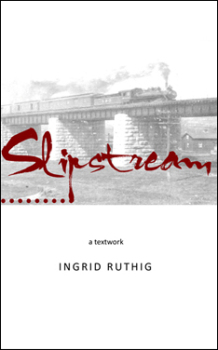
Microsoft Word - Artist's Book Cover in total.docMy good friend, Ingrid Ruthig taught me an important lesson about observation: the same thing can be different. The basis of her book Slipstream was a scene observed out of a window every hour on the hour for eighteen hours.
Try describing the same thing at different times of the day, different seasons. Notice what cell phone covers women or young people choose over older men. Don’t just notice a colleague’s scarf, notice how it is tied today versus yesterday. What colour is the asphalt when it rains versus a sunny day? What colour is snow? (it’s seldom white).

  1. Read people

Don’t just look at people in general, look for specifics: what makes them stand out or blend in. What actions and body language do they use to exude confidence or jealousy or nervousness? What can you deduce from how they dress or wear their hair or hats? If a couple looks unhappy, businesslike or best friends, can you identify what made you come to that conclusion? What is it about someone that makes you uneasy or willing to open your heart to them?

  1. Challenge your powers of description

How many ways can you describe something? What is it like? How many different similes can you come up with? How would your characters describe it? My husband and I try to find different names for the kinds of moons we see: wolf moon, rain moon, wishing moon… Do you always resort to sense of sight? Do you consider light and temperature, texture and mood?

piet-my-vrou

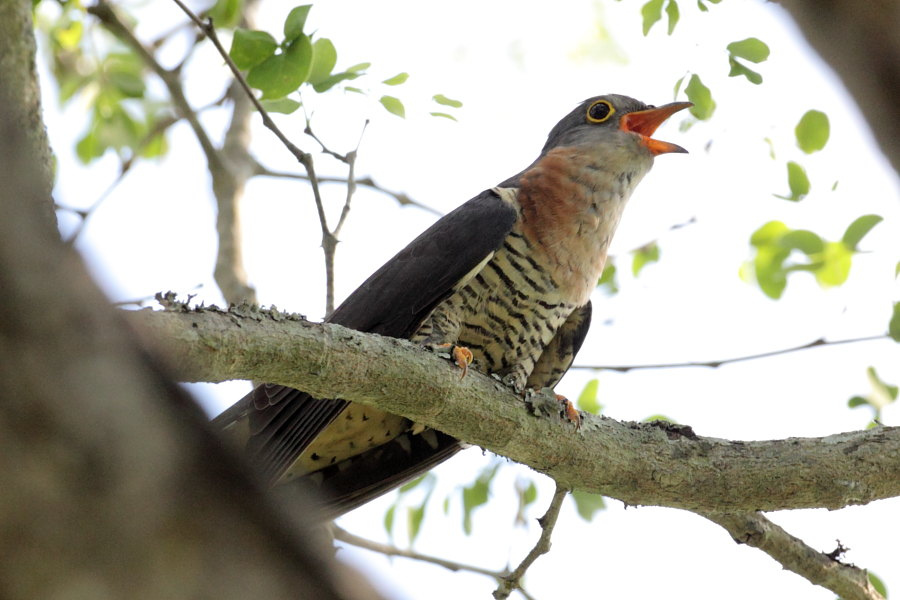
So what have I noticed today? I’ve noticed the three-note call of the piet-my-vrou bird is the first birdsong of the morning. That the pods of the weeping boer bean tree hang like fruit bats. That the blue-green iridescent loerie bird that flew overhead has red underwings, and the bark of the fever tree is yellow.fever-tree

That my sister’s dachshund dog is so portly that when he sleeps his legs stick out straight like roadkill. That the tortoise in the garden can devour half a watermelon in twenty minutes, and that my mother’s hair is the colour of history: iron, copper, silver and gold.

flower-15249_640And I’m waiting to see if, like the lilac Jacarandas, the red flamboyant trees will lose their blossoms in the storm that is now brewing on the horizon.

What did you notice lately?