There’s nothing better than words of encouragement that arrive seemingly out of nowhere. That recently happened to me when my long-time friend, Jessica, sent an email with a link to the local online newspaper, in which she had written a letter addressed to me.
What? Was she airing dirty laundry? NO! She was supporting
me as a poet. To explain…
Jessica Outram currently serves as Cobourg’s Poet Laureate. One of her projects is an online poetry chapbook called Poetry Presents. I have successfully submitted poems a couple of times. Jessica also writes a poetry column for Cobourg Now, where she engages with a poet and /or a poem and muses on poetry generally. Here is where the stars aligned. Jessica chose one of my submitted poems to feature in her column. Thank you , Jessica!
Story is at the Heart of Poetry
An exchange between Gwynn Scheltema & Jessica Outram, Cobourg Now
(Note from the Poet: I grow as much of my food as possible and forage as well. I love the memories of nature that cooking smells bring forth for me.)
Dear Gwynn Scheltema,
Your poem
‘Carrot Soup’ invites me to reflect on harvest and a way of looking at the
passing of time through the life of a carrot. The food we enjoy today has a
story that connects to more than one season. From preparing the soil to
planting the seeds to harvesting fully grown crops, a process and patience are
paramount to success.
It can be
the same with poetry. From preparing to use form to planting phrases and lines
to harvesting metaphors, poetry thrives with the use of process and patience.
When I was younger, I wrote poetry quickly, usually a poem (and sometimes two!)
in one sitting. Over the past couple years, I’ve looked for ways to slow down,
to linger in a line, to return to a poem over time to better understand its
story. It’s good to give a poem space to change and grow.
Story is
at the heart of poetry. Story is who we are and story is how we connect. To
prepare to write a poem, I reflect on these questions: What story do I want to
share? How will this story connect to others? After writing the poem, I return
to the same questions.
In ‘Ars
Poetic’ Archibald MacLeish writes “a poem should not mean, but be.” A poet
shows a story rather than tells a story, inviting the reader to share the
experience. By appealing to the senses (the eye, the ear, our senses of taste,
touch, and smell), the poet invites readers into the world of a poem. When
reading a poem, rather than ask ‘what does this poem mean?’ Ask ‘what are the
stories here?’ Use questions to shift understanding and points of connection.
For those
starting to write poetry, begin with your stories. The stories of your life,
your every day, and of your imagination. Everyone has stories. What are yours?
You may find that you never have writer’s block since our stories can be more
abundant than the Fall harvest.
Thank you,
Gwynn, for sharing this story of carrot soup with us.
With
appreciation,
Jessica Outram
Poet Laureate of Cobourg
About Jessica Outram:
Jessica Outram is Cobourg’s 4th Poet Laureate. She is a Métis writer and educator with roots in the Georgian Bay Métis Community. Since 2019, her mandate has been to honour and nurture Cobourg’s culturally dynamic community. A resident of Cobourg, Jessica has worked in Northumberland both as a principal and vice-principal and continues to participate in local arts, music, and theatre. Currently, she works as Principal of Indigenous Education K-12 in the Kawartha Pine Ridge District School Board.
Some weeks ago, one of our regular retreatants, Lori Twining, shared her retreating experience at Writescape’s fall retreat. But what if you can’t get away to write on retreat? How else can you keep the words flowing?
Have you ever considered an accountability partner?
Lori wrote about the magic of accountability partners on her blog in August, and we reprint it here today with her permission.
Accountability Partners: Colleen Winter & Lori Twining
Accountability Partners: Are They Beneficial?
I
have a simple goal: I want a writing career.
Unfortunately,
it is not as simple as quitting my day job and writing the damn novel. Other
things factor into a writing career, besides having money to pay the bills. In
2021, as a writer, it is essential to have a social media presence, network
with others, be searchable on Google, be knowledgeable and experienced with the
craft of writing, have an agent, have a publisher, and the list goes on and on.
It is endless.
Is a
writing career something I can do alone?
Somewhat.
The writing part falls on the individual writer. However, if you have other
people who share your wants, your desires, and your future dreams of a writing
career, then you should team up and do it together. Build an army. Challenge
each other. Support each other.
This is where the benefits of having an accountability partner come into play. These people establish a relationship with you to help achieve your goals. They hold you accountable for what you said you would do and try to keep you on track, even if you are experiencing a meltdown of some kind.
Let me explain..
Yesterday,
I sent out multiple emails regarding my volunteer role as a Blog Wrangler for
my local writing group. Most of my writing group writes novels and short
stories as a side hustle to their “other” careers (that pay the bills). All of
us write blog posts that relate to our writing lives in some way. As a
volunteer, I admit that I get tired and overwhelmed (sometimes cranky) at
working behind the scenes for zero money and little appreciation. I’m not
complaining; I offered to do this to further my writing career (if it ever gets
further than barely existing). I admit that it is a selfish reason. Sometimes,
I have days that I question my choices on volunteering. I want to quit
everything and just write. But, then something like this happens:
During
the frantic emails (and FB messages and text messages) back and forth with my
writing tribe, I received a message:
“Has
anyone told you that you should be a writer?”
I
laughed. Reading this message broke the stress and frustration I had been
holding tight inside. My shoulders released the tension, and I relaxed a bit. I
wrote back to say, “Not lately. I’m too busy wallowing in a puddle of
self-doubt right now.” I often wonder if all this writing is simply a
time-waster, and I’m going nowhere. Several text messages followed to say they
appreciated my time and effort, and I need to keep writing. This is one writer
supporting and encouraging another writer. I love it.
Minutes
later, the following email came in from another accountability partner. It
said:
“Sorry,
I am late in responding to you. Thank you so much for your accountability email
(you were on time, I’m two weeks late). Ha! I’m never on time. At the moment,
I’m sitting on my couch crying about not making any progress during July. I
decided to email you and tell you the small amount that I did manage to find
time to do. Then, I surprised myself with what I actually got done. This makes
me happy. Writing it down, so I can see the progress. Yes, I was still a couch
slug for most of the month, but I did submit two short stories, sent ten
queries to agents, and updated my website so that if the literary agents ever
decide to google me, I will look important! I might even fool them into knowing
what I am doing! Thank you for this. I love you! Talk to you in a month. Or
sooner.”
After reading this message, it reminded me to check in with a few of my other writing buddies. I have multiple people that I keep in close contact with, where we exchange emails on the first of every month (with many emails in between, just to keep us motivated). I keep a list of excerpts from their emails to encourage me, so I remember that working toward a writing career is not a waste of time. People do get something out of this. It keeps me moving forward with my goals.
My partners are inspiring
Here
are a couple of example messages from them:
“Overall,
I did awesome on my goals! I really want to say thank you for this. Having
these goals keeps me motivated and helps to keep me working on all aspects of
writing.”
And,
this one:
“I am
excited and scared and motivated and terrified all in one. I am so thankful for
you and this accountability thing we do together. I have WORK TO DO… so here
are my new goals.”
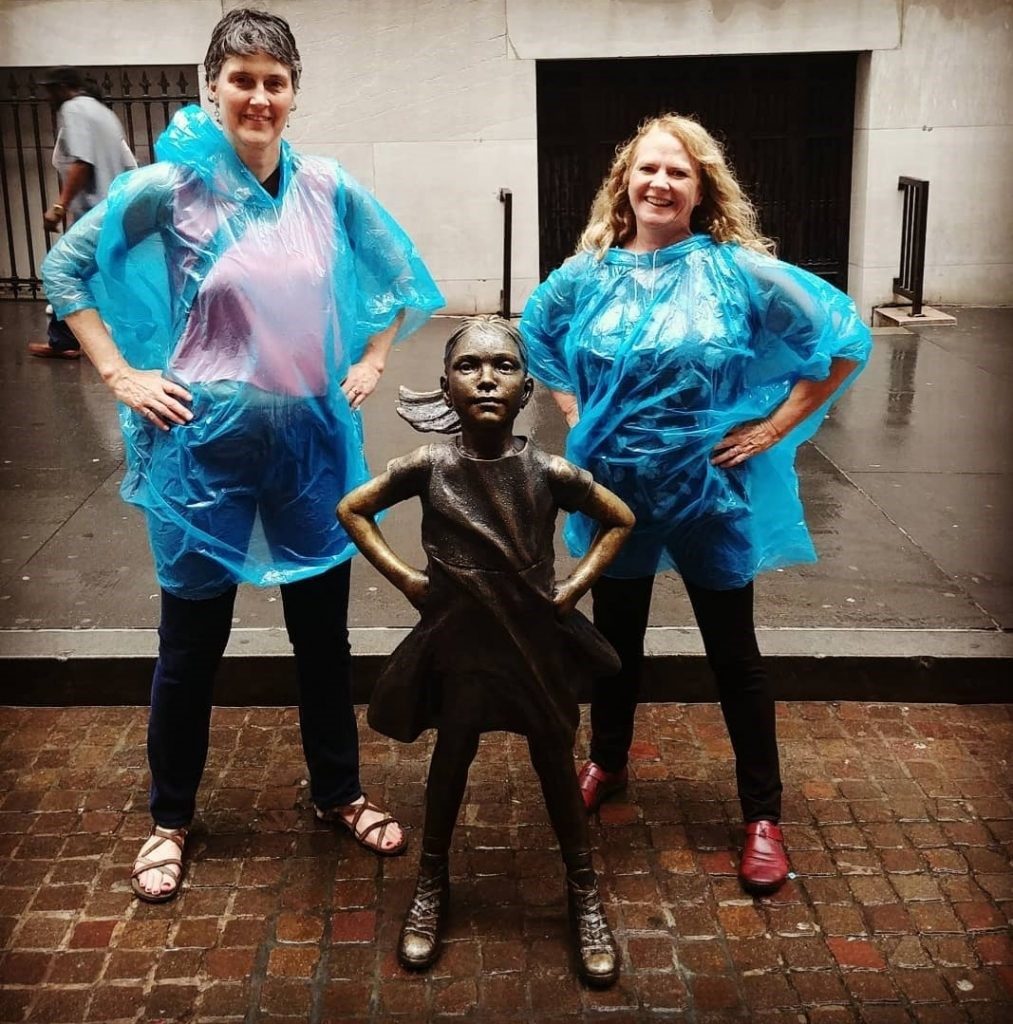
Accountability Partners: Donna Judy Curtin, Lori Twining and Seana Moorhead.
How I stay accountable
I write an accountability email at the beginning of the month describing everything I accomplished (or didn’t accomplish) from the previous month, and add my goals for the following month.
I exchange these emails with a few different writers to encourage them (or challenge them) to do “something” to further their writing career. And they do the same for me.
Here are a couple of examples that show progress in someone’s future writing career:
Woke up at 5 am for two weeks straight. Butt in chair. Writing.
2-hr sessions.
Published four book reviews for novels in my genre on Goodreads.
Posted five Instagram photos of books I purchased written by my
#5amwritersclub writing buddies.
Submitted my short story to a contest.
Attended Inkers Con virtually.
Finished the Dan Brown Master Class on Mystery Writing.
Ran a giveaway on Goodreads. Sent out the print copies to the
winners.
Attended two virtual book launches this month.
Signed up for a 7-day IN-PERSON writing retreat.
Took a course online, “How to Nail Writing Multiple POVs &
Timelines” (this one is something I’m doing this month).
All of these examples keep you in the writing game. You are supporting other writers, networking, learning your craft, or writing the book—all good things.
Cutting Yourself Some Slack
The end of my July accountability email listing all my goals was this:
“My
August goals are to tackle as much as possible with my writing, without
breaking down and bawling like a baby because I don’t have enough time to do
ALL THE THINGS that I want to do this summer.”
I
received this immediate response from one of my accountability partners:
“I
have a similar goal for August and the rest of the year. Now that I’ve had a
vacation, I will try to go several days in a row without yelling/swearing at my
computer screen. And that’s just for work. It doesn’t include the head-hanging
despair during the writing sessions. Maybe we should ease up on our
expectations of ourselves? Just a thought.”
This
excerpt above is from an experienced published writer, and she has made a good
point. I have high expectations for myself. Maybe this is why I am biting my
nails to the quick? I’m walking the fence between giving up (by sitting on the
couch watching every Harlan Coben Netflix series and not writing) and moving
full force ahead with writing every chance I get, hoping my novel gets a little
better with each pass through of edits.
Self-doubt
is an evil monster, and accountability partners can help with that. They remind
you that you are not alone on this path to a future writing career, and
everyone struggles with so many things (and I don’t even have to mention the
pandemic and all the stay-at-home orders that interfered with our mental state
for writing over the last 18-months). They are full of motivation and
inspiration. They can help you plan and strategize how to approach editors or
agents. They can advise on improvement on your query letter or book blurb.
Also, they can help you stick to your commitments and expectations, so you can
continue to make progress.
We
are all in a different place with our writing careers. Some writers are already
published, and some of us are still struggling with that first novel (that
would be me). But, overall, we are suitable matches for being accountability
partners. We strive to be full-time writers and are putting in the work to get
there. We all struggle with time management, primarily since we all work
full-time or part-time for other people. So, being able to discuss it with each
other is a bonus. It echoes the reminder that we are not alone.
Every
little thing you can manage to do (writing, networking, reading, promoting
yourself & your writing friends) proves that you are showing up for
yourself and committing to the work. The best part of having accountability
partners is that you can share your progress and celebrate everyone else’s
progress too. There is no need for jealousy; it is all a wild and fun
experience of living life to the fullest and conquering that writing dream.
Together.
Bottom line
If you are struggling with pulling your butt off the couch back to your writing chair, maybe you should look for an accountability partner? They are perfect for brainstorming and bouncing ideas around, supporting each other, motivating, and inspiring you to continue with your dream. Plus, they are there if you want to cry or rant about something when you are grumpy or extremely pissed off. They are also there to laugh with you, and everyone needs a good chuckle from time to time.
If you don’t have one and would like one, just ask another writer if they would be interested. It is as simple as that. Good luck on your path. Baby steps will get you there. Eventually.
Lori Twining writes both
fiction and nonfiction, with her stories winning awards in literary competition
and appearing in several anthologies. She’s an active member of many writing
groups: International Thriller Writers, Crime Writers of Canada, Sisters In
Crime, Toronto Romance Writers, and Ascribe Writers. She’s a lover of books,
sports and bird watching, and a hater of slithering reptiles and beady-eyed
rodents. Find more info at www.lvtwriter.com; Twitter: @Lori_Twining
I will go on retreat and when I come back, I will be energized and my writing will be brilliant.
We all start a retreat with optimism, plans and hopes and dreams. But on the drive home, or maybe just as you turn the handle on your front door, something hits you.
It’s over. The planned escape to focus on your writing is done and here you are, back home, facing all that your return will mean. And it ain’t always pretty when you once again face reality.
Some of us easily get past that return to reality and can gather back the positive energy we found on retreat. But others might get mired in one or more of the following disappointments:
NOTHING HAS CHANGED
Right on. Once you add the laundry in your suitcase to the pile you didn’t finish before you left, you realize your life waited for you. And there is no escaping it.
YOU DIDN’T DO ENOUGH ON RETREAT
That’s right. You lazy, good for nothing writer. You spent time staring out the window at the lake or the forest or the desert or…whatever. And some of the stuff you wrote is so lame, you won’t even look at it.
THE RETREAT DIDN’T HELP YOUR WRITING
Oh yeah. This is just like the diet you started in January. Your 3 lb loss turned into a 5 lb gain in April. You are just the same writer you were when you started, so why did you even bother?
THE TRUTH
MUCH HAS CHANGED
YOU ACCOMPLISHED FAR MORE THAN YOU REALIZED
YOU ARE A DIFFERENT WRITER
PROGRESS IS NOT ALWAYS RECOGNIZED
Don’t look at that laundry pile the same way. Consider that t-shirt you wore on retreat before you put it into the washing machine. It’s full of your writer’s sweat and you can launder that out. But even if you deleted every single word you wrote, you can’t wash your retreat away. Instead, those words you crafted will percolate in the back of your mind and two things can happen:
ONE, you’ll realize the writing wasn’t so awful after all. In fact, those words are looking pretty good again
OR
TWO, those less-than-perfect words will inspire fresh ones that will move your work forward (after all, we all know the true work of the writer is in the edit)
FEEDING YOUR CREATIVE SELF
Even if you did very little writing, your retreat was not a waste of time because everything you experience flavours your creative self. Sometimes, we don’t recognize the new ideas and perspective a retreat gives us. Chats over dinner with the other writers, quiet walks down country lanes, staring out the window at a completely different view — all of this has an effect on you and your writing. While it’s not bum-in-chair writing, it is a legitimate form of creative work. You’re feeding your subconscious.
Your subconscious is your best friend as a writer and none more so than when your main purpose is to create. That’s why you went on retreat in the first place. When you come home, your ugly Internal Editor may perch again on your shoulder whispering negativity into your ear, but your Creative Self is still being fed by your subconscious. And it’s rich in retreat compost.
So turn your back on any negative thinking. Start digging into your retreat compost and see what treasures are buried in your mind. And follow that energy!
For more on retreats, see Ruth’s post on preparing for a writing getaway.
What writer wouldn’t love to disappear from their life and spend an entire week hidden away at a remote location? With no other obligations other than to put fingers to keyboard or pen to paper and tell a story. Maybe, a story no one will ever read? That’s a possibility. But hey, if you are a writer, you will have a strong desire to write that story whether someone reads it or not, right?
Disappearing to a remote location sounds fantastic, especially after the tough year or two we have experienced. My doctor said I was becoming a workaholic, even though I’m working from home now, and I should take a mental health break. She said something like, “Take a vacation.”
In my mind, I watched her scribble a prescription on her pad for me:
Go somewhere. Eat, sleep, and write from sunrise to sunset. Repeat for seven days.
So, I passed the fake message along to my family and booked a writing vacation. I realize that most writers can only dream about going to a week-long writing retreat. Sometimes, writers struggle to leave their family behind or they find it challenging to schedule time away from work, or they can’t even manage to save enough money to go away. The stress is real, but if you can achieve it, I highly recommend doing it.
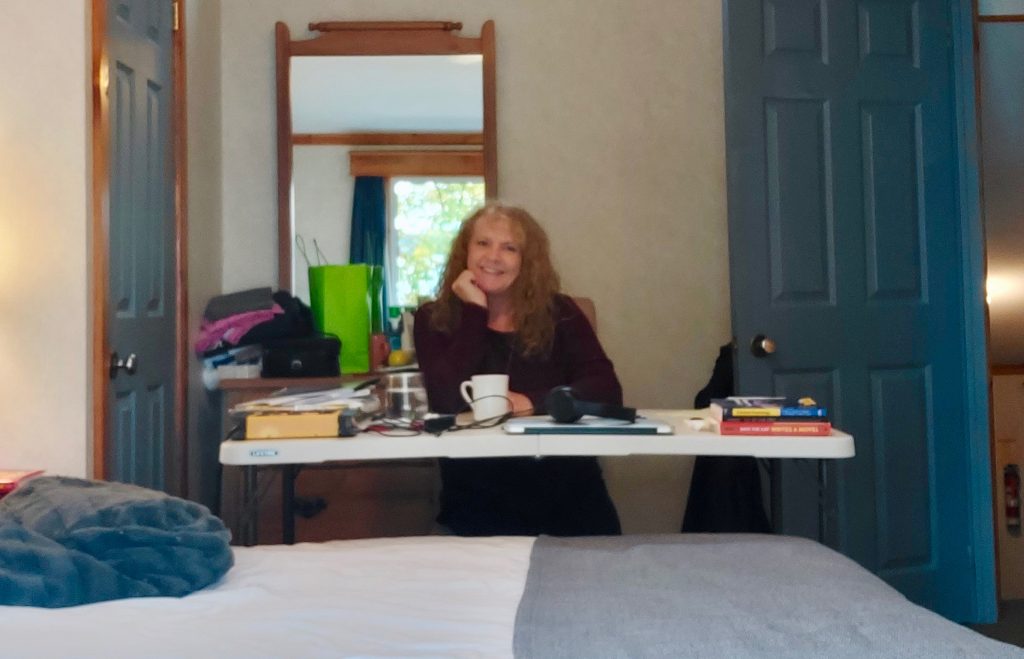
Lori Twining ~ Coffee at Sunrise, Elmhirst’s Resort
At this moment, I’m finally experiencing a writing vacation that I have been looking forward to for almost two years. I booked the retreat with Writescape in the fall of 2019 to celebrate my spring birthday away from home doing something I like to do: WRITE! However, the event was postponed three times due to the pandemic happening right outside our door. Although we are not finished with the pandemic yet, I’m thankful for science and knowing everyone at this retreat is double-vaccinated, masked, and keeping their distance.
With that in mind, I cannot express how ecstatic I am to be tucked away in a bedroom on the second floor of a rustic cottage with a 4-foot wide window overlooking beautiful Rice Lake FOR SEVEN DAYS. I haven’t been setting the alarm because I’m on vacation, but I still manage to roll out of bed around 5 a.m. I make a pot of coffee, pull out my notebook and a pen, and write until the darkness gradually turns to light.
The sunrises are breathtaking at the Elmhirst’s Resort nestled along the shoreline of Rice Lake (see photo above of me gazing out my bedroom window at sunrise). It is so peaceful and relaxing here that I can’t help but focus on the first light breaking through the early morning darkness. The vibrant red, yellow, and orange colours reflect across the serene lake, sending a tingling sensation that rockets from my toes to my earlobes.
Usually, I’m wearing my Jack Nicholson’s grin along with my pajamas, and I think about how lucky I am and whom I might have to kill today. (I’m a fiction writer, so it is allowed.)
Lori Twining ~ Writescape Writing Retreat, Elmhirst’s Resort
I set up a folding table beside a comfortable chair, and my job is to write ALL the words. This is my solitude time where I can immerse myself inside my novel for seven days. I can wear my pajamas all day if I want to; the same goes for the Jack Nicholson smile. I open my suitcase full of notes and reference material and scour through it for something important. I throw sticky notes up on my wall and figure out my plot holes. I read some parts aloud, looking for extra words or clunky dialogue. I slip outside for a breath of fresh air, walk to the floatplane dock, and make an apple disappear. Then, I get right back to the writing.
Occasionally, during this Writescape retreat, there are writing workshops where the instructors, Ruth E. Walker and Gwynn Scheltema, teach us something small but specific. A timed writing exercise follows this teaching moment. It is funny that when I attended my first Writescape writing retreat, I loathed participating in writing exercises. I wanted to slink out of the room and pretend I was never there. Seriously, what writer can come up with material that is worth keeping during a ten-minute interval of freefall high-pressure writing? Well, it turns out, when I use the courage buried deep inside me, I can surprise myself and find something golden in my words almost every single time. It might have something to do with the other writers’ artistic and creative energy in the room with me. It is extremely electrifying.
By participating in the workshops and partaking in the exercises, you learn that it is a process, not your finished product. It is a tiny step along the way to creating something new. It doesn’t have to be perfect, as long as the muse is nipping at your ear, pushing you to experience the magic and go where you have never gone before. The sudden release of endorphins triggers positive feelings in your body, similar to morphine. You can honestly get addicted to the high of someone saying they love your writing or trying a new concept and having it work for you.
We discussed art emerging from art by using Ekphrastic Writing, which was a fascinating workshop for me. I created six pages of new writing about a piece of art that speaks to me. With that, I will select the words, sentences, and statements I want to keep to form a poetic response inspired by the sculpture, thereby enhancing the artistic impact of the original art through synergy. I will need to do a little more research on my own to see if I’m attacking the project in a clever and creative way. I’m excited to see where it will take me.
Today, I’m reaching the halfway point of my retreat, which makes me sad, happy, and freaked out. I have so much I want to do here that I’m considering skipping the sleep portion. *Joking* I’ll just reduce the shut-eye time to five hours instead of six. That will make all the difference.
If you are a writer and you want to be more productive in your quest to finish that novel, then grab a couple of your writing buddies and plan a writing retreat vacation.
I’m grateful for the solitude mixed with the camaraderie that is happening this week. The pleasure of attending this contemplative retreat makes me cherish every minute of this writing journey, and I’m honoured to spend it with friends who have the same passion and mindset as I do.
Thank you to Ruth and Gwynn for running a fantastic retreat that I will miss dearly. I look forward to finding a new adventure for next year’s retreat (although I might just camp in Gwynn’s backyard, looking for poetry advice).
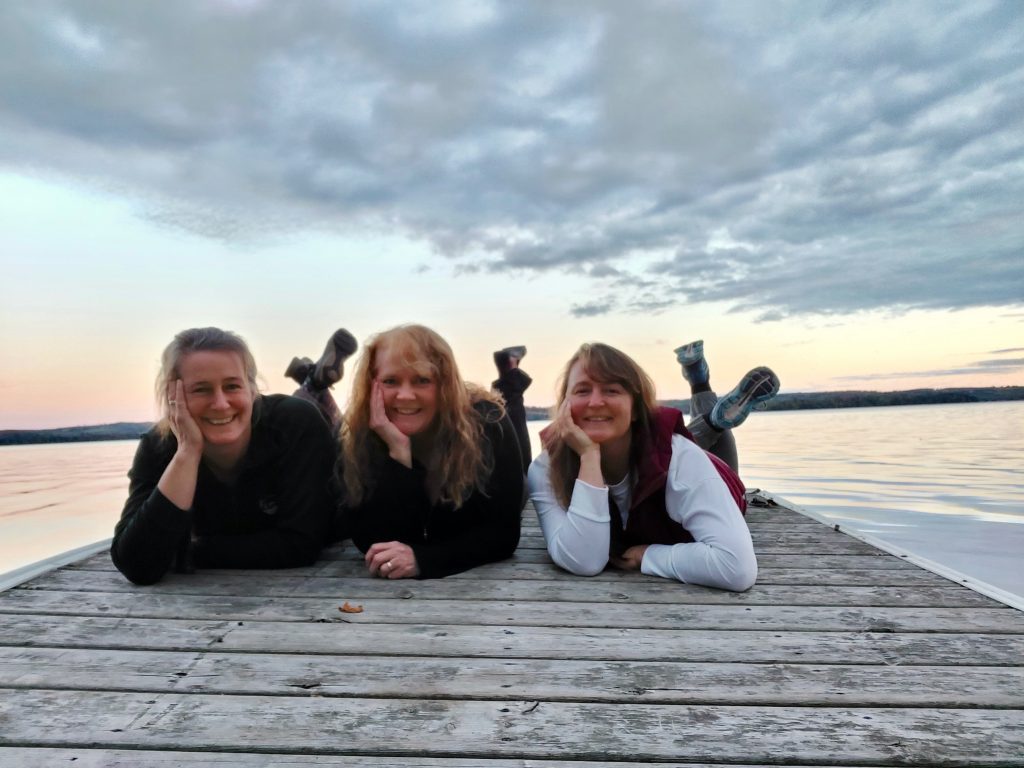
Lastly, I’m thankful to the two writing friends pictured below: Seana Moorhead and Donna Judy Curtin, for always accompanying me on these writing retreats. They are the best cheerleaders a writer could ever ask for. They remind me that I’m here to unplug, focus on my writing, and need to get my shit done.
I look forward to the day that we are successful best-selling authors, and we can tour the world together. Look at me! I’m always dreaming when I should be writing. Ha!
What could be better than going on a writing vacation with writer friends?
Nothing.
Writing Buddies at Elmhirst’s Resort ~ Seana Moorhead, Lori Twining & Donna Judy Curtin
Meet Lori
Lori Twining writes both fiction and nonfiction, with her stories winning awards in literary competition and appearing in several anthologies. She’s an active member of many writing groups: International Thriller Writers, Crime Writers of Canada, Sisters In Crime, Toronto Romance Writers, and Ascribe Writers. She’s a lover of books, sports and bird watching, and a hater of slithering reptiles and beady-eyed rodents. Find more info at www.lvtwriter.com; Twitter: @Lori_Twining
Last week, I was watching a TVO documentary “Art Detectives” about experts in art and history who team up to find undiscovered treasures, and it reminded me of a Top Drawer post I wrote five years ago. I took a quick look and discovered how remarkably current it still is.
Like my “Art Detectives”, I focused on Pieter Bruegel’s Landscape with the Fall of Icarus that, at one point, was the subject of scrutiny thinking it might not be his work. But in the context of our current lives, the provenance of the art seems of less importance than its subject.
The painting and the various poems, plays and books it has inspired is about how terrible things happen in the middle of ordinary days and that life just carries on. And how framing that everyday reality into words–searingly brilliant words–is the work of the writer.
Given how we were all going about our plans: trips, family gatherings, dining in restaurants, sitting in classrooms, taking in a play or movie, grocery shopping without thought of physical distancing…and then, we were not. Could not. Not as we once did.
Some of us took longer than others but eventually, most of us shifted into this “new normal.” And life continues–albeit altered in large and small ways. So with that in mind, and with W.H. Auden’s beautiful poem underpinning the many, many losses of the past 20 months, I offer up this post from the past.
October 2016
A friend and fellow writer posted an excerpt from a poem on Facebook. It happens to be one of my favourites, W.H. Auden’s “Museé des Beaux-Arts.” Like so many poems, it is a take on one aspect of the human condition. How truly awful things happen to people at the same time most of the world is going about their ordinary lives.
His opening lines set the tone:
About suffering they were never wrong, The old Masters: how well they understood Its human position: how it takes place While someone else is eating or opening a window or just walking dully along;
On the surface, Auden is talking about those great old Master painters — Rembrandt, Vermeer and Caravaggio, among them — how they understood the contradictions of life. In the poem, he focuses on a famous painting by Pieter Bruegel the Elder, “Landscape with the Fall of Icarus.”
In this tragic snippet from Greek mythology, with a pair of wings held together by string and wax, poor fated Icarus flew too close to the sun. The wax melted. The feathers fell apart. And Icarus landed in the sea. Great story inspires great poetry. (See also poet William Carlos Williams for his equally gorgeous take on the tragedy.)
I’m not going to discuss Auden’s poem, which is a masterpiece of subtlety. I’m going to talk about the painting which, for years, has hung in the Royal Museum of Fine Arts of Belgium, touted as a masterwork by Pieter Bruegel, the Elder.
They might have made a mistake. Or not.
There are inconsistencies that call into question if this painting is actually Bruegel’s work. There have been suggestions that perhaps it’s an excellent copy of the original, likely by a very talented student, perhaps even Pieter Bruegel the Younger.
Studies show it was likely a painted wood panel, probably by Bruegel, that was later transposed onto canvas. Somebody had to do a lot of over-painting to cover up what didn’t survive the move. Over the decades, this painting has been radiocarbon dated, scanned by electron microscope, zapped by energy dispersive X-ray spectroscopy (whatever that is) and had the charcoal under-drawing examined by infrared reflectography. (Don’t ask.)
Yup. It’s a Bruegel alright. We think. Pretty much. His. Maybe.
Is the painting and the poetry it inspired any less marvellous for all its controversy-inspiring history? Of course, it is vital for art historians and museums of art to know as much as possible about the treasures in their care. It’s more than placing value (though that is an obvious factor) — it’s about the life story of the art, its provenance.
But for those of us who are inspired by beautiful art, and especially work that offers a ticket to inspiration, the who really made that part of the equation is secondary. Auden’s poem is no less brilliant if it wasn’t really Bruegel’s painting. Williams’ poem would still move me to tears.
And that painting, it’s haunted me for years. Not because I didn’t know who painted it but because of those pale white legs, way off in the bottom corner and flailing just above the surface, desperate yet completely ignored. The farmer tilling his soil. The shepherd looking off in the opposite direction. The angler, mere feet away, just working at getting a catch. The lovely ship, sailing past into the harbour…
It’s the human condition that inspires my art. Our crazy, conflicted selves who can feel compassion and contribute money and goods to help those suffering in never-ending senseless wars. And who can, that same day, head out for popcorn and a movie that glorifies shoot ’em up scenarios and terrorist car bombs. (This, of course, includes me. I am human, after all.)
We make no sense, really. Capable of stunning and original art in so many forms: music, dance, theatre, film, painting, sculpture, textiles, multi-media and yes, literature. All of our art is an overwhelming rainbow of style, voice and technique. At the same time, we are cold, cruel and self-centered.
In life, we are constantly flying too close to the sun and forgetting the rest of the world. This contradiction, this puzzle of what makes us spectacular and despicable at the same time, this is a big part of what drives me to write.
And imagine, this post came to me because my friend, artist and poet Ingrid Ruthig, posted a snippet of a poem on her Facebook page. So what inspires you to make words on the page?
Did You Know?
If you’d like to see one of Bruegel the Elder’s painting up close without taking a trip to Belgium, check out this YouTube video of how Google’s art project captured a digitized image of “The Fall of the Rebel Angels” (1502).
Like a lot of teenage girls, I kept a diary for several years. Entries are a hodgepodge of the trivial: (we didn’t have the geography test today), funny: (my blue dress seems to have shrunk and Daddy is not amused!), and, on occasion, surprising: (I found myself sleepwalking last night).
I wrote strictly about my life, what happened and how I felt about it. The diaries were hard-cover, date-at-the-top-of-the-page books, and fifty years later, I still have them. I’m glad I have them. But I know I likely wouldn’t if they had been soft-cover spiral-bound notebooks.
And now?
Yet these days, I do journal in spiral-bound notebooks—and tiny pocket notepads, on the computer and in large books with unlined paper. So why the difference?
What prompted me to think about my different journals, was a comment on my post To Edit or Not to Edit, where she mentioned the Steinbeck style of journaling (a guest post by by Kendra Levin on Brian Kelms blog) where Steinbeck had a “companion journal” chronicling his progress on his novel. I don’t have a Steinbeck companion journal (yet), but I do have a variety of journals that serve different purposes and their physical form does seem to influence their use.
Sadly, I have several beautiful journals—handmade paper, illustrated, filled with wise sayings, beautifully bound—and I will likely never write in them. I’m afraid I’ll “spoil” them, like everything I write in them needs to be perfect. Silly, maybe, but that’s me. Many writers are inspired by beautiful paper or pens, or illustrations and bindings. Just not me.
So here’s what I use and why:
Journal for Morning Pages
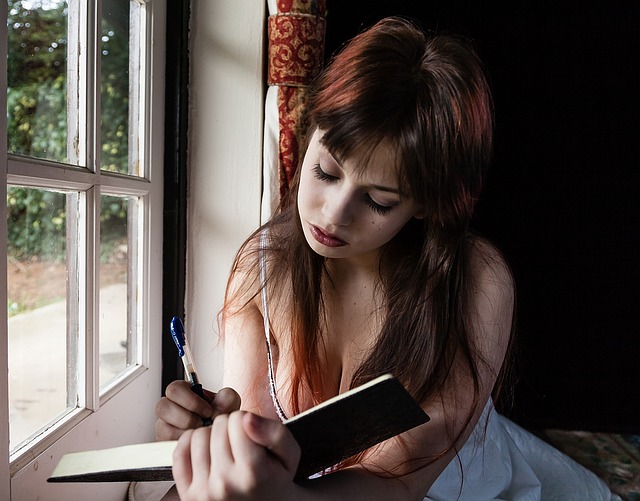
After the teenage years, I didn’t journal for decades. What got me back into it was Julia Cameron’s creative self-discovery book The Artists Way, where I discovered morning pages—three pages of uncensored writing done first thing in the morning. No rules, don’t overthink, just write three pages of something. When I first started, a lot of it was ranting or wishing and even to-do lists. But now, it’s a mix of personal and creative. Most of my poetry starts in mornings pages, and I use it to “talk out” fiction problems too, and start fiction scenes.
I tried various sizes, lined and unlined, and finally settled on a 6 x 9 lined. It fits easily on my bedside table and filling 3 pages doesn’t intimidate me. The reality is, I often fill far more. They fill up quickly, so I invested in a leather refillable version that closes with a tab and has a pen holder. Refill notebooks are cheap and easily found at the dollar store, because it is a standard size. I’m not forced to buy refills from the original manufacturer. As I finish each one, I label it with the dates it covers and store them on a shelf in my writing room.
B.I.C. File
Morning pages are done by hand on paper before I get out of bed. If I wrote everything by hand, however, I would waste a lot of time typing it up. So I have a computer journal too.
I house it in Scrivener, and the project name is BIC (bum in chair). I write here with the same uncensored writing attitude as morning pages: sometimes timed freefall sessions, sometimes writing prompts, all in an attempt to stay ahead of the internal critic. It works. Many blogs and fiction scenes have been birthed here. When I create something I think is useful, it’s easy to copy and paste it to the relevant writing file and keep going.
Journal for Anytime – Anywhere
This notebook has to fit in my purse, so it’s much smaller, about 3 x4, dollar store quality. In it, I record odd thoughts or observations that come to me when I’m out and about. It has no organizing method, and I make sure it doesn’t have too many pages, because if it stays rattling around too long in my purse, it tends to fall apart. This forces me to take the contents and do something with them: type them up in appropriate computer files (blog ideas; scenes for the novel; poetry ideas etc.), add them to projects, or discard them.
Visual Journal
A good friend of mine keeps her journal in a large blank-paged artist’s sketch book. She writes in it, draws in it, sticks photos and leaves and feathers in it too. It’s like a giant scrapbook, and she says she likes the freedom of not having lines. I’m not so good with things that don’t have boundaries—safety edges—but I do keep a version of this. I have one for my novel, with newspaper clippings, photos, magazine cut-outs, maps of towns or plans of houses. Visual stuff. Electronically, I use Pinterest (a board for each novel) and Scrivener has great research capabilities for keeping visuals and web links.
Teeny-tiny sentence-a-day journal
Quite by chance, I was given a pocket journal, about the size of a credit card. I wondered what on earth I could possible use it for. I decided I would force myself to observe through all the senses and each day write just a single line to describe something in a different way. The sentence-a-day part didn’t work out, but those single lines have inspired poetry and been a great exercise for my creative mind.
Whether you want to keep the personal separate from your fiction, or hate margins, or need space to draw, it’s all your choice. Ultimately, there is no right or wrong form for a journal. What’s important is that it suits your way of creating.
As a former president of a writing organization and someone who is known for giving workshops and presentations about writing, I’m occasionally approached by a parent about their child who “wants to be a writer.”
Invariably, it’s Mom who calls or stops me to chat. They have a daughter or son who writes all the time, makes up great stories and even puts them together into homemade books.
The question always is: What programs are out there for my child? Where can my child go to take workshops and be encouraged about their writing? Is there any place my child can submit their stories to?
I’ve also been a guest in many classrooms. Eager students want to know where they can submit their writing to be published.
There are places for young writers to submit, but first let’s take a step back and focus on what we can do to keep that child’s enthusiasm fuelled.
Caring adults are key
As in any aspect of a child’s development, a caring adult can make all the difference. For young writers who are immersed in their imaginations, the way their fledgling stories are treated might make all the difference as they get older.
Parents, guardians — even next door neighbours — can keep young kids writing as long as they remember that correct spelling, grammar and logic isn’t the point at an early stage. What matters is that the child feels their words on the page have value. It might be tough not to point out that “witsh” should be “witch”, but it’s so much better to focus on how scary their Hallowe’en story is. And to ask them questions about the story, inspiring them to include a few more details the next time.
And teachers — with several educators in our family, I know the tightrope you walk balancing your teaching day with administrative demands, curriculum expectations, exemplars, resources, extracurricular duties, prep, supervision…and the expectation that you engage every single student you teach. The last 20 months, in particular, have been exhausting and full of uncertainties.
However, when you release students from the expectations of the aforementioned spelling, grammar and logic with their writing, marvelous things can happen. Make space for free writing. Later on, you can lead them gently to the editing process. If their confidence and connection to their stories remains strong, you can easily show them how revision is part of creativity.
Young writers taught me
I’ve been an artist in residence for our local board of education. I visited classes to share my journey to publication and give them a taste of a workshop.
I always told young students in my workshops: It isn’t about spelling or grammar or logic. It’s about your words, your way. Almost without exception, this was key to getting them to write.
I especially loved working with the alternative high school students. The ones who didn’t fit in the regular classroom. They had complex and difficult lives and often unhappy relationships with adults. Earning their trust was a major accomplishment and I treasured it. They taught me that all of us, given the chance to express ourselves in writing, can move others with our words on the page.
And finally, I learned that an aptitude for the written word may not be the primary gift of a talented young person. At the school board’s integrated arts camp every June, I ran a creative writing workshop. For just over a week, grades 7 to 12 students explored freefall writing, prompts and story ideas.
Back in 2017, I posted a story about a student in my arts camp workshop. In A Boy, His Words, His Way I shared how this brilliant writer showed me that excellence can move through more than one creative outlet. And equally important, how some young writers want to care about spelling, grammar and logic. They’ve already moved beyond free expression and are working on the next level.
It changed my approach, as follows: It isn’t about spelling or grammar or logic. It’s about your words, your way. But if spelling, grammar and logic matter to you, I’ll honour that. Because it’s still about your words, your way.
Resources for young writers
It’s a tough market for even experienced writers and young writers have fewer opportunities, but there are places that will accept submissions. And places where supports and resources help keep the fires of inspiration going.
If you’re a young writer or a caring adult with a young writer in your life, here’s some links of interest:
In The Learning Network, an education resource of The New York Times, there’s an article with over 70 places young writers can submit work to. Updated in October 2020, the article notes that many of the sites listed accept international submissions.
Some
of my writing buddies have been struggling to find the words lately. I’m no
different. There are days I sit at my desk and stare at a blank page and wonder
why I am even bothering to get up. Seriously, I could be sleeping right now. I
never get enough sleep.
The thing is, I have found a way to get my writing mojo back. I’ve been multi-tasking. While I paint or quilt or indulge in other other creative pursuits, I’ve been listening to podcasts specifically for writers. They are so engaging that it has turned me into a BINGER! I have become a person who exhibits excessive or uncontrolled indulgence in podcasts—a podcast binger who often listens to four podcasts in one single day.
But,
why? How could they be that good?
All
of the podcasts listed below inspire me. Authors explain how they balance their
family life with their writing life, what time of day works better for them, or
how they came up with such brilliant story ideas. I love hearing how my
favourite authors churn out bestsellers one after another.
Whether
these podcasts help you improve your craft or help you understand how other
people are making a living doing the one thing you are passionate about, I
should warn you that you have hours of binge-worthy episodes waiting for you.
Here
are a few of my absolute favourite writing podcasts:
“The Shit No One Tells You About Writing” with Bianca Marais.
This
podcast has a segment called “Books and Hooks” featuring two Literary Agents as
cohosts: Carly Watters and Cecilia Lyra. Writers are encouraged to send in a
query letter and the first five pages of their manuscript. They discuss what
the writer did well, what the agents were confused about, and suggest what the
writer could do to improve it. I have listed some examples of their podcasts to
try, but you can find hundreds to choose from on their website. Following the
Books and Hooks, Bianca interviews an author about a specific topic such as:
How
Writers Write is a podcast for creative writers to learn how their favorite
writers tell their stories. The podcast’s host, Brian Murphy, interviews
world-class writers to decode their tips, routines, and motivations for
producing bestsellers.
If
you have tried listening to podcasts and they are not lighting a fire under
your butt, then perhaps you should try listening to author interviews. Live
events are happening across the globe almost every single night. Most of these
events can be listened to while you lounge in the bathtub, eating cookies
(meaning your face will not be on ZOOM camera). This is always a plus because
no one needs to comb their hair during a pandemic if they don’t want to.
Live Events (Live Facebook or Instagram Events):
Murder By The Books ~ Live Author Interviews via Facebook Live
Anderson’s Bookstore ~ Live Author Interviews via Facebook Live
Genre Masters ~ Live Interview via ZOOM
Day Drinking with Authors with Molly Fader~ Live Interviews via Facebook
First Chapter Fun with Hannah Mary McKinnon and Hank Phillippi Ryan
*NOTE:
Many live interviews are archived online after the event and are available to
listen to at any time.
Last Words:
After
binging on a few podcasts or author interviews, I am positive you will be
inspired and motivated to write your own words down on the page. There is no
stopping you now. Get to it. Just put your butt in the chair and write all the
words. I can’t wait to read them.
Lori Twining writes both fiction and nonfiction, with her stories winning awards in literary competition and appearing in several anthologies. She’s an active member of many writing groups: International Thriller Writers, Crime Writers of Canada, Sisters In Crime, Toronto Romance Writers, and Ascribe Writers. She’s a lover of books, sports and bird watching, and a hater of slithering reptiles and beady-eyed rodents. Find more info at www.lvtwriter.com ; Twitter: @Lori_Twining
History holds so much richness for writers. It’s a deep well many of us dip into, finding inspiration, surprises and mysteries. And it’s why we call it a rabbit hole–wander in and you might find it tough to resurface.
As I work on the second book of my speculative fiction, I research ancient (and not-so-ancient) history to strengthen plot developments and character actions and reactions. I look for the sparks that ignited revolutions, for the leaders and strategies behind uprisings, and for the willful blindness of those in power.
Good grief, we humans are ridiculous when it comes to
willful blindness. From aristocrats to bureaucrats to potentates, the “safe”
bubble that power, influence and wealth creates is the reason so many of them
are in shock when the masses are at the gates.
Similarly, we humans are one hot mess when we are that angry mob. Just wander through social media of all stripes to find postings of extreme outrage, disgust and threats. And algorithms make sure that like feeds like, so travelling down that rabbit hole is risky business.
Frankly, it’s why I barely dip my toe into that form of fury. Give me instead human interest stories or pics of your grandkids any day.
The online anger is nothing new. The difference is the speed
and volume that social media platforms provide. And while they can offer
insights into discontent, there is no lack of page-by-page context available in
physical text. That’s why I like to research through books and magazines. Just
one phrase or footnote can launch a whole new idea.
When you write with history in your back pocket, your characters, plots and themes carry a truth. Truth grounding any fiction creates reality for the reader – and most importantly, confidence for the author. And that, dear writer, is pure creative gold.
Revisit Research
Research is a topic we’ve covered in previous Top Drawer
posts. So I’ve gathered a collection of some of our more popular posts on that
topic because, after all, they’re still useful and timely. You’ll notice that
most of them are written by Gwynn. She is known for bringing her analytical
mind to the creative table, and for that I am grateful, as are her readers.
Let’s start with the treasures found in archives. In a well-received two-part series, Gwynn explores where and how to dig in:
Always thorough, Gwynn followed that post with the answer to “Now what?” in Digging up Archives – Part 2 Top Drawer readers told us they had a much better understanding of where and how to use archives for research after reading Gwynn’s posts.
I chronicled my own experience with Canada’s National Library and Archives, researching my great-great-great-grandfather’s book about the Hudson’s Bay Company in the late 1700s. Holding History in My Hands shares what that moment was like.
And more recently, Gwynn posted a number of computer hacks that make writing — and researching — easier and faster.
A final note – many of the featured sources are online. Given that we are still treading a careful line between in-person and virtual activities, what was convenient less than 18 months ago is now pretty much a lifeline.
We writers know that library and archive staff are incredibly helpful when doing our research. Express your appreciation when they go that extra mile and be kind when health and safety regulations limit their efforts.
Writing in the time of the pandemic…that has an interesting ring to it, don’t you think? I wonder what the textbooks, novels, poetry, lyrics and archives of 2020 will reveal to writers in the year 2220 and beyond?
LAST WORD: OUR FALL RETREAT
Re-emerging, our all-inclusive writing retreat in October is now fully booked except for one single cottage available at a premium rate. OR if you’re a cottager/resident nearby, we have a couple of spaces for day-rate participants.
We are launching a Wait List for anyone who’d like to join us at Elmhirst’s Resort this fall. Email us at info@writescape.ca with the subject line: Wait List Fall Retreat and if we have any cancellations, we’ll let you know in the order your email was received.
A restaurant’s Help Wanted ad caught my attention the other day. It wasn’t the requirement “Must be 18 years of age or older” that piqued my interest. Under Ontario’s labour laws employers can’t schedule anyone ages 14 to 17 during school hours unless they’ve been excused from school. So, it’s okay to require an age minimum of 18 for daytime work.
But the restaurant was looking something else in their applicants. The job was for a waitress. A waitress? I haven’t seen that in a very long time.
What do you imagine with that word? Not a male applicant. Not a binary or transgender person. Nope, you conjure up a female.
Maybe your mindsight has that woman in an apron, hair tied back in a bun or net, order pad and pencil poised to take your order. Maybe she’s wearing sensible shoes as she balances a loaded tray in a crowded diner somewhere. No matter what you imagine, when you read waitress, you think female.
In Ontario it’s illegal under the Human Rights Code to reference and/or require directly or indirectly anything that is listed under the code as discriminatory, and that includes “sex” unless it’s a bona fide exception. A specific driver’s license, for example, to be a cab driver or transport truck operator.
So how come this clearly defined by gender job title sits there, bold as brass in the newspaper? Because words don’t matter to everyone — but they should. And most especially to writers (and newspaper editors, too.)
The times have already been a-changin’
Years ago – and I do mean years ago: over 40 to be precise – I worked in Human Resources in the health care field. It was a time when you had nurses aides and orderlies. Nurses aides were female and orderlies were male. It was just hospital staff titles. Our world back then had waiters and waitresses. We had firemen and policemen and chairmen and postmen.
There’s a long history of separation by gender. Our elementary school still had the boys entrance and the girls entrance carved over the doors, where, before my time, students lined up by gender. My gym classes were all female. Girls took Home Ec. Boys took Industrial Arts.
No wonder language and, specifically words and especially job titles, were framed within gender. The wake-up call arrived while I was working in HR during the 1980s. It was a revolutionary time when women (and some men) demanded gender-neutral job titles. Women didn’t want to be constrained by their gender. They wanted to be persons first. And there were males who wanted careers in “traditionally female” jobs.
Oh the outcry and resistance was massive. But eventually,
common sense prevailed. Union contracts had to be revised. Policies and
procedures updated and, in some cases, deleted. Nurses aides and orderlies
became nursing assistants and, eventually, personal support workers. Firemen,
policemen and postmen became firefighters, police officers and postal workers.
The chairman of the board awkwardly tried on “chairman/chairwoman” for a while
but eventually morphed into the much better Chair. No gender necessary.
Language reflects society
As language and its uses changed, opportunities developed
for women in “non-traditional” jobs. Now, when a woman drops envelopes in my
mailbox, it’s not unusual or remarkable or noteworthy. It’s my mail being
delivered. And when a tragic fire happened in my city some months ago, the
firefighter quoted in the paper was a woman. We mourned the losses. We didn’t
stop to question why a female was working as a firefighter. As it should be.
Of course, it hasn’t been all smooth sailing into this transition. There are still pockets of “waitress” out there. But the fact that it stands out as I skimmed the classified (often the source of story inspiration, by the way) – it’s a sign that my brain has accepted “server”, a non-gender job title, as normal.
Language is dynamic. It is always changing just as members of society change. Successful writers pay attention to the way language changes because it is more than just a word used to describe something. Language — the words we use and how we use them — reflects changes in social values, in institutional structures and how something that was remarkable or strange becomes ordinary.
And paying attention to those changes (and those diehard stubborn holdouts who think it’s all just being “politically correct”) can lead writers to stories, characters and diverging plot lines they’d hadn’t considered before.
Well worth looking more carefully, don’t you think?









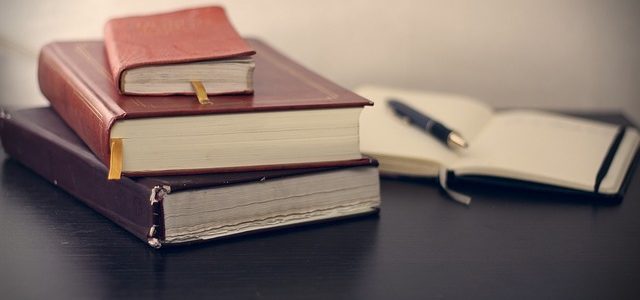
 Sadly, I have several beautiful journals—handmade paper, illustrated, filled with wise sayings, beautifully bound—and I will likely never write in them. I’m afraid I’ll “spoil” them, like everything I write in them needs to be perfect. Silly, maybe, but that’s me. Many writers are inspired by beautiful paper or pens, or illustrations and bindings. Just not me.
 I tried various sizes, lined and unlined, and finally settled on a 6 x 9 lined. It fits easily on my bedside table and filling 3 pages doesn’t intimidate me. The reality is, I often fill far more. They fill up quickly, so I invested in a leather refillable version that closes with a tab and has a pen holder. Refill notebooks are cheap and easily found at the dollar store, because it is a standard size. I’m not forced to buy refills from the original manufacturer. As I finish each one, I label it with the dates it covers and store them on a shelf in my writing room.
 A good friend of mine keeps her journal in a large blank-paged artist’s sketch book. She writes in it, draws in it, sticks photos and leaves and feathers in it too. It’s like a giant scrapbook, and she says she likes the freedom of not having lines. I’m not so good with things that don’t have boundaries—safety edges—but I do keep a version of this. I have one for my novel, with newspaper clippings, photos, magazine cut-outs, maps of towns or plans of houses. Visual stuff. Electronically, I use Pinterest (a board for each novel) and Scrivener has great research capabilities for keeping visuals and web links.
 Quite by chance, I was given a pocket journal, about the size of a credit card. I wondered what on earth I could possible use it for. I decided I would force myself to observe through all the senses and each day write just a single line to describe something in a different way. The sentence-a-day part didn’t work out, but those single lines have inspired poetry and been a great exercise for my creative mind.