Editor or Writing Coach?

Editor or Writing Coach?

Ruth E. Walker

It’s been my pleasure to serve as an editor on non-fiction, memoir and novel manuscripts. I’ve offered up my copyediting and proofreading skills to writers wanting a clean manuscript. Some of these manuscripts have gone on to become successful self-published books. And a few have gone on to agents or publishers, finding a home in traditional publishing.

Of course, no writer is perfect (even you, Ms. Atwood) and all books have benefitted from a good editor. However, some writers look for an editor for their manuscript when what they really need is a writing coach.

Whenever I’m asked to quote for an edit, I read an excerpt first. I’m looking for narrative skill (is this a story or a series of knocked-together events?) and a focus on craft (is there active narration, strong character development, solid plot and theme, a structure that fits the genre OR is it flat in several important areas of craft?) I’m also looking to see if my strengths are a good fit with the editing the writer needs. If not, I’ll suggest where the writer might look for editing support.

But if I see the necessary work on a manuscript as significant, I don’t give an editing quote. Instead I suggest the writer works with a writing coach and offer my services. I will still use my editorial skills but there is a big difference to how I apply them.

What is a writing coach?

A writing coach has a focus on your development as a writer. More than offering editorial advice and copyediting skills, a writing coach recognizes important areas that need developing and will work with you to improve them. It’s important to help you understand why something isn’t working well. Just as importantly, a writing coach will try to help you hold onto and use that understanding in your work. In my case, I’m like a cheerleader every time my clients apply what they’ve learned to their manuscript.

Serving as a kind of mentor, a coach spends time talking with you about your project, your intended audience and your overall goals as a writer. Consider a writing coach to be like an athletic trainer, someone who helps the writer focus on the skills needed with the desired goal as a constant beacon. A writing coach keeps you accountable and, even better, can help you approach the page with excitement and energy.

A writing coach is not your friend; instead, the coach is there to encourage and support your journey and to be clear about the steps needed to be successful. You should expect to see examples or suggestions that help your writing develop. If after a couple of sessions, you don’t feel good about the process or your progress, than it’s likely that writing coach is not for you.

Coaching is far more “organic” than editing. For example, I’ve recently worked with a writer on Point of View (POV). Once that writer gained a deeper understanding, I knew it was time for her to experiment with different approaches. My intention is to help her make decisions about writing a novel from one POV,  various POVs or as third-person narration with a limited POV.  Ultimately, it is her decision. But it’s a decision she’ll make with a clear focus on the kind of story she wants to tell and the best narration to achieve that.

Writing Coach on your shoulder

I’m far more interested in seeing the writer’s skill develop than in fixing a manuscript to “okay” level. If the story doesn’t resonate and the characters are flat stereotypes, readers won’t engage even if there are no typos and the grammar is perfect.

Nonetheless, I still make any necessary standard edits such as typos, grammar or textual errors. And I’ll comment on areas to develop: glitches in logic, lack of character development or a plot gone awry. But as a coach, I want my clients to understand what can strengthen their narrative skills. And I want them to apply that new understanding in subsequent work.

While I can’t let go of the editor, as a coach I want to support a writer to develop their storytelling techniques. When writers explore areas of craft that will enrich what they’re trying to share in their work, they reveal abilities they didn’t know they had.

Did you know?

Coaches for writing are also found in business. Clear written communication can be struggle for some people in the corporate world and with the speed of social media, one wrong word can create a huge backlash.

For another take on the role of a writing coach, take a look at author Ryan G. Van Cleave’s post on The Writer online.

Copy that! January Update

Copy that! January Update

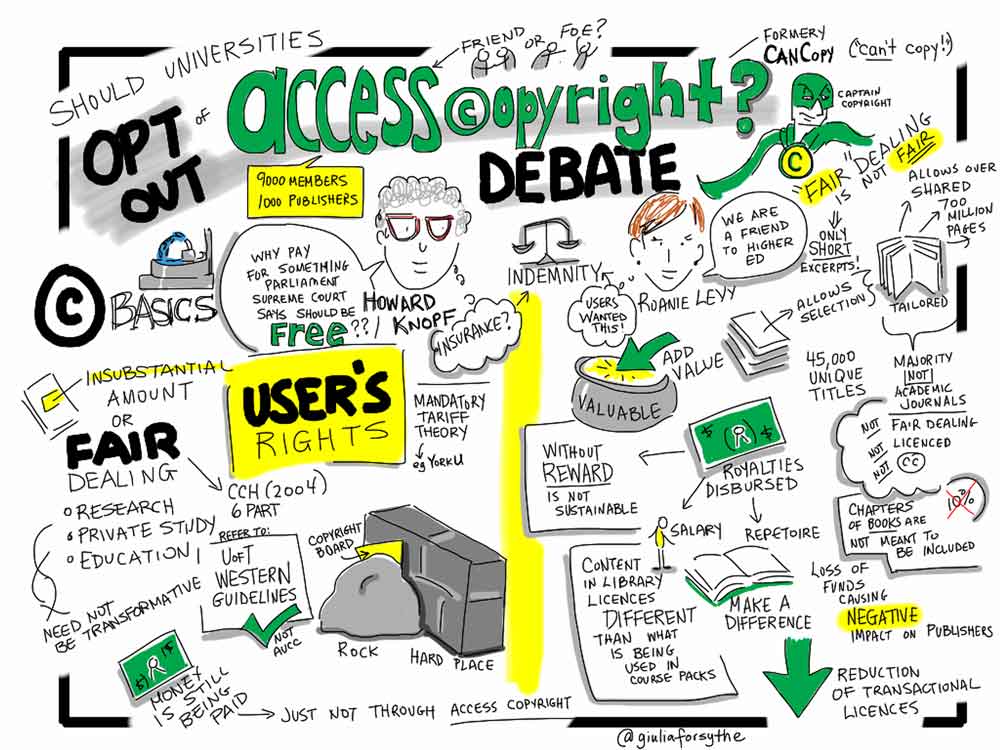
In 2018 our Top Drawer blog Copy That! explained the situation with the ongoing court battle in Canadian courts over creative rights. We then updated you on the Review of the Copyright Act and brought you an update. As we enter 2019, here is the latest update as emailed to creatives by Access Copyright:


Related image

I’ve spent a large part of my professional life at Access Copyright. I’m often asked by publishers and creators what keeps me going, especially through the challenging times.

The answer is simple: it is my privilege to work on behalf of Canadian creators and publishers to make sure their rights and the value of their work are both recognized. In the last few years, workplace gurus have talked a lot about the importance of alignment between your personal values and your work. I feel like I’ve been blessed; this is meaningful work and I cannot imagine doing anything else.

Image result for access copyright

Late last year, I testified before the Standing Committee on Canadian Heritage for the Study of Remuneration Models for Artists and Creative Industries. I had the honour of being accompanied by one of Canada’s most prolific Young Adult writers, Sylvia McNicoll. Please take a moment to hear her opening statement before the Committee.

During the question period, one of the MPs asked if there might be a middle ground, a way to protect writers and ensure learners in the public sector have access to high quality materials, given limits to funding.

It’s a question I’ve heard (and answered) many times. Sylvia’s response below truly gets to the heart of the issue.

Ms. Sylvia McNicoll:
     I think it’s just obvious that immediately tariffs have to be enforced [1]. That was never a compromise, to say that you could have an educational exemption and not pay anything. That’s full-handed giving them free….

    This has been going on for close to five years. Different schools opted out at different times. They believe now that they are entitled. It will be very difficult. They have no knowledge of ever paying for photocopying or for digitally reproducing materials.

    We need to get the fines, the tariffs, in place, and then we need to rein in this exemption.

Ms. Roanie Levy:
    If I could add something, the system of collective licensing was created precisely so that the entire book doesn’t have to be bought all the time. It provides that means of accessing without having to pay the full price of all books all the time for every student.

     It’s also important to keep in mind—because I think that because of all of the noise we hear about this and all of the efforts that are made to evade having to pay—that we have the sense we’re talking about incredible sums. In the elementary and secondary sector, we’re talking about $2.41 per student per year. Then they could do the copying of their chapters and their 10% to their heart’s content. It’s $2.41 per child per year, and the ministers are still not paying.

    In post-secondary, at most we are talking about $26 per student per year. It’s the price of a pizza. In college, we are talking about $10 per student per year. We’re not talking about sums that would bankrupt anyone, that would add any true additional burden on students whatsoever.

Ms. Sylvia McNicoll:
    May I add that while it’s just a pizza for them, it’s my mortgage, my groceries, and it’s my car payment. Right now, it’s my dental bill.


[1] Since 2012, educational institutions outside of
Quebec have refused to pay royalties under tariffs certified by the Copyright
Board of Canada. This action has deprived creators and publishers of an
important source of income. For example, under the current elementary and
secondary schools tariff, this non-payment results in an annual loss of $9
million in royalties for the copying of published works by K-12 schools.


Related image

Canadian creators and publishers have suffered under the education sector’s copying policies and practices. I believe politicians and policymakers in Ottawa understand the unintended, negative consequences the 2012 changes to the Copyright Act have brought about.

Now, as they prepare their report and recommendations, I hope they’ll remember Sylvia – and the thousands of writers and publishers who are in the same predicament – looking to make their next mortgage payment, book a dentist appointment or pay for groceries.

It doesn’t have to be this way.

The licence costs are minimal, but the resulting royalty payments make a significant and meaningful difference to Canada’s creators and publishers.

Sincerely,

Roanie Levy
President & CEO
Access Copyright

Access Copyright files submission to the Heritage Committee as part of its Remuneration Models for Artists and Creative Industries study

The submission outlines how copying policies enacted by the education sector after the passage of the Copyright Modernization Act have had serious consequences for creator and publisher income levels and proposes four concrete actions to address this critical issue:
• Amend the Fair Dealing Exception to distinguish between individual and institutional copying;
• Introduce the Artist Resale Right;
• Harmonize statutory damages available to collectives;
• Confirm tariffs set by the Copyright Board are and have always been mandatory.
Our submission can be found here.

Access Copyright teams up for joint Copyright Act review submission

In December, Access Copyright was one of 34 organizations that came together to form The Partnership for the Future of Canadian Stories to represent those who create, read and care about Canadian stories. Collectively, the Partnership prepared an evidence-based analysis to correct misleading claims put forward by opponents of effective copyright to members of the Standing Committee on Industry, Science and Economic Development, and the Standing Committee on Canadian Heritage.

In December, the submission was filed with both the INDU and the Heritage Committees. Read it here.

The Partnership makes two recommendations to address the current reality facing creators and publishers and their ability to be fairly compensated for the educational use of their works:
• Clarify that fair dealing does not apply to educational institutions when the work is commercially available;
• Harmonize statutory damages available to collectives.

Lend your voice to support Canadian creators and publishers during the Copyright Act review

When creators speak, politicians listen. It’s important we remind the Heritage and INDU Committees of the negative consequences of the 2012 changes to the Copyright Act. It is also vital that they continue to hear this message while they write their final reports.

With this in mind, the I Value Canadian Stories coalition will launch a new letter on the I Value Canadian Stories website the week of January 21. We’ll send an email when it’s ready. It will take no more than two minutes to visit the site and send your letter in support of Canadian creators and publishers.

In case you missed it…Last fall, the I Value Canadian Stories campaign shone the spotlight on Canadian writers and visual artists. Check out the site’s Videos page to learn more about the work of creators like Andrew Pyper, Amy Stuart, Sky Gilbert, David Chariandy and Jennifer Mook-Sang.

Negative consequences of the Copyright Modernization Act in the media

Recently, CBC Radio’s The Sunday Edition (hosted by Michael Enright) and CBC’s The National covered declining incomes for Canadian creators and publishers. The segments addressed the unintended consequences of the Copyright Modernization Act for both communities.

Take time to enjoy the gift

Take time to enjoy the gift

In January, we traditionally take stock of our lives. For writers, that involves our creative lives, our writing lives. So far, we have already looked at Getting into Writing Balance. Our guest blogger (and long-time writing friend), Aprille Janes offers an uplifting take on examining our creative lives from the perspective of “taking time to enjoy your creative gifts”. Currently, Aprille focuses on visual art at her Stone Bay Studio in Nova Scotia, but her message is relevant for any creative.

Guest post: Aprille Janes

Take time to enjoy the gift


The artist is nothing without the gift, but the gift is nothing without work. – Emile Zola

Time away is a gift

This year, being away for a whole month was a first for both of us.

A month changes things, providing distance and perspective. It made me see I was in danger of filling my schedule with things that took me away from what I really wanted. Putting together a program to help artists find time was keeping me too busy to paint.

How’s that for irony?

So I took a deep breath, slowed down and asked,

2019 Planner“What do I really want in 2019?”

Easy. I want to prioritize my painting.

That means committing to a daily practice of drawing and painting, taking time to be a student and making my art a priority rather than an afterthought. Like practicing daily scales, I need to put in the work.


We all have our own ways of bringing our dreams to life, but what we do each day, at a ‘right here, right now’ level, will determine whether we get there.  — Tara Leaver, Artist

And, as we all know, for every action there is an equal and opposite reaction. When I say “Yes” to something then I must say “No” to something else.

“What is necessary and what is distraction?”

When I arrived back home I began making time for my dreams by looking at the “mental clutter” I had allowed into my life. Like physical clutter, it took up space, made it hard to navigate and gathered dust.

I don’t know about you, but I tend to subscribe to things as I’m browsing because they catch my eye or I want their ‘freebie’ or there’s a program I’m interested in. That means I end up on a lot of lists if I’m not careful.

Now I looked at each and every promotion and update that came through my inbox and held it up for scrutiny.

  1. Did I even sign up for this? Even with all the anti-spam laws, I still get added to lists without my permission. Those are an easy decision. Unsubscribe.
  2. Is this information pertinent to me anymore? More often than not the answer was No because my life has changed so much. Unsubscribe.
  3. When was the last time I read the information this sender provides? If I can’t even remember – unsubscribe.

Now I’ll admit that unsubscribing sometimes felt a little like breaking up. Often they ask “Why” and it’s tempting to write “It’s not you, it’s me”. Mostly though, I skip giving a reason unless the sender is a friend in the real world.

This is an ongoing process but the difference in less than a week was phenomenal. My inbox holds only those things I deem important to me personally or to my renewed focus on the painting.

the gift of mental decluttering
And speaking of distractions…

Where do I want to invest time on social platforms? Do I have a reason for being there?

For me, it boils down to InstagramFacebook and Pinterest, which make sense to me as a visual artist. I deleted my profile on LinkedIn because I’m not in the corporate/business world any longer. The jury is still out about Twitter.

I left a number of Facebook groups because I wasn’t interacting or they belonged to a different phase of my life. My Creative Fire Café , of course, stays put. I love the community we created and what we learn from each other. The social aspect of Facebook is also a gift because it keeps me in touch with family and friends.

Gift of Changing “The way it’s always been”the gift of studio time

The “Yes” part means daily time in my studio, painting and learning. In the past, I held a belief that my creative time “had” to be in the morning. And yet, I easily slipped into an afternoon routine which feels natural.

By taking care of a few things each morning such as social media, my coaching practice and biz admin (and yes, household chores) I relax and totally focus on my art in the afternoons. Up to now, I hadn’t even recognized that feeling of “something’s not done” and the pressure it created to hurry through my painting time.

Now the parent part of my brain says “Right. Chores are done. Go play.”

Gift of Self-Care

At The gift of self care via a dogthe end of my studio time, right on the dot of 4:00, Joey the Dog comes in, sits down and stares hard at me. He’s letting me know in no uncertain terms, it’s time for his walk. It’s like having my own personal trainer.

These days I find myself taking longer walks which means more fresh air and exercise. Because my other priorities now have their place, I am free to enjoy the moment plus the exercise loosens me up after sitting for so long. When I get back to the house, my husband and I have a cup of tea and spend some quiet time together.

Without even trying, I’m practicing better self-care and enjoying quality time with the spouse, a precious gift.

The Sum of the Equation

All of these small changes add up. Fast. I see positive growth in my art which translates into feeling relaxed and happy, knowing my dreams are getting daily attention. I even sleep better. My time is being spent on priorities, not busy work.

What strategies have worked for you when it comes to finding more time to focus on your priorities?

More about April Janes

Aprille has fond childhood memories of outdoor adventures and time spent near the water. Today, she lives by the Bay of Fundy and her art reflects this love of the outdoors. She divides her time between painting, writing and teaching watercolour workshops.

Find her at:

10 Movies to Inspire Writers

10 Movies to Inspire Writers

Launched in 2018 as a year-long celebration of our 10th anniversary, this monthly post proved so popular that we’re keeping it going. Look for Writescape’s 10 on the 10th for writing tips, advice and inspiration on the 10th of every month. Think of it as Gwynn and Ruth sitting on your shoulder and nudging you along. Share with your writing colleagues and encourage them to sign up for more.

Movies. Film. The cinema. The flickers…or flicks as they became known. Since 1895, the art of filmmaking has left a legacy of profound movie moments. For nearly 125 years, audiences have lost themselves in the stories unfolding on theatre screens. While the way we watch movies has changed — reclining and wired-for-motion seats in state-of-the-art theatres to surround sound in homes with 75″ television screens and Netflix at the ready. What hasn’t changed is the importance of a compellling story to create excellence in film.

Yes. Of course. Some “blockbuster” films are more about sound and fury than a believeable plot and characters. At a recent screening of “Aquaman,” Writescape’s Ruth Walker almost always knew the next plot twist or line of dialogue before it was voiced. “It was a fun movie with great visual effects,” she said. “But so predictable.”

Nonetheless, in our first 10 on the 10th for 2019, we’ve come up with an admittedly arbitrary list of movies that are useful to explore and perhaps will help you find some inspiration to be completely unpredictable.


#1  I Remember Mama— a 1948 movie about a young aspiring writer who discovers her “ordinary childhood” as a Norwegian immigrant in 1900 San Francisco is actual gold for her stories. Memoirists, be inspired because despite a dose of sentimentality, there is also a frankness in this movie that surprises. All memoir is strongest when it tells the truth. The movie is based on the stories of Kathryn Forbes which she based on her own Norwegian-born grandmother’s life in early twentieth century San Francisco. Real life is the well of inspiration for writers everywhere.


#2  Adaptation written by Charlie Kaufman who is also, coincidentally, the lead character played by Nicolas Cage  — a funny and unsettling 2002 film about a screenwriter failing at adapting a novel for film and his overshadowing, successful twin. Twists. Identity crises. Writerly angst. More twists. Confusion. Mayhem. In fact, many writers will recognize this as just another day in the life. Is this Kaufman’s memoir? Sort of. For the screenwriters among you, here’s a link to the screenplay on Stephen Follows’ website.


# 3 Sense and Sensibility 1995 Ang Lee version for a film adaptation of a timeless plot. All of Jane Austen’s books make for terrific film and television series but this is an excellent example of subplot doing brilliant service to the main plot. Austen wisely set the subplot with the main character’s sister and made these sisters different in almost every regard. The simple main plot of girl falls for unattainable boy needs the heightened tension of girl’s sister falls for falsely attainable boy while one true love watches in agony from the sidelines. The standard romance plot in Austen’s hands becomes a look at social status and, in particular, women’s power (or lack thereof) in the early nineteenth century England. A deceptively simple plot with a potent punch.


#4  Pan’s Labyrinth — this visually stunning and mood-rich 2006 film set in 1944 Fascist Spain was written and directed by Guillermo Del Toro. Part fairy tale and part historical film, this Spanish-language movie blends reality and fantasy so well that belief in the mythical creatures is as strong as in the heroic characters. Why should you see it? Del Toro worked from his 20-year journal notes of ideas and concepts to carve out a screenplay that feels like an ancient parable told long ago. He had the whole screenplay in his head before he wrote a single word of it. And bonus trivia for all writers: he wrote the English subtitles because he was disappointed with the subtitle work on his earlier movies. Clearly, a writer who is dedicated to his craft, and who cares about his audience and conveying his story to them.


#5  Dinner at Eight — a clever, star-studded 1933 comedy/drama. The whole complex plot revolves around a high-society dinner party organized by a wife to help her husband’s business dealings and all the problems in the hours before: Suicides, business failures, affairs, sneaky backroom deals and lack of a single man to balance the table setting. Nonetheless, Mrs. Jordan’s dinner gets served precisely at eight. The “over-acting” of the age is a fabulous metaphor for when stereotypical characters can be successful because they carry a message: pretense vs reality. No one is who they pretend to be. The writing is darn good as well, adapted from a Broadway play.


#6  Julie and Julia – 2009 “blogger” story based on the real-life Julie who has a blog in which she will make a Julia Child recipe every day and blog about it. We get Julia Child’s history as well, as Julie’s life takes twists and turns she didn’t expect. Julia refused to acknowledge the Julie blog which adds another rich layer to the background of the story. A useful examination of writing two POV characters and ways to create thematic connections between two separate stories. In real life: Julie and Julia never met and they don’t in this movie, either. Yet we suspect they could have been friends.


#7  Run Lola Run — a 1997 German thriller written and directed by Tom Tykwer. It’s a simple plot: Red-head Lola has 20 minutes to get 100,000 Deutsche Marks to her boyfriend Manni or he’ll rob a store to get the money to pay back the mob. Much of the movie is about Lola running. And running. And, yes, running. But it is a clever tale, told with three different endings. Every action and interaction Lola has the first time she tries to save Manni shows up in the next two endings. Like the butterfly effect, a simple pause not taken or decision delayed has consquences. And through each iteration, there are important constants that anchor the themes of free will and fate. Take note of the “blind woman” character and her pivotal role: is this fate for Lola or is she being given the chance to, at last, get it right?


#8 The Princess Bride — This 1987 classic film’s screenplay was adapted by the novel’s writer, William Goldman. Directed by Rob Reiner, the movie preserves many of the elements that make the novel a delight to read. Ironic. Self-aware. Fantastical. Romantic. Adventurous. And rich in life lessons, including: There is such a thing as Mostly Dead. Revenge can’t give us back what we’ve lost.  And inconceivable is a word that can be overused and, occasionally, misused. The Princess Bride is a story of True Love, framed by a grandfather reading the book to his ill grandson. It honours the gift of imagination and delights in playing with the tropes of fairy tale and fable, just as the novel continues to do for readers since its 1973 publication date.


#9  Misery – a 1990 adaptation of Stephen King’s best-selling 1987 novel, the movie was directed by Rob Reiner. And the screenplay adaptation was written by William Goldman. Despite that successful pairing for The Princess Bride, there is little humour in this movie but plenty of irony. And really, it’s about a best-selling novelist, so already it has a hook for any writer. The movie is true to the novel with few exceptions. Given that many of Stephen King’s novels and novellas have been made into movies, it’s interesting to note that this is the only one to have garnered an Academy Award. Actor Kathy Bates embodies the obsessed fan Annie Wilkes and deserved that award. King structures well-paced plots and develops engaging characters that translate well onto the screen. However, this is a psychological horror film so it’s not for everyone. But with a novelist as our protagonist and a crazed reader as our antagonist, it comes close to the writerly bone. Perhaps having a Number One Fan is not always something to strive for.


#10 Moonlight — a 2016 coming-of-age film, written and directed by Barry Jenkins. Just like Del Toro, this movie’s writer and director lovingly crafts an evocation of time and place that is both highly specific and broadly universal. As writers, we strive to create characters and storylines that resonate with readers. Moonlight manages that because it is unflinching in giving us flawed characters with rich layers of humanity. At its heart, the storyline explores the outsider’s journey: a quest to discover who he is and embody that person. It takes the standard 3-act structure to heart: each act, or chapter of the film, is a slice in the life of a boy who becomes a teen and eventually, in the third act, an adult. There’s a lot of learn even from the film techniques of Jenkins, for example, changing the colour tone and palette of each act to echo the time in which it occurs and the emotional energy of our lead character.

As writers, we need to be aware of tone and palette choices in our stories. As we gain ability of that technique, it will transfer into emotional resonance every time we want it to occur in our writing.

More on that subject another time.

This list of movies for writers is by no means exhaustive. What movies do you think writers should put on their “must watch” list?

Getting into Writing Balance

Getting into Writing Balance

Gwynn Scheltema

Several years ago, I attended a writing workshop with Caroline Pignat, (a wonderful author and twice a Governor General Literary Award winner!) and she began the session with this simple exercise:

  • On a piece of paper draw a circle that represents the creative talent you think you have.
  • In relationship to that, draw an overlapping circle that represents the writing craft skill level you think you have.
  • And now add another overlapping circle that represents your commitment to actual writing.
 What did it mean?

The middle area where the three circles intersect represents the success you can expect with your writing goals.

My talent and craft circles were about the same size, but my commitment circle was woefully small in comparison. The resulting central shape for success was tellingly small too. According to this diagram, if I upped my level of commitment, my success area should increase. I kind of knew this in my heart of hearts. I can write, but I don’t. I should submit, but I don’t. It was common sense really. And it compelled me to change some things in my life to remedy it.

Your circles may be different: perhaps you write every day and have a natural talent for telling stories, but your level of craft is low — passive writing, bad grammar or a lack of understanding of structure. Or you’ve taken a boatload of workshops and read widely on the craft, and you have a high level of commitment, but your storytelling skills need help and it means you don’t turn out compelling fiction.

Whatever the imbalance, paying attention to it will help you succeed.

Getting back in balance

So as part of your resolution making /goal setting this January, work on getting your circles in balance. There are many ways to do it, but here are a few tips:

Commitment:

  • Schedule writing time like any other appointment and stick to it
  • Find a writing buddy, and support and motivate each other
  • Fight feeling overwhelmed by making small, specific and achievable goals
  • Find a place to write where you feel creative and are not disturbed
  • Tell your family about your goal and ask for their support


Talent:

  • Believe in yourself; confidence is the best boost for talent
  • Face fears – submit even though you fear rejection; try a new form or genre – you won’t know what you’re good at until you try
  • Remind yourself why you like to write and rekindle your passion
  • Read, read, and read – your ability will improve by osmosis. Really!
  • Fill your creative well often – try other art forms; visit museums, galleries, parks and natural spaces. Remember observation, mindfulness and curiosity.

Craft:

  • Join a critique group – the critiques you receive are just part of the learning process. Giving critique and listening to critique of others’ work helps you understand all aspects of craft and different genre expectations. You’ll also learn to read critically.
  • Read as a writer – when you are impressed by the way an author handles a scene, analyze what they did to achieve it.
  • Take workshops or attend conferences – choose them wisely depending on what you need to know to improve right now. Random courses are more likely to boost procrastination than skill.
  • Allow yourself to write a “shitty first draft” by knocking the inner critic off your shoulder. Like all skills, writing takes practice.
  • Network with other writers at breakfasts, workshops and writing events. I often learn as much from attendees as I do from facilitators.

I’m happy to say that when I check in with myself this New Year, I know my circles are more in balance – still not equal – but improving. And I’m happy with that.

A few more tips

Some previous Top Drawer posts you might like to revisit that speak to aspects of this post:


Assumptions Stump a Writer

Assumptions Stump a Writer

Ruth E. Walker

A writer—any good writer—has certain gifts and qualities that should serve them well away from their works in progress. But recently, I was reminded that those gifts can only show up if they are called on to do so. When we let assumptions take over and when our imaginations are dulled, it won’t matter how creative our thinking is. We’ll be as clueless as the next guy.

It all started with the dishwasher. We’ve gone two years without a working dishwasher and when recently offered a gently used one, we said yes. It’s nice to have one when there’s a lot of company and a lot of dishes, I reasoned.

Our lovely gift was easily installed and the first run through was a total success. Sparkling clean dishes and I didn’t need to don rubber gloves.

Reality bites

Two days later, we ran it again. Once again, the dishes were sparkling clean. But the nearly 1/4 cup of water on the floor was a sign our free dishwasher might be a bit of a lemon.

Now here’s where the writer in me should have given this a lot more consideration. Writers are supposed to look closely at things, to puzzle out mysteries and consider optional scenarios. Many of us suffer from the ” What if” syndrome. We ask questions. We do it all the time for our characters and plots. So, logically, we should do it in life.

But the writer in me jumped ship as I stared at the small puddle in front of our dishwasher.

I called the installer. It would be a few days before he could come back out to look at it, so we waited.  Meanwhile, we worried. How much would the repair cost? Could it even be repaired? Was this a huge mistake, taking on a used dishwasher?

Asking yourself the right questions

It was my husband who first broached the optional scenario. Maybe it was the ice cubes.

Ice cubes?

The evening of the water leak, he’d dropped a tray of ice cubes onto the kitchen floor. He thought he’d got them all, but in retrospect he wondered if he missed a couple under the cupboard. Beside the dishwasher, in fact.

And here’s where my writer-brain finally kicked in. If this leak was from the dishwasher, why had it only been clean water? Cold clean water, in fact. If the gasket was faulty on the door in just one corner, it still would have been faulty during the whole cycle and not just the rinse. But there’d been no soapy residue.

No. The more logical culprit had been a couple of wayward ice cubes tucked up next to the bottom right corner of the dishwasher. And there they melted. And there they waited for me to jump to conclusions.

Hand slap to the forehead

I ran the dishwasher again. No leak. I called and cancelled the service call. No invoice to pay.

I’ve used the dishwasher two times since the ice cube hypothesis and not a drop of water on the floor. The dishwasher is fine. It’s my brain that needs some work.

Assumptions can be the bane of any writer’s life, especially when they filter into our writing. It’s the place stereotypes lurk, the home of As You Know, Bob moments and the heartbeat of a complete lack of surprise in our stories.

It is exactly what you do not want your reader to experience. Ho-hum…

And writer, here’s the thing to remember: if you can avoid assumptions in other areas of your life, it can save you some angst and expensive service calls.

By the way, did you take a close look at the picture at the top of this post? Did you assume he was a writer, sitting on that stump? He’s actually an artist sketching in the forest. Give yourself ten points if you thought he was an artist. Otherwise, guess you’ll have to keep working on looking closer at things.

Let’s end with a wish for you all to have a lovely holiday season and all the best for an inspired new year.

Just one sentence

Just one sentence

Gwynn Scheltema

Something I’ve learned from my yoga practice is how to calm my mind and rid it of swirling daily mental debris by focusing on my breathing. I take a few deep breaths and listen to the sound of it, notice the temperature of the air as it enters and leaves my body, feel the rise and fall of my belly as I inhale and exhale — and before I know it, my heart rate slows and a calm comes over me. Daily problems are pushed away and I feel renewed.

Mental filters

I do the same kind of mental focussing at the start of freefall writing practice. I learned this from my friend and mentor, Sue Reynolds. She explained to me that when we do this kind of breathing practice, we put ourselves in a state similar to that we experience just before we fall asleep, where we are aware but not necessarily thinking in the same rigid patterns that we would when awake.

Medical researcher Valdas Noreika is his study “Intrusions of a Drowsy Mind” hypothesizes that when we enter sleep, the brain steadily dismantles the models and concepts we use to interpret the world, leading to moments of experience unconstrained by our usual mental filters.

I believe that, yes, this works for writing because we are putting aside our usual mental filters like the inner critic; the fears; the lack of self-confidence; the desire to be and do what others want of us and on and on…. But I also believe that the act of focussing is just as important.

Focussing

The beauty of focussing is that we need only think about (substitute “worry about”; “imagine”; “create”) one thing—one small thing—at a time.

At our recent Writescape Turning Leaves 2018 retreat, we were talking about writing every day: how hard it is; how necessary it is; how productive it is. One of the participants said that she demands only two sentences from herself daily.

She went on to explain that having made the effort to sit down with her WIP to write “only two sentences” she invariably writes a lot more, but that having such a small focused goal is not overwhelming and easily doable, so she does it.

Go Small to go Big

In an article in Glimmer Train, Jane Delury uses the technique of writing just one sentence to get unstuck.

She says: “This sentence doesn’t need to have anything to do with the work that you are wrestling. Maybe it’s about the chip in the coffee mug on your desk. Maybe it’s about a phone call with your mother last night. Or the patter of rain against the window. Maybe it’s about the doubt that your story or novel has stirred in you, concretized in an image that will form if you stay long enough between capitalized letter and period for the clichés to flow away, long enough for the appearance of magical corpuscles.”

Just one Sentence

There is power in writing just a sentence or two. When I attended a retreat with Peter Carver and Kathy Stinson, we did an exercise that I use often now to get my writing flowing. It combines the principles of continuous writing, like freefall, with the focused goal of “just one sentence”.

Set a timer for one minute (when you get good at this, increase to longer times) and write without ending your sentence. Use any and all conjunctions and other methods of joining phrases, such as: and; and then; but; until; because; however; etc. Just keep writing and writing and writing. Afterwards, it is easy to erase the bits you don’t want and fix the sentence structure.

I find that this exercise forces me to stay with a topic, character or scene and go further with it than I would normally have done, and that is when the good stuff comes—when the mental filters are gone and I’m focused.

Try it!

.


The Minimalist Writer

The Minimalist Writer

Bronwyn Hannelas, guest post

Open concept is a must in all modern IKEA-catalogue-worthy homes. The glossy photos selling Swedish furniture promise you zen and relaxation. The reality is, unless you are living in a staged home, the open-concept layout likely means you’re being more overwhelmed by constantly looking at your overstuffed abode.

And for some writers, that can be deadly.

When you don’t have an uncluttered space to disappear to, your ability to hunker down and write can be seriously hampered.

Yes, you can write amid household chaos, but on some level you will always be fighting the distraction. It’s something I’ve had to struggle with until I found a solution.

Writer in a small house

Without a basement rec room, our main floor living space does triple duty:

  • toddler jungle gym
  • adult relaxing space, and
  • hubby’s office

Our cozy open concept dining room/living room always contains a lot of noble to-dos. The clean laundry waiting to be folded, the out-grown toys that can be donated or sold, the droopy plant begging for some water, and a thousand other half-finished projects that “will only take a few minutes.” You can’t feel guilty about not writing when you’ve tackled a stack of six months’ worth of unfiled health insurance claims.

But that’s exactly why we need to create a dedicated writing space. It should be a firm barrier against the rest of our lives’ clutter. No bake sale reminder notes or unpaid electricity bills allowed.

For Stephen King, it was the laundry room. For me, it’s the kitchen.

Choose your clutter battles

Even on our messiest kitchen days, we can get that sucker clean in about twenty minutes.Thanks to minimalizing purges and keeping things simpler, the countertops are clear once devoid of dirty dishes. Just don’t peek in the odds and ends drawer that every kitchen seems to harbour. (Editor’s note: That odds & ends drawer image is what inspired Writescape’s weekly blog for writers: The Top Drawer.)

The chairs may not be the comfiest ones in the house, but my kitchen has a good sized — and most importantly — empty writing surface. The best part? There is no sightline to the main living area — a minefield of emotional and physical clutter despite our best efforts. Once the crushed Cheerios and glitter have been swept up, the kitchen feels light and clear, and so does my mind.

Plus, the kettle is very handy for a cup of tea.

Clear off other distractions

Clutter goes beyond the tangible mammoth expresso machine and stack of Keurig cups eating up half your counter. Better turn off the data on your phone too when you want to have the space to write. The reminder pings of library books to renew and notices of who’s commented on your status go a long way to derail your week’s word count goal.

If you are fortunate enough to have a dedicated writing space, it’s well worth the time-investment to apply a Marie Kondo approach to that room. In a nutshell, keep only items that you consider beautiful or useful (i.e. research is informing your novel – but really, can’t you just digitalize that and recycle the folders?).

Even tackle that mug of twenty random pens picked up from conferences and hotel stays. Yes, pens are useful. No, you don’t need twenty of them stuffed into a coffee mug with an undecipherable dishwasher-faded logo. We all work best when not distracted and stressed by our things.

Sometimes though, life’s clutter can be a welcome creep into our writing havens. The other night, both kids ended up in the kitchen with me for cups of cocoa after a thunderstorm had them calling for “Ma!” Their presence  — a lovely distraction that left sticky cocoa rings and dirty mugs on the table  — provided the bones for this post. So, some distraction can give birth to inspiration.

Just make sure the laundry hamper is tucked out of sight. It’s hard to write a bestseller while folding undershirts.

Bronwyn Hannelas is a blogger at Small House Big City where she writes about her family’s adventures in minimalism.


Speaking Google’s search language

Speaking Google’s search language

Gwynn Scheltema

When I search Google with writer, the search engine returns 1.6 BILLION results. If I get more specific with creative writer, the search results are halved to just under 800 thousand. So it would seem that being more specific is one way to get better results. However, if I now enter Ontario creative writer, the opposite happens and the returned results climb to 1.7 billion—more than the original search.

If you know how to search in terms that Google understands, you can get quicker, more accurate results:

Quotation Marks

Using quotation marks is known as a string search. Quotes around a “string of words” tells Google to search titles and text for those specific terms appearing together, but not necessarily related to each other. The search is now reduced to less than 100 thousand.


Minus Sign

Often in a search a certain result that we don’t want shows up again and again, cluttering up the search. In our Ontario “creative writer” search, the first pagesof results were are all related to jobs and hiring. If we want to exclude all job related results, we add a minus sign in front of the word job:  –job  or –hire The search more than halves again to less than 40 thousand…

and all the results with job or hire are gone.

Specific sites

When I look at the results after applying my minus signs, I notice that most of the sites are .com or .ca. If I was specifically interested in results from educational institutions, I can tell Google that adding site:.edu  

You can even ask Google to search a specific URL the same way. Just leave out the http://www. part:

Search only titles/text

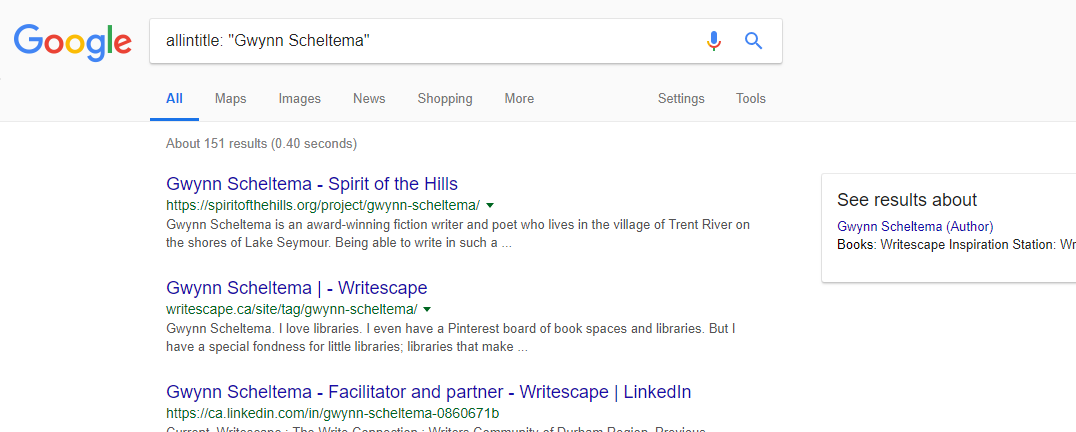
If I wanted to research articles that focus on a particular person, I might ask Google for results that feature that person’s name in the title: allintitle: “Gwynn Scheltema”. As well, you can search only the text, and exclude the titles, by using allintext:


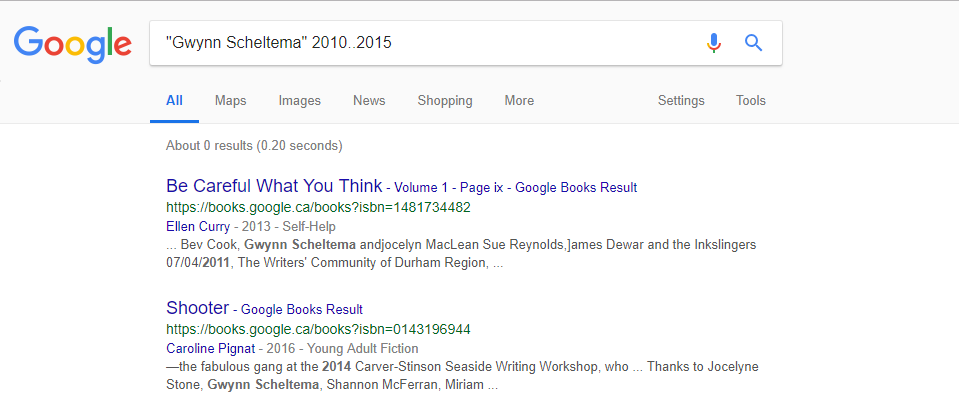
 Search a date range

If you want results from a particular time period, enter the dates you want with two zeros in between such as 2010..2015

Search for terms near each other

One of the most frustrating things about searching with several terms is that many results appear somewhere on the page, but bear no relation to one another. However, you can ask Google to find terms near each other by using AROUND(1) between terms.

“Gwynn Scheltema” AROUND(3)  “editor” will find pages where the exact name Gwynn Scheltema appears within 3 words of the exact word “editor”.

Use an asterisk within quotes for unknown words
If you know part of a phrase only, such as lyrics or titles, use an asterisk to represent the unknown words: girl with * tattoo or  *before the lord of song*

Of course, these tips only scratch the surface, but mastering them will give you more relevant results in less time. And for busy writers, that’s worth something.

Your Anytime Writing Retreat

Your Anytime Writing Retreat

Ruth E. Walker

Shortly after our most recent retreat, Turning Leaves, I heard from a writer who wasn’t able to attend. She was disappointed to have missed the retreat and, of course, we missed having her there. But it started the kernel of an idea for me.

What to do when you can’t get away to write but you really need that getaway?

Do it yourself

A self-directed retreat can give you the boost you and your writing need. There are two basic ingredients necessary to create your own writing retreat.

  • permission — allow yourself this gift — whether it’s for 30 minutes or 33 days, gift yourself and your muse with writing time
  • difference — as simple as facing your laptop in a new direction or as drastic as getting in the car and driving west without a destination in mind, a different writing space will loosen your perspective

The “where” doesn’t matter as much as the “okay” you need to give yourself. Once you commit to accepting the gift of time to write, the rest will fall into place. So, you’ve said okay to a retreat? Now to focus on the “where.” Many writers don’t have to even head out the front door.

Retreat at Home:

Begin by creating the right space that will give you the retreat vibe. Turn off the TV. Log off the WiFi. Unplug the phone. Eliminate distractions — if you need to, hire a babysitter or dog walker. Maybe light a candle or incense.

Take your journal or laptop into a room you don’t normally write in. Stand at a window you don’t usually look through. Sit on your apartment balcony or the backyard deck. If you’re a morning writer, keep your jammies on before you start to write. If you tend to write later in the day, start out with a walk in your neighbourhood, but travel in a new direction.

Do a little fuel prep in advance of your self-curated home retreat. Put together meals and snacks in advance. I don’t mean potato chips and dip…treat yourself so this feels special. Crudité. Antipasto. Shrimp cocktail. Whatever will raise the bar for you to a place of being pampered.

Retreat away from Home:

If a retreat at home would never work (i.e., noisy neighbourhood, roommates, cramped quarters) consider where you might escape to. I know writers who write at their local library. They turn off their phones, squirrel away in a quiet corner and spend the day writing. And with so many libraries loosening up those old rules of no food or coffee, bringing your lunch and favourite munchies along is less of a barrier. You can’t sit there in your jammies but there’s nothing that says you can’t wear your old sweatshirt and kick off your shoes to get comfy. My local library has an upscale coffee shop onsite where you can write your book and eat your cake, too.

Another option is to book yourself into an inn or B&B to write for a couple of days. Book for the off season to get lower rates. A friend and Writescape alumnus, Ingrid Ruthig, is an award-winning poet and accomplished artist. She creates her own writing retreats by booking a room in a B&B and staying for a few days. She’s disciplined enough to keep her focus on why she’s there and uses the new space as inspiration for her work. And she notes that the breakfasts make for a stellar start to her day.

Be creative. Head to a coffee shop to write. How about the local museum? Do the kids have a backyard treehouse? Retreating away from home doesn’t need to be an overnight excursion. The main point is finding a place that is different; it is difference that can inspire creativity.

Look for artist residencies

An artist residence can offer time and space to writers. Some residencies involve a large financial commitment. But some are provided free of charge or have scholarships or bursaries to offset the cost. And some pay you to attend.

There are dozens and dozens of residencies in Canada, the U.S. and abroad. The Write Life has a list of 27 Amazing Writing Residencies. I’ll admit to being intrigued by the winery retreats — Writing between the Vines will give you a week-long, no charge residency in either California or B.C. You have to get there and you need to bring your own food but my goodness, imagine a cabin tucked away among the cabernet sauvignon in the Sonoma Valley!

Closer to my home in Ontario, the A-Frame Residency in Ameliasburg offers writers the use of poet Al Purdy’s iconic Prince Edward County home. $650 paid to writers weekly for a no-fee 4-week stay is a remarkable gift. Not to mention the hope that some of the Governor-General Award-winner’s creative spirit could rub off on you as you work. Applications re-open fall 2019.

Heather O’Connor, who’s attended many of Writescape’s retreats, wrote about her artist-in-residence experience at Quetico Provincial Park, west of Thunder Bay and bordering Minnesota. In that post, she shares how she also funded the travel expenses to get her to Quetico, which gives us a nice transition to the next topic.

Fund Your Retreat

Apply for writing grants to help cover the cost of any writing retreat, either self-directed or carefully curated by others. Local, regional, provincial and national organizations offer grants to help support you in this journey. We’ve written a few blog posts about grants and how to get them, including this story of a breadmaker’s grant. And Heather O’Connor, arguably one of the most successful writing grant applicants we’ve ever known, offered some sage advice in this 2016 blog post.

So, whether you hunker down at home or leave the country, there are many ways to create your own writing retreat. Whatever it takes to charge your batteries and keep the words flowing, we wish you well. May the muse be ever-present and the writing, sublime!

Writescape’s next retreat

Registration for Spring Thaw, our annual creative getaway at Elmhirst’s Resort, doesn’t officially open until December 1. But for our retreat alumni and subscribers to our Top Drawer blog, we’re giving you a bit of a head start.

Spring Thaw, April 26 to 28, 2019, is an all-inclusive writing retreat in cozy cottages on the shores of Rice Lake in the Kawarthas. We create an intimate and safe space in which writers can explore ideas and stretch their creative energy. At Spring Thaw, you’ll have:

  • editorial review on 10 manuscript pages
  • private feedback consultations
  • creativity sessions to inspire your muse each morning
  • private room in shared, fully equipped lakeside cottages
  • optional evening activities
  • full access to resort amenities: WiFi, indoor pool, whirlpool & sauna, trails

Writers can keep the energy going with our Extend-Your-Pen option, April 28 to 30, two more days devoted just to working on your writing.

Retreat alumni and members of writing organizations can take advantage of our special discounts. Spring Thaw is a wonderful escape to let you imagine, reflect and write.