One of my grandchildren texted me: “School starts in 2 days” followed by no less than 6 emojis, all different. Smiley, sad, angry, astonished, upside down and shrugging.
By themselves, her text words could have been interpreted several ways: Yikes! I can’t believe school starts in 2 days after so long. Or I’m so excited that school is starting in 2 days. Or OMG I’m dreading the fact that school starts in 2 days.
What was this child trying to tell me? Or was she just trigger happy on the emoji screen? What was she expecting from me? A thumbs up, or something more? I opted for the “something more”, and we ended up having a lengthier discussion about what was bothering her. All good.
But the incident reminded me that in the absence of sound
volume and intonation, words in messages have to be specific enough to convey
the right message.
Fiction dialogue
The same applies to fiction dialogue. And if the words can’t do it, the author
needs to use one of several “dialogue helpers” to clarify.
I remember in a critique group years ago, a writer read
aloud a small excerpt from his chapter where we follow the protagonist (a male
teacher at a private boarding school) up to the principal’s office. Then a line
of dialogue: “Sit down,” said the principal. “We must talk about young
Jonas.”
Had I been reading the words myself from the page, I would have assumed that this was to be a cordial conversation between teacher colleagues, but unexpectedly, the author delivered the dialogue in a loud angry voice. Where was that emotion in the text? The dialogue needed help so readers could imagine the tone.
Dialogue helpers
Using someone’s full name, title or nickname
Did your mother ever add your middle name when she was
angry: “Alison Elizabeth Martin! Get in here this minute.” Or a pet name when
she was trying to console? “Oh Snooks, tell me all about it.”
If this principal usually calls the protagonist Bill, then using his full name William will signal that something is wrong. He might go further by removing any personal connection and using his title, or calling him Mr.
“Coach Simons, sit down…..”
Sentence construction
Match the length and type of sentence to the emotion being expressed. In an angry situation, short commands are more likely. “Get in here.” Friendly conversations will begin with greetings and perhaps questions about the other’s situation or feelings. “What have you been doing lately?” “How’s your Mum?” “What’s the matter?”
“Coach Simons. Close the door.”
The command to close the door signals that what is to follow
is private. Issued as a command suggests that the person entering is in
trouble. Short clipped sentences support tension.
Word choice
Think about how many words people use in different emotional
states and what kind of words. The angry mother commands in simple words what
she wants done. “Get in here this minute.” She doesn’t acknowledge what the
recipient wants or feels, nor is she concerned with politeness. She is not
likely to say, “When you’ve finished playing with Julie, please come inside.”
The principal would need to be professional but show his
anger in some way.
“Coach Simons. Close the door. Sit there… please.”
Allotting a specific chair signals control in the hands of
the principal. Adding a hesitant “please” at the end preserves civility
but diminishes cordiality.
Voice description
A word of caution here. Describing the actual sounds in the
scene is different from “labelling” them using attributives like “he said
angrily”.
NOT: “Coach Simons. Close the door,” the principal said
angrily.
BUT: “Coach Simons. Close the door,” the principal hissed
between clenched teeth
Body language
The unspoken vocabulary of body language is a gold mine for
conveying emotions. Use it.
“Coach Simons. Close the door,” the principal hissed
between clenched teeth. He indicated a chair to his right, stabbed at the air
with a pointed finger. “Sit there… please.”
Beats
Beats are physical actions a character makes
while speaking. The pointed finger in the last example is both a gesture and a
beat. But beats are not just gestures. They are all actions your character
might make that help to animate your dialogue scene. Think of it as the
difference between listening to a stage play where everyone stands in a line
and recites their words versus the acting that happens on stage as characters
speak.
“Coach Simons. Close the door,” the principal hissed between clenched teeth. He indicated a chair to his right, stabbed at the air with a pointed finger. “Sit there… please.” The principal walked to the window, and stared out to the courtyard below for a full minute before he turned to face Simons.
Obviously, you don’t need every helper in every dialogue situation, but add these to your writers toolkit to use whenever you need them.
Brevity — economy of words — to say so much with so few words is far more powerful than filling a scene with tonnes of description. It works the same way that bulleted, step-by-step directions work better than long paragraphs of first set out all your tools and triple check that you have everything you need and then open the box and take out the hoozits and then you put the hoozits into the whatzits, turning all the way and making sure you haven’t…etc., etc
Sound – rhyme, near-rhyme, alliteration – our ears are engaged with words that share similar sounds when placed close together or in patterns. Amidst…pussy-willow pads of labs, a sudden set of deer tracks – Barry Dempster
Repetition — always with a specific purpose to underscore a meaning or idea — your slightest look easily will unclose me / though i have closed myself as fingers, e.e.cummings
Ideas have power — taking us to places in unexpected ways excites our imaginations — To see a world in a grain of sand and heaven in a wild flower… Wm Blake
Imagery — picture words are effective to convey far more Who made the grasshopper…who is moving her jaws back and forth instead of up and down… Mary Oliver
Structure — the scaffolding on which a poet hangs their words — just as any genre of prose has expectations and writers work with and, often, challenge those expectations, poets take familiar forms and upend them.
Risk — poets, like all artists, take risks with more than just structure. Cowboy Poetry is a venerable form, evoking images of the Old West, cattle drives and breaking wild horses. But modern Cowboy Poetry can be a different story: …the bridge abutment already signed with 4 white crosses for those who did not quite make this curve because of booze, because of snooze…Paul Zarzyski
Symbolism — it’s like holding a flash card designed to evoke meaning, a symbol instantly takes us places. Consider a flag — now make it a white flag — now a Confederate flag — now a nation’s flag upside down — it is still a flag but each time, symbolizes something different. Where the flag is placed can change the symbol it represents. Is it tattered and falling from dying hands? Is it held high during an attack? Is it being consumed by flames on a roadway?
Pacing – Use long languid lugubrious multisyllables with loads of vowels to slow the reader or short sharp words with hard consonants to pick up the pace. Somnolent through landscapes and by trees / nondescript, almost anonymous, …P. K. Page
Breaks – line breaks, stanzas, dashes all signal to the reader to notice, to pause and let what has just been said sink in and prepare for a new thought. Writers have similar signals at their disposal: white space when changing POV, time or location; paragraphs, chapters or a statement all on its own line.
Last week, guest blogger Marie Gage, walked us through the process of creating an ebook for sale on the Amazon platform. Today, she shares how to create ebooks that you can freely share on your own. And she explains why, after publishing through Amazon, she chose this additional step.
No strings attached
I recently started working with Prolific Works, a company that brings authors together to distribute free copies or previews of their books in group offers. To participate, I needed to produce an ebook file of the first three chapters of my novel, plus appropriate front and back matter. I couldn’t simply modify the file created through Amazon.
After searching with the wizardry of Google, I found my answer: Calibre makes it incredibly easy. Downloaded for free, Calibre is an open-source program. (They do appreciate it when you choose to support them through a voluntary donation.) Unlike Amazon’s program, Calibre does not offer the .drm (digital rights management protection) but does everything else with minimal effort. If you decide you need .drm, you can purchase it from any one of a number of vendors. But be prepared for the monthly fees.
NOTE: Calibre works best for files that do not have “fixed” elements. A fixed element is one that should not be moved around when readers change the size of text or the orientation of their ebook reader or app. All of my children’s books have fixed elements in the layout. So, I had to first turn each page into a JPG image before using Calibre. As a result, readers can’t adjust the text size on any of these ebooks.
Calibre screen shot: Opening screen
The process is easier for a book that is predominantly text. Follow along on the screen shots of the Calibre software.
After downloading the Calibre program:
press the Add Book button, find the Word file for your book and load it
press the Edit Metadata button and fill in the fields with appropriate information about the book
change the cover picture by uploading the cover file for your ebook
NOTE: Once you press the Edit Metadata button, add your key words in the box titled Tags (more about the importance of key words in last week’s post.) Separate each key word with a comma. Next. select Convert Books from the Calibre header.
Your screen will now look like this:
In the top right corner select the ebook format from the many listed formats to choose from. The most popular is .epub but you might want .mobi or .pdf.
EPUB is compatible with most ebook readers and analogue apps
MOBI is the format used exclusively by Amazon and is compatible with Kindle readers and apps
PDF is compatible with any PDF reader and is easily clicked and uploaded on most computers NOTE: without the ability to change text size and spacing on ereaders, PDF may not be ideal for a long book
Suffice it to say that readers will have their preferred reading device and you might consider offering your ebook in more than one format.
Trouble shooting tips
Take note of the options on the left-hand side of the screen if you experience problems with your first conversion attempt. You may find your text is not converting the way you want it to. The most likely additional choice to make would be to press the EPUB output button and choose either EPUB2 or EPUB3. EPUB2 is still Calibre’s default so you must make a conscious choice if you want the upgraded format. EPUB3 is essentially an update to the sophistication of EPUB2. EPUB3 allows for easier navigation and some fancier elements such as embedded video.
Older ereaders don’t support the EPUB3 format. However, EPUB3 has been around since May 2010 and most readers will have upgraded their devices by now. For my novel, I didn’t require the EPUB3 so I used the default setting.
When you have made your output selection, press OK near the bottom right of the screen and you will see a circle begin to move around. Don’t worry, you can’t miss it as a big arrow comes up and bounces to show you where it is. When it stops, you can select a second format and press OK again and repeat until you have all the formats you want.
Press the click to open button and review your ebook file(s).
NOTE: You will need a program on your computer that is compatible with the file output chosen. For EPUB this is Adobe digital editions. For MOBI, this is the Kindle App on whatever device you use.
Picture this
One final, yet critical, cautionary note: Diagrams or pictures in your Word document must be downsized outside of the Word document. You can’t simply click and drag to change the size of an image; it won’t translate well into an ebook. Instead, use Photoshop or another photo editor program to change the actual size of the file to the appropriate dimensions for an ebook. All images must be no more than 800 pixels (px) tall by 550 px wide, which is the actual size of an ebook reader screen.
I cannot tell you how many professionally created ebooks I have read, and I do mean from mainstream publishers, with images that cannot be seen on my ebook screen.
I used to believe the issue was the ebook format and there was nothing I could do about it. For my novel, I had two maps I wanted to include. Once more using the magic of Google, I found and followed the advice to resize images outside the Word file before converting the file to an ebook.
I couldn’t believe how clearly the maps showed.
If you wish to see how clear an image can be on an ebook reader, I invite you to read my novel.
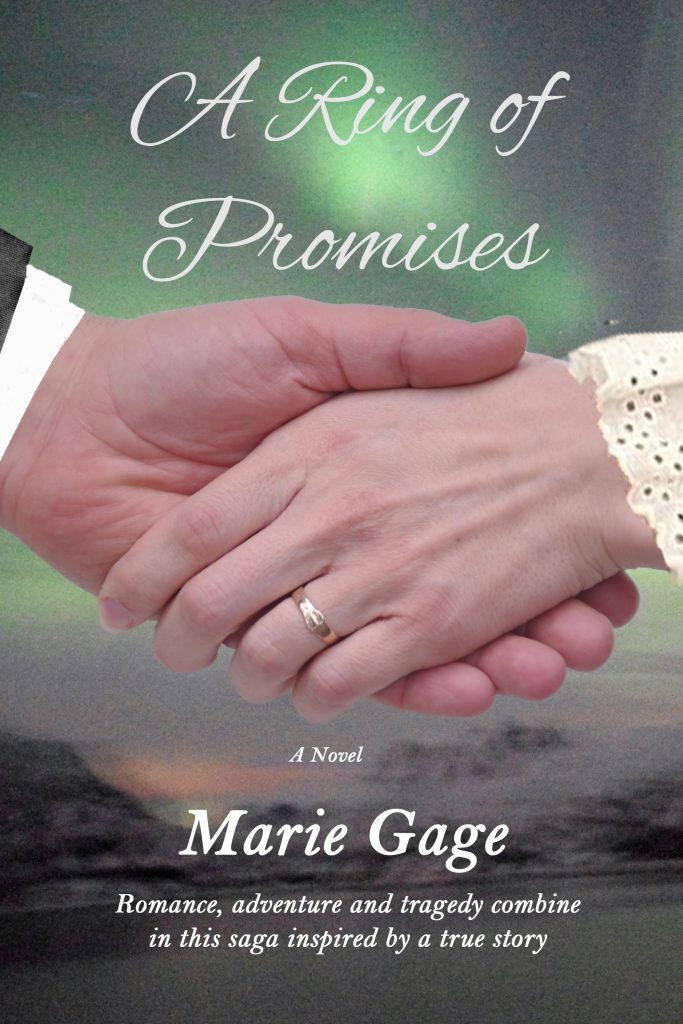
Marie Gage lives and writes in beautiful Haliburton County, Ontario. Creative writing became a part of her life a during genealogical research that unearthed some tantalizing tidbits in her family history. She joined a memoir writing group, expecting to finish that one project and be on to the next interest. Instead, she began to see everything as a story. In the past five years, she’s self-published numerous photo books, four children’s picture books and her debut novel, A Ring of Promises. Capturing her paternal grandparents’ transition as they immigrated to Canada from England and Scotland, her novel weaves the facts of their intriguing lives into a compelling story.
It’s been our pleasure to work as editors with various writers, helping to refine and ready manuscripts for submission and/or publication. One of our clients, Marie Gage, is an indie author of four picture books and a recently released historical novel. In today’s guest blog, she shares her experience preparing her manuscripts for ebook and print publication with Amazon.
Guest blogger, Marie Gage
I wanted to offer readers both ebooks and print books, so I chose to create my books independently. I’ve used both Amazon and Calibre to format my material, but for today, I’ll focus on developing your ebook for sales through Amazon.
Creating an ebook is easy when you work with one of the websites that sell your book for you. Amazon offered me a relatively simple process to upload a word document and have it converted to a .mobi file, compatible with the Kindle reader and Kindle apps. My historical novel follows characters on both sides of the Atlantic Ocean, so I liked that my book became available worldwide through Amazon (but you can choose to limit distribution of your book to specific regions.)
First things first
Before you can upload your file, create an account with Kindle Direct Publishing. It’s a bit more complicated than setting up most accounts because you need to input banking and tax information so they can pay you when your books sell. Notice I say “when”—I’m always the optimist.
Fill in responses to a variety of questions such as “title” and “keywords.” Readers use keywords in the Amazon search box and it’s what Amazon uses to populate what customers are offered. You want your book associated with keywords that people use but are not so competitive as to result in your book never being shown. The keyword must also be relevant to what the customer sees in the description of your book. Using “Romance” for a cookbook will not bring you readers. Here’s a quick introductory course in how to choose keywords.
MARIE RECOMMENDS: Do the research about keywords before choosing the final title for your book. Consider adding a subtitle that strengthens your placement. Once you have published through Amazon, you can change the keywords but you cannot change the title on your ebook or print book. You can change the subtitle but ONLY on the ebook, not the print book. NOTE: Keywords in the title and subtitle have more impact on Amazon’s selection process than those in the form you complete before uploading your book.
Amazon allows more than one word in each of the keyword spaces and indexes them together and separately. For example: “Romantic” and “Comedy” when placed in the same box will be indexed alone as “Romantic” and “Comedy”, as well as together as “Romantic Comedy”. Thus you have a chance of being presented with any one of the three terms typed into the search box. However, it is not wise to flood these spaces with every possible word. You will annoy the Amazon staff, who check your work for relevancy, and may end up not indexing any of the words.
Next steps
Fill in the field for the book’s description. Put on your marketing hat and figure out what you want to say here that will attract the attention of the reading public. You want the description to be so intriguing that it will entice readers to click the “buy” button. What is the hook that makes your book special? Don’t rush this process. When you are sure it’s ready, remember to insert the basic HTML text formatting to note each paragraph end, as well as any italics and bolding. Otherwise, you’ll have one long paragraph with no italics or bolding.
Save and advance to the Kindle Ebook Content Page. A major benefit of publishing on an already available sales platform is that digital rights management (a .drm suffix) can be added to decrease piracy of your ebook. The protection is not foolproof and there’s controversy about whether it’s necessary, but I feel better knowing it’s there. A major downside is that it may penalize purchasers who wish to transfer their purchase to another device. NOTE: On Amazon you have to press the correct button to turn on this function. Once the book is published you are not permitted to change this selection.
Decide if you want an ISBN. You do not need an ISBN (International Standard Book Number) for an ebook on Amazon, but if you have one and wish to use it you can input it. Canadians can obtain one through Library and Archives Canada and there’s no charge. NOTE: You cannot reuse an ISBN from a book you’ve already published elsewhere. Also, print and ebook formats will need separate numbers.
Getting closer…
Upload the file of the interior of your book and a separate file with the cover. Make sure you have a cover that will be noticed among all the others on the page and is consistent with the genre of your book. Launch the previewer, check it carefully and press APPROVE. Or more likely, go back to your original file, correct the errors and repeat the approval process until it is perfect.
Press APPROVE and advance to the Kindle Ebook Pricing page. You will be asked to make decisions about the price. The system will suggest a price based on what it considers to be “other similar ebooks”. The final decision is yours.
Choose a compensation package. The options depend upon exclusivity of your book to Amazon. If you wish to have it added to the Kindle Select program, you give Amazon exclusivity for the ebook only. Note the delivery charge that Amazon subtracts from your royalty. It’s often quite small but for picture books, the charge can eat up most of your profit. The only way to decrease the cost of delivery charges for picture books is to decrease the size of the file. See this article for instructions on this process as it relates to picture-intensive ebooks.
And…voila!
After completing the process you will be prompted to upload a print book or associate a print book with the ebook. It will take up to 72 hours before you get the email saying your book is live on Amazon and it can take a week or more before it is live in all markets.
Next time, I’ll share my experience of creating ebooks without depending on an ebook sales platform. Books you create on Amazon or similar sites are not yours to distribute as you choose and there are times when you need to have that freedom.
Marie Gage lives and writes in beautiful Haliburton County, Ontario. Creative writing became a part of her life a during genealogical research that unearthed some tantalizing tidbits in her family history. She joined a memoir writing group, expecting to finish that one project and be on to the next interest. Instead, she began to see everything as a story. In the past five years, she’s self-published numerous photo books, four children’s picture books and her debut novel, A Ring of Promises. Capturing her paternal grandparents’ transition as they immigrated to Canada from England and Scotland, her novel weaves the facts of their intriguing lives into a compelling story.
Backstory threatens to crowd out my closet. This dark cloak? That
frilly dress? Those dusty trousers? I write memoir and every garment has been
on my body. It all happened. It’s all true. I want each outfit to have its turn
on the page.
Fiction writers and I share the same dilemma. What if we dare to
toss a backstory that turns out to be the very one we should have kept?
Desperation made me dare. My manuscript was too long, and backstory
was to blame. Several writing-craft books and webinars later, I’ve learned a
few things about decluttering, fit, timing and how to dress the main story with
backstory in a way that appeals to readers.
Before I could declutter, I needed to understand that backstory
explains things readers need to know. Sometimes it’s a mini-story: how the
character’s ordinary world ticked along before trouble arrived or a bygone trauma
shapeshifted a character’s personality.
Other times backstory is information, such as how the invented world
works in fantasy or science fiction.
Either way, “less is more.” According to Toni Morrison, “…it is what
you don’t write that frequently gives what you do write its power.”
1. Toss Appeals for Sympathy
Some writers, says author Roz Morris in Past Mastery, a Jane Friedman-sponsored webinar I attended in July,
drop in a calamity from the past out of a desire to generate a dose of sympathy
for a character. The annoyed reader waits in vain for the calamity to mean
something.
I did this when I dropped a reference to my great-grandmother dying
by suicide, a tragedy that slays me but had no bearing on the narrative. Out it
came.
My mother’s tragedy was contracting polio when she was eight.
Thankfully, I realized the story wasn’t about her polio. It was about how this
early trauma warped her worldview and injured every relationship that should
have been important to her.
Marie Kondo-ize your closet by examining every backstory garment.
For each, ask:
Does the reader need to know this?
How does this episode propel the main story forward?
Will cutting this set the reader adrift?
Is the relating of this backstory triggered by a main story event?
Is this scene or slug of information a call for sympathy that goes
nowhere?
Does the incident help to tell the protagonist’s story or another
character’s story?
Culling can be brutal. I comforted myself by building a special
closet at the bottom of my manuscript, out of Kondo’s clutches. Sign on the
door: Private. I move beloved old
outfits here when they don’t fit the main story. Someday, these backstories may
inspire their own narratives.
Threading So the Stitches
Don’t Show
Having decluttered, the next step is to dress the manuscript in
essential outfits in a way that lets it carry off backstory with natural grace.
1. Wait for Thirst
Readers want backstory, but have limited patience for it, especially
in the early pages. The writer’s job is to make readers thirst for it, and then
deliver one glass of backstory at a time, at just the right moment.
What creates curiosity? Emotion—a steady drip of emotional intrigue and
engagement. Who, on a first date, wants to hear the other person’s biographical
details in the first 15 minutes? We long for those later, when romance makes us
eager to sit across the picnic table until dawn.
Readers, says Morris, don’t want facts. They want feels.
2. Show Readers the Gap
But there’s an exception, one that writers sometimes overlook. A
critical plug of backstory that readers need early is what the character’s life
was like before trouble arrives. Without that, they can’t gauge the impact or
feel the related emotion.
Show the “before” early. Make it brief, vivid, perhaps your opening
scene. “Follow the character’s expectations,” Morris says. What had the
protagonist intended to do that day, before Pandora’s Box flew open?
My narrator expected another day of tranquil living with her husband
in their country home. She comes downstairs for lunch. He’s heating soup. She
reaches for the mail on the counter. Dread rises in her throat when she sees
the envelope with the familiar handwriting.
Readers feel the anxiety because, having had some early backstory,
they understand what she risks by opening that letter.
3. Animate Backstory with Scene
Writers can “tell” backstory or “show” it.
Showing is better.
Flashback eases the reader into a dramatic scene from the past, complete with
character, setting, plot, conflict and resolution. If the scene satisfies
curiosity ignited by the main story, it can be whatever length it needs to
be—including its own chapter.
Another way to animate backstory is by having one character share an
anecdote or instructions with another who needs to hear it. Michael Crummey
does this splendidly in Sweetland
when the main character spars with a visiting government official, giving us a
glimpse of “ordinary life” and how the growing conflict threatens it.
Sometimes a “tell” cannot be avoided: a biographical detail, an
historical event, how something works. In these cases, deliver the information
in short, engaging bursts at the moment of keenest thirst.
4. Use Logic to Shift into Backstory
Readers want a reason to be interrupted out of main story. Moments
of reflection, discovery or epiphany serve as a water slide into backstory.
Perhaps your character ruminates while driving to meet an old friend
at the winery where the murder took place. Stumbles on a locked tin of old
letters in the potting shed. Finds himself repeatedly sketching a mysterious
face and wakes one morning knowing whose it is.
I bustled a fair amount of backstory into a pensive hour sitting at
the foot of my father’s bed as he lay dying, giving my narrator a logical
opportunity to muse on who was this man.
5. Signal Your Entrance and Exit
Readers like to know where they are in narrative time.
One way to signal a transition into backstory is through a change in tense. Start with a single use of past perfect: “She had estranged herself from her family.” Continue in simple past tense (less clunky): “She had writtenwrote threatening letters.” Signal your transition out with another single use of past perfect—“What she hadn’t foreseen was how she might need these people”—before returning to main story.
In Three Day Road, Joseph
Boyden’s transitions are like lubricant. “I have paddled by myself…to get
here,” Niska says. “My one living relation died in a faraway place”—and with
that, Boyden rocks us into a story from the past.
Backstory can be necessary outfits and supportive undergarments for
your main narrative, or mismatched, distracting accessories. Taking time to
examine your wardrobe for fit will help make your manuscript the best dressed
in town.
What are your backstory secrets and techniques? How do you make backstory as compelling as main story for your reader? We’d love to hear your discoveries.
Meet Heidi Croot
Heidi Croot lives in Northumberland County and is currently working on a memoir. She has been a finalist with The Writers’ Union of Canada, The Malahat Review, WOW! Women on Writing, Tulip Tree Publishing, and her work has been published in the inaugural edition of Linea magazine, the WCDR anthology, Renaissance, in Long Term Care magazine, and others.
Gwynn’s home county, Northumberland County, Ontario, has a vibrant arts community, including the dedicated and prolific Spirit of the Hills Writer’s Group of which Gwynn is a member. The group has been publishing a blog since April: A Journal in Time of Pandemic and Lockdown. Today’s guest post originally appeared on July 3 on that blog, and we reprint it here with author and poet Kim Aubrey’s permission.
Kim shares her personal story of keeping in touch with relatives far from home during the pandemic, and also her new found method of journalling that works for a time when our minds aren’t as focused or creative as we’d like.
Kim Aubrey
The call for lockdown came just as my husband and I were preparing to drive to New Hampshire to care for my mother during her recovery from surgery. Her hip replacement was scheduled for March 18. On March 14, I read the Prime Minister’s online message advising Canadians to stay home, and my husband read that our health insurance would probably not cover us if we went to the States.
The next day I talked
to my younger brother M. in Texas. He prepared to step in and take care of Mom.
The stress mounts
“We can’t come,” I told
my mother. “Maybe you should postpone your surgery.”
“Not going to happen,”
she said, determined to go ahead with the hip replacement which would relieve
her pain.
But on
March 16 the surgeon’s office called her to reschedule for May.
My middle brother E. survived a terrible traffic accident when he was nineteen. Since then he’s lived with a brain injury. He and Mom share a house and are company for one another, but during the past few years, he’s had trouble keeping his balance and has suffered a few bad falls.
On March 19, he fell for the second time in the space of a week. Mom called an ambulance, which took him to the Emergency Room. Luckily, he didn’t break any bones, but he was in pain for over a month. I wanted to be there to help my mother and brother, but all I could do was call by phone and Skype, remind him to ice his shoulder, remind her to take the anti-inflammatory pills the surgeon had prescribed.
As May approached, I waited for the surgeon to postpone again, but it didn’t happen. My brother M. once again agreed to stay with Mom during and after her surgery. Despite my worries, the surgery was a success, no one got sick, and Mom has had a good recovery.
New routines needed
Since mid-March I’ve been talking to her and E. every day. I used to call once or twice a week, but knowing I can’t visit anytime soon and aware of the danger the virus poses, I feel the need to check in more often. It’s become part of my pandemic routine, like working on my novel, online yoga and Nia classes, and the journal I’ve been keeping since December, inspired by an exercise in Lynda Barry’s wondrous book Syllabus: Notes from an Accidental Professor.
Barry’s book is based
on the writing/drawing classes she taught at the University of Wisconsin. I’m a
fan of her comics and have been wanting to write/draw a graphic novel for many
years now. To prepare myself, I started doing a couple of the exercises Barry
set her students—a quick daily self-portrait and daily lists of seven things
done, seven things seen, and one thing heard, along with another quick drawing.
I’m grateful I began this practice before the lockdown as it’s been an easy and satisfying way to keep track of these pandemic days.
Meet Kim Aubrey
Kim Aubrey’s stories, essays, and poems have appeared in journals and anthologies, including Best Canadian Stories, Event, Numero Cinq, Room and The New Quarterly. Her story collection, What We Hold in Our Hands, won an Honorable Mention in the Bermuda Literary Awards. Kim leads an annual writers’ retreat in Bermuda.
Writescape’s summer contest is over, but for writers, the process of submitting is never over. We’ve noticed on Facebook, that Writescape Retreat alumnus Lisa Reynolds has been submitting relentlessly, and succeeding! Her poem “Midday in a Café” was accepted by the online literary journal, Loud Coffee Press, and her entry was chosen by PonderSavant.com for its One-liner Abound contest.
Not just that, but she has had works
published or accepted by intriguing sources: groups that fight world hunger, or
support women’s issues or an international online Berlin-based
arts/cultural/politics magazine called The
Wild Word.
So we asked
her: How do you find all these interesting markets? How do you pick the ones
that work for you?
Guest Blogger – Lisa Reynolds
I used to scan the internet for hours, trying to locate reputable contests, blogs, journals and other places to send my work. This strategy was not only draining but time consuming. I ended up submitting short stories and poetry I already had on file instead of writing fresh pieces which were more in line with the aesthetic and vision of the magazines, anthologies and online publications I sought publication in.
When
rejections came back, I knew I had to change things up before my
self-confidence plummeted and I stopped submitting altogether.
This is when I
decided to use Facebook as a resource to find submission options.
A Wise Decision
I’m happy to say it was a wise decision. In the past three months, ten of my works have been accepted for publication. Although I am no expert, I increased my chances of success with these five steps:
Join Facebook Groups
I am a member
of Facebook groups that post poetry and writing contests. Some of these groups
are Public while others are Private, requiring three to five basic questions be
answered prior to acceptance.
Although I initially
found the high number of members in these groups intimidating (for instance,
the Calls for Submission Group has 65K private members), I didn’t let fear of
competition deter me from joining. I focused on the positive, believing the popularity
of these groups meant they were credible.
Be Selective
When perusing markets posted in these groups, I was able to quickly eliminate those that didn’t appeal to me because of the type of literary form, theme, requirements in terms of length, and/or deadline.
After saving my preferred choices in my Facebook portfolio, I created an Excel spreadsheet so I had a tangible list on hand. Then I focused my energies on reviewing the submission guidelines for each choice in detail.
Do Your Research
Reducing my longlist of submission options to a manageable shortlist was easier than I expected.
With more time available to research past issues of magazines, read previous contest winners’ works and check out blog archives, I was able to determine whether my writing fit their preferred style and had a chance of being accepted.
Find Your Personal Fit
It wasn’t long before I noticed my selections gravitated towards certain publishers: those that published works that related to my themes of interest, particularly social justice.
This led to self-reflection and the realization that I wanted to write about issues that mattered to me. I wanted to be a small part of supporting charities, saving wildlife, fighting hunger, feeding the homeless, advocating for children and women in crisis, and other social justice issues. When I write about these issues, I believe my voice is sincere and authentic. Perhaps that is why they been have been chosen for publication.
Share with other writers
Having a target list of places to submit to and constant deadlines keeps me writing regularly. But for me, the most exciting part is the domino-effect of sharing. This mindset has helped me remain humble and committed to my writing practice.
I regularly post on my Facebook page to encourage others to submit, and I am overjoyed when I receive messages from writers saying, “Did you see this one?” It’s a wonderful feeling to share and celebrate our successes together.
Using Facebook as a resource to locate contests and other markets has worked for me. I hope it works for you too.
Below are a few links to groups that you may find
helpful. Good luck!
Lisa Reynolds is a teacher, writer, and proud member of the Writers’ Community of Durham Region, Ontario. Her poetry and short stories are published in several print and online publications. She lives in a waterfront community east of Toronto.
Websites for writers can be a treasure trove of inspiration and resources. For this month’s 10 on the 10th, we’ve compiled, in no particular order, a list of ten helpful places for you to visit. These are websites that, as writers, we’ve found useful and upon occasion fun. Happy surfing!
#1 Writers’ Digest has been around for decades, first as a magazine and now also hosting a massive site that’s loaded with articles on just about any topic a writer might want to explore. Sign up for their newsletter — it’s full of advice and ideas. https://www.writersdigest.com/
#2 Literistic. Imagine receiving a monthly list of contests and magazines with upcoming deadlines for submissions. Literistic caters to people who write poetry, fiction and nonfiction in Canada, the United States and Britain. There’s a free shortlist or you can choose the $8.50/month list that is curated with only the markets and topics that you select. https://www.literistic.com/
#3 One Stop for Writers is a great site with a range of tools for writers. Angela Ackerman and Becca Puglisi (co-authors of six best-selling resource books including The Emotion Thesaurus) joined forces with Lee Powell (creator of Scrivener) to build what they term a “library” for writers. You can register for free and if you like what you see, sign up for a monthly paid subscription. https://onestopforwriters.com
#4 49th Shelf is a website focusing on the books of Canadian writers (but a great discovery for writers outside our borders). Why are we featuring a website about books? Let us quote an American writer here: “If you don’t have time to read, you don’t have the time (or the tools) to write.” from Stephen King’s Top 20 Rules for Writers. Yup. We agree. https://49thshelf.com/
#5 Word A Day. Five days a week, 52 weeks of the year, receive the gift of a daily word. Not only do you get a word, you get its pronunciation, meaning(s), and the history of that word. Each week is thematic. Last week’s theme: weird plurals. Who knew more than one charisma are charismata? Or on the theme of words that don’t mean what you think they do, bloodnoun — it has nothing to do with the stuff in your veins; instead, it’s another word for bullfrog. Words, words, words!https://wordsmith.org
#6 GrammarlyThe more you write (and read) the stronger your own store of grammar and spelling know-how should develop. However. There are times when having a quick resource to check for clear writing and correct grammar is appreciated. Like 3 a.m. when the deadline is looming and you need to feel confident. You’re welcome. https://www.grammarly.com/
#7 WorldCat Need an out-of-print book? Researching for a historical novel? Get connected to world-wide library catalogue system. A 3-minute YouTube video https://www.youtube.com/watch?v=vos5ivBeZ5c gives you a walk-through on how to use WorldCat. Search by subject, title or author. Create your own lists of resources and add or delete items as it suits you. Locate books in a multitude of languages. Read and/or post reviews. A gigantic library at your fingertips. Meow!https://www.worldcat.org/
#8 Poets & Writers Like Writers’ Digest, this is a wide-ranging website for writers, but it’s a non-profit organization. And we like seeing “Poets” listed first and foremost. Yes, there’s lots here of a general note for writers but P&W gives attention to those of us who work with fewer words on the page. The Bard would approve.https://www.pw.org/
#9 The Writers’ Union of Canada This website offers writers some free resources, such as lists of Canadian writing-related associations, literary agents in Canada, award programs for self-published authors, and many more links. In addition, the union’s resource books for writers are low-cost and high-value: for example, negotiating your own contract, or estate and legacy planning for writers.https://www.writersunion.ca
#10 Freerice This fun online word game is perfect for writers who want to challenge their brain while helping out a good cause, The Word Food Programme of the United Nations. The ad-supported site generates words with multiple possible meanings. You contribute 10 grains of rice for every correct answer. Increase your speed to raise the stakes and shift out of your comfort zone. Playtime for writers in English, French, Spanish, Italian or Korean! http://freerice.com/#/english-vocabulary/6116
By no means is this a complete list of useful or interesting writerly websites.
What sites have you discovered that other writers will find helpful? Suggest them in the comments section.
Our congratulations to Helen Bajorek-MacDonald for winning Writescape’s summer Postcard Story Contest, with her story Woman with Cigarette
You can read her winning story below, followed by our comments on why we chose this story as our winner. And after our comments, read why and how Helen wrote this story. Truly inspirational!
If you missed them, please follow these links for the 2nd-place and 3rd-place winning stories and our comments on those.
Here again is the contest image that inspired this story.
Woman with Cigarette
by Helen Bajorek-MacDonald
You think you want to crawl over me, slither across my skin, creep into my soul.
You think you can create a masterpiece with your authoritative direction and with darkroom magic. One that will earn what you expect: praise for your technical skill, for your ability to render beauty.
You think you can possess me, after you gift me with your obsessive eye, and the promise of immortality.
And you think you can do all this with a click of the shutter.
Maybe.
You perform as artiste.
Uncompromising behind the camera, you peer through the viewfinder.
Click.
Then the sound of the film advance lever.
Click-advance.
Again, again, between prompts and coos and directives barked by a lusty hound.
Click-advance.
“Good! Almost there! Lift your face. No, don’t look up. Chin up! A little. Eyes on the camera. Look deep into the lens.”
The staccato rhythm of the shutter-and-advance-lever echoes the intensity of your tone and commands.
“Don’t move. Just look. Right at me.”
My head’s right, but the eyes aren’t.
More barking.
My neck’s right, but the shoulders aren’t
“Raise your arm over your head.”
Not a question.
I thought it would be easy and fun. First one, then the other, taking photos for our first portraiture assignment. It’s just a few weeks into our photography programme where I am the sole female student, and already it’s all insistent tones and breathless snapping. Just another reminder that I am – merely – subject. For your camera and of your desires.
You complain that there’s not enough light because of the storm.
The rain beating against the window of your shabby one-room apartment makes me shiver, and I wonder … when will you ask me to take off my clothes, for the sake of art?
More instructions.
“Back in a minute,” you announce as you get up from your crouched position on the hardwood floor.
~~~
As she stands to stretch, her eyes sweep the room. Her camera waits on its tripod. Atop a beaten dresser, cup circle stains are partially exposed under the clutter of keys, cigarette packs, matchbooks, a brimming ashtray, and other miscellany.
Maybe it was the clatter of thunder that drums an idea into her mind.
She moves quickly and purposefully.
She sets up her camera. Pre-focusses on the couch. One frame left in the roll of film. One chance to get the focus and exposure right, and to coolly pose herself.
She grabs a cigarette from atop the dresser, sets the camera’s self-timer, dashes to her position at the couch.
Pose. Gaze into the lens. Be you!
Click.
She and her camera are gone before he emerges from the bathroom.
Later, under her darkroom’s safelight, the image reveals itself in the developer tray.
A whisper: Woman with Cigarette.
Why we chose this entry as the winner
Risk in any art form is part of stretching the creative soul and we feel that in this story, huge risks were taken, and they worked. Risks in POV and content themes.
Narration/voice/POV – the writer took a huge risk in moving from what seems to be second-person narration but what the reader is surprised to realize is first-person narration by the character directed at an anonymous “you” — followed by a full shift into third-person narration at the point the “I” narrator takes control of her movements and poses, makes the decision to photograph herself with the last shot in her film (which means she likely expended all but one on the fellow student who is male.) It’s unexpected and despite common advice to not switch POV in a short piece, in this story it works. It does take time to realize what is happening and may challenge some readers, but the payoff was worth it. The story begs a second read to savour the story again with that realization.
Theme: Tackling a familiar subject — the female as object — is also risky because it has been done and done and done. But this feels fresh, partly because of the intriguing shift in POV.
Intensity of the moment which is always a plus for a postcard story — like the click of the camera, a few minutes only are captured and shared to create an emotional effect on readers. Little is given as background or character relationships, but a lot is implied.
Layers – even though we see only a few moments of story action, there are big issues presented for readers to consider: We’re asked to consider the idea of “subject” as seen through the lens of the camera — and that that lens takes a perspective from the person lining up the shot. We are asked to consider the trope of female model posing equals permission for sex. We are asked who has control – of the art and of the model?
Twist: the tropes of subject and model and control as part of the production of perfect art is upended with the sense of the personal as she takes control of the last photo — she chooses the lighting, the pose and backdrop — all of it her decision.
The style of the first part is staccato like the click click of the camera. Short sentences and paragraphs, sometimes even just one word per line. No descriptions of setting or characters. Everything is focussed, mechanical, shallow, artificial, dehumanizing. In the second half, the writing becomes more fluid and human. We see some of the surroundings and there is character movement and building to a motivated point. The reader is involved in the action and outcome.
Both of us felt that the writer’s attention to craft in this fine story was as strong as any we’ve read over the years in various journals and anthologies.
We asked Helen why she entered and what was it about this photograph that took her into this story…
Helen Bajorek-MacDonald
Over the last two years I have been home ill, battling sarcoidosis. Symptoms include debilitating fatigue and visual and cognitive impairment. Not good for a college professor who teaches communications!
When the Covid-19 quarantine struck, I was already accustomed to self-quarantine. But, my world grew even smaller. While unable to devote more than a few minutes each day to reading or writing, I decided as the quarantine dragged on that I needed something to do. So, I turned to Writescape as I knew of the work of Gwynn and Ruth from Writers’ Community of Durham Region (WCDR). A blog is short, requiring little time and energy, and it is easy to enlarge text on a computer screen. It was something I could give precious time and resources to, without compounding my health challenges.
Ruth’s blog, “Picturing Inspiration” resonated especially strongly. Firstly, because it combined two things I love to do: writing and photography.
Secondly, the image haunted me. Maybe because of the times, but I kept thinking about the masks we wear. Yet, the woman in the photograph seems to be unmasked.
Further, she is in repose, but this didn’t make visual sense to me, so I kept turning the picture around to see what the image might ‘say’ if she were erect.
I was especially struck by the direct gaze of the woman in the photograph. Not blank, I wondered what she was projecting to the photographer. What was the photographer trying to achieve? And who was the photographer? Further, there was a nagging whisper over my shoulder … why was her cigarette unlit?
These and other questions led me to conclude that the woman must be the photographer. Her gaze suggests a certain confidence, defiance, direct communication with the camera’s lens. Though this is no 21st century selfie. It’s a self-portrait. It’s art. But how did she come to take the photograph? And what was her motivation for the self-portrait?
I began to think about the reasons one does a self-portrait. Lots of history and critical mass of the male self-portrait, in painting, photography and in writing. Not so for women. Even less awareness of the female self-portrait.
Frida Kahlo Self Portrait
Perhaps predictably, I imagined the woman in the image to be a student in a photography programme. I determined she was a trailblazer. Defiant. Confident. Keenly aware how others might view her self-portraiture – as ‘less than’ in the art world [yes, I imagined her an artist; she’s got something of a beatnik look to her which helped me determined her era] – similar to the reception given to painters Frida Kahlo and Tamara de Lempicka, who woman-with-cigarette might have known, and photographers Elsa Dorfman and Vivian Maier, who remained largely unknown throughout their lives, and about whom woman-with-cigarette likely would not learn of in a school of photography.
As I thought of the challenges woman-with-cigarette would face in her aspirations to be a photographer, I was reminded of the work of African-American photographer Deborah Willis, who was told when she entered an all-male Bachelor of Fine Arts (photography) program in the early 1970s that she was taking up a man’s seat, when all she’d end up doing was have babies. One of her earliest and most profound works is Willis’ self-portrait triptych, “I made space for a good man.” A direct, confident, and political response to those who would silence her creative voice.
And so, I envisioned the woman-with-cigarette in the late 1960s; maybe early 1970s. A nascent feminist and emerging artist, committed to the study of photography, and most certainly possessing some skill and creative talent. She was going places with her art!
And, I determined, she knew enough about art history to know that Woman with Cigarette is almost a cliché over-saturated subject for painters. The greatest challenge in writing “Woman with Cigarette” was to find a subtle way to expose her ironic joke with self.
Writescape’s contest became a much-needed distraction during challenging times, as well as allowed writing to become part of my wellness plan.
Thank you to Writescape for offering the writing challenge, “Picturing Inspiration”. It’s not easy to write to spec. But, Ruth’s blog and the image were a perfect Goldilocks challenge for me. Absolutely, the right time! Just the right length to manage with my limited personal resources. The image checked all of the right inspirational boxes. And, most important, because I struggle with brevity, clarity, and conciseness in my writing, the postcard parameter of the competition offered a perfect opportunity to wrestle with these skills. As Timothy Findlay once observed, a writer must learn to “kill her darlings”. Not so easy! My first draft was almost 900 words.
Thank you, Ruth and Gwynn, for this writing challenge, for your feedback, and for allowing readers to read the three finalist stories. It is inspiring to read the unique approaches to the telling of ‘her’ story.
Helen Bajorek-MacDonald is an educator, writer and photo-text artist, whose writing has been published in books, journals, anthologies, magazines and newspapers.
Helen has exhibited collaborative visual/textual works with partner Jean-Michel Komarnicki, such as “Water and Iron” in Clarington Taken (Visual Arts Centre of Clarington), and in a group exhibition, Reading the Image (Whitby Station Gallery).
Today we continue with our 2nd-Place winner, Lori Twining and her story Smoke Job. Our comments and suggestions appear after the story.
Here again is the contest inspiration image.
SMOKE JOB
by Lori Twining
There’s an off-duty cop in the backyard blowing leaf-litter all over the grey Ford sedan and the black Cadillac SUV, both stolen days before in a violent carjacking. There’s an ex-con sprawled out on the living room floor wielding a highlighter over a set of blueprints. There’s a young techie perched over the kitchen table setting all four watches—stolen in a smash and grab last month—to the same time because seconds are crucial.
Lastly, there’s a liar, a thief, and a snitch stretched across the leather couch enjoying her last dart. She contemplates several of her life choices, especially the ones she neglected to make, and the one she made hours ago, but regrets already.
Individually, the four of them are troubled souls with big dreams, but together, a powerful force.
Stella blows a smoke ring above the ex-con’s head and stares at the clock. In less than two hours, she’ll be celebrating her last heist, boarding a plane, and sinking her toes into the soft sand of the Virgin Islands. Nothing beats the smell of deep-fried conch fritters basted with sweet and spicy sauce wafting from Hemingway’s Caribbean Café unless it’s the salty taste of her forever sea.
* * *
The sedan stops in front of the building. Four individuals touch their watches to begin the countdown. They are clothed in black, wearing balaclavas, with guns firmly gripped in gloved hands. They step out of the car, leaving the doors wide open and rush toward the bank.
Ten seconds later, Techie has them inside. He uses a jamming device to knock out the security cameras, along with the alarm system. Blueprint guy heads to the vault, with off-duty guy hot on his heels. They have five minutes.
Stella stands in the shadows scanning the street for activity. Waits three minutes. She reaches into her backpack and retrieves the item, pulling the pin and tossing the frag into the sedan. She races into the bank, down the hall, and out the backdoor to the waiting Cadillac. She climbs behind the wheel.
Her mind wanders as she tries to remain calm…Serial killers still feed their goldfish, pyromaniacs still swim with dolphins and the president still swears on an upside-down and backward Bible, while spewing lies.
She holds an imaginary cigarette between her fingers and blows another invisible smoke ring. This will be her last. She’ll be sure to tell her offspring she never smoked a day in her life.
Sirens sound. Soon, they’ll be running for their lives from Police with dogs, helicopters with reporters, and grandmas with their I-told-you-so wagging fingers. There are many decisions in life, and now, she wonders, should she stay or should she bolt?
The snitch would kill for another smoke. Instead, she drops her hand to her belly, fingers splayed. She whispers, “Time for Mommy to disappear and time for Daddy to have a 20-year sleepover with all the men who hate him.” She presses the gas pedal to the floor.
Strengths:
Authentic voice — hard-edged and worldly yet tentative. Stella is a complicated narrator telling a tale of betrayal. The slow reveal of her betrayal is tantalizing with tension building nicely and the ending packs a nice punch.
Deliberate attention to detail and word choice – This is a story that invites a second read to look for the clues offered. The two cars: the team think she’s distracting by blowing one up but she’s faster than they are, and the SUV waits at the back door for her to leave the three holding the bag. She’s “the snitch” — and told us so in the beginning. We just didn’t know she was snitching on these particular three at this particular moment. No names here but hers which helps us believe she can be that cool to make this choice. And the coming baby – lots of echoes in the text — “offspring” and “Virgin Islands” for example — that fit with her pregnant state.
The twist: Her motivation for betrayal becomes crystal clear — it’s not the lure of escape for herself but for her baby. After all, she’s already given up smoking for that baby.
Loaded title: Smoke Job. So many definitions for that title and all of them relevant to this story. Smoke job – hiding the truth; smoke job – exposing others; smoke job – sexual heightening by the woman; smoke job – destruction.
There’s subtle, clever and topical humour here. Very difficult to pull off successfully, but well done in this piece. “Serial killers still feed their goldfish, pyromaniacs still swim with dolphins and the president (purposely lower case) still swears on an upside-down and backward Bible (purposely uppercase), while spewing lies.” Or “She’ll be sure to tell her offspring she never smoked a day in her life”
What could be stronger:
In such a tight piece, clarity must be paramount. Readers should not need to re-read a line to be sure to understand the events. The leaf-litter being blown over the cars was intriguing but didn’t seem logical as the heist was “in less than two hours”. Was the leaf-litter to hide the cars? Was the leaf-litter being blown OFF the cars in readiness? They were stolen days earlier.
Postcard stories are stories of the moment – resist long lead- ins and begin “in media res” if possible. We know you wanted the image (like the contest image) of Stella “enjoying her last dart”, but perhaps consider starting instead driving to the bank, and converting the beginning part to her thoughts on the ride.
Naming only Stella was a good choice, but “tag-names” can get confusing. Especially when they change: Off-duty cop became off duty guy; ex-con became blue-print guy. Suggest using consistent tags as names with Caps – still impersonal, but easier to understand: “Off-duty Cop blows leaf-litter …. Ex-con sprawls on the living room floor… Techie perches…..
Passive construction rears it’s ugly head a fair amount in this story. Lots of “to be” verbs keep readers distanced from the rising tension. Look for “was/is/are” and replace with more active verbs or reorder the sentence to avoid them as much as possible.
Also, proofread to catch grammar errors like police vs Police — generic so no capitalization.
A quirky and fun ride, Lori. We enjoyed reading this story — congratulations!
That’s two winning stories down and one to go….the 1st Place winner. We’ll publish the winner next week complete with our comments.
In the meantime, perhaps you have a flash fiction piece you can polish up and submit to one of these contests or journals: