Prenatal care for your book baby

Prenatal care for your book baby

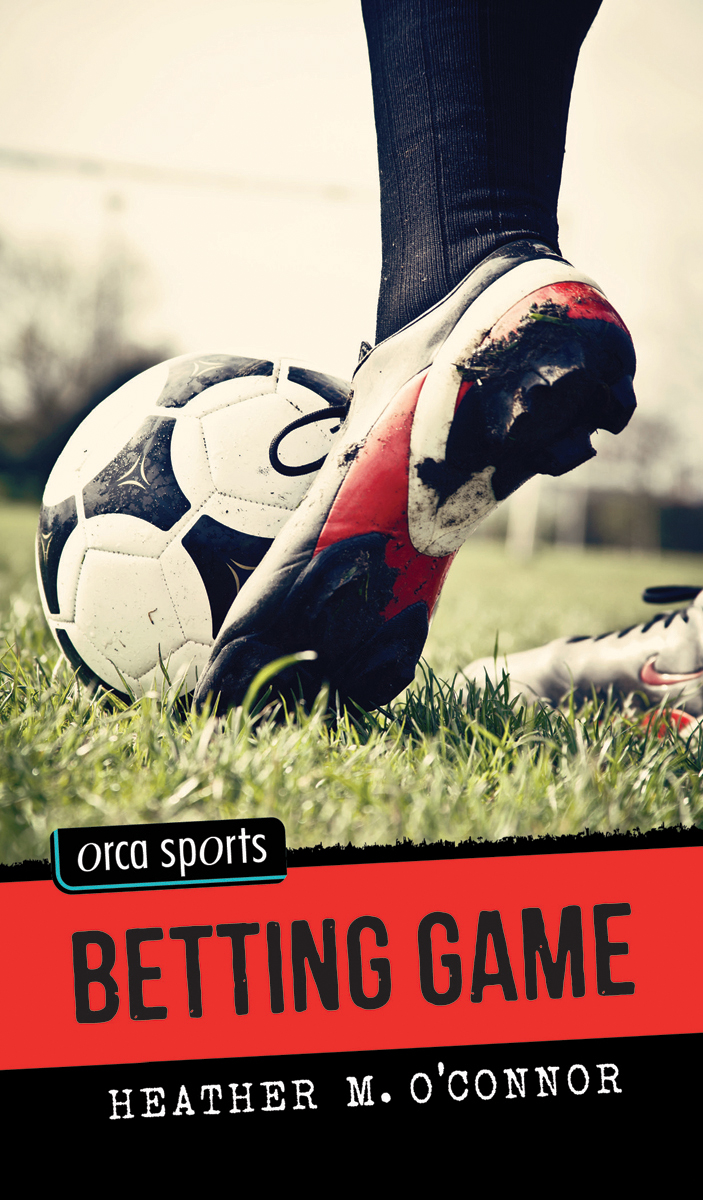
Last fall, Orca Books published my debut novel Betting Game. I had nine months between signing a contract and delivering my book baby. It seemed like plenty of time. It wasn’t.

Here are a few lessons I learned along the way.

Start earlyPregnant woman with a journal

Next time I’m expecting a new book baby, I’ll sit down right away and make a plan of action.

What do I need to do, and when? How much time will it all take? What are my priorities?

Get organized

scrivener logo

Keep everything. Edits. Images. Ideas. Promo materials. Information from your marketing team. You will use, reuse, rework and re-purpose these files again and again, so find a logical way to organize them for easy retrieval.

Scrivener worked for me. I stored all the flotsam and jetsam in one project, using labels and keywords to make the project super-simple to view and search. Of course, you can also store everything traditionally in folders and subfolders. Just be sure to file and label wisely.

Sure, it takes a little longer to be meticulous, but it saves you time every time you need to find something. And bonus! The next time you publish, you have a ready-made road map instead of starting from square one.

Gather the building blocks

wooden block towerThe first items my publisher asked for were basic promo items: an author bioback-cover blurb and a professional author photo (more on author pics in a future post.)

I tucked these items in my Scrivener project, and as time went on, I added more elements:

I also collected a variety of links and bits of code:

Raise your profile

My memberships came in handy. I belong to national writers’ organizations like CANSCAIP, SCBWI, The Writers’ Union of Canada and the Canadian Children’s Book Centre, and locally, to the Writers’ Community of Durham Region. They offer a variety of promotional opportunities.

  • book and event pages
  • school visit and speaker pages
  • member profiles

You can also create author pages on GoodReads and Amazon.com, as well as social media channels like Facebook, Twitter and Instagram.

Prepare these pages and profiles well in advance. Unfortunately, it’s not as simple as uploading the same bio and photo to each site. But they all start with the same basic building blocks.

Don’t forget to update them along the way. I kept the most recent version of each profile in Scrivener. It was easier than viewing each website one by one. (Aren’t you glad you started Scrivener project or folder system now?)

Ways to work smarter

Front-end-load the tasks. For example:

  • write newsletter announcements and media releases early so they’re ready to go
  • prepare your website, blog and social media platforms so you can trickle out your good news

Make a book trailer

One of my best investments was Rich Helms’s Book Trailers 101. This 5-week workshop taught me the elements of a successful trailer, as well as the specialized knowledge to make one. Basic tech like how to use Animoto and Movie Maker. A bit of Audacity. Where to find reasonably priced voice talent, music and images. Tricks for uploading the final product to YouTube.

Step by step, my book trailer grew from concept to finished video. The weekly group critique helped me figure out what worked and what didn’t. I came out with more than a video. I also came up with strong tag lines and blurb text. Which, of course, I tucked away in my promo folder.

Book a launch dateBetting Game book launch

Book your launch as soon as you get a publication date. I launched Betting Game at Blue Heron Books in Uxbridge. They’re one of Canada’s best independent booksellers. As a result, they get booked up quickly.

Like many indies, Shelley Macbeth and her staff really care about promoting Canadian books and authors. They gave me great advice and support. But that’s a post of its own!

Got any prenatal advice of your own for authors expecting their first book baby? Please share it below!

Find Your Way to First Place

Find Your Way to First Place

Dorothea Helms, a.k.a. The Writing Fairy.

Writescape shares sage advice from award-winning humour writer and writing contest judge and administrator, Dorothea Helms, on entering and winning writing contests. Dorothea offers her special branch of magic and insider insights in The Top Drawer.

Winning writing contests is one of the most exciting things I’ve experienced during my career. In addition to validation for my writing from an objective source, the wins have brought money, publication, plaques, prizes and prestige. Oh, and surprise. I once came in third place in a poetry contest with a submission that didn’t begin “There once was a …” Contest wins listed on my writer’s CV have also added credibility.

I don’t know of a magic formula for winning (even though I’m The Writing Fairy), but I do have some tips I’d like to share on how to increase your chances.

  1. Be creative in your approach to the contest topic
  2. Follow the rules
  3. Write with abandon, but polish your writing with care
  4. Follow the rules
  5. Enter
  6. Follow the rules

Sound simplistic? For years, I have served as a writing contest judge from local to national levels, and I have run several contests myself. I’m always astounded at the number of entrants who ignore the rules. To be fair to all competitors, contest judges must eliminate those who don’t follow the rules.

Here are some reminders:

Word Count Maximumsnumbers

If the maximum word count is 2,500 and your entry is 2,501, it will be eliminated before it’s even read. I’ve had to axe entries for this mistake many times. What a shame; often, they are brilliant submissions.


Published versus Unpublished

If the rules stipulate that the piece has to be original and unpublished, make sure it is. It’s easy for contest administrators to do a Google search for a sentence and find out if it’s on a website somewhere. I’ve done that and found published work that has been entered as unpublished.

Entry Fee

coins-948603_640Many respected writing contests include entry fees. It costs money to run a contest, even when there are volunteers involved. Some journals give you a year’s subscription to their magazine as part of your entry fee. Some give you feedback on your entry. If you choose to submit to a contest with an entry fee, remember to include your payment. This is part of the rules you need to read.


Read, Read, Read Those Rules

referee-1149014_640The best way to start following the rules is to read them. In one of my Writing Fairy contests, after I published the names of the ten finalists, one of them contacted me to say he had just read the rules and that his entry had been previously published in a major US newspaper. I had to eliminate his piece, and it took time and effort to figure out who was next in line to take his spot in the top ten.


Enter

When it comes to increasing your chances of winning writing contests, the only thing worse than not following the rules is not entering. If you read winning contest entries and think, I can do better than that, then do better than that and send it in.

Oh, and did I mention—follow the rules?

DorotheaRead more about Dorothea Helms, a.k.a. The Writing Fairy, at www.thewritingfairy.com

Want to know more about entering and winning contests? Dorothea Helms teams up with Writescape’s Ruth Walker for Write to Win, a one-day workshop that covers everything from entering, to judging, to winning, to celebrating. Write to Win is a winner of a workshop.


What’s in your writing drawer?

What’s in your writing drawer?

Gwynn Scheltema

There’s plenty of advice out there on how to prepare your work for submitting, but what if, like me, your problem with submitting—is you!

Do any of these statements apply to you?

  • ·         You have completed work ready to send out that hasn’t been submitted ever.
  • ·         Many of your completed pieces have been waiting to go out for years.
  • ·         You have several projects that are “almost ready” to send out.
  • ·         You have pieces that you sent out once, had rejected and never submitted again.

head shot of isaac Asimov


“You must keep sending work out; you must never let a manuscript do nothing but eat its head off in a drawer. You send that work out again and again, while you’re working on another one. If you have talent, you will receive some measure of success – but only if you persist.”

  Isaac Asimov

Facing fear

You likely already know that the prime reason for not sending your stuff out is fear:

  • ·         of rejection (I‘m not as good a writer as I thought I was)
  • ·         of success (now I’ll have to do it again)
  • ·         of someone stealing my ideas (lack of trust of new people or situations)
  • ·         of facing the reaction of readers (don’t like to be judged)
  • .         of rewrites and edits (what if I can’t do what they want)

book cover Art & Fear

What separates artists from ex-artists is that those who challenge their fears, continue; those who don’t, quit. Each step in the artmaking process puts that issue to the test.
― David BaylesArt and Fear


Like eating well and exercising, you know what to do and why you should do it, but you can’t bring yourself to do so. So here are a few ideas to help you over that hump:

1. Join the clubwoman afraid

We can’t control fears and feelings. Likely they are deep-rooted in our psyche. But we can find ways to move forward despite the fear.

Accept that pretty much every writer has these fears at one time or another. The trick is to accept it as part of the writing process. Embrace it and face it.

You will get rejected. It’s a given. But you will survive. You will live to write another day.

2. Let go

Ironically, the greatest feelings of self-doubt seem to come at the moment when the task is almost done. You want it to be perfect; the pressure to finish increases, and the knowledge that you will have to put it out there sits menacingly on your shoulder. But there comes a time when you must fight self-doubt and have faith in what you’ve created. You must let go.

If you don’t? What happens? Nothing. Your writing stays in the drawer. You beat yourself up for not moving forward. Nothing gets resolved.

3. Trust the Processtrust yourself

Fear focuses on unknown results of possible action. You can’t control unknown and possible. You can control process—and action. So start on the process of submitting; create a forward motion as a way to outwit, outrun, outsmart fear.

It’s hard, sure, but it’s the writing life. You can either face it or not. You can trust the process or live in fear. Your choice. The solution in your hands.

4. Get started!
  • ·         Set yourself a target date to have just ONE piece sent out.

Writers live by deadlines, so harness that attitude to help you submit. Make yourself publicly accountable—tell your writing buddy, your critique group, anyone who will call you on it.

  • ·         Break the process down into actionable tasks.

Submitting your work can feel overwhelming. But like any process, breaking things down into bite-size actionable pieces helps you to get started so that once begun, the task takes on a momentum of its own.

Try making a list for each stage of the process (which you can use again and again), and then tackle just one item on the list at a time. Tell yourself you only have to do one thing on the list. Chances are, once you get started, you’ll do a lot more. And each action you take will build your confidence. Focus on the idea that each small item is doable.leap of faith

5. Don’t Stop!

By the sheer law of averages, the more submissions you make, the more publishing success you will likely have. Think of rejections as “acknowledgments” that you are doing what real writers do. You are submitting!

A good place to start is writing contests. Join Ruth E. Walker and Dorothea Helms in May for their popular workshop Write to Win.

If you want to start the process now, make a public commitment in the comments below to a date to have ONE submission completed. We’ll follow up and see how you did.


Paging Dr. Edit: Line or copy edit?

Paging Dr. Edit: Line or copy edit?

Ruth E. Walker. When I first started writing, I didn’t know the difference between a line edit and a copy edit. After some workshops and lots of reading, I learned there’s similarity between the two. Which is good to know because not only do I edit my own work, I edit other people’s work.

Both line editing and copyediting skills zero in on how you are using words. When done properly, they both give you helpful notes and editing marks on your manuscript. Check out some of those marks with a free download from Writer’s Digest of 11 Editing Symbols All Writers Should Know.

It’s so easy to miss errors in your own writing. That’s why I’m immensely grateful to have a consistent critique group. Even so, my editor at Seraphim Editions caught things my colleague writers missed. But he commented that mine was a cleaner manuscript than he often sees. Yay critique group! Yay me!

EditingMy editor, George Down at The Book Band, still asked some tough questions and challenged some of my choices. But a good editor is supposed to make you think hard about your work. I was pleased that he didn’t have to spend too much energy on copyediting and line edits. Instead, it was more about substantive editing: he pointed out missed opportunities in the manuscript — areas where I needed important connections, transitions or back story. More on substantive editing in a future post.

So what is the difference between a line edit and copy edit?

A line edit focuses on the creative side of writing: your style, how you use language in each sentence and paragraph. A line edit helps you achieve clear meaning that helps you connect with your reader.

Line edits eliminate unnecessary words, phrases, sentences:

          • weak modifiers (such as: very, really, so)
          • adverbs (such as: suddenly, slowly, allegedly, terribly, utterly)
          • vague references (such as: this, that, those)
          • repetitions (such as: saying the same thing in different ways)
          • clichés (such as: straight as an arrow, dead as a doornail)

Line edits identify weak verbs that could be more active:

• she walked by
becomes
• she sauntered; she ambled, she strode…etc.

Line edits alert you to awkward sentence structure and unnecessary details:

• He looked up into her face above him, for a moment.
becomes
• For just a moment, he looked up at her face.

Look closely at your own work. Is there clarity in how you’ve constructed those sentences? Are you connecting with your reader in the way you intend? Have you avoided tired, overused clichés?binoculars-1015265_640

Copy edits zero in on the technical aspects of all writing:

  • grammar
  • punctuation
  • spelling
  • typos
  • syntax.

Are you correct and consistent in when and where you capitalize words? Have you missed hyphenations, quotation marks or commas?

If you’re writing non-fiction, a copy edit should catch where you don’t have your facts straight. Accuracy and consistency is important for fiction too: If the moon is out in the beginning of the scene, how come it’s snowing at the end of the paragraph?

I have a confession to make.
I cannot keep my editor’s eye on only one kind of edit. If I’m doing a line edit on someone’s manuscript and I notice a typo, I’m going to point it out. I’ve tried to look the other way, but I want the work to be as good as possible, so I mark the error. Similarly, when asked for a copy edit, well, if the sentences are stumbling over clichés and characters are moving through physical impossibilities, I will mark that too.

But my first pass on my own work is to bring a line edit focus. And it should be the same for your work: focus on the craft, on the language you’ve used, on the images you’ve included, on the mood you want to convey. This focus strengthens your creative voice. You are the chef, so help your sentences offer the kind of magic that swallows your reader’s imagination whole.Imagined Book in Paris cemetary

Don’t spend your energy (or editing budget) on just getting the spelling perfect. That won’t matter if your story doesn’t hold anyone’s attention. And it won’t reflect what you want it to: a great story that connects with the imaginations of readers, editors and publishers.

At our Spring Thaw writers’ retreat, we kick off the weekend with a feedback session. Both Gwynn and I receive, in advance, up to ten manuscript pages from the writers attending the retreat. We each review those ten pages and make line and copy edit notes for the writers. And then we meet with them for a one-on-one chat about their work. We love hearing more about each writer’s plans. We talk about plot, about character development, about markets and agents. And sometimes, writers use that one-on-one to discuss an outline or query letter.

I think Gwynn and I enjoy it so much because we have both benefited whenever an editor or mentor met with either of us to comment on our work. It can make all the difference to be able to ask a question and feel safe in doing so.

Dr. Edit has the answers.radiation-33438

If you have any editing questions, why not write to Dr. Edit? The Doctor is always “IN” and ready to take your questions. Send an email to info@writescape.ca with Dr. Edit in the subject line; the Doctor will answer you directly and we’ll feature your questions and our answers in upcoming posts.


The Unoriginal World of bobbi leblanc

The Unoriginal World of bobbi leblanc

Gwynn Scheltema

I was reminded about poetry when I went to the ballet this week. And not necessarily what you may expect…expressions of beauty through pattern or escape to a lyrical world (although that certainly happened).

No, I was reminded about the quest for meaning in art and the effect of succumbing to fads and affectations.

The Quest for Meaning

The National Ballet’s mixed winter program began with two offerings of classic Balanchine choreography: The Four Temperaments and Rubies. As the knowledgeable and always eloquent creative Director and Principal Ballet Master, Lindsay Fischer reminded us in the pre-performance talk, Balanchine choreographed always with the music uppermost in his mind. He didn’t start out with an idea he wanted to express. Instead, he listened to the music and let the music suggest the movement.ruby-1254568_960_720

When you listen to a symphony, you don’t spend that time wondering what it means. You let it transport you and enjoy the way it makes you feel. Balanchine’s ballets are like symphonies. You enjoy them for the emotions they stir in you, for the beauty in the patterns that delight you, for the surprises that please you when you least expect them to.

Good poetry is like that too: the music of the words and rhythms, the surprise of juxtapositions and turning points, the satisfaction of found mutual experience and ah-ha moments. And the delight of images that make you feel like you see what the poet sees. To paraphrase Chekov, poems that allow the reader to experience the moon by seeing “the glint of light on broken glass”.

And always emotion. It’s not necessary to read poetry looking for meaning. Allow the images to evoke whatever emotion or memory they do for you. There is no right or wrong reaction to what is written. Like a symphony, or a Balanchine ballet, let the poem transport you and move you.


Fads, Trends and Affectationscactus-659128_960_720

The final offering was a new work by Swedish choreographer Alexander Ekman called Cacti. At first it was disturbing, confusing, but it didn’t take long to become comical, in fact, hilarious.

It poked fun at all the trendy things we’ve seen on stage and in dance competitions: androgynous dancers; bizarre props that seem to be symbolic but aren’t; weird, intrusive (and often annoying) lighting and stage sets; contorted body positions and music that isn’t sure what rhythms or mood it’s going for.

In short, it was using conventions and trends that others had been using, in fact, overusing. And did it result in “art”? Was it trying too hard to be “art”?  What resulted was a parody of art.

In this case, the choreographer was going for that and succeeded brilliantly. But it was a heads up to those who forget to open their minds and let the muse be original.

It took me back tofun issue 2004 when Ruth and I were on the editorial board for the literary journal LICHEN Arts & Letters Preview. Submissions of poetry went through a “fad” at that time, where everything was lowercase, even the pronoun I, and the poet’s name. Poems were made up of numbered parts, had words in italics, parentheses and were often divided by slashes. And all of them (it seemed) started with a quote from someone else or notes on what inspired the poem. That’s not to say that these devices cannot be used; there are some very fine poems with one or more of these elements in them. But what we were seeing was random, put in there without meaning or context because the poet had seen it elsewhere and was imitating without understanding why it was like that in the first place. That’s the pretentious part.
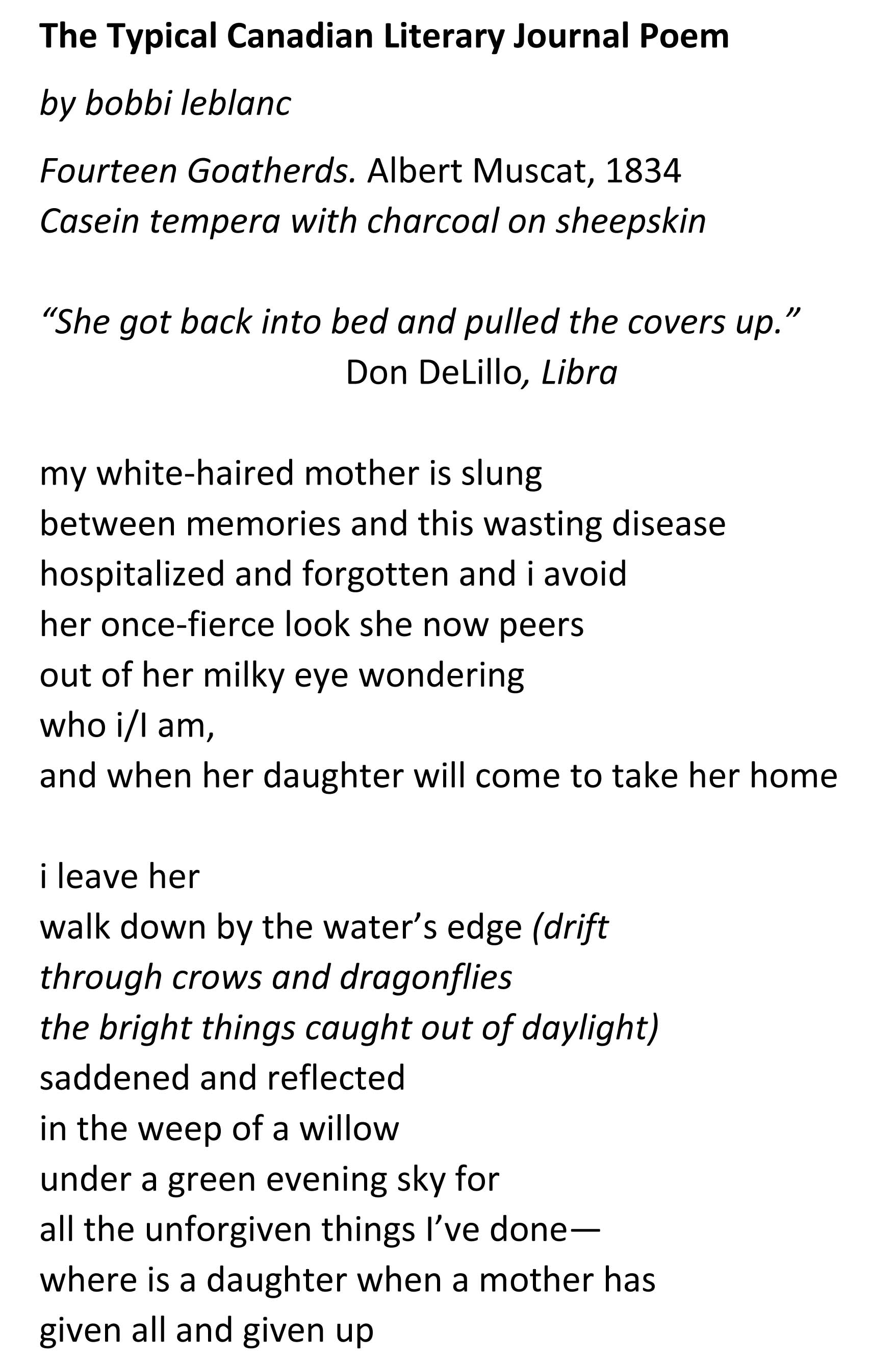
Given that we had to deal with hundreds of submissions, it was frustrating. Our 2004 spring issue was the “fun” issue, so as a lark, and to do much the same thing that Ekman did in the ballet Cacti, we (the editorial board) collectively wrote a poem that parodied all these affectations. We published it as “The Typical Canadian Literary Journal Poem” by a fictitious poet called bobbi le blanc (Notice: non-gender, possibly French and/or English and all lowercase name.). It was a hoot. But in the fun, like the ballet Cacti, there was that same heads up to those who forget to open their minds and let the muse be original.

It was a long poem with many numbered parts (of course), but just to give you a taste, here are the first two stanzas. Enjoy a giggle. The Typical Canadian Literary Journal Poem


Can You Use Parody?

Interestingly, parody is a great way to loosen up the mind and your writing. Try taking something you’re editing and rewriting it in the same style of a well-known writer, say, Ernest Hemingway (simple, direct and plain prose) or William Shakespeare (image-rich, iambic pentameter, 16th-century prose) or Margaret Atwood (precise, ironic and witty). When you are finished, consider how  your own work is different. What makes your style, your voice, unique? 

Grants: Straight to the Source

Grants: Straight to the Source

Heather M. O’Connor.

When I didn’t know something in school, I was never afraid to put up my hand. Call me curious. Call me nosy. I like answers.

When I started applying for grants for writers, I had lots of questions. I studied the application and searched for reliable resources on the Internet. But grant applications are complex and slippery beasts. You don’t have any examples to follow, and there’s no teacher to ask.

Or so I thought.

Call me!

Most grant applications give you a contact name or an email address. The person on the other end is ready and willing to help you. As one program administrator explained, granting organizations want you to apply. If the number of applicants falls off, so do the funding dollars.

What can these problem-solvers do for you?


Approved stamp

Answer questions

What exactly is a project description?” (Marion Hebb Research Grant)

Offer helpful tips

“There’s nothing wrong with asking for the maximum amount. The recommenders can’t give you more than you ask for, but they can give you less.” (Writers’ Reserve)

Share the jurors’ preferences

“They often prefer to read your first chapters.” (OAC Works in Progress)

Tell you news

“Graphic novels now have their own category.” (OAC Works in Progress)

Explain why you were unsuccessful

“The level of writing this time around was very high.” (Canada Council)

Encourage you

“Be persistent. A lot of good writing goes unfunded.” (Every writing grant ever offered.)

Go for it!

The grants are there for the asking. So apply, and do the asking!

I promise you, getting a writing grant feels a hundred times better than getting straight As on your report card. And you can take that–and the grant money–straight to the bank.

What would you use a writing grant for? Education? A writing retreat or conference? Research? Writing time? Let us know in the comments.

Get That Grant workshop

If you think writing grant applications ranks right up there with getting a root canal, Writescape can ease your pain. Gwynn Scheltema and I are offering a hands-on workshop that will walk you through the steps. From finding grants to submitting a polished and convincing application, you’ll be ready to Get That Grant (runs April 16 in Oshawa and April 17 in Bracebridge.)

A Newbie’s Guide to Book Conferences

A Newbie’s Guide to Book Conferences

Heather M. O’Connor. My publisher Orca Books recently invited me to sign copies of Betting Game at the Ontario Library Association (OLA) Super Conference.

“Me? Sign books at the OLA? Sure!” It’s the largest library conference and trade show in Canada.

A day or two before the big day, I felt like a preteen going to her first boy-girl party. What should I wear and bring? What are the signings like? What do I say?

I’ve gathered some super tips for preparing for and attending the OLA Super Conference. You can also use this advice to get the most out of other major book events, trade shows and conferences.

Be prepared

Check out the event website. You never know what you’ll find. (The OLA provided a cool photo frame for my pics.) Identify and use the conference hashtag, and add the conference app to your phone.

Read the program, even if you’re not attending the panels. Who is signing? Who is speaking? Maybe you’ll “bump into” that editor you want to meet.

Shout out on social media that you’re going, and ask who else is attending. If you’re signing books, announce the time and your publisher’s booth. Share news about other signings and events. If the conference has a Facebook group or event, join it.

What to wear

The default attire is business casual.

However, some authors add a little cosplay flair to their signings. Lena Coakley donned a prim Brontë-style bonnet to sign Worlds of Ink and Shadow at the OLA. Kari-Lynn Winters signed Bad Pirate in ARRR-some pirate gear at Reading for the Love of It, a big Toronto teachers’ conference.

Skip the high heels and opt for comfortable shoes. You’ll be on your feet for hours.

What to bring

A phone for taking and posting pics, following the program and connecting with friends. A watch. Business cards. A strong bag for carrying all the book loot.

Two reliable pens or Sharpie markers for signing, if you’re picky about your writing implements. (What writer isn’t?) Book swag, like bookmarks or buttons. My time slot was at the end of the day, so I offered a free draw to entice people to stick around.

Coffee for your publishing team—they can’t always get a break.

Meet the people

Conferences are the perfect place to network, do market research, and connect with writers and book-lovers. Strike up a conversation with your neighbour. Browse for books. Share a lunch table.

Librarians and teachers:

  • find out what their kids like to read and what they ask for
  • mention you do classroom visits, book clubs and programs
  • tell them about funding for author visits (more about that in a future post)
  • swap book recommendations

Publishers:

  • study the books they showcase at the booth–what are they selling?
  • find out which books they’re excited about and why
  • identify trends and ask market-related questions (when they’re not busy)
  • pick up catalogues and take advantage of a live peek at their books

Authors:

  • hang out with other writers and expand your tribe
  • observe experienced writers in action and ask their advice
  • promote other authors and their events–what goes around comes around
  • check out the event before you’re published so you come prepared
Schmooze dos and don’ts

DO take lots of pictures. Selfies. Signings. Capture the excitement, then share your pics on social media and your blog.

DON’T accept book giveaways or enter the free draws at conferences for librarians or teachers, no matter how tempting they look. You’ll take those resources away from classrooms and libraries.

Book signing tips

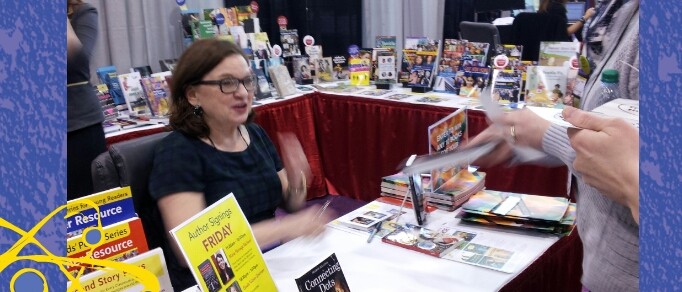
Check in with your publisher when you arrive, and return to the booth 10-15 minutes before your signing. It gives you time to stow your bag, straighten your clothes and thoughts, and think about what you want to write. Ask someone to take pictures.

Librarians and teachers are book people. They’re your fans. When they ask you to sign their book “For the students of XXX School,” you feel like a million bucks. I add a personal line, like “Always count on your team” or “Keep kicking!”

Make small talk. Find connections—a student who likes soccer books, a familiar school. If they seem interested, share interesting facts and valuable resources for your book, like extras on your website or an online teachers’ guide. Or mention you do school and library visits.

You feel like a rock star while you’re signing, but it’s over before you know it. Enjoy!

What are your tips for getting the most out of a big book event like the OLA Super Conference? Share them below.