If You Read It, They Will Listen

If You Read It, They Will Listen

Ruth E. Walker

A recent invitation to read my work at Tall Pine Tales in Haliburton set me off on a complicated journey. Tall Pine Tales is a collaborative reading series shared by writer organizations in two of Ontario’s cottage communities: Haliburton and Muskoka. Running successfully for the past 5 summers, there are expectations from the audience for this 6th season: plenty of laughter and smiles, along with thoughtful nudges about life’s twists and turns.

For me, an invite to a public reading is an ego-boost (especially useful when my muse opts to dance just out of reach.) It’s an opportunity to share my work with an audience, to feel my words slip among listeners and tempt their interest.

But when I looked at the writing I had on hand, I panicked a bit. I have a rather dark and serious muse, so this was a real challenge. Then I remembered The Perfect Beauty of Yvon Torville, an in-progress manuscript that I plan to return to in 2019.

Choose the right piece
  • think first; read later
    • there’s a big difference between reading your work to a group of colleague writers and reading aloud to an audience that is mostly readers. You need to consider the purpose of the event, the location and the likely audience:
      • indoors or outdoors
      • a library auditorium or a noisy local pub
      • elementary or high school students or adult audience
      • consider the people and the place, then choose: humour, pathos or high-tension drama?
  • pay attention to the tone of the organizers/event
    • I knew that Tall Pine Tales is a charming mix of memoir, humour, children’s authors and local content, so I chose accordingly: Yvon Torville is a revisionist take on an old Breton fairy tale with irony and magic at its heart
Get comfortable
  • practise
    • the more your practise, the more familiar you are with your own work. During readings, you need audience connection…and that means not keeping your eyes fixed firmly on your words. Look up as you read and move your attention throughout the room: help your listeners feel that you are reading to them and not to the podium.
    • the more familiar your are with your reading, the more easily you can govern your pacing. No matter how many times I’ve read publicly, I’m still a bundle of nerves. I channel that nervous energy into my readings and work hard at not rushing through, slowing down and giving emphasis to parts that need it (a lot of character names or unusual settings or a fast-paced scene.)
    • video or record your practice readings to help you hear your intonation, pauses and occasional stumbles. If you don’t want to record yourself, at the least listen carefully as you practise again and again to ensure a smooth and confident delivery
  • reconaissance/research
    • if you aren’t familiar with the location, do what you can to get familiar. Many out-of-town locations can be viewed online (check out the website for the reading event and a list of past readers)
    • ask the organizers: will there be a podium? Does it have a reading light? Is there a microphone? And here’s a really important question: How long do I have to read? (see “Deliver” for more on this one.)
Deliver
  • listen to the other readers
    • not only is it respectful to give your colleagues your full attention, it helps you to gauge the audience. And that helps to prepare you to deliver your work. Even if the audience is not overly receptive, you’ll know you’ll have to step up your game to get their attention.
  • engage your audience
    • if you have practised then you will read clearly and with some variety in your tone and you will be able to at least glance up in their direction. That’s all part of engagement.
  • stick to the time limit.
    • I have been in the audience when readers have gone over their time limit and it’s disrespectful to the organizers, to your colleague writers who keep to their time limit and most especially, to the listeners. No matter how “rivetting” your piece is, don’t do it.
    • At Tall Pine Tales, I cut my reading off at the requested 7-minute mark and then got to hear more than one person call out “No! What happens next?” I won’t have trouble selling them that book, will I?

Accept criticism

  • take stock of success and what still needs work
    • if possible, have someone in the audience you can quietly ask about what worked and what didn’t. At Tall Pine Tales I asked my husband, “So, what do I need to do better next time?” “Nothing,” he replied. But I’m not fooled by that. “C’mon, give it to me.” He let me know that the reading was great but “…next time, give a bit more time to the set up before you read. Tell them a bit about the original fairy tale first.” Bingo. He was right. It was a good reading but would have been even better if they knew why I am compelled to revise this old tale.
    • I like to read my work aloud to an audience, and I’m pretty good at it. But even so, it’s a never-ending journey to refine and improve each time. If I’m lucky, the invitations will continue to arrive and give my muse a kick in the pants just when I need it the most.

      Ruth reads from “Living Underground” in 2012


Weddings and Writers

Weddings and Writers

Ruth E. Walker

Later this week, I’ll watch my youngest child get married to his beautiful bride. I’ll likely cry a bit — happy tears. And I’ll be relieved that my son is the last one of our children to choose a life partner. That’s it for now, until the grandchildren start the cycle all over again.

Many mothers of the groom will tell you our role has challenges: Will the rehearsal dinner menu be a nice complement to the wedding themes or a mish-mash of wrong choices? Will my dress be appropriate and not clash with the mother of the bride’s chosen colour and style? Will I remember all the names of the large wedding party, their partners and great-aunt whoozits from out West?

For a writer, there are even greater challenges that come with this territory. For example, my husband and I have written speeches together for all the other kids’ weddings. While we rarely write anything together, this one task seems to go quite well. Over four decades of marriage helps with that one. So, no, that’s a challenge but it’s one we manage to pull off. It helps that we love all our kids’ partner choices.

No, this is a different kind of challenge for me. It’s the mother and son song that is making me run around in a conflicted tizzy. I do love to dance. I’m not very good at it and likely show up in a few party videos as the one who doesn’t quite get the beat or the moves but looks happy while she’s messing it up. No. It’s not the dance itself — it’s the song choice that’s so difficult.

Lots to choose from

If you Google “mother and son wedding songs” you’ll get over 8 million hits. And links to hundreds of sites that list the “top” mother and son dances, from country to rock to contemporary to traditional and variations thereof. YouTube is a treasure trove of music videos for this one important dance. One bride website lists 40 Best Mother-Son Dance Songs. So, with so much to choose from, how can this be a problem?

I’m a complete sucker for the sentimental yet charming film, Love, Actually. I tear up at the great airport love-in montage at the end as the Beach Boys sing their hit, “God Only Knows.”

A song about love — all kinds of love. So logical choice, right?

Not the melody; it’s the lyrics

Let’s get real people. I’m a writer. So while I may love the overall sentiment of a song and enjoy a beautiful melody, the words matter. Let’s consider “God Only Knows” — great lines likes God only knows what I’d be without you — so true. Most of the grey hairs on my head can be traced back to life with children, the youngest perhaps accounting for more than all the others put together. But the opening line on that Beach Boys song stopped me cold: I may not always love you.. Nope. Not that song. Because I will always love him.

Surely, with 39 other songs, I will find the perfect song.

“Forever Young” sung by Rod Stewart. Are you going to drop the bomb or not? Bomb? I don’t think so.

“Because You Loved Me” sung by Celine Dion. I’ll be forever thankful baby/You’re the one who held me up/Never let me fall…  Just who are the lyrics meant for — mother or son?

“I Say a Little Prayer” sung by Aretha Franklin. While combing my hair now/And wondering what dress to wear now/I say a little prayer for you… 

As much as I love my son, I don’t stand before the mirror every day and think of him.  Obsessive mama, I’m not.

Who picks these songs, anyway?

Oh the songs I’ve listened to. Some are so sickly sentimental, I need a glass of water to dilute the sugar. Some stretch the boundaries of rhyme and rhythm to excruciating levels. And some make no sense at all. And speaking of “combing my hair and choosing my dress,” exactly what lyrically challenged person thought “Wonderful Tonight” sung by Eric Clapton is an ideal mother-son wedding dance song? How about that last stanza:

It’s time to go home now and I’ve got an aching head
So I give her the car keys and she helps me to bed
And then I tell her, as I turn out the light
I say, “My darling, you were wonderful tonight
Oh my darling, you were wonderful tonight

Good grief. My son’s bride won’t have to worry that Mommy is driving him home after the reception, putting him to bed while he calls me “My darling.” Nope. Not this mama.

So you see my challenge? I can’t tune out the words because they matter. Words mean something. Right now, I’m waffling between two different songs, the sentimental but lyrically true song, The Man You Have Become sung by Molly Pasutti and the sweetly upbeat 93 Million Miles sung by Jason Mraz.

Of course, my son may have some ideas on the song choice. In fact, he’s written a few lovely songs himself. But remember those grey hairs? It will likely be just before the reception before he manages to tell me what those ideas might be. Ah well. I will always love him no matter what song we dance to.

Which brings me to a song I hope we will dance to: “Love is All You Need” by The Beatles. Because, if I had one thing to tell him, it’s this: Love is all you need. Love for yourself. Love for your family. Love for the world and its inhabitants. Remember love my son, especially at times when it is the furthest thing from your mind. It will bring you back to what really matters.


Update on the Copyright Struggle

Update on the Copyright Struggle

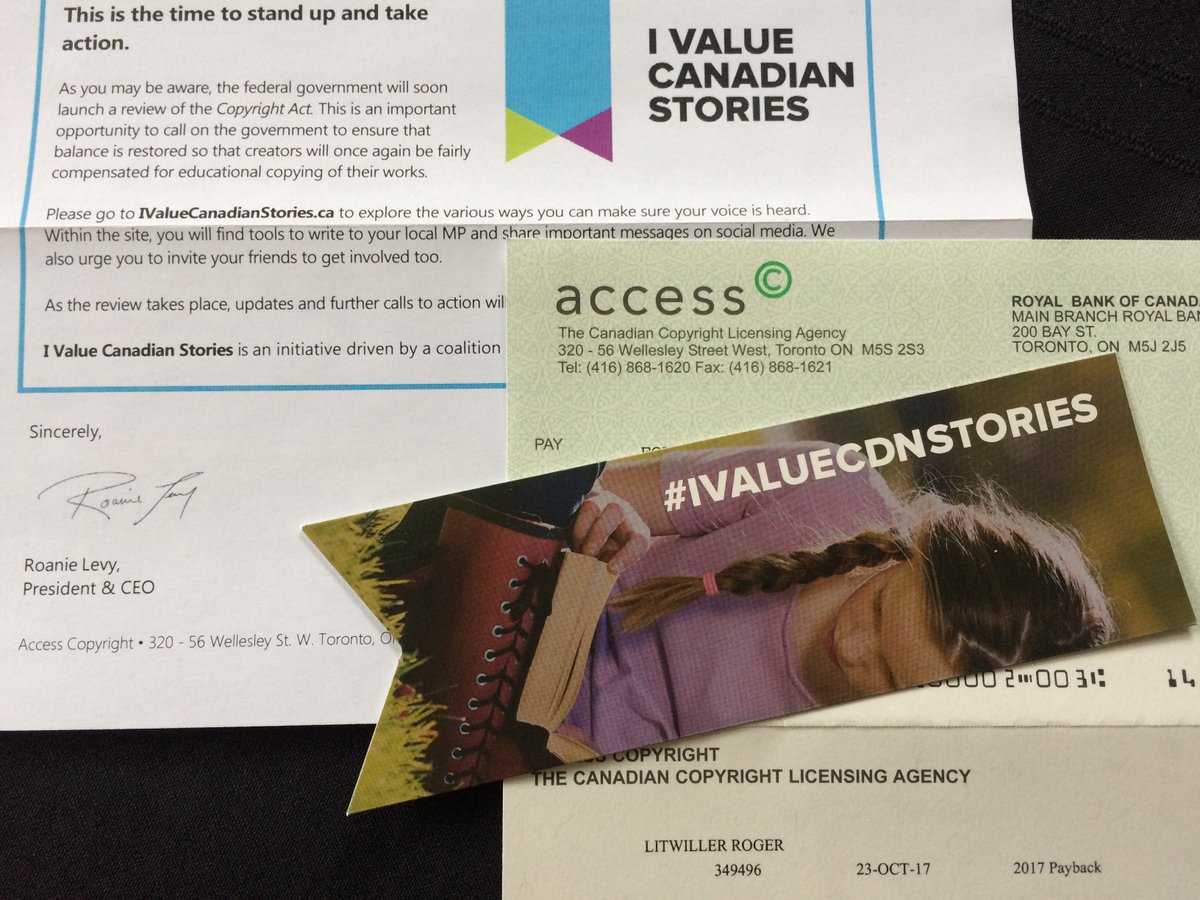
Because we feel that the issue of copyright is so important for all writers, we have chosen to present the latest update on the parliamentary review of the Copyright Act received from Access Copyright in its entirety. This message was sent out to all Access Copyright members on May 25. Please read, share and submit your story to the members of the review committee. It matters for all writers and visual artists…including you!

If you are not sure what the review is all about, read our previous blog Copy that! that explains it all.

Roanie Levy, President & CEO of Access Copyright, appeared before the Standing Committee on Industry, Science and Technology on May 22nd, as part of the ongoing Copyright Act review.Watch Roanie’s appearance before the Industry Committee (it starts at 16:38:00 of the video).

The session was very well received and based on the nature of the questions that were brought forward by members of the committee, it is clear that the committee is beginning to appreciate that creators and publishers have been significantly harmed since the Copyright Modernization Act was passed.

Image result for i value canadian storiesThe outcome of the session is a testament to the hard work that our community has been doing with the INDU Committee. The number of creators and publishers who have shared their personal stories during their recent cross-country tour have made an incredible difference by putting a relatable face to the problem, making it more difficult to ignore.

While this gives us all pause to feel encouraged, it is also critical that we bear down to double up our efforts and keep up the momentum. The opposition is pulling no stops and we can’t afford to either.

Make a submission to the Industry Committee

We encourage everyone to take the time to write a submission to the INDU committee.

Written submissions are meant to be brief and can be as simple as a one-page letter outlining your personal story of impact. They will help to keep reinforcing that Canadian creators and publishers have been hurt economically by 2012 changes to the Copyright Act and that the continued creation of Canadian content is at stake during this review.
 

The House of Commons has prepared detailed guidelines on making a written submission.

Image result for i value canadian storiesHere are some basic things to keep in mind for a submission.

  • Address your submission to the “Members of the Standing Committee on Industry, Science and Technology”
  • As submissions will be posted online, they should not include personal contact information beyond your name.

For the email used to submit your submission (the email will not be posted with your submission):


  • Send to indu@parl.gc.ca.
  • The person reading the emails is Michel Marcotte, the clerk of the Industry Committee. The email should be addressed to him.
  • The email should include your address, email and phone number.
  • We recommend asking for confirmation of receipt of your submission.

EImage result for i value canadian storiesngage Through I Value Canadian Stories

If you haven’t visited IValueCanadianStories.ca recently, new letters directed at the Committee were added in late April so please take a moment to send one today.  You can also get active on social media and encourage your friends to take part.

Theme and Premise

Theme and Premise

Gwynn Scheltema

I’m often asked what the difference is between theme and premise. Here’s my take—with a comment or two from others:

 What is theme?

A story needs to be unified around something, and that something is theme, a recurrent idea or motif.  You can begin to identify your theme by coming up with ONE word to sum it up. That one word is usually a human quality: Friendship. Love. Trust. Fear. Redemption. Abandonment. Freedom. Motherhood. Truth. Ambition. Justice. Revenge. Confidence.Or a universal quality: Duality. War. Confinement.

But the theme of a novel goes deeper. Theme in a novel is not just that one word, say LOVE, but the statement the author makes about the motif with the story.


FROZEN: sisterly love is greater than power.

Generally, theme is linked to the emotional growth of the protagonist, or the personal vendetta of the antagonist.

Sometimes you don’t know what your theme is up front. You might change it, or discover it in the course of storytelling. It evolves. And that doesn’t matter because it isn’t stated anywhere in the narrative. It’s a sense we come away with, a flavour, a key.

Theme can also be several statements/explorations around a human quality. For example, an author could explore different kinds of LOVE through different characters: brotherly love, love of self, absence of love, parental love, love of money over people, love of country etc.

What is Premise

Premise, on the other hand, is the idea behind the story, what the author is writing about, the basic idea and foundation for the plot.

John Truby suggests premise is the simplest combination of character and plot: Some event that starts the action, some sense of the main character and some sense of the outcome.

Author and screenwriter Alexandra Sokoloff talks about the premise being “the pitch” for the story. That works too. After all, a pitch is the one-liner distilled version of your book and introduces us to the main character, what obstacles he must overcome, and why.


HARRY POTTER: When boy wizard Harry Potter and his friends at Hogwarts wizard school are threatened by the Dark Lord, Harry must find his magical power to overcome him and become a man and a great wizard.


Premise out of theme

Chris Vogler agrees that premise is the basic idea and foundation for the plot but also that it is “a more developed expression of the “theme” idea, beyond just one word. It’s a sentence that you pull out of that one word.”

First be specific.  “LOVE” isn’t specific enough. What kind of love? Brotherly love? Blind love? Love of country? Loving yourself?  What kind of trust? What kind of faith?

And then restate it as a kind of formula:   

X behaviour leads to Y consequences

MACBETH: ruthless ambition leads inevitably to destruction


Why does it matter?

Premise is useful as you write because it holds the ultimate character transformation in the front of your mind, so you are conscious of your character’s actions and reactions being in step with where he is along the character arc. For instance Harry Potter could never have faced the dementors at the beginning of the series, not only because he didn’t have the wizardly skills, but because he had not yet found his confidence or his loyalty.

As you write, theme doesn’t matter, but when it comes to editing, it provides an umbrella measure to decide which scenes and characters can get cut. Does this scene support the theme better than this one?

One last word

Screenwriter Andrew Oye sums the whole thing up very nicely. He says premise and theme are cousins not twins. That the premise is the subject of the story and the theme is the meaning from the story.


Copy that!

Copy that!

Gwynn Scheltema

My Access Copyright notification came the other day to say that the Writers and Artists Payback Claim period for 1997 to 2016 opened on April 1 (closing date is May 31). I’ve also received several updates about the ongoing battle for creator rights in our Canadian Courts and what we as writers can do to help. The Writers’ Union of Canada (TWUC) also sent an update on the court cases and the advocacy they are doing.

I’ve watched my Access Copyright cheque shrink drastically over the last few years because of the education sector’s refusal to pay royalties, as has every other writer. Access Copyright and TWUC, along with other national writers organizations, are working hard on our behalf to address this issue, but ultimately, we the creators should also take action.

I’ll bring you up to date on the legal situation, and tell you how you can help.

What is Access Copyright?

Access Copyright is a non-profit, national organization representing Canadian writers, visual artists and publishers, and the work they create. Access Copyright also partners with similar organizations around the world doing the same thing abroad. Together they represent our creative works when it comes to those who want to copy and share those works in schools, corporations, governments and research situations.

Access Copyright manages the licenses and the collection of licensing fees for copied, shared and remixed content and passes those royalties on to the copyright holders. These royalties have traditionally formed around 20% of writers’ and 16% of publishers’ income. Advocacy around intellectual property is also an important part of the services Access Copyright offers to creators.

Background to the current court action

Prior to an amendment to the Copyright Modernization Act in November 2012 adding “education” as an allowable purpose under fair dealing, the education sector assured Canadian writers, visual artists and publishers they had nothing to be worried about and that this change would not impact their royalty income negatively.

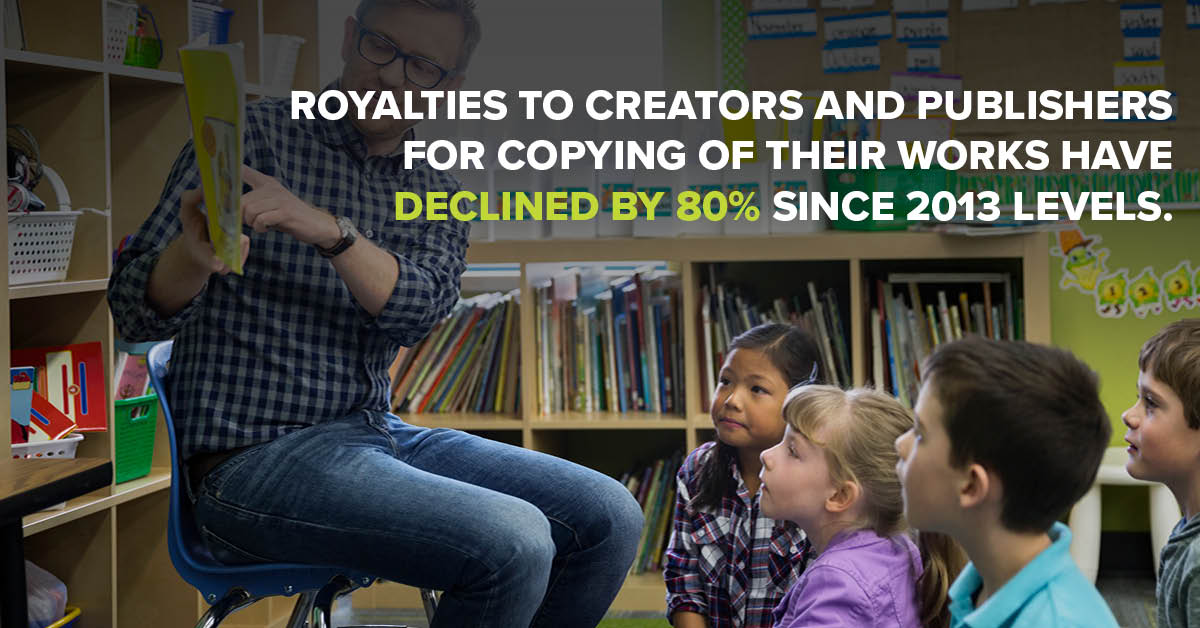
Then in 2013 the ministries of education and post-secondary institutions walked away from long-standing licensing agreements. According to Access Copyright, over 600 million pages are now copied FOR FREE each year by that sector. Education’s new copying policies have devastated royalty income for creators and publishers resulting in a whopping 80% decline.

And it goes further: Course packs containing entire chapters of books, full short stories from collections and anthologies and shared online digital book copies have reduced primary book sales so that publishers receive less and, in turn, writers receive less in royalties from their publishers.

Taking the matter to court

Access Copyright felt it was time to take the matter to court. They sued York University for non-payment of mandatory fees (known as the Interim Tariff) and York counterclaimed that they did not have to pay because their actions constituted “fair dealing” under Fair Dealings Guidelines.
Finally, in 2017, the court ruled in favour of Access Copyright on both claims, but York immediately appealed.

Then at the end of 2017, the Federal Government launched a Parliamentary Review of the Copyright Act. There was now hope that the review would rebalance the law allowing creative professionals to earn the income they were due.

The big surprise, and disappointment, came in February of this year when most of Canada’s provincial education ministries and all of Ontario’s school boards launched legal action against Access Copyright.

It becomes vital now that we make our voices heard by the policy makers conducting the review, so that the legislation can be made stronger to ensure that creators are fairly compensated.

So what can you do to help?

  1. Start by understanding the issue fully. Go online and check out Access Copyright, TWUC, I Value Canadian Stories and Focus on Creators.
  2. Watch and share this video to learn how present copying practices impact the creation of content for tomorrow’s classrooms, and create a value gap for creators.
  3. Write a letter to your MP urging them to support creators during the ongoing Federal Parliamentary Review. Several of the sites listed in #1 have letter kits to guide you.
  4. Make a personal submission, to the Standing Committees from both Canadian Heritage (CHPC committee) and Innovation, Science, and Economic Development (INDU committee) who have begun considering witnesses and submissions as part of the Parliamentary Review.
  5. Tell other writers and urge them to get involved. 

Want to learn more about copyright in Canada?

(links and explanations thanks to Access Copyright website)

  10 Quick—and effective—Edits

  10 Quick—and effective—Edits

It’s Writescape’s 10th anniversary and we have lots of excitement planned for writers in 2018. To kick off the celebration, we’ve launched 10 on the 10th. This series of monthly resources will bring tips, advice and inspiration directly to your inbox. Think of it as Gwynn and Ruth sitting on your shoulder and nudging you along. Share with your writing colleagues and encourage them to sign up for more.

Here are your first 10 tips:

 1. Get the action going

Replace passive, weak verbs, especially forms of the verb “to be”

  • Before:      It was a dark and stormy night.
  • After:        The storm raged through the blackness. 

2. Keep things moving forward by reducing the use of “had”

“Had” refers to “completed’ action. It has no forward movement. Use “had” once or twice at the start of a section/paragraph to establish the time period, then revert to simple past tense.

  • Before:      She had been the only one in the house, and had paid the rent faithfully each month. She                                   had taken care of the place and had put up drapes and painted.
  • After:        She had been the only one in the house, and paid the rent faithfully each month. She                                          took care of the place and put up drapes and painted.

3. Keep the action going

Delete empty words like very/somewhat/really. Energize the word being modified instead.

  • Before:      Despite the very hot afternoon….
  • After:        Despite the afternoon’s sweltering heat…


 4. Keep your actions strong; beware the “-ly” adverb

Can you replace it with a stronger active verb?

  • Before:      He went quickly
  • After:        He ran – or dashed, charged, bolted…


 5. Change up the senses you use in description.

We default to the sense of sight. Try replacing visual details with ones of another sense.

  • Before:      Anita set the gold-rimmed tea cup  on the lace cloth…
  • After:        The tea cup rattled in the saucer as Anita placed it on the lace                             cloth…


 6. Take your reader deeper into the world of the story

Look for named emotions (happy, sad) or physical states (fearful, tired) and replace with concrete and sensory detail.

  • Before:       She felt disappointed
  • After:        She sank onto the bench and hugged her knees


 7. Keep your writing fresh

Look for tired and overused clichés. (Microsoft Word’s grammar checker notes clichés with green squiggly lines.) Create visuals that add to the story or your character.

  • Before:      His beard was as white as snow
  • After:        His beard was as white as his lab coat

8. Eliminate repetition. Eliminate repetition.

Identify any “writer’s tic” that you know you have. Phrases, descriptions, gestures and so on, rapidly  lose their energy when they are overused or placed too closely together.

Example:

  • How many times do your characters “roll their eyes” or “take a deep breath?”
  • How many times have your told readers it’s “a red car?”


9. Keep your tricky words tamed

Are there words you constantly mispell…um…misspell? Are you working with strange names or technical terms? Keep them correct and consistent by adding them to your software’s dictionary or AutoCorrect function.

How to:     Right click on the word. Choose either Add to dictionary or AutoCorrect


 10. Know your country

Is it color or colour? Are they good neighbours or good neighbors? Writing for American readers, Australian readers or British readers? Incorrect spelling won’t please your publisher. Make sure your  software is defaulted to the “right” English.

How to:     Most MSWord programs have the language default on the bottom info bar. Left click to select your language.


If you found this helpful, let your writing friends know. Share it!

GPS for the subconscious

GPS for the subconscious

Gwynn Scheltema

I call it mind mapping. You might call it clustering or brainstorming. It doesn’t matter. What does matter is that this visual technique works to generate ideas and get subconscious thoughts down on paper before you lose them.

What is mind mapping?

Mind mapping is a my non-linear way to organizing thoughts without my internal critic getting in the way. At the same time it allows me to link and organize those ideas, so that the finished exercise is something I can work with.

Sound contradictory?

Perhaps, but it is based on some interesting studies on the way we think. Ralph Haber’s study of memory, found that we have nearly 90% success rate recalling images rather than words. Tony Buzan’s research found that those who took notes using key words learned more effectively. Mind mapping combines keywords and visual representation.

Mind map mind set

Start with an open mind and playful attitude. Mind mapping is a “brain dump.” Expect that many of the ideas you produce will not be useful. That’s not important. You can harvest the valuable nuggets later.

Your brain works best in short, intensive bursts (5 minutes or so), so once you begin, work fast and write down only key words, symbols, images, phrases … not sentences. Strive for an explosion of ideas.

Write with a pencil, your favourite pen, coloured markers, crayons or whatever helps to make you feel creative. Same goes for the paper you choose: with or without lines, coloured, big or small.

Where do you start?

Begin with one central keyword or concept in the centre of the page. Starting in the middle of the page gives the creative right brain a head start, as our non-creative left brain is used to starting in the upper left-hand corner.

You can put the keyword in a circle or a cloud shape or not enclose it at all (this is a creative process, so there are no “rules.”)

You can use an idea you want to work with or a random word picked from a book or given to you by someone else.

Then what?

I started with the word GERANIUM.

Write down/draw anything that keyword suggests to you, and then a word or symbol associated with that new thought, and so on, until you have a chain of linked ideas moving out from the central theme. Do not judge your ideas at this stage; simply write them down.

Put an idea down even if it seems unrelated – your subconscious probably knows more than you do.  DOCTORS OFFICE showed up on one of the branches. What does that have to do with geraniums? Seemingly nothing now, but when I organized the ideas afterwards, the link became clear. (I’ll explain later).

Keep your hand moving. If ideas slow down, take your hand back to the central concept and begin a new branch. Draw empty lines, and your brain will move to fill them automatically; or inject more energy with a different colour pen.

Eventually you’ll have several trains of thought, all different from each other and yet linked by the central concept. You can now organize them to fit your purposes.

Organizing and using your mind map ideas

Ways to use the ideas you’ve generated can be as varied as the ideas themselves.

Say I’m looking for an idea for a non-fiction article. Perhaps my first instinct around the word GERANIUM is to do an article on container gardening, I take a highlighter and highlight all the ideas that fit in any way with that slant. In the example, I’d highlight: POTS, RED, HANGING, TRAILING, VERANDAH, PATIO, SUMMER, SCENT. Hmmm….. boring!

But in the process, the word SCENT reminded me that geranium leaves can be used to scent and colour sugar. The mind trail on HERBS, TEAS, SPA suddenly becomes more interesting. A non-fiction article on “Using Flowers for Special Teas” now has possibilities. I might do another mind map now with the word TEA in the centre.

Use a mind map over and over

But don’t stop there. The same mind map can be used several times, at different times for different styles of writing.

The phrase DOCTORS OFFICE has me curious. I follow the branch back towards the centre, trying to work out what PINK and SUGAR have to do with it. Then it hits me… when I was a child, our doctor used to hand out tiny cylindrical candies that smelled like scented geraniums. I realize that I haven’t seen them in decades. What other sweeties from that era are no longer around? Hmmm….. Another article? A scene for my novel? A short story? Things are brewing now.

Later, it strikes me as interesting that I have two trails that contain the word VERANDAH, and I’m drawn to the references to LATIN WORD; SECRETS; SCHOOL FRIENDS; IVY; OLD BUILDINGS; ENGLAND. I think I feel a poem emerging…..

Even the trail that started out with the boring POTS; RED, ended with SQUIRREL; CRINOLINE: HIBISCUS. Now I realize, that’s a story my subconscious has unearthed about a little critter that came to my garden last year. He loved hibiscus shoots, and …

When should I do a mind map?

Use a mind map whenever you want to generate new ideas. Use it to focus in on a particular problem area. Use it to expand something you are already working on. Use it to reveal hidden subconscious perspectives on a seemingly boring topic. Or just do it for fun and see where it takes you. Quick. Easy. Worth it!

DID YOU KNOW

The perfect spot to be creative – and mind map to your heart’s content – is at Spring Thaw 2018 on beautiful Rice Lake in Keene, Ontario. Come for 3 or 5 days and escape to write with Writescape.Tailor your weekend to suit your needs.There is an agenda and formal programming, but you choose what sessions and activities will work for you.

My Digital Idea Archive Project

My Digital Idea Archive Project

A reader left this comment on one of our recent blog posts: “Great blog! I’ll be saving this to my Digital Idea Archive.” What’s a Digital Idea Archive??? We contacted the reader, Leah Murray from BC, and asked her to explain….

Guest blogger: Leah Murray

Do you sometimes need a new idea to get creative and writing again? I do. But now I know what to do about it, thanks to my Digital Idea Archive Project.

I figured my project needed to be tackled in three parts:

  1. Find inspirational ideas I want to keep
  2. Stash ’em someplace safe for future reference
  3. Find ways to retrieve them after we’ve passed through the ancient mists of time (gulp).

Getting the archive set up was straightforward. Sure, it posed a few questions, but I found the solutions and in the end it was worth the effort.

 Find ideas I want to keep

Google’s computerized searches are well up to the work of finding inspiration. If Google could do it online, could I harness that for personal use?

Yes. There’s a handy thing called a Google Alert that will scour the web and bring back whatever it finds about your interests in the form of a daily emailed digest. It took me no time at all to set up Alerts for books, writing tips, photography, farming, small business, and other topics that interested me.


Emailed items turned out to be another piece to the puzzle:  if I can see the original text or image that triggered my idea, I can recreate my train of thought in a flash.  Getting ideas emailed to me or emailing myself and then archiving those emails appropriately seemed a good way to start. My Google Alerts became  part of that

My written work is often triggered by images, so Pinterest was the next stop. There I set up “boards” for books I wanted to read, writing craft, punnies, inspirational artwork/photos, places I want to go, and my perennial interest in self-help/DIY things. Like Google Alerts, Pinterest also sends me a weekly email based on my preferences.

My newest venture is Instagram, a mobile app a lot like Pinterest, but which I find good for sourcing and organizing videos and the people who produce them, like this video on what Instagram can do.

Idea archive part one, check.

Stash ’em someplace safe

I live in a tiny granny suite in the southwestern corner of BC, where space is at a premium. I can no longer keep physical archives, and I didn’t have enough empty file storage space on my existing computer. My archive still had to exist in a form that was

  • accessible with minimal effort,
  • human browsable, for when I’m leisurely searching files for a fresh idea or slant on a perennial topic, and
  • computer searchable, for when I’m working on a broad topic with lots of disparate notes from different times.

A quick poke through Staples and London Drugs websites unearthed the perfect solution: a hefty 2 terabyte Passport drive that plugs in to a USB port on my computer, and holds LOTS of files. All I needed was a sale and less than $100 to end my space challenge.

Most mail programs allow you to print your emails to pdf and put them in disk folders, but I’m lazy-fingered and find that inconvenient. Gmail for example: Right-click on any white space in the email you’re looking at, choose Print, and then use the Change button under Destination to select “Save as PDF”. Most recent versions of Windows and Mac OS have this built in – if yours doesn’t, an Adobe Reader download – – will install it for you.

But my emails get sorted into archive folders under my in-box: I just drag and drop them from inbox to mail folder as I’m checking email each morning. I then use Office 365’s Outlook archiving features to put folder structure and emails onto my Passport drive.

All social media platforms have been known to lose links to information, so things I want to keep, I save to my own archive. In Pinterest I just click on the image, then the “Read It” button at the bottom right hand corner of the image, and copy-paste the article into a Word document and store it in an appropriate folder on my computer. LinkedIn lets me copy and paste entire conversations the same way.

Consistent folder names across the various storage, email, and social media platforms make retrieval much easier. Folder structures work best for me if they are named in the ways that I think, so I created my own. A couple of hours saw my folders labelled and matched on every platform.

I write a LOT about photography and digital imaging, and write poetry, essays, and fiction, so here’s how I organized things.

Occasionally I create a desktop or browser shortcut, aka a bookmark, if I think a topic is a passing fad rather than a long term trend. Bookmarks are easy to create both in Mac and Windows.

For stuff I’ll work on in the next month or two, I save browser bookmarks in folders (yes, you can make – and search – your own folders there too)! ( Chrome does it this way; Firefox this way, )

Idea archive part two, check.

 Retrieve ’em when you need ’em.

Getting things back from storage, of course, is key.

Emails (in individual folders OR across the entire inbox and all sub-folders) are searchable by subject line, content, keyword, date and sender and by some or all of the above in every mail program out there. You just have to learn how. Every email program is slightly different, and not everyone uses my beloved Outlook. For Gmail, I read the search instructions first, learned about search operators next, followed up with a couple of questions in the support chat forum, and I was away to the races.

I then started to learn how to use my File Manager search function to retrieve things. I was astonished to find that my computer has a collection of lovely internal searching systems tucked away in its version of “plain view” – here’s a Windows tutorial on how to find and use those effectively. Macs aren’t wildly different: you use Finder there instead of File Manager, but the principles are identical.

Et voila: one big idea archive, for zero physical space, a few dollars, and a bit of head-scratching.

Digital Idea Archive Challenge conquered!

Meet our guest blogger – Leah Murray

Leah Murray operates byteSMART Strategies from the Lower Mainland of British Columbia, Canada.

Following a career in the Canadian Forces, Leah opened her first technology support business in Oshawa, Ontario.  She closed that business in order to work with scientists in the Research & Development division of an international pharmaceutical company headquartered in Toronto. Several years in rural Ontario developed her passion for small businesses, artisanal, agricultural and otherwise, and today she devotes her energy to helping these enterprises plan, transition and manage their technology.

Today, her raison d’etre is the bringing of technology into the service of the arts, and she writes about it!

Rinse and repeat

Rinse and repeat

Gwynn Scheltema

Okay, I know; I know. New Year is yelling out “GOALS” and “RESOLUTIONS”, and no one really wants to hear it, least of all me. But when I got to thinking about it, I realized I have a few ongoing goal-setting and goal-achieving tools in place already. And they work! So I thought I’d share them with you.

Little and often

While I’m a great supporter of having big long-term goals and a vision of where you want to go in life, I find that sometimes the big picture can be overwhelming. I believe that those big concepts should be the background canvas on which you paint in the details as you go—and re-paint them if you choose.

The writing critique group I belong to understands this perfectly. We meet every two weeks and at the end of each meeting we all set a writing goal for the next two weeks only. We each set our own goal depending on what we are working on at the time and what is happening in our lives.

We encourage specificity— “5000 words” or “edit 3 chapters” or “fill plot hole in Chapter 7 or “four meaningful bum-in-chair sessions”. At the next meeting if we miss our goal, we pay up to a charity fund. But we also encourage life balance. It’s okay to not set a goal if your life dictates. We also recognize that sometimes “thinking about” a plot or character qualifies as long as sooner or later that turns into “writing about.”

This system works because it is frequent, achievable, and there is accountability. Small goals and small successes that add up over time.

Eat that Frog

Mark Twain once said that if you start the day by eating a frog you will have the satisfaction of knowing that this was probably the worst thing you had to do that day. The frog is a metaphor for your biggest and most important task of the day and has become a popular procrastination-busting technique.

When I’m trying to avoid that “frog”, I play solitaire, disappear into social media or sort the kitchen junk drawer or….. I’m sure you have equally pointless—and time consuming—avoidance tactics.

Learning the skill of attacking the most important task first (writing related or not) and getting it out of the way frees you up. You’ll have more time, less guilt and a clear mind to be creative. It’s a skill that helps you accomplish whatever you set as your priorities—including your goals.

It does take practice, but like anything in life, the more you consciously do it, the easier it becomes. Most writers can perform to a deadline. Perhaps putting your own deadline on your “frogs” will help?


Make your bed

Now this may seem contradictory to the “eat the frog” principle, but getting through your to-do list and achieving your goals begins with making your bed.

Your mom probably drilled that in to you, but the idea came back into popularity with Navy SEAL Admiral McRaven’s speech to grads in 2014: “If you want to change the world, start off by making your bed. If you make your bed every morning, you will have accomplished the first task of the day. It will give you a small sense of pride, and it will encourage you to do another task, and another, and another.”

All I know, it works for me.

Your frog for today

So there you have it.

Today, go make your bed, then sit down and decide on a reasonable achievable goal to be accomplished within the next two weeks. Then break it down into what needs to be done first, and then next, and next after that….

Tomorrow, make your bed, look to see what is #1 on that list and eat that frog.

Day after tomorrow, eat frog #2

Rinse and repeat…rinse and repeat…

DID YOU KNOW

A writing retreat is a great way to focus on your writing projects and goals and registration for Writescape’s Spring Thaw 2018 is now open, and already half full.

This all-inclusive writing retreat is held at the fabulous Elmhirst’s Resort on Rice Lake in Keene. Stay for the weekend or treat yourself to an extra two days of writing.

    • 10-page manuscript evaluation with written feedback from Ruth and Gwynn
    • one-on-one manuscript consultation with either Gwynn or Ruth
    • private writing time
    • optional daytime creativity sessions to fire up your pen
    • a companion workbook with inspiration, prompts and supports
    • optional evening activities to network and share ideas and inspiration with retreat colleagues
    • comfortable cottages with wood-burning fireplace
    • first-class amenities and delicious meals

Brochure-Spring Thaw-2018

Winter’s Here

Winter’s Here

It’s winter. Ah yes. There’s no escaping it, but guest blogger Felicity Sidnell Reid sees it as a chance to indulge in books. And she tells us how a particular book turned a cold day into a warm experience.

Felicity Sidnell Reid

When the wind is whipping snow around my garden and even my dog is reluctant to brave the cold outside, it’s time to read without guilt. 

My Christmas, this year, has been filled with books. And the weather is cooperating, encouraging me to stay home and read… and read.

An intimate conversation


Dancing Fish and Ammonites: A MemoirAt present I am perusing Penelope Lively’s memoir, Dancing Fish and Ammonites. Penelope Lively is the author of 17 novels, 3 collections of short stories and several memoirs. She won the Booker Prize for Moon Tiger (1987) and has been awarded many other honours.

Dancing Fish and Ammonites is full of insights for writers, as well as, a passionate defence of reading and books.Its discursive nature demands such attention. Written when she was 80, she reflects, in a series of essays, on Old Age, her Life and Times, Memory, Reading and Writing, and Six “Things”.

Her book is not a chronological narrative, but more of a conversation, which bewitches the reader into silent — or sometimes out-loud debate. I found myself commenting, questioning, agreeing and disagreeing as though she were sitting across from me by a flickering fire, surrounded by her personal library of books—which seemed a little odd because Penelope Lively is not a cosy author.

Sympathetic to the human condition, in her fiction she creates complicated, engaging characters with a masterful brush and brings her narratives to a satisfying conclusion. But a certain detachment and a satiric eye also contribute to the style of her writing. Not surprising then that her memoir turns out to be an examination of the ideas that have shaped her life, rather than a chronicle of it— but, though I’ve finished the book, I still don’t know how she made this discussion so intimate.

A tethered life


Lively has always been deeply interested in time, memory and context. “A lifetime is embedded; it does not float free; it is tethered to certain decades, to places, to people…” Though she read history at University, she has had a life-long interest in archeology. Artefacts and the physical evidence of the past which she examined in The Presence of the Past; An Introduction to Landscape History (Harper Collins, 1979) as well as personal and contextual history, have inspired much of her writing.

She explains that, “age, memory, time and this curious physical evidence of what I’ve been up to—how reading has fed into writing” are the topics of this meditation on her life.

Lively writes passionately about the importance of memory, both individual and collective. Of collective memory she says, “We all need…the ballast of the past, a general past, the place from which we came.” The study of history enables us to see ourselves as part of a narrative; the “understanding of time and a respect for memory…” prevent us from being “afloat, untethered.”

A mass of lurking material


She explores the operation of memory, and how it affects people, in her novels. “You can make lavish use of it, allowing it to direct what happens or simply evoke what has once happened to flesh out a character, or give added meaning to what a person does or thinks. It is the essential secret weapon for a novelist.”

And personal memory is a “mass of lurking material” which frequently inspires or colours one’s fiction. “Time itself maybe inexorable, indifferent, but we can personalize our own little segment; this is where I was, this is what I did.” So is it memory which makes us who we are?

Books are a central part of the writing experience


Then Lively considers the importance of reading and how that has shaped her life. Living, always, in a house full of books, she knows that the “inferno of language” sitting on her shelves, is sorted by the mind; much is discarded, forgotten, but a “significant amount, becomes, that essential part of us—what we know and understand and think about above and beyond our own immediate concerns. It has become the life of the mind.

What we have read makes us what we are…” A survey of a lifetime’s eclectic reading illustrates how it refines a writer’s taste and allows the exploration of a myriad of possibilities. She recalls the wonder of wandering in libraries, of how the “reading of a lifetime—has been [a] marriage of the fortuitous and the deliberate, with the random, the maverick choices tipping the scale and serving up, invariably, the prompts for what would next be written.” This is not to say that writing is a direct response to what we read for it may be years before it becomes the prompt for a story or a novel.

She concludes that we write fiction out of “every aspect of experience” but as far as she’s concerned, “books are a central part of that experience…” Her fear in old age is that, one day, she may not be able to read or keep her books around her, that she may lose her “familiar, eclectic” collection that “hitches me to the wider world; that has freed me from the prison of myself; that has helped me to think, and to write.”

Leap out of your own timeframe


In her final chapter, Lively returns to the topic of identity. In picking out six objects she values and which “articulate something of who I am” she gives the reader another look at herself, the interests of a lifetime and how her imagination works.

None of the “six things” is of great monetary value, but each object, lovingly described, provokes recollections, associations and is a “vivid, tangible reminder of people who have been here before, making things, and using them and discarding them…” for, from ammonites to a sherd of pottery, decorated with dancing fish, these objects have enabled her to make “imaginative leaps out of [her] own timeframe and into other places—places where things were done differently.”

Meet our guest blogger – Felicity Sidnell Reid

Felicity Sidnell Reid is an author, poet, artist and broadcaster. Her historical novel Alone: A Winter in the Woods was published in 2015. She is a co-host on the radio program “Word on the Hills” on Northumberland 89.7FM .


Title picture of cardinals courtesy of Anne Sidnell