Overwriting Revisited

Overwriting Revisited

Ruth E. Walker

Last week’s blog post in The Top Drawer summarized the three deadly sins of overwriting: over-emotional writing (i.e., sentimentality); hammers and know-it-all writing. We kept our focus on sentimentality and over-the-top emotions.

This week, we’re heading to the workshop to focus on those hammers.

Hit that nail, again and again, and again…

My Writescape partner, Gwynn Scheltema, introduced me to the concept of hammers. She used to draw tiny hammers at the side of my text in any spot I “hammered home” a point for my readers. It’s an image I’ve never forgotten and one I imagine every time I come across it in my editing role.

The most common hammer I find is when a writer “shows” something (usually by creating a vivid image or two) and then “tells” it afterwards. As in:

Pay attention reader

Camille dabbed her eyes with a tissue. Her cheeks were wet from the falling tears.

The first sentence is a nice show through character action (dabbing her eyes) that also reveals reaction (crying). Of course her cheeks are wet from the falling tears. It’s like the writer isn’t sure the reader has the whole picture.

Remember, your job is to show enough for readers to envision the scene — the reader’s job is to use their imagination and it’s hard for readers to do when you paint the complete picture.

Similarly, writers hammer home emotions: Camille dabbed at her eyes with a tissue. She was so heartbroken, she’d begun to cry. Again, the action/reaction happens in the first line which shows us the emotion. Don’t water down the power of the action/reaction with an Are you getting this, reader moment.

In dialogue, writers hammer home emotions when they use qualified attributions like:

“Oh my God! You didn’t,” Zhan said with surprise.

Or

“Oh my God! You didn’t,” Zhan said incredulously.

The dialogue’s emotion is clear without adding descriptions to the attributive. Instead, use this opportunity to insert a beat or bit of business to underscore the emotion or enrich the development of your character or the plot.

“Oh my God! You didn’t.” Zhan balled his fists and turned away from his mother.

Just one more tiny nail

Another hammer is more challenging to recognize but no less important to know as you edit your work. This hammer comes when writers set something up and then, at the last moment, tag on a bit more to make sure readers get it. In this case, setting up that a character “paused.”

Releasing him, Daddy placed both his hands on Teddy’s shoulders, holding him at arm’s length, appraising him head to toe as he paused for a moment or two.

If you read over the actions: hands placed on shoulders, holding at arm’s length, appraising head to toe — all that takes a moment or two so that last bit tagged on “as he paused for a moment or two” is unnecessary. Readers have already imagined the pause as they read.

Hammers often show up in early drafts, especially in drafts with an excess of passive writing. When I see a lot of adverbs and too few active verbs, I can expect to see a high number of hammers as well. Look for those “ly” words and see if a verb with energy can be used instead (walked happily: skipped/danced; ran swiftly: raced/rushed/fled; slowly walked up: crept/snuck up/step by step — there are plenty of active verbs out there.)

In our workshops, Gwynn and I often talk about adding new skills and techniques to your writer’s toolkit. But hammers are one tool you want to leave on the workbench and out of your writing.

Next week, we’ll be looking closely at Know-it-all moments, another common form of overwriting.


Trust Your Reader & Yourself

Trust Your Reader & Yourself

Ruth E. Walker

As an editor, I see a great deal of overwriting. Sometimes, it’s just an occasional dip that needs correcting — a moment of unnecessary description or repetition. But when overwriting overtakes the story, it slows pacing, deflects from the story’s core and distracts readers with “window dressing”. My job as an editor is to help writers see when they overwrite and discover ways to fix it.

Overwriting can find its roots in a lack of trust. A writer may not trust that the reader will “get it” and so puts in extra material to ensure complete understanding. Or a writer may not trust themselves– that they’ve created enough detail that the reader will see what is intended.

Three Deadly Sins of Overwriting

Overwriting covers a lot of sins in stories. Three of the most common forms of overwriting are: over-emotional writing, hammers, and know-it-all writing.

Over-emotional writing leads to sentimentality, theatricality and hyperbole. For today’s Top Drawer blog, I’ll focus on this one. But first, a quick summary of the other two. Next week we’ll take a closer view of them.

Hammers are those phrases and sentences that “hammer home” something a writer wants to make sure their reader “gets.” Repetition and over-use of imagery and metaphor can turn into hammers in your work.

Know-it-all writing is similar to hammers but it’s related to research or knowledge that the writer has and adds in to “prove” they know their stuff. Not restricted to historical writers, know-it-all writing can come across like an author “info dump” of details.

Let’s get emotional

Here’s an example of overwriting for emotional impact.

As she sat before her vanity mirror, Camilla lowered her gaze and placed her right hand on her beating heart. If she could, she would squeeze the life out of that heart and fling it to the floor and stomp all over it. He was leaving her without saying goodbye and the sadness filled her very being, her soul. How could she live without him? Her throat constricted with a burning lump of pain and tears welled up from her eyelids and trickled down her cheeks. They fell from her chin and plunked one after the other onto the letter she clutched in her left hand, resting on her lap.

Of course, without having the whole story before us, it’s hard to know what part of this scene is window dressing and what is essential to both plot and character development. But if we look closely at the work each part of this scene is doing, we could decide what to cut, what to tweak and what to leave as is.

So let’s examine:

As she sat before her vanity mirror — is this a reflection scene? Is it, literally, a mirror moment where a character reflects and realizes something about themselves? Is this “scene setting” even necessary? With “As she…” we’re pretty sure that Camilla is already sitting there, the line or two before this likely put her in front of that vanity. Trust your reader to make that connection.

Get right to the moment. Camilla lowered her gaze and placed her right hand on her beating heart. All hearts beat. Does it matter which hand? Cut beating and right. Your reader doesn’t need it.

Be true to your character. If she could, she would squeeze the life out of that heart and fling it to the floor and stomp all over it. He was leaving her without saying goodbye and the sadness filled her very being, her soul. How could she live without him?

Is Camilla a drama queen? Is she petulant, angry or heartbroken? Is she all three at this moment or do her feelings progress? What is the overriding fear? Start with that. He was leaving her without saying goodbye. And then the deeper, primal fear: How could she live without him?

Squeezing her heart, flinging it to the floor and stomping all over it — that’s hyperbole and petulance — in this moment keep us in the sorrow, the grief. And as for sadness filling her very being, her soul — that’s far too cliché and a full on “tell”. Her behaviour — hand to heart, tears falling unchecked — shows us her sadness.

Show me the sorrow

And it’s there, in those last two descriptive sentences that with some careful paring and tweaks, we can move this scene from sentimentality to deep emotion. A simple constriction of the throat — don’t we all know that feeling when sorrow moves up from our aching hearts to tighten our throats? And tears that we can’t stop, coursing down our cheeks and sliding off our chins? Simple short images that call up our own experiences with sorrow –without any window dressing.

Camilla lowered her gaze and placed a hand over her heart. He was leaving her without saying goodbye. How could she live without him? Her throat constricted, and tears welled up and trickled down her cheeks. They fell from her chin onto the letter in her lap.

In any high-emotion scenes, you can double-check your approach and seek out any phrases or sentences that are more than what is necessary to convey the emotion. But also look for what is necessary to stay true to your character and your plot and then decide what can be cut or amended.

Just remember to ask yourself: am I trusting my reader? and am I trusting myself?

Picturing Inspiration

Picturing Inspiration

Ruth E. Walker

A picture is, indeed, “worth a thousand words.” An excellent photograph offers the eye a doorway into imagination and emotion. We often use images in our workshops and retreats as prompts or to underscore an important point.

It’s always a matter of perspective — both the perspective taken in the framing of the photo or painting and the perspective of the viewer. We bring our experience, our baggage and our emotions to how we see what is before us.

Here’s a favourite of mine. The clever overlay of shadow and light draws the eye to the jumble of papers. I suppose it reminds me of my desk, often a sea of papers — mine and those of others I’m working on. The solitary blue pen invites me to pick it up. The touch of green prismed onto the papers is a subtle contrast to the snow outside the window.

So why else does this photograph appeal to me?

There’s a story here. These papers are a mix of note cards, graph paper and full scratch sheets. The different coloured ink and the variety of writing styles suggest that various hands have held these papers. And the script doesn’t look like it’s English on any of the papers.

And of course, the blank lined note card in the bottom left. Ready for…what?


There are secrets here

A group of papers that don’t seem to be someone’s journalling or manuscript could be plans or formulas. There are numbers, lists, notations in the margins.

The room is otherwise unlit with the only light arriving through the window. It begs the question: why take this photograph in particular? Was it a surreptious snapshot taken in the only light available because to turn on the lights otherwise might give away the photographer’s presence? Was the power out?

But for me, the big question is what are the slivers of green light from? We can’t see it. We can only guess at what it is. There’s no shadow of a shelf so it must be hanging there. Or is it hovering? I get lovely shivers thinking of ghosts or aliens.

Follow the questions

For writers, a great visual is one that triggers questions, emotions and ideas. Here’s a couple more to take a look at and see what they trigger for you.


There’s something about black and white photos, as in the one above. The eye needs to interpret a scene without the use of colour and with the use of shadows and light. What might be missed in a colour shot comes into stark relief with the absence of colour.

Immediately, my mind slipped back to my tour last year of the old Kingston Penitentiary. Two things continue strong in my memory from that historic place: the solitary confinement cells and the graffiti on the walls of almost every spot that held prisoners. Prisoner messages were everywhere. Rude. Full of misspelling. Poignant. Denoting territory. Despairing. And often just practical: Don’t plug in the toaster when the microwave is on.

The graffiti in this black and white photo makes me wonder if this is an homage, a snippet of poetry or a threat. Story gold, in my opinion. Message in a photo instead of in a bottle.

Conversely, colour excites other ideas and emotions in the viewer, especially in this photo with the dark twisty tree limbs that layer the forefront. Behind that “barrier” rests a bridge of possibility: red for excitement…or danger? A curved shape makes the first half an effort to climb and the last half an effort to keep from racing down.

See those leaves on the ground and the early yellows of late August or early September in the trees? What does autumn represent? Is this a bridge to “the other side” of life or a way to leave the past behind?

People who need people…are writers

Finally, here’s something just for you, writer. A story found in a face. Spend some time with this photograph and see where it takes you. Can you craft a postcard story (500-word maximum)? Can you see beyond the obvious and look deeper into this image, imagining the past, forecasting the future? Find one detail and follow that thread.

Image: Uki Eiri from Pixa
bay

Deadline: Midnight, Friday, June 5, 2020 (12:00 p.m. EST)

Prize: We’ll publish the best postcard story right here in Writescape’s The Top Drawer weekly blog, along with your bio and a friendly interview on what inspired your entry. Bragging rights!

Judges: Gwynn and Ruth. And we might invite one more judge to join us — someone to balance out the panel.

Open to writers age 16 or up at any stage of the writing process: published, unpublished or in between. Winner and runners up will be announced by June 30, 2020.

SUBMIT: by email to info@writescape.ca with your entry attached as a Word doc and in ms format (double spaced; 12 pt font Times New Roman or similar). Email Subject: Postcard Story Writescape

Just a note that many of our photographs come from pixabay.com with photos and graphics created by artists from all over the world. If you use Pixabay, it’s free of charge. Just remember to “buy a cup of coffee for the creators” by occasionally donating.

Words For Comfort

Words For Comfort

Ruth E. Walker

On Friday evening April 24, like so many others, I watched the televised vigil for the terrible tragedy in Nova Scotia. Music, prayers and tributes were shared to honour the memories of the 22 people killed in a senseless rampage.

Senseless.

That word goes both ways. We are numbed by the loss and we can never understand the motivation. There’s no making sense of it. And no amount of evocative music or heartfelt prayers will remove how powerless we feel.

Words are just words even with the best of intention.

And then Sheree Fitch read a poem. The words came to her after she heard the news of the mass shooting. The poem arrived unbidden, landing on the page in the morning as if already written, ready to give voice to the unspeakable. Some of us writers know what that is like, when a scene or story comes to us and we are lost in the writing, almost on auto-pilot, possessed.

In these days of social distancing, how can anyone find comfort without a hug or handhold or hot cup of tea in a friend’s china cup? Yet I felt comforted by her reading. Her poem spoke of the child in all of us that when the inexplicable happens, we fall back into that child-place, where the world is strange and frightening and we need a voice that tells us our feelings are okay to have.

Sheree kindly gave Writescape permission to share her poem here. It’s a wonderful example of how words can find a way through the dark.

I hope Sheree’s poem brings the same comfort to any one of you, who, like me, is still trying to process how horrors could happen to ordinary people, living ordinary lives, just like ours.

April 20, 2020

Because We Love, We Cry

Sometimes there is no sense to things my child
Sometimes there is no answer to the questions why
Sometimes things beyond all understanding
Sometimes, people die.

When it hurts like this, my child
When you are scared, suffering, confused
Even if we are not together
Together, let us cry

Remember there is so much love
Because we love, we cry.

Sometimes the sadness takes away your breath
Sometimes the pain seems endless, deep
Sometimes you cannot find the sun
Sometimes you wish you were asleep.

When it hurts like this, my child
When you are scared, suffering, confused
Even if we are not together,
Together, let us cry

Remember there is still so much love
Because we love, we cry.

Pray that I had answers, child
Pray this wasn’t so
There are impossible things, child
I cannot bear for you to know.

When it hurts like this, my child
When you are scared, suffering, confused
Even if we are not together
Together, let us cry

Yes, there is still so SO So much love
Because we love, we cry.

Sheree Fitch by Keith Minchin

Sheree Fitch is the award-winning author of over two dozen books for children and adults, as well as a storyteller, poet and book shoppe owner. She lives with her husband, Gilles, and many critters on Happy Doodle Do Hobby farm in River John, Nova Scotia where they run a seasonal book shoppe, Mabel Murple’s Books Shoppe and Dreamery.

Nobody’s Fool

Nobody’s Fool

Ruth E. Walker

On the first day of April, it feels right to consider all the times I’ve been fooled in the past. Despite the pandemic upending our world right now, it is probable that plenty of people had something pulled on them this morning.

Of course, some of the April Fools’ Day jokes I’ve endured have been the usual silliness, like the kids hiding under the bed so I’d think they disappeared. Or a decidedly less-than-brilliant piece of mischief like putting plastic wrap between the bowl and the toilet seat (saw the plastic before I sat down…phew!)

Corporate chuckles…

April Fools jokes even find traction in news media. I recall a front page story in London, Ontario, that confirmed a massive dome would be built to cover the city (just think — no more shovelling snow and one bad-ass form of isolation).

The corporate world has had its fair share of April Fools’ foolery. Ikea once had a recall on its “left-handed Allen key.” Can you imagine all the toolboxes upended to find the faulty item?

But for readers of thrilling fiction, Amazon launched a Twitter ad on April 1, 2018 that goes one step further in terms of “delivering” books. Author Patricia Cornwall jumps off her yatch and scuba dives to California to get her book to an avid fan.

How about that for delivering the goods? It’s a joke, of course. But fun to imagine. I’ve always said I’d do anything for my book, but I guess scuba diving is not on that list after all.

Put funny in your fiction?

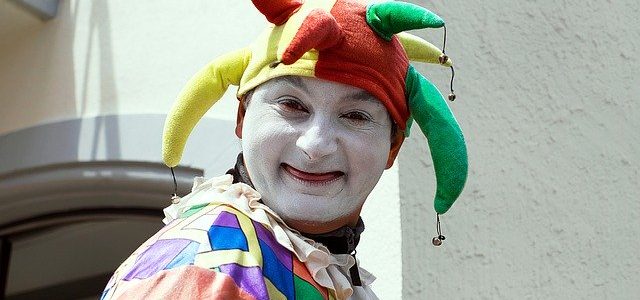
I suppose we could all benefit from things to laugh about — especially these days. But also consider the power of humour to capture our imaginations and remind us of our gullible, fallible selves. It’s a useful writers’ tool to keep in your writing workshop: the human condition, warts and all.

We Canadians have a long line of writers whose sense of the absurd finds its understated way into stories and novels, chief among them Margaret Atwood. I once told her that her novel Life Before Man was the first novel that made me laugh out loud. In retrospect, I hope she took that as a compliment.

The great American storyteller, Mark Twain, opined that “there are several kinds of stories, but only one difficult kind — the humorous.”

Indeed. But it’s not often recognized as such. In a May 1, 1916 Maclean’s magazine article, beloved Canadian humourist Stephen Leacock wrote:

“…ordinary people, quite unconsciously, rate humor very low: I mean, they underestimate the difficulty of “making humor.” It would never occur to them that the thing is hard, meritorious, and dignified. Because the result is gay and light, they think the process must be.”  

While writing humour well is difficult, readers do value the end result. Especially from brilliant writers like Margaret Atwood, as well as in the works of Twain and Leacock. Great storytellers have always understood that to hold difficult truths up to the light, humour in its many forms can keep us reading. And more importantly, it can plant the seeds of changed perspectives.

And that is one powerful tool for any writer.

What funny novels or stories have tickled your funnybone just when you needed it most? What writers made you laugh first and then stop and think? On this April Fool’s Day, share with us in the comments.

Quaking Before the Query

Quaking Before the Query

Ruth E. Walker

Next to the synopsis, the query letter is one of the biggest challenges writers face. It comes with loads of baggage because it’s the first thing of yours an agent or acquisitions editor will see. As such, it has specific tasks to accomplish and the pressure to get it right can knock the enthusiasm out of any of us.

According to New York Book Editors blog post: In essence, a query letter is a marketing page that talks up your book, without overselling it.

Simple enough on its face but there is an art to querying agents and publishers. And that art looks darn near impossible when faced with boiling down your 85,000-word manuscript into a single “marketing page.”

It’s as hard for me as it is for you. So, like in my post two weeks ago about the synopsis, I broke my query down into manageable steps.

  • Basics about the book
  • Special about the book
  • About the author
  • Invitation
  • Double-check

Basics

Genre, word count and title are necessary basics.  In my case it’s a science-fiction YA novel at 98,000 words and set on a terraformed world. I tossed in a bit about setting which, for science fiction, is often a key element.

The basics must appear in your query; if not as part of the opening then just before the closing.

You can, and should, add a bit of flavour to your basic stats especially if you have some way to make a connection with the agent/publisher. For example:

  • I took note of your preference for unreliable narrators OR
  • Your client list includes several YA speculative fiction authors who are favourites of mine OR
  • I heard you speak at last year’s AdAstra Convention and noted your interest in YA series books.

In my case, my most recent query is to a U.S. agent with whom I have no connection. But a bit of research clued me in to what caught her attention in other queries, so I flavoured my query with a teaser: As with Defy the Stars and Enemy Mine, my protagonist is naively wrong about who her enemy is. Her challenging journey is painful but necessary for her to recognize that she alone is her world’s enemy…and its hero.

Will it work? I have absolutely no idea, but I believe it’s worth trying. If nothing else, it got me thinking about how to use comp titles AND boil down the overarching issue of my protagonist.

Special

Here’s the “juice” of your query. It’s what makes your book special and the reason the publisher’s eyes widen and your manuscript gets read. This is the hardest part for me to write. I resist the temptation to cram in details, subplots, minor characters and thematic elements that I love in my novel.

Instead, I must share my main character’s wants and needs, and highlight the obstacles and crises that keep her from getting either. Finally, I have to avoid the telling how it all ends (after all, that is the job of the synopsis)

So just like editing anything else, I pare the Special section to less than 200 words and end up with a full query of 380 well chosen words. I think I still have some trimming to do but my query is now in much better shape because I brought focus to it, especially to the “juice” section.

About you

Keep your bio short but include details that resonate with your book. For example, my query always includes a reference to my creative writing workshop at a school board’s art camp (arts kids read YA) and my stint as an artist in residence primarily working with at-risk teens at an alternative high school (inspiration for my strong-willed protagonist.)

If you have some writing award or genre-specific detail to add here, go for it. But there’s no shame in being a debut author and stating that: This is my first completed novel. You can always add in a bit of branding: I am an eclectic writer who follows inspiration, characters and ideas onto the page.

Invite a response

The closing paragraph is a place to show that you actually read their guidelines without saying so. If the agent only wants the first 3 pages of your ms: I’ve attached the first 3 pages of my manuscript… and to show you are ready, you can add…the full ms and synopsis are available upon request.

Inviting the agent or publisher to contact you if they’re interested is simple enough but remember to say thank you. A simple finishing line: Thank you for your time and consideration acknowledges that you understand that reading your query took effort.

Take a second look

Even one little spelling or grammar error can put off an agent. So take it slow and give your query some cooling off time before you send it. Just like the manuscript you spent years on, a query is not a 30-minute process.

What a query is not

Over one page in length — it is a quick scan process so make sure that agent will read beyond the opening paragraph. In short, keep it short.

A major suck-up to the recipient — While it’s fine to offer some sort of connection or understanding of the agent’s/publisher’s preferences, don’t gush how they’re your dream agent or longed-after publisher. It might bring a smile to their faces…just before they click on the “trash” icon.

A place to show off — promote your strengths but summarize — instead of listing all the journals your work has been published in, summarize: …with fiction and poetry in several national journals. Your literary C.V. is for grant applications, not your query letter.

Cast in stone — An agent who only wants two paragraphs about the book and your contact info won’t look at your four-paragraph query. A publisher who wants the synopsis and no query letter…well, you get the drift. Know your audience and revise each approach accordingly.

More context

Jane Friedman

I’ve already given you a link to New York Book Editors. Here’s a few more websites I’ve found helpful in crafting my query. Jane Friedman set me on the right path to break down my query and Writers’ Digest offered several examples of successful queries.

You can never learn too much in this tricky world we write in. I’ll let you know if my query nets more than a polite no — you let us know how the query process goes for you.

p.s. If you need an escape to focus on your synopsis or query letter, there’s still a couple of spots remaining in this year’s Spring Thaw writers’ retreat. And you get a one-on-one consult plus notes from both Gwynn and me on up to 10 manuscript pages. That’s enough for both your query letter and synopsis.

Crybaby for Characters

Crybaby for Characters

Ruth E. Walker

Life of Pi movie still

True Confession: I cry in the sad parts. Tears trickle down with a good book. Louisa May Alcott’s Beth in Little Women, again and again with Jeannette Walls’ memoir The Glass Castle (alternating with laughter, of course), the tiger at the end of Life of Pi.

So many books have brought me to tears. I’m also a sucker for a well-acted stage production, movie or TV show.

It’s the characters

I invest in characters. I cheer for them and I admonish them and I cry for, or with them. Of course the story matters because that’s where the characters come to life. But the most compelling actors or characters in a story won’t move me if I don’t believe in the truth of their situation.

Captain Picard of the USS Enterprise

Star Trek is a television series I’ve followed since the early days of Captain Kirk. I watched every single television incarnation or reboot. And the movies. I don’t have a room full of Trek memorabilia but until my doggie decided to chew off his leg, I did have a tiny Captain Jean-Luc Picard on my office windowsill.

I’ll admit that some of the stories are not especially well drawn. And especially in the early days of limited FX options, those alien masks were, shall we say, rudimentary?

But it’s always been the characters for me: how they act, react and yes, occasionally, over-act (sorry Bill.) Because I believe, on some level, that they are real and the situation they are facing is founded in reality.

A learning moment

A recent story-time session with my 2-year-old granddaughter Clara reminded me that characters — even non-human ones — can have an emotional impact on readers.

One of her favourite books when she comes to visit me is Snow by P.D. Eastman. It’s an early reader in the Seuss series and frankly, the text could use some work: What is snow? I do not know. I do not know what is snow. and  Do you like it in your face? Oh yes, I like it anyplace. Suffice it to say, while I like repetition for word recognition, encouraging snowballs to the face is problematic. And yes, Grandma does know what is snow and explains it. But I digress.

Clara loves the book, always asks for it and so we read it. Until last weekend.

My granddaughter immerses in books. In the case of Snow, when we reach the pages where they building a snowfort and make snowballs, her fingers are all over the page, gathering imaginary snow to add to the construction.

But then we come to the snowman

At first, everything is fine. Just like every other time, she gathers the snow with the book characters, rolling each one into a three-tiered figure. Adds the glasses, pipe, coal smile and the ubiquitous hat. We turn the page.

The sun comes out.

The snowman melts into a slushy puddle.

And this time, for the first time, her face is stricken. “I don’t like it,” she says, her face now on the verge of tears. “I don’t like it,” she repeats.

What? This never happened before. Not with her. Not with any of my other grandchildren. I shift into hyper-vigilance and flip over the page. Distract her with the kids putting snowballs into the fridge freezer to keep them from melting. Suggest the snowman could go there as well.

Then I say, “We don’t have to read the snowman part again.”

Clara looks up at me, thoughtful. “Okay,” she says. But I’m pretty sure what she means is that we won’t read the book again. Ever.

Mending a broken heart

An illustration on two pages of a simple early reader book came to be absolutely real for her. And she was heartsick for the melting snowman.

It was a beautiful moment for me and a teaching one, at that. I was the learner and she, the instructor. Characters can be beloved even before words on the page are familiar.

I always thought that stories were favourites of very young children because the rhythm of the words and engaging illustrations caught their attention. But I hadn’t thought about a relationship with the characters. I thought that was something that grew as toddlers became more self-aware primary kids.

Pixabay

I also recognize that despite my love and frequent interaction with dozens of very young children over the years (my own, my daycare charges and my grandchildren), I had more to learn about the way story characters impact them. That even toddlers can have sufficiently developed empathy to be moved by characters.

It will be some time before I’ll be introducing Clara to Star Trek. But in the interim, I’ll be looking for additions to my children’s library at home. Suggestions, as always, are welcome.

Copy This – Our work is not free

Copy This – Our work is not free

Ruth E. Walker

At a recent panel discussion at The Writers’ Community of Durham Region, an inevitable topic came up: money. A question from the floor about payment for work triggered an emphatic response that writers, like all other artists, need to remember to ask for—and expect—payment for our work.

Image by mohamed Hassan from Pixabay

But not unreasonably, we also need to recognize that income for writers comes from a range of activities, not just putting words to the page. For me, that includes designing and delivering practical writing workshops, and providing a range of coaching and editing services for other writers.

Write for money?

Few authors can live exclusively off our royalties from book sales and big money movie rights. Frankly, if people wrote just for the money, I suspect there’d be many empty spaces on bookshelves. But again, that’s the reality for most artists. It’s a passion that drives us. A dream of creation. A love for the rush of putting the best possible words in the best possible order. A compelling desire to create a connection with readers.

Whatever it is that puts our butts in the chair and fingers on the keyboard, it’s also why some of us don’t stand up and demand reasonable compensation for our work.

(Un)fair deals

In 2012, the Copyright Modernization Act, Bill C-11, created a new set of exceptions for “fair dealing” for “educational purposes.” The Writers’ Union of Canada published an article by lawyer Jeananne Kathol Kirwin in Write magazine that explores those exceptions and the impacts.

Our posts from 2018 and 2019 offer some general background on the legal fight to restore compensation for writers and the negative effect those new exceptions set in motion.

In short, writers’ incomes dropped significantly from an already subsistence-level reality. And it became open season for institutions to copy Canadian writers’ work for free.

Image by Tasy Hong from Pixabay

On December 6, the Copyright Board of Canada issued a ruling that reinstates per-student fees for colleges and universities. It’s an amazing development and it changes everything.

As Access Copyright‘s President and CEO, Roanie Levy said: “The Copyright Board decision serves as the foundation for renewal of the symbiotic relationship that exists between creators and education after almost a decade of uncertainty. Access Copyright looks forward to working with our partners in education to ensure that students continue to have easy and affordable access to content.”

The decision from the Copyright Board of Canada gave postsecondary institutions a deadline of March 9, 2020 to pay the outstanding royalties. Access Copyright would be able to distribute royalty payments to registered authors by the end of 2020. If the institutions fail to meet the March 9th deadline, Access Copyright will have to take further action to ensure they comply.

Open season is closed

So thank you to Access Copyright and The Writers’ Union of Canada for their tireless and consistent work on postsecondary institutions skewed interpretation of what “fair dealing” meant. In short, for institutions it meant educators copying our work, distributing it to students and not paying for it. Payment for education purposes used to mean the institution paid annual fees to Access Copyright. In turn, Access Copyright paid out annual compensation to authors.  

As an author registered with Access Copyright, I receive a cheque each year. It isn’t a lot of money but it is payment for the use of my work in classrooms or businesses that choose to excerpt my writing for their purposes. That cheque dropped significantly once colleges and universities walked away from licensing agreements with Access Copyright.

A future built on the past

Over the years, I’ve let a lot of financial opportunity pass me by. I’m one of those insecure writers, with that negative voice in the back of my brain. The one that whispers that one day I’ll learn that I’m not truly meant to be a writer. That I’ve just been lucky. That any success has nothing to do with talent or vision. That I’m fooling myself. So the annual cheque from Access Copyright has always been a validation that counters my insecurities.

Image by Niek Verlaan from Pixabay

If my publisher hadn’t pushed me to register with Access Copyright, I may not have done it. I’ve watched how Access Copyright fought hard to bring truth to “fair dealing” for all creatives. And my membership in The Writers’ Union of Canada has meant I’ve had a front row seat to the amazing advocacy of Executive Director John Degan, who, along with the Writers’ Union board and dedicated members, helped to bring us to this stage.

The copyright fight is not over. To quote the Writers’ Union press release: “We have rates to work with,” said TWUC Executive Director John Degen, “so that’s good; and we remain confident pending court decisions will clarify that claims of fair dealing have been grossly exaggerated.”

The Copyright Board of Canada’s ruling is a significant step in the right direction. And that small voice in the back of my head is a whole lot quieter.

Power Foods for Writers

Power Foods for Writers

Ruth E. Walker

In a perfect world, we writers would have a service that takes care of meals while we’re busy crafting another genius piece of writing. Someone who preps, cooks and delivers our meals. Someone who understands we’re “in the zone” and not to be disturbed.

As if.

Who among us could hire our own personal chef? Keep dreaming. A relative of mine is a personal chef. He’s provided with a private onsite apartment, prepares all the meals in a fully equipped gourmet kitchen and occasionally travels with his employers when they, ahem, go abroad.

We can only imagine. (Well, yes. We can imagine because we are writers.)

But what to do when our bodies (or our families) call for fuel but we just want to stay in the zone, creating beautiful words on the page? We have to eat, folks. Our brains demand we keep them functioning well as we write. So here are some options to keep fuel stops to a minimum of effort for a maximum of writing time.

Create a basic pantry

If you must cook (and pretty much you have to) make it is as easy on you as possible. Stock your pantry with tinned beans and legumes, a can or two of tuna and/or salmon, pasta, rice, canned tomatoes, boxed stock (beef, chicken or vegetable), onions, garlic, oil and a variety of spices.

Salmon Salad

There are plenty of pantry recipes online. From ifoodreal, I really like this salmon salad recipe. Simple. Quick. And adaptable to change up as you like. Jessica In the Kitchen offers an easy 15-minute Mediterranean chickpea salad that’s likewise quick and easy to change up ingredients.

I prefer to work from print cookbooks to avoid having to scroll through copious advertisements but online is a fast option to get you started.

Plan ahead

Try batch cooking. Pretend you have 10 people to feed and make a massive stew or lasagna or hearty soup. Portion it into containers and freeze it. Defrost when you need it. Toss a side salad and cut a slice of bread, and voila! Dinner is served.

I can recall a time when TV dinners were all the rage. Oh my. Sliced turkey brushed with thick gravy, mashed potatoes, peas and sometimes even dessert (!) in a divided tin foil pan. Simply heat in the oven and serve. They were terrible. And we all marveled at “modern living.”

Frozen meals have come a long way since rubber turkey and instant potatoes. So if you don’t have the time or inclination to batch cook, stock your freezer with a few prepared selections to give you more time to write.

You can always order in

If your budget will allow it, there are plenty of food options out there and not all of them are standard fast foods. Remember to give a nod in the direction of healthy by including salad and/or a side of veggies. And yes, cold pizza for breakfast is not out of the question when the Great Novel awaits.

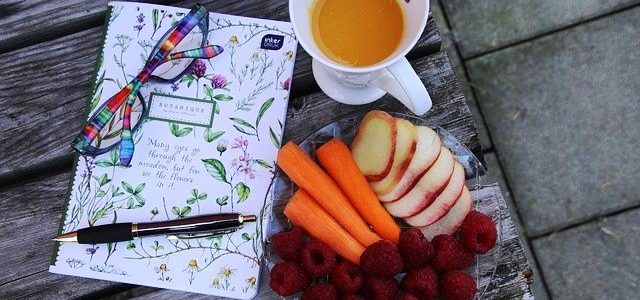
A different option for ordering in: your weekly grocery shopping. Remember to put items on your list that can nourish without a lot of work: fresh fruit, simple veggies (broccoli, celery, carrots), salad fixings (or even a couple of bagged salads), and basic protein.

Several big chain grocery stores will deliver anything you can find inside their walls–from food to electronics to lawn chairs. Keep it simple with specialized delivery services that can drop off your weekly fruit and vegetable needs such as Mama Earth Organics and Durham Organics.

If you have that basic pantry set up and some basic condiments, along with eggs, cheese or protein alternatives in the fridge, you’ll have no reason to resent mealtime.

Last word

The Harvard Medical School published a summary of what foods we need to include in our diets to keep our brain function at a high level, especially as we get older. As writers, our cognition is vital so start chewing those leafy greens if you don’t already. And hooray! Tea and coffee are included in that summary.

A recent visit to the CBC website inspired me to explore this topic. In their Life section, they have 9 Wonderful Pantry Recipes — meant for anyone who thinks they have nothing to eat for dinner. For the most part, they looked pretty quick and simple. And that, for this writer, was all I needed.

Waiting Room

Waiting Room

Ruth E. Walker

As I write this, I’m at a local hospital playing the Waiting Game. My husband is undergoing surgery, a relatively routine repair of a long-standing issue. And I’m going to sit in this less-than-comfortable chair in a busy waiting room until he’s out of the OR, through recovery and on his way to a bed upstairs or, better yet, home.

So what’s a writer to do when the minute hand ticks by with the speed of a dripping faucet. A very slow dripping faucet.

I could write

There’s lots of ambient noise and I read recently that white noise was an important factor for many writers. My friend Rabindranath Maharaj worked on several of his novels in coffee shops. A Globe & Mail article cites a 2012 paper by researchers at the University of British Columbia describing the creative benefits of working in certain noisy settings. They found that in the buzz of low-level noises, our brains can easily shift into broader thinking, a useful tool for developing concepts or brainstorming.

So, I should be writing. Let all this hubbub and Paging Nurse White and Code Blue 3rd Floor murmur in the background as I map out the Next Great Novel. I should be writing. But I can’t because I worked in a hospital years ago and I know what those announcements mean. Too distracting despite being a useful tool and all that.

I could read

The second-best thing for a writer to do–if you can’t write, well then, you should read. I have a book with me, Louise Penny‘s Still Life. Even though last night I reluctantly put it down to turn out the light, here, in this waiting room, I’ve read the same page three times. Even great writing can’t hold me.

There’s a few well-worn magazines over in the corner. I could put my gloves back on (germs, don’t you know) and pick up a gossip publication and distract myself with movie news about who’s getting divorced, married, a film deal, and so on. But as I said. I’ve worked in a hospital. I know what those announcements mean. I’d just get to the interesting part about how some little-known actor finally gets the part she’s been waiting for and…Code Blue.

I also know what the look on that surgical nurse’s face means, too. She’s delivering difficult news to the couple across from me. It’s not the worst news–they don’t do that in the waiting room, that’s done behind closed doors. But somebody’s surgery is not as routine as they thought. So it puts my dripping faucet timeline into perspective.

I could go for a coffee

The cafeteria is just down the hall and around the corner. But if I leave, I’d miss watching the screen of the Family Tracking monitor showing where patients are in the process. For privacy, each patient is given a number and a rolling scroll of those numbers is colour-coded depending on their progress. I’m watching for the number that is my husband to move from In OR green into the next colour, purple PostOp.

So clearly, I can’t go for a coffee because I’d miss the change. And change is good when the clock ticks like a…well, you know.

Open my eyes

So this writer is going to do the only thing she can: watch. At an Andrew Pyper workshop some years ago, I recall his referring to a useful kind of watching for writers are “reportage” observations. Without emotion, observe. Focus on details but don’t attach those details to motivation. Be specific but don’t speculate.

It’s surprising how tough that actually is for me. I’m naturally a “speculator”, wondering about the possible reasons for any given behaviour that catches my focus. Thinking about second thoughts, hesitations, determinations. It’s what drives a lot of my writing. The ever-nagging why.

But with Pyper’s reportage, it is this…an older woman in a red puffy jacket pushes a large navy blue stroller down the hall toward the cafeteria. The little girl in the stroller is asleep, her round face, closed eyes and wisp of black hair just visible above the side of the stroller. They pass an orderly in pale blue scrubs pushing a stainless steel cart, the wheels squealing as he saunters by in the opposite direction. The little girl wakes and begins to scream.

These descriptions are to be tucked away and pulled out later. Perhaps to add some verisimilitude to a scene, drop in a touch of “the real” to ground a narrative.

Old habits…

Of course, I can’t do that very well either. And it has nothing to do with the colour coding on the Family Tracking monitor. It has everything to do with that little girl’s scream. What horror did that squealing wheel awaken in her? Could she be possessed? Is she reliving a trauma? Did the orderly secretly kick the stroller to waken the baby and distract us all from some nefarious scheme unfolding a few doors away?

It appears perhaps I do need a certain amount of noise to trigger some broad thinking. Especially when my attention is so keenly focussed elsewhere. If nothing else, the clock’s slow progress is forgotten for a few seconds.

And look. There it is. The patient number that means the world to me has moved into a new colour: Recovery Room orange. And the doc says he can come home today, after all.

Be a writer, after all

So, the takeaway for me in all of this? Earlier, I said the only thing I could do is “watch” a la Andrew Pyper’s reportage approach. Well, clearly, I also can write in a distracting environment and the evidence of that is this blog post.

Though truthfully, I’d not want to be sitting here again anytime soon. Instead, I’ll head to a coffee shop or hotel lobby or shopping mall to get my distraction fix.

How about you? Can you write anywhere? Or, like some writers, do you need absolute silence in a pristine setting?