

Ruth E. Walker
Every time we organize a Writescape retreat, we email participants a “Useful Information & What to Pack” list. It’s full of practical advice. We remind them to bring comfortable clothes and outdoor wear for spring or fall. After all, Ontario weather can be as unpredictable as a newly discovered character for your novel. We suggest that they can bring munchies and comfort foods but our all-inclusive retreats have breakfast, lunch and dinner
 We provide maps and directions to the resort. And we remind writers to pack anything they need for writing. Most importantly, we suggest they remember to bring their work in progress or ideas they want to develop. But if they forget those, Writescape retreats offer creativity sessions and other inspiration opportunities. We even have a companion workbook and an on-site inspiration station for those 3:00 a.m. inspiration needs.
Gwynn, and I sometimes joke that anyone coming on a Writescape retreat just needs a change of underwear, their toothbrush and jammies.
But there are some other, more subtle things that don’t fit into a suitcase but that a writer should remember to bring on retreat. And these important items are needed no matter where you are heading:
An Open Mind
I’m not talking about how you see the world, your politics or your ethics. I’m talking about some internal housekeeping — o pening your mind to possibilities. It’s a form of mindfulness. It’s you, paying attention to what your muse is suggesting. You, being open to the five senses — taste, touch, sight, smell, sound. You, bringing those senses into your writing. When your writing includes a range of sensory elements, your readers’ memories are tickled. And that results in writing with physical and emotional resonance.
A Plan
 Having a plan may sound contradictory to what I just said about mindfulness but the two are companions on any successful retreat. Gwynn reminds us in every opening session to be S.M.A.R.T. in our retreat objectives: set plans for the weekend that are Specific, Measurable, Achievable, Realistic, and that can be Timed. In short, if you don’t have a plan, how will you know what you have managed to accomplish?
Coming on retreat to “write something beautiful” is not as powerful as coming on retreat to “finish three vital scenes for the climax.” By the same token, planning to “write a complete novel” is not realistic unless you are on a 30-day NaNoWriMo retreat. Be reasonable. There’s nothing unrealistic about a plan that includes “relaxing with a daily lakeside walk and writing in my pajamas for two hours every day.”
Permission
Giving yourself permission — permission to experiment and explore, even permission to fail — offers you a delicious freedom from your inner critic. Most of us struggle with that quiet voice whispering in the background, telling us we’re not real writers. At one of our retreats, a participant told me she didn’t think she really was a writer, that her work “wasn’t good enough.”
We talked about what makes “a writer” and how we all are on a continuous journey with the writing process. When she finally was able to read her work in one of the sharing opportunities, she was thrilled by the response. She got past her inner critic, gave herself permission to risk sharing her words and discovered validation when other writers responded to her work. And she’s grown so much since as a writer, seeing her work published in anthologies, winning writing contests and submitting her novel manuscript to agents and publishers. And all that happened because she gave herself “permission” at her first writing retreat.
 This Friday, a group of writers will be heading to Elmhirst’s Resort on Rice Lake. They will bring casual clothes, walking shoes, bathing suits for the indoor pool, and rain gear, just in case. They will also bring their works in progress or ideas folder, laptops or notebooks, and their pens or pencils. They will have packed a writer’s suitcase full of optimism, plans, outlines, rough drafts, objectives, hopes and dreams for their retreat.
And Gwynn and I will do everything we can to help them achieve their plans and their dreams. Because, after all, that is exactly what they will expect of us.
Let’s Get Practical:
Packing your suitcase can be a real challenge, especially when you want to lug along your laptop and flash drives and chargers cords. Rolling clothes  instead of folding can get you more space. But what about keeping it all organized and quick to pack and unpack?
Here are “13 packing hacks” from MarieClaire. You’ll gain some space for those extras and keep your clothes neat and tidy.
Do you have any packing tips?

 What good is writing a wonderful poem, a brilliant short story, an entire novel manuscript, only to leave them forgotten in the digital drawer? A big part of being a writer is submitting your work. Agreed, not everything you write should see the light of day, but you know in your heart which pieces should be sent out into the world. It’s hard, yes. It takes courage to expose yourself to possible rejection, but you can only enjoy success if you take this important step. So, this fall, dig out those finished pieces, brush them off, pretty them up and decide where they can find a home. Then—the important bit—actually send them out!
 As we near the end of the year, reflect on what you achieved in your writing life. Was it more or less than you hoped for? If, like me, you didn’t get as much done as you planned, don’t beat yourself up about it. Take action instead.
 I am terrible for starting projects and not finishing them. Are you? Is there even one project you could finish up and clean off your list before the end of the year? What about your writing space and daily habits? Are they “cleaned up” enough for you to feel creative, to have the time you need? Should you be throwing some habits out and replacing them with new?
 Now is the time to plan a winter schedule for your writing. What project/s do you want to tackle? Are there courses you need to sign up for in 2019? Conferences or retreats you want to attend next year that you must register for or save for now. A writing residency? A grant application? A submission schedule?
 Start with an open mind and playful attitude. Mind mapping is a “brain dump.” Expect that many of the ideas you produce will not be useful. That’s not important. You can harvest the valuable nuggets later.
 Begin with one central keyword or concept in the centre of the page. Starting in the middle of the page gives the creative right brain a head start, as our non-creative left brain is used to starting in the upper left-hand corner.
 Keep your hand moving. If ideas slow down, take your hand back to the central concept and begin a new branch. Draw empty lines, and your brain will move to fill them automatically; or inject more energy with a different colour pen.

 The phrase DOCTORS OFFICE has me curious. I follow the branch back towards the centre, trying to work out what PINK and SUGAR have to do with it. Then it hits me… when I was a child, our doctor used to hand out tiny cylindrical candies that smelled like scented geraniums. I realize that I haven’t seen them in decades. What other sweeties from that era are no longer around? Hmmm….. Another article? A scene for my novel? A short story? Things are brewing now.
 The perfect spot to be creative – and mind map to your heart’s content – is at


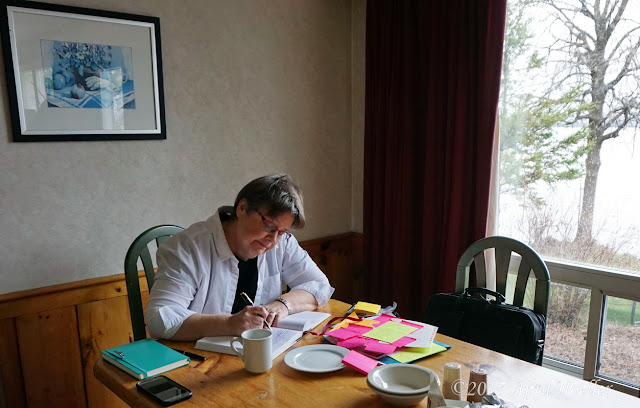 I found the doorway into a section of the memoir that I’ve been struggling to get a grip on for months. I not only plotted out my way through it, I also committed some 5000 words to paper, half of the chapters. Woot! Woot!


 I include a record of submissions that I send out —whether they come to fruition or not— because even the act of submitting is a positive and motivating step for any writer. I list writing events I attend. I list open mic opportunities, readings, interviews or panels I participate in. I paste copy from encouraging emails about my work. I record the completion or start of writing projects, or even segments within writing projects— “finished Chapter 3!”. I record workshops attended or given, and retreats and writer’s breakfasts. I fill in the dots on the calendar for every B.I.C session I complete.
 Seeing where you were a year ago and where you are today can be revealing. Priorities and goals can change over the course of the year. Projects can fizzle or get sidelined by new projects (and life) unimagined at the start of the year, and that is not necessarily a bad thing. Just because something on your goal list doesn’t get completed doesn’t mean you’ve failed. Reflect on what you’ve learned. Adjust and move on. Go with the flow.
 Achieving writing goals is all very well, but if they are achieved at the expense of your health or your family relationships and other important aspects of life, then perhaps you need to reconsider your life balance. As Ruth said in her blog,
 National Novel Writing Month is an Internet-based challenge to write 50,000 words of a new novel in one month. It started in 1999 with only 21 participants. By 2012, there were over 340,000 who collectively wrote over 3.2 billion words.
 Churning out over 1600 words will keep you busy–and alone–most days, but you can also connect with fellow participants and participate in daily challenges, pre-Nano prep sessions and post-Nano activities. You can connect through Twitter [@nanowrimo], on
 It sure does. Even if participants don’t complete the 50,000 words, they get words written, lots of words. And anything that helps you write is worth trying. Sometimes just the tension of knowing you have a deadline combined with being part of a larger global event can bring inspiration and focus to the creative process.


 through Chapter 1 again. For the moment you are convinced that, yes, you started in the right spot. But you find a short cut on an upper stretch that improves the trip, so you make it. Chapter 1 feels really good now.
 And the truth is, most first drafts are not publishable. As Hemingway so succinctly said, “All first drafts are shit.” First drafts will have strong parts and weaker bits, and bits that should be axed and areas where more needs to be written. That’s NORMAL. That’s what the editing process is for.


 Lately, I’ve been trying to increase the number of steps I walk each day. I bought a pedometer to record them. At first I just went about my regular routine to see what I was achieving already. Sad. Very sad. Some days I didn’t even break 500!
 At first glance, if you do the math, an 80,000 first draft written over a year, five days a week, 50 weeks in the year, would only require a measly 320 words a day! A 100,000 word book is only 400 words a day.

