Dialogue is not filler, nor is it secondary. For readers, dialogue is the illusion of active listening, of ‘looking’ from person to person as the conversation unfolds. There are technical effects from dialogue that support and enhance your story. The following 10 on the 10th blog shares some examples of the important work of dialogue:
1. Develop Plot: To ensure you’re not writing “filler”, give your characters dialogue that moves the plot forward, develop scenes.
"Pete, meet me at Crawley's barn at sunset. I'll bring Billy."
"Want me to bring a gun?"
"Nah. If I find Billy before sunset, we won't need one."
2. Move in Time: When the story needs to shift into a new scene, or you want to cover a period of time without going into detail about that period of time, offer a line that sets up the new scene:
“Good then. I’ll see you next week."
 or “So it's settled, we leave at dawn.”
or "Give me an hour or two and I'll call you back."
3. Reveal underlying tensions: Characters, like real people, have emotional baggage and secrets. Dialogue can give a clue that a character has something they’re hiding.
“Just what did you mean by that?” she asked.
He shrugged. “Nothing. Now let’s just move on, okay?”
4. Enrich themes/mood: Characters can help readers pick up on the mood of a piece by what they say.
“I hate this damp and cold. And those dark clouds can only mean
 we're in for more rainfall.”
or "Come on, Charlie. Let's jump in every puddle we see."
5. Echotime/era/culture: Dialogue can add authentic details to bring out the story’s genre, culture or time period.
“Ach, lass. Will you no be gettin’ down from there?”
or “My lady, 'tis unseemly to be about at this late hour.”
or "Golly. Is that one of them new tellyvisions?"
6. Establish setting: Setting a scene through description alone can turn into a laundry list of what can be seen. Let dialogue do some of that work so that readers get enough detail to fill in the rest. More importantly, let dialogue help readers to stay connected to characters by “seeing” what they see and with the emotion they see it.
"Zargon! Power up the hyperchute—enter that wormhole!”
or "Bring me that beautiful leather bound volume from the top shelf."
or "Careful now! Mind you don't step in that stinking muck."
7. Imagine geography: Not all stories need large scale world-building but many fantasy, science fiction or quest stories will involve creating a world that readers can believe in. Dialogue helps to make it real because it’s real to the characters.
“Wait. I think I see a body of water through the trees.”
or "This map doesn't show......."
or "That desert's got to be five day's walking or more. And not even
 stones or scrub for cover."
8. Reveal facets of character: Dialogue is an active way to reveal character emotions, backstory and motivations.
"Please don't leave me alone with him; I can't go through that again.”
or “How amusing. You dare to speak. Guard—kill him.”
or "I'm going to tell you a secret...."
9. Focus on dynamics: How chracters talk to each other reveals not only clues about each character but also about their relationship with one another.
“You just can’t leave me alone, can you?"
“Ah, but if I did, you’d start to hate me all the more.”
10. Show don’t tell: Dialogue is one of the easiest ways to give tired prose an energy lift, and turn “Tell” into “Show”. And that includes the body language and action beats in between the words. It’s dramatization that the reader can be immersed in, can “hear”, “see” and therefore feel.
Tell: Her father was abusive, but she had long since stopped caring.
Show:"Jesus girl. What's this slop ya call dinner?" Pa swiped the dish from
 the table. Ma's best china plate shattered against the door. "And look
 what ya made me done now, ya good-for-nothing..."
Mary scooped up a shard and turned to face him, looked  Pa square in the
eyes. "You can break me all ya want, Old Man, but ya'll never touch another
 thing what belonged to Ma."
As noted in last week’s Top Drawer, Gwynn and I attended the Spirit of the Hills (SOH) Festival of the Arts in Cobourg, and filled our creative wells with workshops on the craft of writing. But there was more energy and inspiration to be found in the community rooms at St. Peter’s Anglican Church.
Ruth at Writescape’s table
Drawing together the arts of all kinds, the festival celebrated visual arts, music, theatre, dance and literature. And in each of those disciplines, there was a myriad of creative expressions. From Flamenco dancing to fabric art to photography to performance poetry, SOH festival attendees were treated to a rich immersion in the arts.
Not only were there feasts for the eyes and ears, there were several opportunities for collaboration and communication between artists.
Gwynn moderated an intriguing panel discussion between four poets, who proved that poetry is not just an economy of words on the page. Ted Amsden, Cobourg’s poet laureate emeritis was joined on the panel by American/Canadian poet Katie Hoogendam, subversive poet Wally Keeler and performance poet Dane Swan. The audience was challenged to consider how each poet approached their craft
A Royal reception
Hon. Elizabeth Dowdeswell
The arts tend to be taken for granted, so when the Lieutenant Governor of Ontario, the Honourable Elizabeth Dowdeswell, entered the exhibition hall on Friday afternoon, the excitement meter rose significantly.
She is the Queen’s representative in Ontario, and in her own words, is “Storyteller in Chief.” Her Honour knows the power of words to engage others, and holds close the stories she hears from her travels throughout the province. Gwynn and I were delighted when she stopped by our table for a brief chat.
Reva Nelson & Piers Walker
On Friday evening, we were treated to an evening of music, dance and theatre. As much as I enjoyed all the offerings, one short play held a special joy.
“Mouse”, by Marie-Lynn Hammond, explores how two different commuters — an introverted older woman and an over-active young man — have far more in common than they first realize. Of course, the fact that I had a connection with the young male actor might have influenced my strong preference. Cannot lie: I’m always a proud mother when I watch any of my children do something they love.
Mixing up the arts
The arts were thrown into a different mix of voices when Saturday’s lunchtime panel, moderated by Alan Bland, brought together poet Dane Swan, multi-talented singer-songwriter David Newland, award-winning author K.D. Miller and opera singer turned author and editor, Christopher Cameron. The audience engaged in a free-ranging discussion on the challenges and benefits of sharing across the arts.
Our consensus? There’s a definite richness of thought when artists of various disciplines take the time to talk with and learn about each other.
Marie-Lynn Hammond & San Murata
Gwynn reading poetry
But the best example of sharing across the arts, for me, was the very cool Words on the Wire, multi-media event on Saturday afternoon. Video poems engaged our eyes and minds, exquisite music and singing rose to the rafters in the chapel setting, pioneer Susanna Moodie addressed the audience, and poetry and prose was shared by diverse voices. Musician and songwriter Marie-Lynn Hammond was joined by acclaimed violinist San Murata. And a personal favourite of mine, Gwynn Scheltema, read two gorgeous poems from her poetry manuscript.
By bringing together a diverse gathering of arts and artists, the Festival attracted the attention of the Queen’s representative, someone who regularly consults with the provincial government and who articulated her belief in the power of grassroots art and volunteer activity to bring people together and enrich their lives. The Festival showcased the work of creative people in a public, accessible place. But more than that, Spirit of the Hills festival organizers created a space in which artists could share ideas, inspiration and art forms with each other.
The Festival of the Arts is held every two years in Northumberland County. I’ll be marking fall 2021 on my calendar to be ready for another immersion in the many creative experiences that will be on offer. In the interim, I’ll be looking at ways I might collaborate with various artists to see what synergy can develop.
Collaboration + creative people = ??? Share in the comments what you think can come out of collaboration across art forms.
Collaboration Opportunity
Applications have just opened for Halls Island Artist Residency in Haliburton County. For summer 2020, organizers are dedicating one 12-day residency for up to four artists who want to collaborate on a project(s).
main cabin
Halls Island is an off-grid, eco-sensitive island on Koshlong Lake. Residencies are available to artists of all disciplines. Other than a $10 non-refundable application fee, residencies are free to successful applicants.
“As an environmental artist and geo-poet, the Island itself was a way to rejuvenate, and become re-inspired in my practice.”
This past weekend, Gwynn and Ruth spent some time at the Spirit of the Hills Festival of the Arts. We’ll have more to say about this great festival next week but wanted to share some insights we gained from each taking a writing workshop.
K.D. Miller
Ruth attended The Captive Moment with author K.D.Miller where she spent time with the haunting paintings of Alex Colville. K.D.’s Governor General’s Literary Award-nominated collection of short stories were inspired by 12 of Colville’s paintings.
Cynthia Reyes and Ronald MacKay
Gwynn attended Your Journey, Your Story with Cynthia Reyes and Ronald Mackay. Both published memoirists, their workshop covered the structure and purpose of writing a memoir.
Both Gwynn and Ruth are seasoned workshop facilitators. They both spend a great deal of time researching the topics they teach and discover new ways to inspire writers to keep their pens moving and their imaginations engaged.
So why would either of them want to take workshops?
To be better writers
More than just wanting to learn new things to bring into their workshops, they are both, at their core, writers. As such, they need their pens to keep moving and for their imaginations to be engaged.
Ruth left The Captive Moment with two new poems and one story idea. Gwynn left Your Journey, Your Story with a workable plan for focussing the story aspect of a memoir.
Of course, they both left with new ideas to bring into their own workshops. But that was simply a bonus. For Gwynn and Ruth, carving out time to devote solely to their craft, to stretch, experiment and explore always fills their own creative wells.
That makes them better workshop facilitators AND better writers.
Workshop with Gwynn and Ruth
On Saturday, November 2, join Ruth at Blue Heron Books in Uxbridge for a creative writing workshop, A Recipe for Great Characters. This hands-on morning session is part of Blue Heron’s inspired Book Drunkard Literary Festival. Cook up a new character or add spice to an established character in a fun and creative way.
On Sunday, November 10, Gwynn is at the Writers’ Community of York Region’s monthly meeting. Drawing on her expertise as a professional accountant, Gwynn is sharing Touching on Taxes, helping writers identify the different kinds of revenue associated with writing and how to report it.
The manuscript is finished. You’ve edited until you can’t
look at the words for one more minute. Your beta readers are all giving you the
Thumbs Up. It’s ready to go out.
Then you see it. On the submissions page of the publisher
you hope will publish your book. They want a synopsis. (Cue Jaws music.)
Good grief. You’ve perfected your manuscript. Shouldn’t that
be enough?
Get over it. They want a synopsis and you have to produce
one. So let’s cover the main points to help you pull it together.
Just the important bits
A synopsis is a kind of point-by-point outline of the story, summarizing what happens and who is changed by the end.
A synopsis is not a marketing tool but the first paragraph should offer a touch of a hook or any of the unique elements of the story. It’s not written like your novel yet it should hold a sense of your writing voice…your style…and the genre/style of the book. And just as important, it’s not a jacket blurb so be prepared to reveal the ending.
If a synopsis is interesting enough, agents and publishers will want to read the manuscript despite knowing the ending.
Short is sweet
For a novel, a synopsis can be as short as one page or as long as five pages. I recommend going shorter. Ideally, no more than two pages. Unlike the manuscript, text is single spaced so you have a fair amount of room in those two pages.
To take full advantage of two pages, keep to the main story and the primary characters. You’re outlining the events but this is not a point-form summary. So your creative self needs to come through in how the synopsis is crafted. You can, for example, lift a slice of description or a touch of dialogue right out of the manuscript to use in your synopsis.
For example: Mary is distraught by her husband’s perceived betrayal. “I’ve wasted years of trusting you!” Little does she realize that she is the one who betrayed them both.
Motivation + action = story
A synopsis needs to introduce the main characters, a touch of character(s) motivation and reveal conflict right from the beginning.
Don’t be coy—set the stage for the rest of the story: Mary and Omar are the ideal couple, leaders in their rural community and a successful left-leaning political team. Newly re-elected mayor, Mary is confused when Omar opts to resign his council seat without telling her first. But when she discovers he’s involved with a far-right insurgency, she’s horrified and throws him out of their home. Then terrorists take a bus full of school children hostage and Omar is the only person they’ll negotiate with.
Subplots are not part of a synopsis but you can offer a single line or two if it matters to the main story.
For example: The themes of betrayal and loss are mirrored in a subplot involving school friends. In the same way, background or walk-on characters don’t need to be mentioned unless they are integral to the plot. As with subplots, keep it to one line: When the terrorist spokeswoman hesitates, she’s executed by the leader who then gives police 5 minutes before one of the children will be killed.
Zip up the ending
When you get to the ending, don’t short change your
synopsis. Demonstrate how your ending has punch or significance: As Mary holds a dying Omar in her arms, she
realizes her refusal to listen to the only man she’s ever loved cost him his
life. Whispering into his ear, she promises to raise their unborn child with a
true understanding of its father and his beliefs.
Check for basics
There are several
ways to tackle a synopsis. A simple approach builds it from listing the major
turning points for your main character, then fleshing out a brief summary of
the action at each point. Don’t forget to keep the whole narrative arc in mind
as you work:
Inciting incident
or the crack in the world of your main character that sets them off.
Rising action or
the events that add tension and propel the story forward.
Climax or the
point of excitement, ultimate change or Oh My God moment.
Resolution or the
place that brings the story to a close.
There’s no perfect way to write your synopsis. But if you
keep to these four elements, add in a dash of your writerly style and remember to
focus on the main story, you should be well on your way to a compelling
two-pager.
For the past two years, I’ve participated in the Hike Haliburton Festival, leading one of the more than 100 hikes held over 4 days each fall. But not just any trek through the woods or up a hillside, my hike is called a Hike and Write: Inspiration Trail.
It all started three or four years ago when Barrie Martin, a curator of outdoors experiences in Haliburton County, invited me to sponsor a hike in the festival. Our back and forth correspondence led to him inviting me to instead lead a hike in 2018.
Me? Lead a hike? At first, I had this picture of some of the challenging trails I’d portaged and hiked over the years. Frankly, I’m past all that.
But Barrie persisted. Told me I could design whatever kind of hike I might like that would include writing.
And that’s the so cool factor that elevates the Hike Haliburton Festival from a series of treks in the bush to hikes that integrate the arts, culture, heritage and foodie experiences.
For example, Hike for Art’s Sake was a wander along quiet roads with a local artist to sketch abandoned buildings from bygone days. And for the mushroom lover, they could take the Fungophile Foray, an easy walk in search of edible fungi. All 115 of the 2019 hikes were free.
After hosting two back-to-back hikes last year, I opted to extend the pen with a single walk in the morning and an afternoon writing at my cottage. Five hikers joined me at Dahl Forest for a hike along the Big Bend Trail Loop. They were ready to walk along, using the senses to make observations to apply to writing opportunities.
Special guest magic
Just before we started, a sixth hiker arrived. A celebrity guest, in fact. The 2019 Writer in Residence for Haliburton, Susanna Kearsley, joined us. The bestselling author of 13 books was generous with her time and attention to the other hikers. Notebook in hand, she explained how paying attention to small details is a vital part of recreating reality in her novels. How the light hits the lichen and moss on a rock, or the power of the damp scent of a pine forest — these are the kinds of things she looks for and records.
Dahl Forest
The weather was perfect. A stunning blue September sky, a light breeze riffling the tall pines and fir trees, and a carpet of moss and pine needles underfoot.
Susanna Kearsley captures a scene
Stopping at a riverside picnic bench, I led the hikers in a freefall writing exercise. The pen starts and doesn’t stop. Writers are encouraged to “follow the energy” and “write what comes up.” There’s more to it but that’s for another time.
It was magical. I was wondering how well the afternoon could go given how perfect the hike and morning had unfolded. Would an afternoon of tea and light refreshments lead to more brilliant writing?
I needed not to worry. The afternoon was just as perfect as the morning had been. Was it spent writing in hushed stillness, against the backdrop of the cottage birdsong and rustling leaves in the breeze?
Not exactly.
Inspiration comes in all forms
It was, instead, a delightful afternoon of discovery. Over tea, coffee, cheeses, fruits and ginger ale, Susanna shared some of her experiences as a writer. She spoke of her research and pleasure in writing. And soon enough, the conversation turned to the importance of story.
I sat to one side, judging just when I’d suggest clearing the table to start to write. I waited for the inevitable lull in the conversation.
But then — oh then — the real magic happened when the topic of films that tell a good story came up. And chief among them, the Marvel movies. It turned out that Susanna and one of our hikers (and a colleague writer of mine), Stephanie, were both big fans of the comic book film series. Drawn to the cinema for the strength of story and characters that carry that story, the two fans exchanged favourite movie titles.
The other hikers were intrigued and soon enough, Susanna and Stephanie were curating the ultimate list of Marvel movies to watch. Titles were broached, discussed, discarded and reordered into a “must see” list, and in what order they should be seen.
I’ll admit relief that Guardians of the Galaxy was included on that list — I’m an old-school Marvel fan but that revised rag-tag band of misfits resonated with me. At this point, I stopped to consider what we were all talking about. Frankly, I was perplexed by how a writing afternoon morphed into an analysis of superhero characters, their origins and challenges.
And then I got it. It’s the story, stupid.
What drove Stephanie and Susanna to get into such animated chatter about the film series was to talk about the power of story to transport us. Story in cinema led to the Marvel movies and the rest, as they say, was our afternoon.
2019 Hike & Write: Inspiration Trail
As the afternoon wound down, the hikers went home elated with their day spent hiking and writing in the morning and exploring ideas of story at my cottage. The curated list of “must see” movies went with them and they were already planning a series of binge movie nights.
Was this a silly thing to end our hike with? Absolutely not. We all crave story in our lives.
From the once-upon-a-times of our childhoods to the complexity of a well-crafted novel, it’s story that nudges our imagination and offers us new ways of seeing our world. It’s why we write. And thankfully, story can be found just about anywhere: on a morning walk through a stunning forest or over tea and biscuits in a rustic cottage.
Lucky us. We get to find those stories and make them our own.
The autumn season is always a busy time: harvesting the last of the crops and taking in the warmth of daytime sun. We’re all aware winter is waiting in the wings.
For writers, this often means hunkering down into our writing space and getting serious about our projects. Maybe we start a new story or poem, review our plot and character arcs, or ready our works in progress for submission.
Getting serious can also include taking workshops, attending events or signing up for long-term courses. At the very least, getting serious means being open to learning something new about the business or craft of writing. In short, adding to your writer’s toolkit.
The British novelist Matt Haig (How to Stop Time, The Radleys and Reasons to Stay Alive) offers this about courses in creative writing:
To say that creative writing courses are all useless is almost as silly as saying all editors are useless. Writers of all levels can benefit from other instructive voices.
Of course, you can find quotes from bestselling writers that will say the opposite–that you either have it or your don’t. Workshops won’t make any difference, etc.
But I side with Matt. We all have the ability to write, to shape ideas into words, to blend those words into sentences and put those sentences into a kind of order to say what we want to say. But even natural ability, dogged determination or unique vision will benefit when a writer focuses on the why and how of the craft.
Of course, I have an interest professionally in writers taking courses because I occasionally offer workshops. And I’ve seen first hand the discoveries and breakthroughs many of those participants have made in my workshops. But I also take workshops and attend writers events because I always learn something new. Every. Single. Time.
Ready, set…learn
For the next few weeks, I’ll be involved in several learning opportunities, either as a participant, organizer or instructor. This doesn’t include my biweekly meetings of Critical MS, an intense critique group where we all learn from offering and receiving feedback on our works in progress.
On September 28, I’ll be attending From Inspiration to Publication, a professionals panel of folks with publishing know how. The world of publishing has never been more interesting so I’ll want to understand more about self-publishing, audio books and co-operative approaches. Compare and contrast, as they say.
From Inspiration to Publication Saturday September 28
In the afternoon, I take off my participant hat and put on my workshop facilitator hat to offer a hands-on workshop From Inspiration to Publication, running concurrently with the one-on-one sessions participants have booked with the panellists.
I know this will be a fantastic event because I’m also one of the volunteer organizers for the Arts Council Haliburton Highlands, Literary Arts Roundtable. Three hats. One event.
Travelling words
I’ll be back in Durham Region on October 17, meeting with the Sunderland Writers Group at the local library. I’m an invited guest, sharing some exercises along with writing tips and resources to support the launch of this new group.
On October 22, I’ll be offering a creative writing workshop for the Peterborough Library for their Try It Tuesdays program. Try it Tuesdays is meant to be a taster for anyone curious about creative writing. Experienced writers can challenge themselves in this workshop by going deeper with each of the exercises.
Laura Rock Gaughan
On October 23, I’ve organized an evening writing workshop at the Haliburton Library with author Laura Rock Gaughan. Laura was a resident artist at the Halls Island Artist Residency in Haliburton County (another of my volunteer organizations) and this workshop is part of her community project for the residency. As a side note, Laura is also the recently appointed executive director of the Literary Press Group, representing 60 independent publishers in Canada.
October 24 to 26, Gwynn and I will be in Cobourg at the Spirit of the Hills Festival of the Arts. The Festival is a celebration of sharing across the arts, and naturally Writescape will be there as participants and to showcase what we do.
Gwynn has worn several hats for this event too. She was an editor for the anthology Hill Spirits IV that will launch on the Saturday evening; as a co-host of Word on the Hills on Northumberland 89.7FM she has interviewed several of the participants in the festival line-up, and she was the judge for the poetry contest run by the festival. Even my son Piers will be performing in a play that was a winner in the playwrights contest.
Shelley Macbeth
On November 2, I’ll be at the Book Drunkard Festival in Uxbridge, Ontario, offering my half-day workshop, A Recipe for Great Characters. From October 17 to November 3, the Festival — a brainchild of the great Shelley Macbeth of Blue Heron Books — celebrates all things bookish. As the website says: The festival captures the wonderment of the written word and its ability to intoxicate, transport and transform.
When winter comes, spring can’t be far behind…
Once you’re finished with all that hunkering down in winter, you’ll want to dig out and be inspired as nature comes back to colourful life.
Spring Thaw 2019
Join Gwynn and Ruth at Writescape’s Spring Thaw writers’ retreat April 17, 2020. Choose from 3 days, 5 days or 7 days to focus on your writing. The all-inclusive escape includes lakeside accommodation at Elmhirst’s Resort on Rice Lake and all meals, as well as all taxes and gratuities.
One-on-one feedback sessions, daily workshops and group gatherings over the weekend combine with plenty of private time for writing and reflection. $250 deposit secures your spot at Spring Thaw 2020.
This week we welcome Seana Moorhead’s thoughts on writing the second book in a series. Seana is a Writescape retreat alumus, a lawyer and a fine writer and blogger at Ascribe Writers. She’s also a fun person to be around.
Guest Post from Seana Moorhead
I’ve been struggling with the second novel of my planned trilogy. I have all the words but it doesn’t feel like it holds together and I have no idea when or how to end it. My two main characters split up and I don’t know how to structurally deal with that. I try to console myself that the middle book of a trilogy is supposed to be the hardest to write.
Here’s my theory on why that is: a common problem with any novel is that the middle can sag. We spend so much time developing a great beginning and the perfect ending that the middle often drags. Magnified into a trilogy, the middle book struggles to compete with the fantastic first book and the final resolution of the third. Like a “middle” child, it can feel neglected, having neither the attention of the first child nor spoiled like the youngest.
This distresses me, since I am a middle child. I am personally invested in having my middle book soar. But here’s the hard truth: I feel like I am failing it. I have read many trilogies where the second book is weak; even with trilogies that I love, I often suffer through the middle book. Their flaws can be many:
(a) often second books read like they have been rushed (which is most likely true in today’s market where a sequel must come out as soon as possible; thus my anguish now before I have even managed to publish the first)
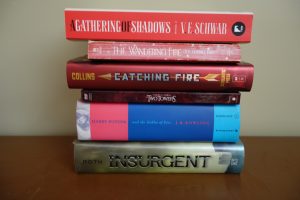
(b) second books read like a rehashing of the first book (in my opinion, book two of the Hunger Games is guilty of this)
Image by TréVoy Kelly
(c) they wander, lack structure, have no focus because the middle is treated like a bridge between one and three with no real purpose of its own
(d) In an attempt, to “dark” or “deepen” the conflict of the characters, there tends to be a lot of whining by characters or characters acting poorly towards each other, gratuitous violence, often with torture as a way to “ramp” up the stakes but without any other clear purpose.
I like a well structured book. My first novel is like a well-stitched dress, with its darts and pleats in all the right places, everything hanging properly. Currently my second is like a Raggedy-Ann affair made from patchwork pieces. Typical of a second child, only getting hand-me-downs. Poor thing!
When in doubt, I research.
First, I tried to research how to write a good trilogy. I will summarize the common general advice as follows: an overarching three act structure in the trilogy with each book containing its own three act structure. It helps to add new characters in book two.
Image by Erik Stein
Although all very good, but I need more. Why do second books so often fail? Or maybe I should turn this question around: Are there any middle books that outshine their siblings? If yes, what creates this magic?
Since I am writing a fantasy trilogy, I focused my research in this genre. There are likely different answers if you are writing in other genres or a series (instead of a trilogy with an overarching storyline). Two examples came through in my research, one from film: The Empire Strikes Back; and one from the classic book, Lord of the Rings: The Two Towers.
Note: spoiler alert ahead in case of the rare possibly that you haven’t actually read or seen the movie versions.
A side note: often Book 4 of the Harry Potter fame, also came out as an example of a middle book that works (although being in a seven part series). However, I wasn’t as fond of book four myself (my fav is still book 3 but that might be because I fantasize about having the cool hour glass time piece featured in book 3).
What is interesting about both Empire Strikes Back (ESB) and The Two Towers (2T), is that neither fit well into the classic three act structure (although you can impose this structure on them). The Empire Strikes Back is often cited as being one of the better films in the Star Wars trilogy. Unlike the first film (the original Star Wars), which followed a classic three act structure complete with a clearly defined inciting incident and climax, ESB, doesn’t fall as easily into that structure. One commenter even suggested that ESB does have a 3 act structure but in reverse order (with the big battle scene at the beginning). I have read analysis that show it has a 6 act structure maybe because one difficulty with ESB is that it quickly divides into 2 subplots – one following Luke as he goes to find Yoda and learn the ways of the Jedi and the other, following the Han Solo’s and Leia’s storyline. It doesn’t have a definite end as Han is left frozen in carbonite and things looks very bleak when the movie ends. I also read a very interesting analysis that shows how the ESB does have a perfect symmetrical structure with mirror scenes between beginning and the end (look this up if you’re curious).
The Two Towers, the middle book of the Lord of the Rings, is divided into two books (“Book III and IV”) and also involved multiple subplots – one of Frodo and Sam as they travel to Mordor; one of Aragorn, Gimli, and Legolas and their travels in the Rohan and the battle of Helm’s Deep; and a third subplot with the other two hobbits. Instead of going back and forth between the story lines, Tolkien spends most of book III with the latter two plot lines and then in Book IV, shifting back to the Frodo and Sam plot line. Arguably, each sub-book separately has a 3-act structure within it, but when you examine The Two Towers, as whole, it is hard to impose the classic structure on it. I did notice how spending time with each subplots (instead of the more modern trend of leaping back and forth between chapters in subplots), allows the reader to appreciate the rise and fall of each subplots instead of being yanked back and forth.
Image by Gerhard Janson
Another thing I noticed immediately about ESB is that it does have a clear midpoint / mirror moment. It is the scene when Luke is in a cave and has a battle with a vision of Darth Vader. Luke severs the head of the specter but when Luke pulls off Vader’s helmet, he sees his own face. It’s an omen that Luke could be lured to the dark side. It symbolizes the theme of the story; the struggle between the light and the dark. Also it hints at the big reveal at the end that Vader is his father. In the 2T, I would argue that the midpoint is when Gollum decides to let his evil side take control and betray Frodo (note, this comes a different point in the movie but in the books, this is the midpoint of book IV). This is an important plot point in the books since it is this decision that sets up the plot sequence for the rest of 2T and through to the third book.
The other thing I take from these examples, is that both focus on developing the characters, deepening the readers compassion and connection. Although both also have more dark moments, they are done purposeful. There are also good moments; in 2T, Gandolf returns; there is a celebration of the victory of Helm’s Deep. In the ESB, there is lots of moments of humour; the romance between Han and Leia blooms. All is not doom and gloom. Although there is a tendency for a writer to want to “deepen” the conflict and make the second book all gloomy and black like a rebellious Goth teenager, there must be balance against this darkness.
Finally, both stories lack a solid ending but it’s okay. It’s a middle book and if your readers have stuck with you through another 100,000 words, take them with you to the third book. I am not a big fan of a cliffhanger ending (such as leaving Han in cardonite) but I also don’t have to try to tie up loose strings at the end of book 2. That’s book 3’s job. At the end of Two Towers, things do not look good: although there is victory at the battle of Helm’s Deep, the characters know there is a bigger war to come; Frodo and Sam’s fate appeared completely doomed. For Harry Potter, at the end of book 4, things look very dreary; Cedric is dead, Voldemort is back and powerful. There may not be a cliffhanger but there are many unknowns and we clearly need to pick up the next book and find out what happens.
What does this mean for my problematic second book and me?
Maybe I need to stop trying to find the three act structure (Oh, rebellious second child!). I have two subplots and I should embrace them, allow each their own breathing space.
I need to find the crucial midpoint, the centre tie that will allow it to hang properly without sagging in the centre.
Add humour and celebration as well as creating greater odds.
I can let the ending hang loose, like a thread to be pulled later by book three.
Off to write!
Seana Moorhead
Seana Moorhead is an aspiring writer and is working on completing her first fantasy novel. She moved to Grey County in 2002, having a passion for outdoor adventures, including kayaking and wilderness camping. Suffering from a book addiction, she will read almost anything that will grab her attention, lead her into another world or teach her something new. Seana lives in a bush lot near Owen Sound, Ontario with her partner and three dogs.
The world is richer for its artists, not the least of which are the writers. In every country, indeed in every nook and cranny of Planet Earth, you’ll find storytellers, word spinners and scene makers. For many writers, there are places on the planet that will forever be associated with them. The following list offers you 10 writers with whom place has a connection — whether they wrote in that place, or wrote about that place — the connection is clear.
As with all our 10 on the 10th lists, this one is not complete by any means. But it is, we hope, an interesting list.
1 Havana, Cuba — ERNEST HEMINGWAY; The Nobel Prize winning author wrote seven books during the 30+ years he lived in Cuba. Among them: The Old Man and the Sea; A Moveable Feast; Islands in the Stream. Ten miles east of Havana, his island home, Finca Vigía (Lookout Farm/House), is now a museum and a place to imagine his inspiration.
2 Huron County, Ontario — ALICE MUNRO; Nobel Prize for Literature winner, Munro’s short stories are most often grounded in Huron County, Ontario, Canada. The fall is a lovely time to drive through Huron County and visit Wingham where her childhood home is still standing. Dozens of small towns are scattered throughout the rich farmland and it is the ordinary lives of those ordinary people Munro writes about in the most extraordinary way.
3 London, England — CHARLES DICKENS. Take a literary pub crawl through London Town with Dickens (as portrayed by an actor/tour guide) and glean inspiration and literary tibits. Tourists are invited to visit the public houses and taverns frequented by great writers. They promise you’ll meet Dylan Thomas, Virginia Woolf, George Orwell, Anthony Burgess, T.S. Eliot and others. And support new London writers! (We really liked that last bit.)
Jeff Turl/Bay Today
4 North Bay, Ontario — GILES BLUNT. Thinly disguised as Algonquin Bay, the detectives in Blunt’s wildly successful crime novels travel streets with familiar names for anyone who knows North Bay. His Detective Cardinal series of books and now a 3-season television series is set (and mostly filmed) in the city perched on the shores of Lake Nipissing, 2 hours north of Algonquin Park. Blunt’s characters are believable and the dynamic between Detective John Cardinal and Detective Lise Delorme adds spice to the rising tension in each mystery. Blunt, also a screenwriter and poet, was born in Windsor, Ontario and raised in North Bay. Lucky for readers, even after he moved away, he recognized how ideal it was for setting a murder mystery there.
5 Georgia, USA — FLANNERY O’CONNOR; The childhood home of O’Connor is in Savannah, the heart of which boasts some of the finest restored urban antebellum mansions. The South is the heart of O’Connor’s stories and she is unflinching in her tales of what some called “Southern Gothic” and even, “grotesque.” O’Connor said: “anything that comes out of the South is going to be called grotesque by the northern reader, unless it is grotesque, in which case it is going to be called realistic.” She lived out the last 12 years of her too-short life in Milledgeville, Georgia.
6 Trinidad — RABINDRANATH MAHARAJ; Born and raised in George Village, Tableland, Maharaj came to Canada because he wanted to attend a masters program in creative writing. But he found that the distance from Trinidad gave him a new perspective with which to write his novels and short stories. His award-winning novel, The Amazing Absorbing Boy, captured the view of Canadian life through the eyes of an immigrant Trinidadian teenager. So while some of Maharaj’s stories and novels are set in the lush tropics of Trinidad, beautifully described so that readers will want to visit, the island flavours even his books set in Canada.
7 Montreal, Quebec — MORDECAI RICHLER with a dash of LEONARD COHEN; Montreal is a city of creatives. Artists, poets and novelists have made this cosmopolitan city their own. Chief among them, Mordecai Richler, one of Canada’s best known writers who has left a legacy of literature. Like the vivid energy of his hometown, Richler was never a background player and spoke his mind freely. That same energy was found in his characters and storylines. His award-winning novels have been made into films — The Apprenticeship of Duddy Kravitz and Barney’s Version — and Richler’s books remain in bookstores today. In 2015, Richler was posthumously made a “citizen of honour” in the city of Montreal and a library in the neighbourhood he portrayed in The Apprenticeship of Duddy Kravitz, was given his name.
8 Ameliasburgh, Prince Edward County, Ontario. AL PURDY; In 1957, poet Al Purdy with his wife and father-in-law constructed the now famous A-frame.(Al tells the story in Reaching for the Beaufort Sea.). There he wrote poems about the area published as Poems for All the Annettes . The following year The Cariboo Horses won the first of Al’s Governor General’s Awards. Even while the A-frame was being built, it became a meeting place—for poets, for poetry lovers, for those aspiring to be poets. The list of people who travelled to the A-frame reads like a who’s who of Canadian letters—Margaret Atwood, Michael Ondaatje; Earle Birney, George Bowering, Margaret Laurence, Jack McClelland, …. The legacy continues through the A-Frame Residency Program.
9 Lakefield, Ontario — MARGARET LAURENCE; One of Canada’s finest writers, Laurence’s novels, short stories and essays were framed by the many places she called home. Born and raised in, a small town well west of Winnipeg, Laurence set her books in Western Canada, Somaliland and Nigeria, Africa. In 1973, she settled permanently in small town Lakefield in the Peterborough/Kawartha Region. On the shores of the Otonobee River, she crafted scenes for her final and brilliant novel The Diviners. The town of Lakefield honours Laurence every July (her birthday month) with a literary festival.
10 Neepawa, Manitoba. MARGARET LAURENCE Yes. That’s two places for one writer and why not? Laurence’s childhood home in Neepawa is a museum dedicated to her and her writing. Purchased the year before her death, Margaret Laurence House hosts writers’ workshops and book launches. As an inspiring mentor to several young writers, Margaret would surely be pleased to know she continues to encourage writers to explore their craft.
At the end of every summer, I’m on the hunt. My prey? Bushes loaded with blackberries. Our Haliburton Highlands cottage property and the nearby road is thick with wild blackberry bushes and, depending on the year, they can offer a treasure trove of tartly sweet fruit.
Berries or no berries, those bushes are also loaded with thorns. Even the leaves of the blackberry bush are ready to tangle in your hair with a grip almost as powerful as super glue. But I persevere.
Why?
Blackberry jam.
I feel just like a pioneer as I gather those berries and the resulting jam is a delightful mix of sugary sweet and tangy tartness. I’ll admit that hunting for berries is not an easy task. The nasty thorns, for one thing. And the sneaky way blackberries can hide from even the most diligent picker.
Sneaky? Yes! This morning, I picked what I thought would mash down into 3 1/2 cups of crushed berries. I picked my bushes clean of ripe fruit so surely…nope. So I added my few blueberries and my last two strawberries. Surely now…nope, again.
I’d scoured those bushes and brought in what I could and it still wasn’t enough. Nonetheless, I know ripe blackberries can hide under leaves and deep inside the undergrowth. So I slipped back outside and…
Fresh eyes
A treasure trove waited for me. As I picked the berries I’d completely missed just two hours before, I thought about how editing is a lot like this. In two hours, the sun had shifted the shadows from early morning. The glistening ripe berries were there all along but in shadow.
Just like the typos and grammar glitches and dropped plot threads can elude me until I put the writing away for a while, the berries needed me to take a second look with fresh eyes.
It’s my pleasure to work with other writers as their editor and sometimes, their writing coach. While it may be easier to find typos, grammar glitches and dropped plot threads in others’ work, it is still important that I take a second look.
It’s not about me
For me, another look at a manuscript is a check for what I missed the first time. It’s also important that I consider my more substantive edits. Maybe I was tired and misunderstood the writer’s intent. Or more importantly, maybe I’m putting more of “me” into the edit.
It’s important to honour the writer’s voice, their style and their intent. If my coaching or edits put any of that off course, then I’m not doing my job.
As an editor and as a writing coach, I work on helping the writer discover their strengths and pay attention to any areas they need to develop. I might offer a suggested approach to a particular scene or ways to build on character development. The writer can take my suggestions and make them their own. Or freely reject the suggestion and take a different approach — one that fits their style and voice.
But when it is about me…
In my own creative work, that second look is vital. It’s especially effective when I’ve put some distance between my first draft and the drafts to follow. Just like those berries and the shifting light and shadows, I can completely miss a treasure trove in my own manuscript unless I give it time enough for my fresh eyes.
Have you ever read a section in a novel and then skimmed or skipped pages to get to the next interesting bit? Have you ever got frustrated over having to plough through screeds of internal character soul searching before anything actually happens? How about being confused and frustrated about where the story is taking place or who the character is and only finding out pages later?
In my recent blog, “What is a scene” I examined what a scene was and its function in a story: namely it is a building block in your story that moves the story forward, actions and tension that result in a change of some kind, either in the growth of the characters/relationships or the course of the plot or both.
If you are including these elements and your scenes still feel flat or confusing, how can you up the energy? Ask yourself these questions:
Is
this scene dramatic?
Image by Isa KARAKUS
I don’t mean: is there violent action or overwrought
emotion happening? I’m talking “show don’t tell.” Make your reader a witness to
what happens. Is the reader “hearing” the character actually speak the words in
dialogue or merely being told that the character said them? Is the reader being
told that a character is angry or actually witnessing the physical or verbal reaction
of that character that shows the anger? Is the reader observing the setting
through the eyes and emotional perspective of the character, or being given a
dry listing of the stage set?
Is
the setting right for the scene?
Important
news delivered in place from which there is no retreat or where expression of emotion
is difficult will add tension. A child being told they are adopted on the
school bus. A wedding engagement broken off in a busy restaurant. Being
followed at night versus in the day.
Sometimes
just changing the weather helps. If a marriage proposal takes place on a cliff,
a lovely sunny day makes things easy (and likely boring). What if there’s a
high wind? (element of danger or resistance) Rain? (negative feelings). Even
proximity to the edge of the cliff can change the feel of the scene and either
heighten or play against the emotions being expressed.
Is
this scene repetitive?
Image by prettysleepy1
Because we write novels over long periods of time, it’s easy to forget that we have already mentioned something earlier. Did the reader already witness a scene that showed the tense relationship between siblings? If so, is this new scene showing something different in the relationship, like an escalation or de-escalation of that sibling tension?
Is
this scene in the right place in the novel?
Would it help to move a scene closer to the
beginning or end? Perhaps if the reader knew that a character hated her father
early in the novel, her negative reactions to other male characters would seem
more natural. Finding out early in internal dialogue that Amy really loves
Jimmy despite her actions to the contrary might deflate the tension. If the
reader believes like Jimmy that she hates him, the later realization and revelation
of her love for him would be a more dramatic moment.
Can
I up the stakes or make things harder?
Can
you inject extra complications, or greater emotional or physical strain?
Anything you can do to make things more difficult for your character helps.
They don’t have to be big things. Rushing up a hill rather than on flat ground;
running out of time; car trouble; interruptions…
Is
this scene important?
If it’s important, slow it down. Our natural tendency as tension mounts is to go
faster and faster, but the opposite maxim applies to good pacing in scenes. If
your action is over too quickly the readers don’t get to enjoy the excitement.
If the moment is high tension, give readers all the details, all the reactions,
all the choreography.
Did
I “Get in late and leave early.”?
I don’t know where I heard it, but I use this advice
all the time to examine my scenes. Excessive internal thought, long description or
exposition, or purposeless action or dialogue is a killer of tension at the
start of a scene. It’s what one of my writing mentors refers to as “throat
clearing”. Get to the action as soon as you can.
Image by Frauke Flohr
Consider this: The scene begins with a groom stuck
in traffic. His cell phone is dead and he’s getting more angry with the taxi
driver who moves him slowly though the traffic so that they finally arrive at
the church just as his tear-stained bride is leaving on the arm of her father. —OR
—The scene begins as a taxi screams into the church parking lot with the groom just
as the tear-stained bride is leaving on the arm of her father.
And the same for leaving early. When a tense action
scene has finished, don’t deflate the whole thing with a page of internal analysis
or angst from the character. Yes, we do want to know how the character is
affected and what they are going to do next, but use that page turning tension to
start the next scene.
You might even consider ending mid –action. Now there’s a page
turner. Or perhaps end with a character epiphany, or a promise of further
revelation, a discovery or a threat. As they say about so many things: “Leave
them wanting more.”
Last Word
Tighter, richer and more textured scenes make for a tighter,
richer more textured novel. Examining individual scenes and making them as
strong as you can is worth the effort.