Trust Your Reader & Yourself

Trust Your Reader & Yourself

Ruth E. Walker

As an editor, I see a great deal of overwriting. Sometimes, it’s just an occasional dip that needs correcting — a moment of unnecessary description or repetition. But when overwriting overtakes the story, it slows pacing, deflects from the story’s core and distracts readers with “window dressing”. My job as an editor is to help writers see when they overwrite and discover ways to fix it.

Overwriting can find its roots in a lack of trust. A writer may not trust that the reader will “get it” and so puts in extra material to ensure complete understanding. Or a writer may not trust themselves– that they’ve created enough detail that the reader will see what is intended.

Three Deadly Sins of Overwriting

Overwriting covers a lot of sins in stories. Three of the most common forms of overwriting are: over-emotional writing, hammers, and know-it-all writing.

Over-emotional writing leads to sentimentality, theatricality and hyperbole. For today’s Top Drawer blog, I’ll focus on this one. But first, a quick summary of the other two. Next week we’ll take a closer view of them.

Hammers are those phrases and sentences that “hammer home” something a writer wants to make sure their reader “gets.” Repetition and over-use of imagery and metaphor can turn into hammers in your work.

Know-it-all writing is similar to hammers but it’s related to research or knowledge that the writer has and adds in to “prove” they know their stuff. Not restricted to historical writers, know-it-all writing can come across like an author “info dump” of details.

Let’s get emotional

Here’s an example of overwriting for emotional impact.

As she sat before her vanity mirror, Camilla lowered her gaze and placed her right hand on her beating heart. If she could, she would squeeze the life out of that heart and fling it to the floor and stomp all over it. He was leaving her without saying goodbye and the sadness filled her very being, her soul. How could she live without him? Her throat constricted with a burning lump of pain and tears welled up from her eyelids and trickled down her cheeks. They fell from her chin and plunked one after the other onto the letter she clutched in her left hand, resting on her lap.

Of course, without having the whole story before us, it’s hard to know what part of this scene is window dressing and what is essential to both plot and character development. But if we look closely at the work each part of this scene is doing, we could decide what to cut, what to tweak and what to leave as is.

So let’s examine:

As she sat before her vanity mirror — is this a reflection scene? Is it, literally, a mirror moment where a character reflects and realizes something about themselves? Is this “scene setting” even necessary? With “As she…” we’re pretty sure that Camilla is already sitting there, the line or two before this likely put her in front of that vanity. Trust your reader to make that connection.

Get right to the moment. Camilla lowered her gaze and placed her right hand on her beating heart. All hearts beat. Does it matter which hand? Cut beating and right. Your reader doesn’t need it.

Be true to your character. If she could, she would squeeze the life out of that heart and fling it to the floor and stomp all over it. He was leaving her without saying goodbye and the sadness filled her very being, her soul. How could she live without him?

Is Camilla a drama queen? Is she petulant, angry or heartbroken? Is she all three at this moment or do her feelings progress? What is the overriding fear? Start with that. He was leaving her without saying goodbye. And then the deeper, primal fear: How could she live without him?

Squeezing her heart, flinging it to the floor and stomping all over it — that’s hyperbole and petulance — in this moment keep us in the sorrow, the grief. And as for sadness filling her very being, her soul — that’s far too cliché and a full on “tell”. Her behaviour — hand to heart, tears falling unchecked — shows us her sadness.

Show me the sorrow

And it’s there, in those last two descriptive sentences that with some careful paring and tweaks, we can move this scene from sentimentality to deep emotion. A simple constriction of the throat — don’t we all know that feeling when sorrow moves up from our aching hearts to tighten our throats? And tears that we can’t stop, coursing down our cheeks and sliding off our chins? Simple short images that call up our own experiences with sorrow –without any window dressing.

Camilla lowered her gaze and placed a hand over her heart. He was leaving her without saying goodbye. How could she live without him? Her throat constricted, and tears welled up and trickled down her cheeks. They fell from her chin onto the letter in her lap.

In any high-emotion scenes, you can double-check your approach and seek out any phrases or sentences that are more than what is necessary to convey the emotion. But also look for what is necessary to stay true to your character and your plot and then decide what can be cut or amended.

Just remember to ask yourself: am I trusting my reader? and am I trusting myself?

10 ways to doom your novel

10 ways to doom your novel

For the month of May 2020, we imagine many of you are thinking about your manuscripts. Isn’t it time to give yourself time away from focusing on hand washing and sterilizing the grocery bags? We think so. This month’s 10 on the 10th blog post is designed to help you spot story pot holes and set about fixing them. Happy writing!

1. Refuse to Revise: Perhaps someone, somewhere, sat down and wrote the perfect 87,000-word novel without making a single change, each word falling onto the page like an elegant dance of perfection. Um. No.

Truth is, for most of us, the successful novel or story is the result of repeated revisions. Not just proofreading and editing for spelling and grammar. We’re talking revisions. Dropping the first three chapters of backstory and starting just before the inciting incident. Rewriting the ending completely with a different purpose in mind than the original ending. Revision is not for the faint of heart, but getting your hands deep and dirty into your manuscript is part of shaping it into publisher-ready material.

2.  Start in a perfect world: A perfect world without any hint of discord or danger is a fantasyland. From kids who leave dirty dishes in the basement to the pestering pets demanding attention, our ordinary lives are full of irritations and disappointments. But remember to save the big issues for the inciting incident. That big crack in your main character’s world is what drives the narrative into the meat of the story.

3. Only develop your protagonist: You know everything about your main character from favourite pets to emotional wounds, from the layout of a childhood bedroom to motivations for every action taken.

But the other characters in the novel circle like stage actors waiting to appear and act for the sole convenience of the protagonist. Life and stories don’t work that way. All characters should act from their own motivations and experiences. Ditch the cardboard, and put flesh on everyone’s bones.

4. Avoid Danger or Fear:  For effective fiction, tension is necessary. There are degrees of tension used by writers. Some books (especially thrillers) can start with a bang but others gradually develop tension in a variety of ways. From a foreshadow (“Careful Maeve, that horse is skittish”) or bit of figurative language (looming dark skies, thunder in the distance, etc.), skillful writers learn to raise the stakes with tension as the story goes forward.

5. Rely on Expounding Exposition: Scenes with action, dialogue and tension propel your story forward. Lengthy passages of and then this happened and then this happened and then this happened will put your reader to sleep. Seek out places where you give information that could be better delivered in a scene between characters.

Ginny was worried that Dewa’an was afraid. It was his first sleepover at her house. She comforted him by reading a story and leaving the light on. 

OR

“Dewa’an, would you like me to stay and read you a story?”

He barely nodded, his eyes still wide and searching.

Ginny held up Stuart Little. “My kids loved this one. Maybe you will too.”

She’d barely read ten pages when he fell asleep. Ginny kept reading for two more pages just to be safe. Before she left the bedroom, she switched off the big light and turned on the wee nightlight on the dresser.

6.  Clog with Filler Scenes:  Sometimes we don’t realize we’re writing a filler scene. It’s a great scene with strong dialogue and character bits and foreshadowing and lots of great stuff. But if you look closer, it’s covering most — or even the same territory as a scene you wrote earlier. It’s advancing the same elements that the earlier scene advanced. 

Time to murder this darling. Or revise it so it’s doing new work to move your story forward. All scenes need to add forward progression with at least some of the following: answer some questions and raise more, enhance character qualities or introduce new ones, add or enhance setting details, and so on.  The scenes you write are meant to pull the reader’s engagement along to the next scene and all the way to The End.

7.  Use Droning Dialogue:  Dialogue in fiction is the illusion of conversation.  And it has specific jobs to do when you use it: convey information that relates to the plot, to the characters, the setting and so on. So like Filler Scenes, mindless chit chat does nothing to add to the reading experience. What does your current dialogue do to advance your story?  Learn to spot the fat and then pare it. And pare it again.

8.  Pack in Know-It-All stuff:  You’ve done your research. You know exactly how many steps it takes to get from the front door to the attic. The map of all the islands, ports, harbours and rocky shoals is ingrained in your mind and you want your readers to know you know. Don’t. Just don’t. There is a huge difference between a strategically placed reference or two to help ground your reader and a litany of details that soon become a list readers must wade through before getting back to the story.

9.  Display your vocabulary: Yes, it’s important for writers to be widely read and in the process, you’ve developed quite a vocabulary.  Whoopee for you, but like the know-it-all research, don’t try to impress your readers with a display and get in the way of the story. Use words suitable for the genre and audience and stand back and let them do their job.  Don’t excavate a cavity, just dig a hole.

10.  Be Predictable: It’s important that your characters react and that the story follows a logical path. But beware the characters that never veer from what we’ve come to expect or storylines that offer no surprises. Take this approach with your dialogue and try for exchanges that show two very different agendas. Many of our conversations don’t quite go as expected, like for this retail store customer:

“Good morning, I was wondering if you had any—”

“Did you close the door?”

“Ah. Yes. Now I was wondering—”

“They get in when you don’t close it tight.”

“I closed it. Now, listen, I’m looking for—”

“There’s one now. At your feet.”

“What— What is that?”

“A displaced soul.”

There you have it. Ten ideas to consider and help you take your manuscript forward. Happy writing.

10 Silent Energy Zappers

10 Silent Energy Zappers

Your story may be dynamite, but stylistically these energy zappers could be undermining it. They’re subtle but can do damage nonetheless. Avoid them to add energy, or use them to dampen when you want to.

  • Negative constructions 

“Is not” and “do not” sap energy, because readers prefer to hear about what something is or what someone does. Often negative construction is paired with weak verb choices too.

Ralph did not like the way Bill treated Liza. 
Better: Bill’s treatment of Liza disturbed/disgusted/horrified Ralph.
  • Wishy-washy constructions

Be confident about what you write. Is your character walking or not? Is the baby crying or not? Did Jimmy understand or not? Using started to/began to/seemed to constructions weaken the action.

Tom started to get up and close the door.
Better: Tom jumped up and closed the door.
  • Unnecessary tags in internal dialogue

When we are “in the character’s thoughts” seeing, feeling and hearing what the character sees, feels and hears, using “I see”or “I hear” or “I feel” is unnecessary, and distances the reader and lowers energy.

I hear a phone ring in the telephone booth.
Better: A phone rings in the telephone booth.
  • Nominalization

Avoid turning an action word into the subject of the sentence i.e.  using the noun equivalent of a verb. To up the energy, re-order the sentence to let the verb do the work.

They had a discussion about .
Better: they discussed
  • Verb weakeners

Re-order the sentence to eliminate these “weakeners”: need to; should; might; could

You need to get motivated.  
Better: Motivate yourself.
  • Neutrality – non-human references.

Readers feel close to people not things. So whenever you refer to a person in a non-human way, you distance the reader.

If you're the type of individual who likes luxury, Gateway Spa is for you.  
Better: If you love luxury, Gateway Spa is for you.
  • Redundancies

So easy to do. How often do we hear about the new baby; or joining together. By default, babies are “new”; joining things results in them being “together”.  Restating the obvious sucks energy.

Sam kneeled down to examine the sword 
Better: Sam kneeled to examine the sword
  • Passive construction /Grammar expletives

No, we aren’t talking swear words here. In grammar circles, a grammar expletive is any word or phrase that does not contribute meaning. The most common culprits are: It is; there are; there is; etc.at the beginning of a sentence.

It is two hours before the sun rises.  
Better: The sun rises in two hours.
  • Meaningless intensifiers.

Really, very, so.What is the difference between a tasty dinner and a really tasty dinner? If you want a degree more of tastiness, use a stronger verb rather than an intensifier. A delicious dinner.

He knew Dana was very smart.
Better: He knew Dana was brilliant.
  • Latinate vs. Anglo-saxon words

Latinate words (those ending in -ate. -ite. -ation and other Latin bases) usually refer to areas of law, administration; government and abstraction. It’s a throw-over from the days when England was governed by Rome and later by France. Anglo Saxon words were the tongue of the governed, the workers – words to do with farming and labouring. That’s why they carry a more earthy energy.

He excavated a cavity. (Latinate)
He dug a hole. (Anglo-Saxon)
On Looking Again

On Looking Again

Ruth E. Walker

At the end of every summer, I’m on the hunt. My prey? Bushes loaded with blackberries. Our Haliburton Highlands cottage property and the nearby road is thick with wild blackberry bushes and, depending on the year, they can offer a treasure trove of tartly sweet fruit.

Berries or no berries, those bushes are also loaded with thorns. Even the leaves of the blackberry bush are ready to tangle in your hair with a grip almost as powerful as super glue. But I persevere.

Why?

Blackberry jam.

I feel just like a pioneer as I gather those berries and the resulting jam is a delightful mix of sugary sweet and tangy tartness. I’ll admit that hunting for berries is not an easy task. The nasty thorns, for one thing. And the sneaky way blackberries can hide from even the most diligent picker.

Sneaky? Yes! This morning, I picked what I thought would mash down into 3 1/2 cups of crushed berries. I picked my bushes clean of ripe fruit so surely…nope. So I added my few blueberries and my last two strawberries. Surely now…nope, again.

I’d scoured those bushes and brought in what I could and it still wasn’t enough. Nonetheless, I know ripe blackberries can hide under leaves and deep inside the undergrowth. So I slipped back outside and…

Fresh eyes

A treasure trove waited for me. As I picked the berries I’d completely missed just two hours before, I thought about how editing is a lot like this. In two hours, the sun had shifted the shadows from early morning. The glistening ripe berries were there all along but in shadow.

Just like the typos and grammar glitches and dropped plot threads can elude me until I put the writing away for a while, the berries needed me to take a second look with fresh eyes.

It’s my pleasure to work with other writers as their editor and sometimes, their writing coach. While it may be easier to find typos, grammar glitches and dropped plot threads in others’ work, it is still important that I take a second look.

It’s not about me

For me, another look at a manuscript is a check for what I missed the first time. It’s also important that I consider my more substantive edits. Maybe I was tired and misunderstood the writer’s intent. Or more importantly, maybe I’m putting more of “me” into the edit.

It’s important to honour the writer’s voice, their style and their intent. If my coaching or edits put any of that off course, then I’m not doing my job.

As an editor and as a writing coach, I work on helping the writer discover their strengths and pay attention to any areas they need to develop. I might offer a suggested approach to a particular scene or ways to build on character development. The writer can take my suggestions and make them their own. Or freely reject the suggestion and take a different approach — one that fits their style and voice.

But when it is about me…

In my own creative work, that second look is vital. It’s especially effective when I’ve put some distance between my first draft and the drafts to follow. Just like those berries and the shifting light and shadows, I can completely miss a treasure trove in my own manuscript unless I give it time enough for my fresh eyes.

Strengthening your scenes

Strengthening your scenes

Gwynn Scheltema

Have you ever read a section in a novel and then skimmed or skipped pages to get to the next interesting bit? Have you ever got frustrated over having to plough through screeds of internal character soul searching before anything actually happens? How about being confused and frustrated about where the story is taking place or who the character is and only finding out pages later?

In my recent blog, “What is a scene” I examined what a scene was and its function in a story: namely it is a building block in your story that moves the story forward, actions and tension that result in a change of some kind, either in the growth of the characters/relationships or the course of the plot or both.

If you are including these elements and your scenes still feel flat or confusing, how can you up the energy? Ask yourself these questions:

Is this scene dramatic?

Image by Isa KARAKUS

I don’t mean: is there violent action or overwrought emotion happening? I’m talking “show don’t tell.” Make your reader a witness to what happens. Is the reader “hearing” the character actually speak the words in dialogue or merely being told that the character said them? Is the reader being told that a character is angry or actually witnessing the physical or verbal reaction of that character that shows the anger? Is the reader observing the setting through the eyes and emotional perspective of the character, or being given a dry listing of the stage set?

Is the setting right for the scene?

Important news delivered in place from which there is no retreat or where expression of emotion is difficult will add tension. A child being told they are adopted on the school bus. A wedding engagement broken off in a busy restaurant. Being followed at night versus in the day.

Sometimes just changing the weather helps. If a marriage proposal takes place on a cliff, a lovely sunny day makes things easy (and likely boring). What if there’s a high wind? (element of danger or resistance) Rain? (negative feelings). Even proximity to the edge of the cliff can change the feel of the scene and either heighten or play against the emotions being expressed.

Is this scene repetitive?

Image by prettysleepy1

Because we write novels over long periods of time, it’s easy to forget that we have already mentioned something earlier. Did the reader already witness a scene that showed the tense relationship between siblings? If so, is this new scene showing something different in the relationship, like an escalation or de-escalation of that sibling tension?

Is this scene in the right place in the novel?

Would it help to move a scene closer to the beginning or end? Perhaps if the reader knew that a character hated her father early in the novel, her negative reactions to other male characters would seem more natural. Finding out early in internal dialogue that Amy really loves Jimmy despite her actions to the contrary might deflate the tension. If the reader believes like Jimmy that she hates him, the later realization and revelation of her love for him would be a more dramatic moment.

Can I up the stakes or make things harder?

Can you inject extra complications, or greater emotional or physical strain? Anything you can do to make things more difficult for your character helps. They don’t have to be big things. Rushing up a hill rather than on flat ground; running out of time; car trouble; interruptions…

Is this scene important?

If it’s important, slow it down. Our natural tendency as tension mounts is to go faster and faster, but the opposite maxim applies to good pacing in scenes. If your action is over too quickly the readers don’t get to enjoy the excitement. If the moment is high tension, give readers all the details, all the reactions, all the choreography.

Did I “Get in late and leave early.”?

I don’t know where I heard it, but I use this advice all the time to examine my scenes. Excessive internal thought, long description or exposition, or purposeless action or dialogue is a killer of tension at the start of a scene. It’s what one of my writing mentors refers to as “throat clearing”. Get to the action as soon as you can.

Image by Frauke Flohr

Consider this: The scene begins with a groom stuck in traffic. His cell phone is dead and he’s getting more angry with the taxi driver who moves him slowly though the traffic so that they finally arrive at the church just as his tear-stained bride is leaving on the arm of her father. —OR —The scene begins as a taxi screams into the church parking lot with the groom just as the tear-stained bride is leaving on the arm of her father.

And the same for leaving early. When a tense action scene has finished, don’t deflate the whole thing with a page of internal analysis or angst from the character. Yes, we do want to know how the character is affected and what they are going to do next, but use that page turning tension to start the next scene.

You might even consider ending mid –action. Now there’s a page turner. Or perhaps end with a character epiphany, or a promise of further revelation, a discovery or a threat. As they say about so many things: “Leave them wanting more.”

Last Word

Tighter, richer and more textured scenes make for a tighter, richer more textured novel. Examining individual scenes and making them as strong as you can is worth the effort.

What is a scene?

What is a scene?

Gwynn Scheltema

I was with a group of accomplished writers last night, discussing emotional shifts in scenes. Part way through, one of the group said, “I understand all this, but my problem is, I can’t get my head around what a scene is in the first place.”

Of course, we all offered up our version of “what a scene is”, but they were somewhat vague definitions and all different. I know for my part, I had to really think to put what I know instinctively into words. Hence this post.

Basic definitions

A dictionary definition describes a scene as “a sequence of continuous action in a play, movie, opera, or book. Synonyms: section, segment, part, clip, sequence”, but when faced with dividing up pages of fiction, that doesn’t really help.

In the film and video world, a scene is generally defined as “the action in a single location and continuous time.” Again, in fiction, that leaves questions. Is a run of internal thought a scene? What if the location changes during a single action? What if the whole book takes place in one location or in one single time unit?

Expanded definitions

Scenes are capsules in which compelling characters undertake significant actions in a vivid and memorable way that allows the events to feel as if they are happening in real time. (Make a Scene by Jordan E. Rosenfeld.)

A scene is a sequence where a character or characters engage in some sort of action and/or dialogue. Scenes should have a beginning, middle and end (a mini-story arc), and should focus around a definite point of tension that moves the story forward. (Teach Yourself How to Write a Blockbuster by Lee Weatherly and Helen Corner )

A scene is a unit of story in which something changes. It has a beginning, a middle, and an end, and at the end something is different than it was at the beginning. It may be a character or a situation, or just our understanding of a character or a situation, but whatever it is, it’s changed when the scene is over. (What’s a Scene (And What’s A Chapter?), Timothy Hallinan)

Never mind the definitions

All of these definitions make good points, and there’s likely no perfect definition that works for every circumstance. It’s largely instinctive, so if it feels to you like a scene, treat it that way.

I think the easiest way to decide if a scene is a scene is to know that every scene must have purpose. Every scene should do these two things:

  • move the story forward—the reader learns new things about the character or the plot events or both.
  • affect dramatic tension —something must change: events escalate, or relationships grow or emotions become heightened or diffused.
Image by Sasin Tipchai

Scenes are building blocks. Most often, they involve an action undertaken by the characters. The reader watches the action unfold “in real time” like watching a movie. They hear what the characters say, they witness the movements they make; they see the setting; and— they learn something new about the plot or the characters. Action and reaction.

A simple description of a setting is not a scene— but a character moving through and noticing that setting in a way that triggers a memory that we then witness as back story played out before us is a scene.

A summary history of a fantasy world is not a scene— but a character discussing that history with another character in dialogue is a scene.

A strong scene is one that has drama (action witnessed; movement and/or dialogue- internal or external); emotion (character reaction that reveals character development), and a sense of time and place (feels real and keeps the reader grounded.)

Image by Wokandapix

How long a scene is, or whether it involves only dialogue or only physical action is irrelevant. My test is to ask myself these things:

  • Does this segment have a purpose? If I removed it would the story be lacking?
  • Does this segment have energy (show don’t tell) or will the reader skip over it?
  • Does the dramatic tension change in some way over the course of the scene?

Last Word

This post just skims the surface, but it’s a start. Explore these links to learn more.

Rebuilding Your (Porch) Novel

Rebuilding Your (Porch) Novel

Ruth E. Walker

Sometimes what happens in our lives has a weird way of being reflected in our writing journeys. It’s a bit like the universe has a sense of humour. And sometimes, we get to laugh. Or at least smile.

At the end of winter at the cottage, it was lovely to see the deep snowdrifts finally melt. Of course, there were also lots of cold snaps, so that the melt was often stopped in its tracks. That included on the roof of our screened porch. Melt freeze. Melt freeze. Melt freeze. We were unable to get up to the cottage for a couple of weeks to check for ice. The ice dam formed. And then the April rain came.

Soon enough, it was raining inside the screened porch. A dozen buckets could barely keep up.

So my husband and I got on top of the roof, for hours scraping off the ice build up. Finally, all the ice was cleared off.

Sifting through a mess

But the damage was done. Not only did we have to replace the roof but some walls, insulation and flooring had to be ripped out. Then, time to shore up the foundation. Add new load-bearing beams.  

Given some moments to rest between ripping out and building back up, I had some time to reflect. It is, I thought, a lot like editing.

Which is what I am doing with my novel in progress. The story explores some turning points in my character’s childhood, teen years and his life as a young man. As the novel is based on an old Breton fairy tale, I wrote earlier drafts all in chronological fashion. Once upon a time…to…They lived happily (ahem) ever after.

But I’ve come to realize the novel isn’t quite working in that structure.

Renovate buildings…or books

So I’m ripping out walls (chapters.) Re-positioning the roof (plot.) Shoring up the foundation (thematic elements.)  And adding load-bearing beams (character development.)

But, like the repairs to our screened porch, I’m making discoveries as I go.

If you have to re-position the screened room roof, you need to consider the roof line of the main (original) building. So, as I’m playing with the plot, I wonder how far I can deviate from the original fairy tale.

Pretty far as it turns out. Just like the screened porch’s roof revision.

Advantages to major repairs

The porch’s new roof line meant walls needed to be built higher. So why not add regular windows instead of the nailed-in screens if we’re doing that? And how about a patio door to bring in more light? And let’s insulate under the floor instead of just the walls. A 3-season room takes on new life for all four seasons.

So as I work with my novel’s plot, I’m bringing in new characters, new scenes, new possibilities to raise the stakes for my character. I’m picking the pockets of other old fairy tales, travelling the world of fable and fabrication to discover ways to enrich the story. Taking a page from the braided essay format, I’m tossing aside chronological structure and weaving together childhood, teen years and adult life.

Will it work? Well, I hope so. But even if I end up back with the chronological beginning-to-end structure, I have far more to work with than when I finished the original draft.

It’s a whole new look.  And I think I’m moving in.

Workshop News

If you want to see Ruth’s Haliburton cottage porch reno in progress, come to her all-day workshop Saturday June 15. Create Compelling Characters will offer writers a series of hands-on exercises and inspiring explorations of character in fiction, memoir and nonfiction. Nestled among the pines, overlooking the lazy river, it’s a location that holds inspiration and the echoes of writers who’ve written their novels in The Rustic.

Oops! Big Mistake

Oops! Big Mistake

Gwynn Scheltema

Last week several Facebook posts about author Naomi Wolf’s interview on BBC had my writer’s heart missing a beat and a whirl of thoughts spinning through my head: OMG! How awful for her. I’m so relieved it wasn’t me. How could that happen? How come no one caught it?

I’m not going to do a post-mortem on what Naomi did or didn’t do. You can read the myriad of articles about it on the Net. What I wanted to draw attention to was what chilled my spine even more than the thought that it could be me—the paragraph in the attached article where Houghton Mifflin Harcourt, the book’s publisher in the U.S., told the New York Times that while it

“employs professional editors, copyeditors and proofreaders for each book project, we rely ultimately on authors for the integrity of their research and fact-checking.”

The reality is, Naomi’s nightmare could easily happen to any one of us.

I believe, however, that not all errors are created equal and understanding why we make errors helps us minimize them.

Sloppiness

I have a hard time calling lack of research, lack of fact checking, lack of all levels of editing “an error”, except in terms perhaps of judgement. Every writer (and publisher) should strive to present as perfect an error-free manuscript as possible.

That said, errors do happen even when we’ve been as careful as we can.

Technical Errors

The most obvious and most frequent errors are what you might call technical errors: typos, format errors, omissions. Despite numerous pairs of eyes, and excellent proofreaders they can still happen—and do.

Some can be funny: In Ruth’s book Living Underground, she noticed that the room she was describing had scones (not sconces) on either side of the fireplace.

Some are embarrassing, like the project I worked on at the Ministry of Training, Colleges and Universities that went through at least 4 levels of proofing, but when it went to the Minister’s office for final approval, someone there pointed out that we had spelled university wrong in the artwork that was repeated throughout!

And some typos, as we well know, can change the meaning of what we write, as my favourite example here shows:

Research errors

In this modern communication age, it is easy to rely on the most popular pages on the internet for research. The golden rule of research, however, is to get as close to source and prime documents as possible. By all means begin your research on the net, but sooner or later, try to use source documents, experts, diaries, photos etc. And understand that Google doesn’t list results based on authenticity and truth. Learn how to choose reliable sites.

Entrenched Errors

Much like the lyrics we sing incorrectly believing all the while that they are correct, we all have other “quirks” that surface every now and then. For years I wrote that one thing “jived” perfectly with another. It should, of course, have been “jibed”, but my mind had a mental picture of two people dancing a fast intricate dance and “jive” made perfect sense to me.

Similarly, memory plays a cruel joke here. We “remember” the “facts” so clearly that when someone with the shared experience corrects us, we are genuinely astounded (and usually highly defensive). My family have always talked of a certain great-grandmother Emma Thomas. One of my hobbies is genealogy and in my documented research, it turns out she was Emma Williamson. (I still don’t think they believe me.)

Entrenched misunderstandings also come from cultural teachings: the same opinions or viewpoints passed down through generations until they become “fact.” I hardly need remind you of the age-old green and orange feud in Ireland or more recently the historical events that have come to light through increased interest in the Indigenous view of our country.

Dangerous Senses Errors

This phrase comes from C. S. Lewis’ book Studies in Words:

“The dominant sense of any word lies uppermost in our minds. Wherever we meet the word, our natural impulse will be to give it that sense. When this operation results in nonsense, of course, we see our mistake and try over again. But if it makes tolerable sense, our tendency is to go merrily on. We are often deceived. In an old author the word may mean something different. I call such senses dangerous senses because they lure us into misreadings.”

This is the kind of error that Naomi Wolf fell victim to. In her book Outrages she refers to dozens of men being executed for sodomy in Victorian London. She based this on research that showed that men accused of sodomy (a capital offense) had been given a sentence of “death recorded”.

Interviewer Matthew Sweet pointed out that beginning in 1823, a sentence of “death recorded” meant that the judge was abstaining from voicing a sentence of capital punishment in cases where he anticipated a royal pardon would have been be forthcoming if a proper death sentence were issued. So in short, “death recorded” meant “pardoned” (the opposite of what Naomi believed.)

Many on social media have been quick to ask why she didn’t look up “death recorded”. But be honest now—would you have? This is a perfect example of what C.S. Lewis was talking about. She was researching individuals accused of a capital offense. The sentence written in the records said “death recorded”. The dominant sense of those words is that “a notation of a death was made”. I think I would have made the same assumption Naomi did.

Last Word

So how can you prevent, or at least minimize these different kinds of errors? Be aware. Understand where and why errors arise, and look for next week’s blog for practical suggestions.

A Happy Dance for Writers

A Happy Dance for Writers

To win an award is such a fantastic affirmation for writers. I know. I’ve won a few and can confirm that validation kept me energized for weeks. I’ll never forget the exhilaration of first place in a national magazine with my first-ever submission.

My kids had to darn near peel me off the ceiling.

So whenever I hear of a colleague or friend winning an award, I do “the happy dance” in my heart, post congratulations online and try to attend any celebration that honours that win.

But when I’ve had something to do with that reason for celebration, then some of those wins are a bit more special.

The Joy of Editing

As an editor, I’ve loved discovering the stories of others writers in unpublished form. It’s been a privilege to move into the creative process of another writer. Their trust is precious to me and forms the foundation of our working relationship.

And it is wonderful when I can do the happy dance for them: when they are ready to submit or to publish. When they have a launch. And when they win awards.

Just last week, I got to do the happy dance for Pauline Kiely, author of No Poverty Between the Sheets. Pauline had previously published her family memoir but asked me to work with her on a new edition.

That new edition was entered in the 2019 Independent Publisher Book Awards. Known as the IPPY Awards, they were launched in 1996 to “bring increased recognition to the deserving but often unsung titles published by independent authors and publishers.”

So I was thrilled when Pauline let me know that her book won the Silver Medal in the Canada East Best Regional Non-Fiction category! And so grateful that she let me know how much she appreciated my work.


Thank you Ruth Walker your edits made this book a winner
!

Pauline Kiely on Facebook
Terry Fallis

Few award options are available for independently published books. A notable exception is the prestigious Leacock Medal for Humour, where jurists accept entries of self-published books by Canadian authors. Author Terry Fallis sent the last 10 copies of his independently published first novel The Best Laid Plans to win the 2008 medal, well deserved accolades and so much future success.

Make it Award-worthy

There are many other self-published books in the world that deserve success like Pauline and Terry have enjoyed. But just like the world of traditional publishing, few great books win awards.

Nonetheless, books that haven’t been put together in a professional package — self or traditional — are far less likely to win readers, let alone awards. From the cover to the last page, you don’t want your book to be full of errors or amateur missteps.

If you’re fortunate, you may have excellent book designers, copy editors and proofreaders in your circle of family, friends and colleagues. But chances are you don’t. So avoid playing with chance.

Unless you are skilled as an editor, hire one to help you polish the text. Should you choose to go the traditional publishing route, agents and acquisition editors expect professional standards in all submitted material.

If you opt to publish independently, you want readers to stay firmly immersed in your story. Just think for a minute about how little it takes to kick you out of something you’re reading: a typo, a logic glitch or a complicated and confusing scene.

Finding an Editor

Editors Canada has over 400 editors listed online. Most independent publishing/printing services have a list of freelance editors you can hire. And traditional publishers employ staff and freelance editors.

No matter where you find your editor, make sure it is someone who understands your book’s purpose. It is a tender relationship — one that balances collaboration with principles. But when it is the right editor for your book, you’ll find no greater champion, dedicated to taking your book to the best possible form.

No manuscript is perfect. But the right editor can help you come close enough to smell the binding.

The Last Word

Writescape offers both coaching and editing for writers at all stages of the process. It’s been our pleasure to see writers achieve their goals for their books and their careers. Some of our authors:

Sylv Chiang, author of the CrossUps series middle grade novels with Annick Press.

Fred Kennedy, author of Huareo, Story of a Jamaican Cacique

Janet Stobie, author of To Begin Again and Elizabeth Gets Her Wings

Felicity Sidnell Reid, author of Alone, A Winter in the Woods

Moving on…grammatically speaking

Moving on…grammatically speaking

Gwynn Scheltema

According to the Global English Monitor, as of January 1, 2019, the English language boasts 1,052,010 words. Apparently, we can thank The Bard for 1700 of those: addiction, assassination, bedazzle, cold-blooded, fashionable and managerare among them. And every 98 minutes another word is added. That’s almost 15 words a day! English is anything but static.

When I was working in communications for the provincial government, we regularly had meetings to discuss what was new and what had gone out of style in accepted grammar and usage. Sometimes, it got quite heated in those meetings, which just proves how strongly professional communicators feel about word usage. A lot of the discussion was around acceptable word choice, like persons with disabilities vs. disabled persons, or First Nations vs. Aboriginal.

But grammar, formatting and punctuation also made it onto the agenda. When proportional spacing became the norm on word processing programs, the double space after a period became a single space (standard now in all ms submissions). When emails were the new thing on the block, we had to refer to them as e-mail messages. Later we dropped the second word and they became e-mails. Still later, we dropped the hyphen and adopted the word email.

So when does a rule start or stop?

For the English language, there is no one body that decides. Our language is a living entity, changing over time. That’s what makes it so rich. While I firmly believe in “correct grammar” for clarity, I accept that sooner or later rules I hold sacred may indeed change. And that’s okay. It’s all a matter of common usage.

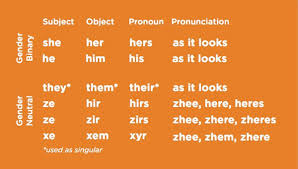
The grammar “rule” that I notice most lately is the changing use of the default pronoun.

The old default pronoun

The rule I learned was to use “he/his/him” as a default pronoun when talking in general terms, as in: “A journalist should always guard his sources.”

I like to believe that writers today know the importance of and support a less gender-based, less sexist approach to our language. So it makes sense to stop using “he” as the default pronoun. The question then becomes: what do we replace it with?

Substituting “she/her” is equally sexist. Flipping between “he” and “she” in the same piece of work would be altogether confusing.  “He/she” is cumbersome. “It” loses the human connection. “One” is acceptable, but sounds like an old-fashioned lecture.

Some people prefer to use gender-neutral pronouns created specifically for the purpose, such as ze, sie, hir, co, and ey, but I haven’t seen much evidence of their use.

The new default pronoun

More and more each day “they/them/their” is emerging as the new default even in singular situations: “A journalist should not reveal their sources.”

Now before you get your knickers in a knot over it, using “they” in this way is nothing new. It appears in Old English from 600 years ago. Here’s a line from Chaucer’s The Canterbury Tales, ca. 1400:

And whoso fyndeth hym out of swich blame,
They wol come up […]”

And if you are interested in the history of the singular “they” through history right from 1375, read this post from the OED website.

I do admit, using a plural pronoun for a singular is something that I still have to get used to, but I see its value, and as imperfect a solution as it may be, it’s the only viable one we have right now.

Is singular “they” really acceptable?

In business situations here in Canada, The AP Stylebook and The Chicago Manual of Style are generally the go-to authorities. Here is what they have to say:

AP Stylebook (2017 edition)

“They/them/their is acceptable in limited cases as a singular and/or gender-neutral pronoun, when alternative wording is overly awkward or clumsy.”

For example, to avoid the specificity of an individual’s gender, this use of their is acceptable: “The employee believed their position was in jeopardy.”

Chicago (17th edition)

 “While this usage [they, them, their, and themselves] is accepted in those spheres [speech and informal writing], it is only lately showing signs of gaining acceptance in formal writing, where Chicago recommends avoiding its use. When referring specifically to a person who does not identify with a gender-specific pronoun, however, they and its forms are often preferred.”

What’s a writer to do?

My first inclination is to structure your sentence so you don’t need to make the choice. Make the whole sentence plural: “A journalist should protect their sources” becomes “Journalists should protect their sources.”

That said, if it is more respectful to do so, use “they” as a singular pronoun. Make sure you match your verbs correctly though: “They are visiting.” Not “They is visiting.”

For business writing, follow your accepted style guide.

For fiction, you have control, but consider your audience and genre. Strive for unobtrusive choices and good flow, and of course, consistency.

Last word

Above all, be aware and don’t fight grammatical change just because you don’t like it or you learned something a different way. Remember, our language lives and breathes and changes all the time. Contractions (don’t; isn’t; can’t; shouldn’t) were once considered uncouth, but now we all use them.

And remember, we can thank writers for opening up the English language to new rules and new words. From Shakespeare’s A Midsummer Night’s Dream, Act V, Scene I: “Where is our usual manager of mirth? What revels are in hand? Is there no play to ease the anguish of a torturing hour?”

Thanks, Will.