Trust Your Reader & Yourself

Trust Your Reader & Yourself

Ruth E. Walker

As an editor, I see a great deal of overwriting. Sometimes, it’s just an occasional dip that needs correcting — a moment of unnecessary description or repetition. But when overwriting overtakes the story, it slows pacing, deflects from the story’s core and distracts readers with “window dressing”. My job as an editor is to help writers see when they overwrite and discover ways to fix it.

Overwriting can find its roots in a lack of trust. A writer may not trust that the reader will “get it” and so puts in extra material to ensure complete understanding. Or a writer may not trust themselves– that they’ve created enough detail that the reader will see what is intended.

Three Deadly Sins of Overwriting

Overwriting covers a lot of sins in stories. Three of the most common forms of overwriting are: over-emotional writing, hammers, and know-it-all writing.

Over-emotional writing leads to sentimentality, theatricality and hyperbole. For today’s Top Drawer blog, I’ll focus on this one. But first, a quick summary of the other two. Next week we’ll take a closer view of them.

Hammers are those phrases and sentences that “hammer home” something a writer wants to make sure their reader “gets.” Repetition and over-use of imagery and metaphor can turn into hammers in your work.

Know-it-all writing is similar to hammers but it’s related to research or knowledge that the writer has and adds in to “prove” they know their stuff. Not restricted to historical writers, know-it-all writing can come across like an author “info dump” of details.

Let’s get emotional

Here’s an example of overwriting for emotional impact.

As she sat before her vanity mirror, Camilla lowered her gaze and placed her right hand on her beating heart. If she could, she would squeeze the life out of that heart and fling it to the floor and stomp all over it. He was leaving her without saying goodbye and the sadness filled her very being, her soul. How could she live without him? Her throat constricted with a burning lump of pain and tears welled up from her eyelids and trickled down her cheeks. They fell from her chin and plunked one after the other onto the letter she clutched in her left hand, resting on her lap.

Of course, without having the whole story before us, it’s hard to know what part of this scene is window dressing and what is essential to both plot and character development. But if we look closely at the work each part of this scene is doing, we could decide what to cut, what to tweak and what to leave as is.

So let’s examine:

As she sat before her vanity mirror — is this a reflection scene? Is it, literally, a mirror moment where a character reflects and realizes something about themselves? Is this “scene setting” even necessary? With “As she…” we’re pretty sure that Camilla is already sitting there, the line or two before this likely put her in front of that vanity. Trust your reader to make that connection.

Get right to the moment. Camilla lowered her gaze and placed her right hand on her beating heart. All hearts beat. Does it matter which hand? Cut beating and right. Your reader doesn’t need it.

Be true to your character. If she could, she would squeeze the life out of that heart and fling it to the floor and stomp all over it. He was leaving her without saying goodbye and the sadness filled her very being, her soul. How could she live without him?

Is Camilla a drama queen? Is she petulant, angry or heartbroken? Is she all three at this moment or do her feelings progress? What is the overriding fear? Start with that. He was leaving her without saying goodbye. And then the deeper, primal fear: How could she live without him?

Squeezing her heart, flinging it to the floor and stomping all over it — that’s hyperbole and petulance — in this moment keep us in the sorrow, the grief. And as for sadness filling her very being, her soul — that’s far too cliché and a full on “tell”. Her behaviour — hand to heart, tears falling unchecked — shows us her sadness.

Show me the sorrow

And it’s there, in those last two descriptive sentences that with some careful paring and tweaks, we can move this scene from sentimentality to deep emotion. A simple constriction of the throat — don’t we all know that feeling when sorrow moves up from our aching hearts to tighten our throats? And tears that we can’t stop, coursing down our cheeks and sliding off our chins? Simple short images that call up our own experiences with sorrow –without any window dressing.

Camilla lowered her gaze and placed a hand over her heart. He was leaving her without saying goodbye. How could she live without him? Her throat constricted, and tears welled up and trickled down her cheeks. They fell from her chin onto the letter in her lap.

In any high-emotion scenes, you can double-check your approach and seek out any phrases or sentences that are more than what is necessary to convey the emotion. But also look for what is necessary to stay true to your character and your plot and then decide what can be cut or amended.

Just remember to ask yourself: am I trusting my reader? and am I trusting myself?

Snippets of Intrigue at Mudtown Station

Snippets of Intrigue at Mudtown Station

These days more than ever, we need our “writing tribe”. This week Writescape welcomes guest blogger Lori Twining. She blogs with other writing friends at AscribeWriters.com and adds laughter and inspiration whenever she joins us on Writescape retreats. As we wait patiently for the days when we can once again get together with writing friends, we listen in on a gathering of Lori’s writing tribe when they met at Mudtown Station last summer.

Guest Blog – Lori Twining

I’m out tonight with my writing friends. You know them. People who hardly ever escape from their houses. Mostly introverts. But get my Ascribe Writers group to Mudtown Station in Owen Sound on the back patio (reserved for the noisy folks), drinking special beer, eating amazing cauliflower steak covered in almonds and raisins and special sauce, and these people want to tell stories. Their stories.

Storytellers know all the best stories are built around conflict and questions to be answered. Right from the start.

So we play a game:

Assume you only have two minutes to tell your story. Two minutes is generous, because everyone at the table has a story they are dying to tell too, and they want to cut in and interrupt your exciting tale. It’s a competitive world out there, so how do you compete?

You start out with a killer line full of intrigue or conflict. A line that grabs their attention so they want to hear more. They become quiet. They listen.

If you are eavesdropping on these loud and happy writers this Thursday night, you hear first lines of stories that are intriguing. They make you want to pull up a chair and join them:

“Well, the first time I tried Cocaine, it wasn’t good, I mean it was goooood, but…”

“We put in-floor heating in our butcher room.”

“It’s not easy for a woman to ride a crotch rocket at the age of 52.”

 “I made this new friend in Colombia, and I didn’t know he was a drug lord at the time, but he invited us in…”

“An active night of passionate sex is great for sleeping like the dead.”

 “My wife has a conversation with a guy named Rocky every single morning.”

 “My wife removed my island without asking me first!”

 “I might commit murder before I retire.”

“I hate wearing pants.”

 We writers feed off of each other. Our first lines with snippets of intrigue become stories full of conflict—suspenseful or creepy or funny enough to have us laughing until we cry. And keeping to the two minutes forces us to get to heart of the story right away and stay there.

Gather post-COVID

They say introverts are not that fun at parties. We say it’s all in the company you keep. For me, it’s these weird and wonderful people who write and create art in some way gathered here on Thursday night at Mudtown Station. Writing buddies getting together to share our knowledge, experiences and stories with each other.

Writing groups are great, if you keep in mind why you are hanging out with them. If they help you stay positive during your bouts of doubts, if they support you and don’t throw negative toxic comments out about you or your writing, then they are keepers.

These people I hang out with have crazy obsessions, strange thoughts and fantastic storytelling abilities, but they match my own and that makes me smile. Laughter is contagious and sooooo comforting. I think I’m where I want to be… surrounded by conflict and intrigue—and amazing writer friends.

Lori Twining writes both fiction and nonfiction, with her stories winning awards in literary competition and appearing in several anthologies. She’s an active member of many writing groups: International Thriller Writers, Crime Writers of Canada, Sisters In Crime International, Toronto Sisters In Crime, Romance Writers of America, Toronto Romance Writers and Ascribe Writers. She’s a lover of books, sports and bird watching, and a hater of slithering reptiles and beady-eyed rodents.

Find more info at www.lvtwriter.com; Twitter: @Lori_Twining

10 ways to doom your novel

10 ways to doom your novel

For the month of May 2020, we imagine many of you are thinking about your manuscripts. Isn’t it time to give yourself time away from focusing on hand washing and sterilizing the grocery bags? We think so. This month’s 10 on the 10th blog post is designed to help you spot story pot holes and set about fixing them. Happy writing!

1. Refuse to Revise: Perhaps someone, somewhere, sat down and wrote the perfect 87,000-word novel without making a single change, each word falling onto the page like an elegant dance of perfection. Um. No.

Truth is, for most of us, the successful novel or story is the result of repeated revisions. Not just proofreading and editing for spelling and grammar. We’re talking revisions. Dropping the first three chapters of backstory and starting just before the inciting incident. Rewriting the ending completely with a different purpose in mind than the original ending. Revision is not for the faint of heart, but getting your hands deep and dirty into your manuscript is part of shaping it into publisher-ready material.

2.  Start in a perfect world: A perfect world without any hint of discord or danger is a fantasyland. From kids who leave dirty dishes in the basement to the pestering pets demanding attention, our ordinary lives are full of irritations and disappointments. But remember to save the big issues for the inciting incident. That big crack in your main character’s world is what drives the narrative into the meat of the story.

3. Only develop your protagonist: You know everything about your main character from favourite pets to emotional wounds, from the layout of a childhood bedroom to motivations for every action taken.

But the other characters in the novel circle like stage actors waiting to appear and act for the sole convenience of the protagonist. Life and stories don’t work that way. All characters should act from their own motivations and experiences. Ditch the cardboard, and put flesh on everyone’s bones.

4. Avoid Danger or Fear:  For effective fiction, tension is necessary. There are degrees of tension used by writers. Some books (especially thrillers) can start with a bang but others gradually develop tension in a variety of ways. From a foreshadow (“Careful Maeve, that horse is skittish”) or bit of figurative language (looming dark skies, thunder in the distance, etc.), skillful writers learn to raise the stakes with tension as the story goes forward.

5. Rely on Expounding Exposition: Scenes with action, dialogue and tension propel your story forward. Lengthy passages of and then this happened and then this happened and then this happened will put your reader to sleep. Seek out places where you give information that could be better delivered in a scene between characters.

Ginny was worried that Dewa’an was afraid. It was his first sleepover at her house. She comforted him by reading a story and leaving the light on. 

OR

“Dewa’an, would you like me to stay and read you a story?”

He barely nodded, his eyes still wide and searching.

Ginny held up Stuart Little. “My kids loved this one. Maybe you will too.”

She’d barely read ten pages when he fell asleep. Ginny kept reading for two more pages just to be safe. Before she left the bedroom, she switched off the big light and turned on the wee nightlight on the dresser.

6.  Clog with Filler Scenes:  Sometimes we don’t realize we’re writing a filler scene. It’s a great scene with strong dialogue and character bits and foreshadowing and lots of great stuff. But if you look closer, it’s covering most — or even the same territory as a scene you wrote earlier. It’s advancing the same elements that the earlier scene advanced. 

Time to murder this darling. Or revise it so it’s doing new work to move your story forward. All scenes need to add forward progression with at least some of the following: answer some questions and raise more, enhance character qualities or introduce new ones, add or enhance setting details, and so on.  The scenes you write are meant to pull the reader’s engagement along to the next scene and all the way to The End.

7.  Use Droning Dialogue:  Dialogue in fiction is the illusion of conversation.  And it has specific jobs to do when you use it: convey information that relates to the plot, to the characters, the setting and so on. So like Filler Scenes, mindless chit chat does nothing to add to the reading experience. What does your current dialogue do to advance your story?  Learn to spot the fat and then pare it. And pare it again.

8.  Pack in Know-It-All stuff:  You’ve done your research. You know exactly how many steps it takes to get from the front door to the attic. The map of all the islands, ports, harbours and rocky shoals is ingrained in your mind and you want your readers to know you know. Don’t. Just don’t. There is a huge difference between a strategically placed reference or two to help ground your reader and a litany of details that soon become a list readers must wade through before getting back to the story.

9.  Display your vocabulary: Yes, it’s important for writers to be widely read and in the process, you’ve developed quite a vocabulary.  Whoopee for you, but like the know-it-all research, don’t try to impress your readers with a display and get in the way of the story. Use words suitable for the genre and audience and stand back and let them do their job.  Don’t excavate a cavity, just dig a hole.

10.  Be Predictable: It’s important that your characters react and that the story follows a logical path. But beware the characters that never veer from what we’ve come to expect or storylines that offer no surprises. Take this approach with your dialogue and try for exchanges that show two very different agendas. Many of our conversations don’t quite go as expected, like for this retail store customer:

“Good morning, I was wondering if you had any—”

“Did you close the door?”

“Ah. Yes. Now I was wondering—”

“They get in when you don’t close it tight.”

“I closed it. Now, listen, I’m looking for—”

“There’s one now. At your feet.”

“What— What is that?”

“A displaced soul.”

There you have it. Ten ideas to consider and help you take your manuscript forward. Happy writing.

Picturing Inspiration

Picturing Inspiration

Ruth E. Walker

A picture is, indeed, “worth a thousand words.” An excellent photograph offers the eye a doorway into imagination and emotion. We often use images in our workshops and retreats as prompts or to underscore an important point.

It’s always a matter of perspective — both the perspective taken in the framing of the photo or painting and the perspective of the viewer. We bring our experience, our baggage and our emotions to how we see what is before us.

Here’s a favourite of mine. The clever overlay of shadow and light draws the eye to the jumble of papers. I suppose it reminds me of my desk, often a sea of papers — mine and those of others I’m working on. The solitary blue pen invites me to pick it up. The touch of green prismed onto the papers is a subtle contrast to the snow outside the window.

So why else does this photograph appeal to me?

There’s a story here. These papers are a mix of note cards, graph paper and full scratch sheets. The different coloured ink and the variety of writing styles suggest that various hands have held these papers. And the script doesn’t look like it’s English on any of the papers.

And of course, the blank lined note card in the bottom left. Ready for…what?


There are secrets here

A group of papers that don’t seem to be someone’s journalling or manuscript could be plans or formulas. There are numbers, lists, notations in the margins.

The room is otherwise unlit with the only light arriving through the window. It begs the question: why take this photograph in particular? Was it a surreptious snapshot taken in the only light available because to turn on the lights otherwise might give away the photographer’s presence? Was the power out?

But for me, the big question is what are the slivers of green light from? We can’t see it. We can only guess at what it is. There’s no shadow of a shelf so it must be hanging there. Or is it hovering? I get lovely shivers thinking of ghosts or aliens.

Follow the questions

For writers, a great visual is one that triggers questions, emotions and ideas. Here’s a couple more to take a look at and see what they trigger for you.


There’s something about black and white photos, as in the one above. The eye needs to interpret a scene without the use of colour and with the use of shadows and light. What might be missed in a colour shot comes into stark relief with the absence of colour.

Immediately, my mind slipped back to my tour last year of the old Kingston Penitentiary. Two things continue strong in my memory from that historic place: the solitary confinement cells and the graffiti on the walls of almost every spot that held prisoners. Prisoner messages were everywhere. Rude. Full of misspelling. Poignant. Denoting territory. Despairing. And often just practical: Don’t plug in the toaster when the microwave is on.

The graffiti in this black and white photo makes me wonder if this is an homage, a snippet of poetry or a threat. Story gold, in my opinion. Message in a photo instead of in a bottle.

Conversely, colour excites other ideas and emotions in the viewer, especially in this photo with the dark twisty tree limbs that layer the forefront. Behind that “barrier” rests a bridge of possibility: red for excitement…or danger? A curved shape makes the first half an effort to climb and the last half an effort to keep from racing down.

See those leaves on the ground and the early yellows of late August or early September in the trees? What does autumn represent? Is this a bridge to “the other side” of life or a way to leave the past behind?

People who need people…are writers

Finally, here’s something just for you, writer. A story found in a face. Spend some time with this photograph and see where it takes you. Can you craft a postcard story (500-word maximum)? Can you see beyond the obvious and look deeper into this image, imagining the past, forecasting the future? Find one detail and follow that thread.

Image: Uki Eiri from Pixa
bay

Deadline: Midnight, Friday, June 5, 2020 (12:00 p.m. EST)

Prize: We’ll publish the best postcard story right here in Writescape’s The Top Drawer weekly blog, along with your bio and a friendly interview on what inspired your entry. Bragging rights!

Judges: Gwynn and Ruth. And we might invite one more judge to join us — someone to balance out the panel.

Open to writers age 16 or up at any stage of the writing process: published, unpublished or in between. Winner and runners up will be announced by June 30, 2020.

SUBMIT: by email to info@writescape.ca with your entry attached as a Word doc and in ms format (double spaced; 12 pt font Times New Roman or similar). Email Subject: Postcard Story Writescape

Just a note that many of our photographs come from pixabay.com with photos and graphics created by artists from all over the world. If you use Pixabay, it’s free of charge. Just remember to “buy a cup of coffee for the creators” by occasionally donating.

Words For Comfort

Words For Comfort

Ruth E. Walker

On Friday evening April 24, like so many others, I watched the televised vigil for the terrible tragedy in Nova Scotia. Music, prayers and tributes were shared to honour the memories of the 22 people killed in a senseless rampage.

Senseless.

That word goes both ways. We are numbed by the loss and we can never understand the motivation. There’s no making sense of it. And no amount of evocative music or heartfelt prayers will remove how powerless we feel.

Words are just words even with the best of intention.

And then Sheree Fitch read a poem. The words came to her after she heard the news of the mass shooting. The poem arrived unbidden, landing on the page in the morning as if already written, ready to give voice to the unspeakable. Some of us writers know what that is like, when a scene or story comes to us and we are lost in the writing, almost on auto-pilot, possessed.

In these days of social distancing, how can anyone find comfort without a hug or handhold or hot cup of tea in a friend’s china cup? Yet I felt comforted by her reading. Her poem spoke of the child in all of us that when the inexplicable happens, we fall back into that child-place, where the world is strange and frightening and we need a voice that tells us our feelings are okay to have.

Sheree kindly gave Writescape permission to share her poem here. It’s a wonderful example of how words can find a way through the dark.

I hope Sheree’s poem brings the same comfort to any one of you, who, like me, is still trying to process how horrors could happen to ordinary people, living ordinary lives, just like ours.

April 20, 2020

Because We Love, We Cry

Sometimes there is no sense to things my child
Sometimes there is no answer to the questions why
Sometimes things beyond all understanding
Sometimes, people die.

When it hurts like this, my child
When you are scared, suffering, confused
Even if we are not together
Together, let us cry

Remember there is so much love
Because we love, we cry.

Sometimes the sadness takes away your breath
Sometimes the pain seems endless, deep
Sometimes you cannot find the sun
Sometimes you wish you were asleep.

When it hurts like this, my child
When you are scared, suffering, confused
Even if we are not together,
Together, let us cry

Remember there is still so much love
Because we love, we cry.

Pray that I had answers, child
Pray this wasn’t so
There are impossible things, child
I cannot bear for you to know.

When it hurts like this, my child
When you are scared, suffering, confused
Even if we are not together
Together, let us cry

Yes, there is still so SO So much love
Because we love, we cry.

Sheree Fitch by Keith Minchin

Sheree Fitch is the award-winning author of over two dozen books for children and adults, as well as a storyteller, poet and book shoppe owner. She lives with her husband, Gilles, and many critters on Happy Doodle Do Hobby farm in River John, Nova Scotia where they run a seasonal book shoppe, Mabel Murple’s Books Shoppe and Dreamery.

The Unexpected Visitor

The Unexpected Visitor

Gwynn Scheltema

Saturday, April 18 was the third Saturday of the month and the usual day for the breakfast meeting of my Northumberland County writers’ group “Spirit of the Hills”. Each month we meet in person at a local inn to check in on what everyone is doing and listen to a guest speaker. We usually go around the table and everyone has a minute or so to talk about what they are working on, share writing news and events and anything else writing related that might be of interest to the members. After that we have a guest speaker or a discussion. The whole thing lasts about two hours.

This month we tried on a new format—we met on ZOOM.

And I have to give a big shout out to our organizers, Kim, Felicity and Katie who made some interesting choices on the flow and content of the meeting so that it was long enough, but not too long, easily participated in without being a free-for-all and most of all for sending us away with inspiration to keep on writing.

The Guest House

Because April is poetry month, they chose that as a theme for the meeting.

Kim started us off with a reading of Rumi’s poem, “The Guest House”. This was such a good choice, not only because Rumi is much loved by so many, but because this particular poem, even though written in the 13th century, was able to speak to what we are experiencing as creators right now. For many of us, the muse is not showing up as she usually does. This poem reminded us to welcome whatever she brings.

Check-in

In our regular meetings, we would then have proceeded with our round-the-table check-in with everyone. Instead, earlier in the week, Felicity emailed those planning to attend asking them to email their usual personal “minute update” to her by the Wednesday before the meeting. She then compiled the responses into a document and emailed it to the group prior to the meeting.

I found this a great idea, because I find ZOOM meetings require more concentration than meeting in person, and so the meeting wasn’t as long as our usual in-person meeting and I have a copy of what’s going on among my friends and colleagues to read at my leisure.

Rumi’s poem in action

Next, Kim called on each of us in turn to read something we had worked on recently (max 4 minutes). We were all prepared, as the Zoom invitation had told us what the plan was.

It was interesting to see Rumi’s poem in action—the muse welcomed no matter what she brought. Several members read pieces in response to the pandemic (prose and poetry); others read pieces as far removed from the pandemic as possible. Some, it was clear, had managed to soldier on with existing projects despite it all.

In their introductions, readers commented on how these strange times had affected them creatively, and again, like the guests at the Guest House, some had found unexpected visits of creativity.

Keep the visitors inspired

Finally, Katie closed the meeting with some comments and resources to check out to keep the visitors to the Guest House inspired. I have shared some of them below for your inspiration too.

Brava Ladies! A job well done.

A poem a day (or week)

  • Poetry Present: If you haven’t signed up to receive or be a part of this delightful project from Cobourg’s own phenomenal poet laureate, Jessica Outram, now’s the time! Residents and friends of Cobourg and the surrounding area are encouraged to send in their own poetry, to be distributed to a growing number of subscribers, one poem a week from a different poet.
  • Poetry Foundation
  • Academy of American Poets’ Poets.org
  • Poetry 180 Project for schools of then-poet laureate of the U.S., Billy Collins:

Other Resources

We’re in this together

We’re in this together

We love our local—and indeed all—independent bookstores, and we wondered how they were faring under the impact of COVID-19. We wanted to shine a light on how they were being innovative during these strange times and how you, our readers, could help them to keep the cash flow…flowing.

Shelley Macbeth

Jennifer Bogart

So, we spoke (virtually) to two of our favourite booksellers, Jennifer Bogart of Let’s Talk Books in Cobourg and Shelley Macbeth of Blue Heron Books in Uxbridge:

1.Can you describe an average day prior to COVID and an average day now.

Shelley:  There is no average day! Part of being an indie bookseller is your ability to be nimble and roll with whatever challenge is set in front of you.  Our days now involve working twice as hard as ever before for half the sales. And then at the end of an exhausting day jumping in your car to deliver all the books. With a jaunty cap and a smile.

Jennifer: Days used to involve customers browsing, and perhaps picking up a book or two. At lunch, a “rush” of downtown workers on break and an afternoon of receiving inventory, calling customers about their orders, and of course, helping customers with their book, gift or card selections in person.

Let’s Talk Books Storefront
at 25 King Street, Cobourg

Now that we’ve turned to delivery only, days start with filling orders—online, by email, or phone messages and a flurry of returning emails and phone calls, making sure to give each customer the time and care we would have given in store, and sometimes more. New inventory is still arriving and afternoons are spent making deliveries all over Northumberland County, and sometimes even a bit beyond. We’re busy because every sale takes three times longer than it did before. But the store is quiet, missing the light conversation of customers, the chit-chat about the books, and that personal connection we all crave.

2. What have you done to adapt?

Jennifer: Our biggest adaptation was opening our website for online orders and payments. It’s been a learning curve, but has helped tremendously with workflow.

Shelley: We’ve turned to e-commerce. The store acts as a fulfilment centre, from which Emily and I valiantly sally forth each day with deliveries hither and yon. 

Parker and Scarlet ready to help you at Let’s Talk Books

Both Jennifer and Shelley have turned more to social media. Jennifer posts what’s in the store and Shelley has done video chats roaming the store, showing books to customers and created in-store videos to show people the store offerings. She’s also created an “order on-line tutorial” for those not familiar with the website.

Shelley normally has regular author visits, so to adapt did a Facebook live storytime with one of the cancelled children’s authors. Shelley says, “We’ll have more of this upcoming — once we straighten out the AV part.  That’s the other thing— we’ve had to learn LOTS of new skills!”

Jennifer has switched in-store book clubs meetings virtual. “Our book clubs have all moved to video conferencing, which in itself was a challenge, but I think we have it figured out now. “

“We’re in this together”

Jennifer tells us she has been connecting with other independent bookstores to share resources, and direct customers to neighbouring towns for inventory she doesn’t have in stock.

Shelley has partnered with the neighbouring natural product/tea/coffee store to send out custom “Bridge Boxes” (short for Uxbridge) Boxes choc-a-block full of toys, games, puzzles and healthy treats.

Shelley has also created a “Trust Us” delivery for gifts. You give them the parameters and the $$ value (e.g. man, likes scifi/fantasy, woodworking and alternative rock – $60 budget) and they send an amazing box full of delights.

Shelley has several teachers who have agreed to help with video lessons using the store’s Canadian Curriculum notebooks.

Jennifer sums it up beautifully: “We’re not in competition with each other; we strive to support each other by sharing online events, videos, and encouraging each other in our endeavours. It’s a pretty amazing thing to see, as we come together to work as a community of booksellers.”

 3. To what extent has this affected your bottom line?

Shelley: The first few days we were holding our own as people rushed to buy things before everything shut down. Now there’s still a steady stream of orders but nowhere near a typical day at this time of year. But we will suffer mostly because we are a big event store and we have lost all the revenue from the season’s events. We have only one full-time employee — Emily — and she is definitely not laid off. The part-timers are all very understanding. For now. The landlord directed me to the government assistance site.

It’s been much the same for Jennifer: Because retail stores are not essential services, even though many consider books to be essential, I had to make some tough decisions. Sales are down because there is no foot traffic. Normally, I sell a lot of greeting cards—close to 30% of my business is cards and gifts, and these are items I select and purchase in advance, which means I’m out of pocket for items that don’t sell, unlike books that can be returned to the publisher.

To reduce costs, I laid off my part-time employees, but they know they will have jobs to come back to when we can reopen to foot traffic. I miss their input and their contributions. They are such an integral part of Let’s Talk Books, and I look forward to them returning to work as soon as it’s viable.

At this time, I don’t qualify for any of the small business loans set up by the banks and government, so I am doing what I can to continue selling inventory so that Cobourg and the surrounding area will continue to have the services of an independent bookstore.

4. What can readers do to help you and all independent bookstores through this?

Jennifer: Shopping local is key to the survival of any small town or independent business that doesn’t have access to the resources that big box stores do and can’t afford to offer huge discounts.

What we offer that they can’t, is a sense of community and belonging, giving each customer a unique shopping experience with care and concern. You’ll find more than books on our virtual shelves; you’ll find individuals who genuinely care about the members of their communities, who try to support their towns, and are working really hard to keep their businesses going in these strange times. Also – it’s safer to shop from home and have us deliver to your door.

Shelley: If you are ordering a book, game or puzzle, check us first.  We are quicker than Amazon (they have de-prioritized books); we are cleaner than Amazon — a two-person production rather than thousands of employees and—we wear a jaunty cap.

Meet our Booksellers

Blue Heron Books; Shelley Macbeth

62 Brock Street West, Uxbridge

Established in 1989, Blue Heron Books is more than a bookstore. It has twice been awarded Bookseller of the Year Canada and is the hub for all things cultural in the quaint town of Uxbridge and for its many satellite communities. The store services over 100 area schools and an astounding 27 book clubs. Known for its top-notch event series offered spring and fall, as well as the Book Drunkard Literary Festival annually at the end of October, and the numerous classes and programs for adults and children alike, Blue Heron Books offers something for everyone.

Website: www.blueheronbooks.com
Phone: 905-852-4282

Let’s Talk Books; Jennifer Bogart

25 King Street East, Cobourg

Founded in 2016, Let’s Talk Books is Cobourg’s only independent bookstore. In addition to new release books, you can find magazines, greeting cards, puzzles, and a selection of gifts. Special orders are always welcome if the book you are looking for isn’t in stock. The store offers four incredible book clubs, the details of which can be found on the website, and hosts authors, guest speakers, and workshops throughout the year. The store shopdogs, Parker and Scarlet, are usually on hand to greet customers, but you’re better off asking staff for help, as the dogs have limited tastes in reading material.

10 Great Responses to COVID-19

10 Great Responses to COVID-19

Today we focus on how organizations, businesses, authors and artists have stepped up and adapted to respond to the pandemic. We’ve picked 10 but please share other resources you’ve come across in the comments section. Remember to be safe and keep well in the weeks and months to come.

1.  Virtual Book Clubs

Now that we can’t meet in person, Zoom is the new virtual meeting space. It’s free, and all kinds of businesses are turning to Zoom and adapting it to the needs of their customers and clients. Gwynn’s local innovative independent book store, Let’s Talk Books has switched their book club meetings virtual via Zoom.

You can link via cell phone, tablet or laptop and talk face-to-face, meet the author, and stay safe and healthy. NOTE: In response to online trolls and bored fools, Zoom is upgrading their security by April 15.

2.  Virtual Writing in Community

Inkslingers is in its 15th year of providing workshops and guided writing practice programs and travel experiences. Helmed by Sue Reynolds and James Dewar, certified Amherst Writers & Artists workshop leaders, they’ve offered regular Sanctuary Sundays for communal writing at their country home. But they can no longer invite writers to come and immerse in their inspiring landscape so they’ve gone online, offering the same supportive space virtually.

3.  Virtual Critique groups

Not just businesses have turned to Zoom. Gwynn and Ruth’s critique group now meets every two weeks via Zoom. Critical ms is a serious group of serious writers, many of whom write professionally. Pre-pandemic, the group met every two weeks alternating between Whitby and Peterborough for in-person deep critiques of one or two members’ submissions. Now the writers keep to that schedule but see each other’s smiling faces online. Yes. Smiling. Critical ms is a serious group but everyone enjoys a good laugh. And these days, we all need that.

4.  Online Courses

Online courses are nothing new. What is new, is that many providers have recognized that with so many people forced to isolate and with added time on their hands, learning something new is a positive way to cope. To that end they have offered their courses for free or reduced prices for the next few months. A couple you may like to check out as a start are  Coursera and #Stayhome@News18

5.  Online Writing Prompts

Most of us know daily writing prompts are easily found in places like Writers Digestonline. Poets & Writers online is another option. P&W offers a mix of inspirations 3 times a week — poetry, non-fiction and fiction each week gets a prompt. Of course, our current pandemic flavours the prompts, but they are subtle about it. From an excerpt of Samuel Pepys plague-time diary to exploring the small details found places in the world using Google’s Street View, the prompts give writers a multitude of ways to stretch their pens during these distracting days.

Whether you start a new piece, add a scene or chapter to a work in progress or just play with words in a different way, it’s exercise for the brain and a welcome tickle for your muse.

6.   Face-time Learning from Artists

Artists of all kinds are sharing their talents via the internet right now to help teach and entertain people around the world. Best-selling illustrator and graphic journalist Wendy Macnaughton hosts a weekly a live class “for kids of all ages, parents of kids, parents of parents, aunties/uncles, friends and pets.” Canadian band the Arkells host “Flatten The Curve Music Class” sharing the chords and lyrics for their music.

7.  Virtual Tour of Museums and Art Galleries

The Guardian newspaper has a list of the “top ten museums and galleries to visit in the world.” There are different ways to virtually tour art galleries and museums but we were intrigued by the British Museum’s virtual Google timeline that users scroll along, choosing time and place in the world to explore the museum’s collection.

Canadian War Museum

In the Canadian War Museum, you can experience trench warfare through an interactive video presentation Over the Top. Narrated voice over leads you to several “choose your own adventure” moments.

Washington’s National Gallery of Art is offering 10 Digital Education Resources that are family friendly. And their online collection highlights is an amazing opportunity for close up views of masterpieces of paintings, sculptures and photographs over the ages.

8.  Copyright Accessing

The Association of Canadian Publishers and Access Copyright announced temporary permissions for online storytime to help educators and librarians connect with students through a program called the Read Aloud Canadian Books Program. Under this program licence fees related to the reading of all or part of select books from participating publishers and posting of the video recording online have been waived.

Publishers who have signed up so far include: Annick Press, ARP Books, Orca Book Publishers, Owlkids Books, Portage and Main Press, Running the Goat, Books and Broadsides, Groundwood Books, and Linda Leith Publishing.

9.  Public Story Time

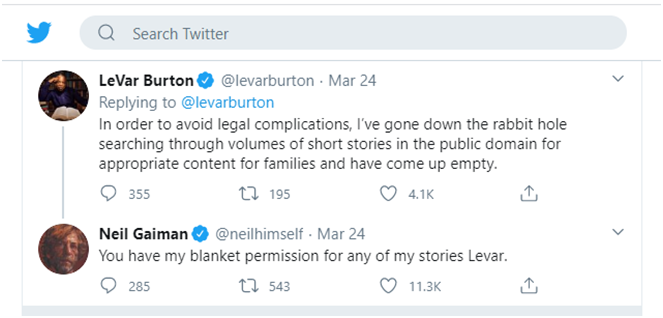
Educators and Librarians are not the only people who bring stories to kids online. For more than 20 years LeVar Burton has been the star of the show “Reading Rainbow.” During this difficult time for families at home, he decided to do a live-streamed version of #LeVarBurtonReads, but as you see in this twitter exchange, he ran into a problem. One of my favourite children’s authors stepped in immediately with a very generous offer. 

10.  Financial Support for Writers and Artists

Finally, we end on something we know is important to all of us who live by our words.  Our financial position has always depended on our ability to work. For many writers, freelance opportunities have vanished. Publishing houses are looking at their already uncertain bottom lines and must be rethinking their coming seasons. Fortunately, there are extraordinary financial supports for businesses and individuals coming from the Government of Canada — the Canada Emergency Response Benefit for example.

For writers, there’s even more help.  The Writers’ Trust of Canada, The Writers’ Union of Canada and RBC launched the Canadian Writers’ Emergency Relief Fund to support writers and visual artists who are suffering substantial income losses during this time. Applications closed on April 9. On April 8, Access Copyright announced a $100,000 donation to ensure the important financial support offered by the Canadian Writers’ Emergency Relief Fund can continue. The second round of applications open April 10 and close April 20.

The Fund provides grants of $1,500 to those who meet the eligibility criteria. Details are on the Writers’ Trust website. And if you’re in the fortunate position to help out a writer in need, details on donating to the fund are here.

A new take on an old genre?

A new take on an old genre?

Gwynn Scheltema

So much dystopian literature is big on a military or quasi-military response from authorities to a global pandemic. Sheep-like broken people follow orders because of fear of the authorities and are hostile to anyone showing signs of infection.

But here we are in a global pandemic crisis and I’m learning that things can be very different and that there are many facets to consider. I don’t see people locking their doors and guarding their “territory” with a gun. I see instead so many kind and generous actions. I see cooperation and compassion. And I’m wondering if a new dystopian genre will (or should) reflect some of what I’m seeing.

The pace of change

If I had to name one thing about the COVID-19 crisis that really boggled my mind, it was the rapid pace of change. I remember doing the math around projected rates of spread at the beginning of March and rechecking my figures because I couldn’t believe the answers I was getting. What I knew yesterday is different today and who knows what tomorrow will bring– that’s a huge source of tension. Any story that mined and recreated that tension would keep me on the edge of my seat.

The hidden human consequences

I don’t see muscled men riding in jeeps brandishing sub-machine guns, or fenced off confinement areas full of people dressed in grey ragged clothes. I see very little of every-man-for-himself attitude (except around TP!!) But the virus aside, there are a host of dangers to be considered–just more subtle hidden consequences:

  • leaders who won’t heed the advice of experts
  • a lack of resources for frontline workers
  • the effects of isolation.

Yes, isolation is vital to stop the spread of the virus, but what dangers can bubble up:

  • women or children with abusers in the home
  • caregivers who get no respite
  • addicts with no access to their poison
  • street people forced inside
  • people living alone not having human contact for prolonged periods
  • mounting stress levels…

Currency

In this new take on the genre, will military, money and politics talk as loudly as before? Or will human interaction, village co-operative strength and simple needs become the top currency? Already dystopian literature often features barter rather than money as water and food resources become currency. In this revisionist genre will digital communications, farming and medical skills, and even art also play a part?

New sets of characters

In the cast of characters, I hope dystopian writers will give due weight to the “unseen” workers. I’m seeing grocery cashiers, fast-food servers, truckers, delivery people, the “unseen” hospital workers and so on, all being as vital to survival as first responders and lawmakers.

The change in attitudes

My observation has been that many people during the COVID-19 distancing have had very little trouble ditching the malls and stadiums and old “must haves”. Some of us quickly realized that we like the extra time with family, no commuting, less waste, less smog, and simpler expectations.

Shifts in values

I saw a post on Facebook that said “In the rush to return to normal, give great thought to what you want that normal to be.”

For dystopian writers— and indeed for all of us—will we find that more companies will allow work from home? Will retail shift from physical stores to online? Will we continue to take walks in the woods, be grateful for fresh produce, take better care of our planet? Will we take more time to connect with family and friends and be more grateful for what we have?

Nobody’s Fool

Nobody’s Fool

Ruth E. Walker

On the first day of April, it feels right to consider all the times I’ve been fooled in the past. Despite the pandemic upending our world right now, it is probable that plenty of people had something pulled on them this morning.

Of course, some of the April Fools’ Day jokes I’ve endured have been the usual silliness, like the kids hiding under the bed so I’d think they disappeared. Or a decidedly less-than-brilliant piece of mischief like putting plastic wrap between the bowl and the toilet seat (saw the plastic before I sat down…phew!)

Corporate chuckles…

April Fools jokes even find traction in news media. I recall a front page story in London, Ontario, that confirmed a massive dome would be built to cover the city (just think — no more shovelling snow and one bad-ass form of isolation).

The corporate world has had its fair share of April Fools’ foolery. Ikea once had a recall on its “left-handed Allen key.” Can you imagine all the toolboxes upended to find the faulty item?

But for readers of thrilling fiction, Amazon launched a Twitter ad on April 1, 2018 that goes one step further in terms of “delivering” books. Author Patricia Cornwall jumps off her yatch and scuba dives to California to get her book to an avid fan.

How about that for delivering the goods? It’s a joke, of course. But fun to imagine. I’ve always said I’d do anything for my book, but I guess scuba diving is not on that list after all.

Put funny in your fiction?

I suppose we could all benefit from things to laugh about — especially these days. But also consider the power of humour to capture our imaginations and remind us of our gullible, fallible selves. It’s a useful writers’ tool to keep in your writing workshop: the human condition, warts and all.

We Canadians have a long line of writers whose sense of the absurd finds its understated way into stories and novels, chief among them Margaret Atwood. I once told her that her novel Life Before Man was the first novel that made me laugh out loud. In retrospect, I hope she took that as a compliment.

The great American storyteller, Mark Twain, opined that “there are several kinds of stories, but only one difficult kind — the humorous.”

Indeed. But it’s not often recognized as such. In a May 1, 1916 Maclean’s magazine article, beloved Canadian humourist Stephen Leacock wrote:

“…ordinary people, quite unconsciously, rate humor very low: I mean, they underestimate the difficulty of “making humor.” It would never occur to them that the thing is hard, meritorious, and dignified. Because the result is gay and light, they think the process must be.”  

While writing humour well is difficult, readers do value the end result. Especially from brilliant writers like Margaret Atwood, as well as in the works of Twain and Leacock. Great storytellers have always understood that to hold difficult truths up to the light, humour in its many forms can keep us reading. And more importantly, it can plant the seeds of changed perspectives.

And that is one powerful tool for any writer.

What funny novels or stories have tickled your funnybone just when you needed it most? What writers made you laugh first and then stop and think? On this April Fool’s Day, share with us in the comments.