Blogging for Authors: Must We?

Blogging for Authors: Must We?

Guest blogger: Kimberly Moynahan

Back in January, this article came through my Twitter stream: Blogging for Authors: Why You Need a Blog and How to Get Started, posted on the Nonfiction Authors Association website. In that article, e-book author Stephanie Chandler recommends that every author have a blog.

She advises you “contact your webmaster” to add a blog to your site; she talks about “keyword concentration”, how blogs are good for SEO and how content is king; she explains how to choose a blogging platform, why you shouldn’t host on a secondary domain and…well…are your eyes glazing over yet?

Here’s the thing: Starting a blog is like joining a gym. Eighty percent of people who begin will not last three months. Okay, I made that number up. But in fact, the realty for bloggers is probably worse. In 2008, a blog search engine company found that of 133 million blogs only 7.4 million had been updated in the last 120 days.

That translates to 95 percent of blogs being essentially abandoned, left to lie fallow on the Web, where they become public remnants of a dream — or at least an ambition — unfulfilled. — Douglas Quenqua, New York Times, June 5, 2009

So before you jump onto the “every author needs a blog” bandwagon, ask yourself if blogging is really for you. Because frankly, having a sad neglected blog is probably worse than not starting one at all.

Here is what you need to be a blogger—


A Bit of Technical Abilitycrow with tools

Even if you have a webmaster, she’s only going to set up your site. You still have to put up your own post, format it, add graphics and tags, and publish the thing. It’s not difficult, but if you are the kind of person who gets faint at the idea of formatting an Excel column, you might want to think twice about blogging.

Lion sleepingTime. Lots of it.

Stephanie, in her article, advises that you blog five times a week. It’s good writing practice she says.

First off, no, it’s not. You know as well as I do, if you are dashing off five quick posts a week, you are not practicing good writing. You’re just adding “content” which is great for attracting search engines bots and random strangers, but not so much for engaging readers and impressing publishers.

Blogging five times a week is a herculean task. Even filler posts – YouTube videos and “Wordless Wednesday” images – take effort to pull together. Recruiting guest bloggers helps, but there is work around that as well. And these stopgaps will only entertain your readers for so long. Your audience wants to hear from you.

How much time does blogging take?

My advice to potential bloggers is this: Write your first five posts before you commit. Time yourself from the moment you start thinking about what you’re going to write, to the moment all five are written, formatted for the web, proofed, have catchy titles, and have legal-to-use images with credits and captions.

Now add an hour a week for site maintenance and improvement, another hour for responding to commenters, and fifteen minutes a day (at the very least) for promoting your blog on social media. Now how’s your week shaping up?

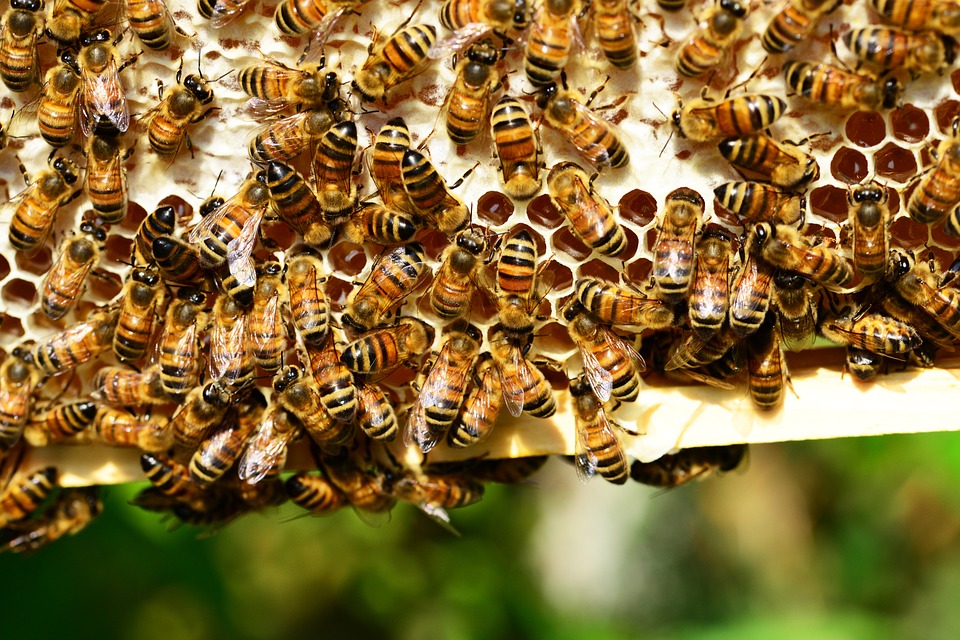
Social Media SavvyBees

Blogs cannot live in a vacuum. It will be up to you to find your audience and make them aware of your blog. Sure search engines will find your blog so people will stumble upon it, but you will have to do the real work of alerting your followers and attracting new readers every time you post. This means mastering and diligently usingTwitter, Facebook, and other forms of social media.

Herd sheepSomething Unique to Say

What are you going to blog about? Here’s a subject that could take up a whole post. But in short, if your blog is to rise above the babble of a million author bloggers all doing the exact same thing, you are going to have to deliver something unique.

Rule #1 is reward the faithful for showing up. Your readers are your most valuable promoters. Feed and nurture them accordingly. Talk to them. Give them something they can’t get anywhere else. What that is depends on your target audience – readers, writers, or both.

Rule #2 is that blogging is not all about you, The Author. If you want to connect with your readers, you must show a bit of you, The Person.  No need to throw your entire personal life onto the screen (please), but talking about your passion for 1940s jazz, your daytime job as a dog trainer or the crazy thing that happened at the grocery store this morning goes a long way towards making your readers feel special and welcome.

Thick Skinwalruses

You’re a writer. You’re used to editors pointing out flaws in your manuscripts. You’re used to rejection. You might even be used to negative book reviews (if one ever gets used to that). So already you are stronger than most.

But how are you when your ideas are attacked? How will you respond when your credibility is challenged? When a reader comments (shouts!) in UPPER CASE that you are not worthy of the pixels you are printed on?

If you blog well, your comment section is going to be more than just people heaping praise and thanks upon you. It can become the lifeblood of your blog, an exciting place where people debate and discuss ideas. It can also become a place where people criticize, even attack you.

For instance, these are actual comments from my blog:

Are you on drugs? You clearly lack journalistic skills on top of empathy for life… 

This article is the biggest piece of SHIT I’ve read so far …

I leave them on my site for my own amusement and also so I have great examples for posts like this.

KittensYou have many choices in how to handle individual commenters and your comment sections as a whole – another topic that could fill a post. But the two choices you don’t have if you want to build a vibrant community on your blog, are turning off the comment sections and screaming back in UPPER CASE. (This never goes well.)

Stephanie Chandler is right. Blogging can help you connect with your readers. It can be a way to increase your following and possibly book sales. But so can meeting with book clubs, starting a newsletter, giving workshops, having a Facebook page, engaging on Twitter, posting on Instagram and doing the most important thing of all – finishing your book.

In the end, the answer to “Should I blog” is, it depends.
But the answer to “Must I blog?” is, no.
Read More:

L.L. Barkett: It’s Time for (Many) Experienced Writers to Stop Blogging

Jane Friedman: Reasons to Keep Blogging

Kidlit.com: Do Unpublished Writers Have to Blog?

Huffington Post: 5 Reasons Authors Should Blog

Joe Bunting: What Fiction Authors Really Need to Know About Their Platform


All images CC0 Public Domain via Pixabay

BIO


Kimberly MoynahanKimberly Moynahan is a freelance science, nature, and interpretive writer. She blogs on the natural sciences, animals, and the writing life on her site Endless Forms Most Beautiful. She has been published in Scientific American’s Best Science Writing Online and WOLVES Magazine. Kim serves on the Leadership Team for Science Borealis, the Canadian science blog network and is a regular blogger for the Canadian Science Writers Association. Find her on Twitter and LinkedIn.



The Guilt of Reading

The Guilt of Reading

On the radio the other day, someone was talking about getting “unplugged” to read paper books. As a writer, and a reader, my ears pricked up.

The person on the radio explained that she usually reads on her phone, but when she does, she is also plugged in to message alerts and Facebook notifications etc. and doesn’t really give the reading her full attention. But what stops her from reading paper books, she said, was dealing with the guilt of being unplugged.

eye glasses on open bookFeeling Guilty?

I wonder what’s happened to our priorities when it feels wrong to be unplugged from the digitally connected world. For pleasure or to grow our minds, what is the problem with reading a book?

Writers need to read. No question. And they need to read widely. Yet her statement about guilt had a certain ring to it.

I’m not constantly plugged in digitally (to which frustrated friends and associates who labour to get hold of me will attest). So I don’t feel any guilt about being unplugged.

But, I have to admit, I do feel guilty about taking time to read.

When I plan my day, reading is seldom, if ever, on the list as an option. I do read. Usually around one fiction book every three weeks and non-fiction in between, but that reading is reserved for before bed or with my morning coffee — a luxury or a reward for an otherwise productive day.

Admittedly, if I get to the point in a novel when the book won’t allow itself to be put down, then I might spend the morning, or stay up late and finish it. And occasionally, I will “allow” myself the luxury of a day with a book. But I do feel guilty when I do that. I feel guilty about all the things I should have done with that time in the same way as I would admonish myself for playing computer solitaire.

do what you loveReading is not a luxury

It’s time, I believe, for giving my head a good shake. Reading, especially for a writer, is not a luxury. It is as necessary as writing or editing.

And I’m not just talking reading as research. Reading other writers is hugely important. It’s important to see what my contemporaries are doing. What’s winning prizes. It’s important to read as a writer. I have a notebook next to my bed where I make notes about things I want to remember or revisit. I list every book I read and the author and date. I keep notes like: Page 57 – good child’s perspective on death.

So if reading is so necessary a part of my writing life, why the guilt?

My brain seems to find it acceptable to read a book on plot or the latest copy of Quill and Quire to stay abreast of what’s happening in the writing world. It’s reading for pure pleasure that seems somehow different.  Hmmmm…

For me, I think it’s time to move all reading into the “acceptable past-time category”. It’s time to ditch the guilt. It’s time to head over to Goodreads and pick my next book!

A Newbie’s Guide to Book Conferences

A Newbie’s Guide to Book Conferences

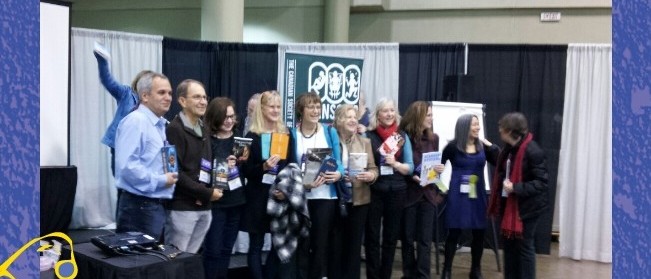
Heather M. O’Connor. My publisher Orca Books recently invited me to sign copies of Betting Game at the Ontario Library Association (OLA) Super Conference.

“Me? Sign books at the OLA? Sure!” It’s the largest library conference and trade show in Canada.

A day or two before the big day, I felt like a preteen going to her first boy-girl party. What should I wear and bring? What are the signings like? What do I say?

I’ve gathered some super tips for preparing for and attending the OLA Super Conference. You can also use this advice to get the most out of other major book events, trade shows and conferences.

Be prepared

Check out the event website. You never know what you’ll find. (The OLA provided a cool photo frame for my pics.) Identify and use the conference hashtag, and add the conference app to your phone.

Read the program, even if you’re not attending the panels. Who is signing? Who is speaking? Maybe you’ll “bump into” that editor you want to meet.

Shout out on social media that you’re going, and ask who else is attending. If you’re signing books, announce the time and your publisher’s booth. Share news about other signings and events. If the conference has a Facebook group or event, join it.

What to wear

The default attire is business casual.

However, some authors add a little cosplay flair to their signings. Lena Coakley donned a prim Brontë-style bonnet to sign Worlds of Ink and Shadow at the OLA. Kari-Lynn Winters signed Bad Pirate in ARRR-some pirate gear at Reading for the Love of It, a big Toronto teachers’ conference.

Skip the high heels and opt for comfortable shoes. You’ll be on your feet for hours.

What to bring

A phone for taking and posting pics, following the program and connecting with friends. A watch. Business cards. A strong bag for carrying all the book loot.

Two reliable pens or Sharpie markers for signing, if you’re picky about your writing implements. (What writer isn’t?) Book swag, like bookmarks or buttons. My time slot was at the end of the day, so I offered a free draw to entice people to stick around.

Coffee for your publishing team—they can’t always get a break.

Meet the people

Conferences are the perfect place to network, do market research, and connect with writers and book-lovers. Strike up a conversation with your neighbour. Browse for books. Share a lunch table.

Librarians and teachers:

  • find out what their kids like to read and what they ask for
  • mention you do classroom visits, book clubs and programs
  • tell them about funding for author visits (more about that in a future post)
  • swap book recommendations

Publishers:

  • study the books they showcase at the booth–what are they selling?
  • find out which books they’re excited about and why
  • identify trends and ask market-related questions (when they’re not busy)
  • pick up catalogues and take advantage of a live peek at their books

Authors:

  • hang out with other writers and expand your tribe
  • observe experienced writers in action and ask their advice
  • promote other authors and their events–what goes around comes around
  • check out the event before you’re published so you come prepared
Schmooze dos and don’ts

DO take lots of pictures. Selfies. Signings. Capture the excitement, then share your pics on social media and your blog.

DON’T accept book giveaways or enter the free draws at conferences for librarians or teachers, no matter how tempting they look. You’ll take those resources away from classrooms and libraries.

Book signing tips

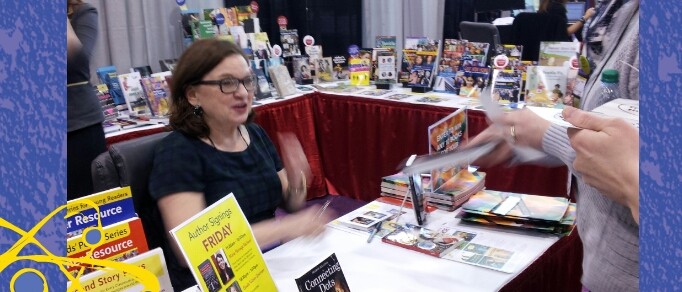
Check in with your publisher when you arrive, and return to the booth 10-15 minutes before your signing. It gives you time to stow your bag, straighten your clothes and thoughts, and think about what you want to write. Ask someone to take pictures.

Librarians and teachers are book people. They’re your fans. When they ask you to sign their book “For the students of XXX School,” you feel like a million bucks. I add a personal line, like “Always count on your team” or “Keep kicking!”

Make small talk. Find connections—a student who likes soccer books, a familiar school. If they seem interested, share interesting facts and valuable resources for your book, like extras on your website or an online teachers’ guide. Or mention you do school and library visits.

You feel like a rock star while you’re signing, but it’s over before you know it. Enjoy!

What are your tips for getting the most out of a big book event like the OLA Super Conference? Share them below.

Can You Write While Travelling?

Can You Write While Travelling?

Ruth E. Walker. My husband and I were visiting our son, daughter-in-law and grandsons in the Texas Panhandle last month. We had a hotel booked for most of the visit so I thought I might have time to do a bit of writing. After all, during the week, our grandsons were in school and their parents were working. Free time, I thought.
Hah! I’d forgotten how exhausting and complicated travel can be. Most of our “spare time” was spent in busy mode (planning and taking day trips, helping out around the house, etc.) Any other spare time was devoted to recovery mode: sleeping. (Grandparents everywhere will understand this.)

So I didn’t write. At least, not on paper.

The thing about travel is that you experience difference and, for writers, difference is pure inspiration gold. While we have been to Texas a few times in the past few years, it’s still intriguing to see men strolling through the modern Dallas airport, sporting wide-brimmed Stetsons and stylish leather jackets. There’s a kind of Texas-walk — confident and straight-ahead. And Texas talk, too — How y’all doin’? (If there is a group of you, it becomes: How all y’all doin’?)Stetson wearing man

There’s difference in food. Biscuits and gravy is on almost every menu and Taco Bell Texas figured out how to work it in: get your taco fixings in a tea biscuit. Before ordering iced tea in restaurants, I remember to ask for “sweet tea” or it comes decidedly unsweetened.

And in every Texas hotel we’ve ever stayed at, the waffle irons at the “Breakfast Included” stations are in the shape of the state.Texas

So what does this have to do with writing? Being somewhere different — whether on vacation or on a writing retreat — it tickles your mind and your senses. Sour gas odours from the oil wells.Oil drill in Texas Billboards touting Texas Pecan Company offering nut cracking services. Pecans fresh from my son’s front yard tree (and cracked locally.) The sticky and soft texture of a white tail deer’s tongue and lips taking a carrot from my hand. The quick intake of passengers’ breath when our plane hit strong turbulence coming home.


In short, the senses are on overdrive. For me, that usually results in my imagination working overtime, and it was certainly the case this time.


I’ve come home with an idea for a play. It’s rough. It has nothing to do with Texas. But it does have a lot to do with airplanes that encounter far more than turbulence. I’m excited just thinking about the possibilities of that play, of the characters, of the idea behind it all. Once I finish my current manuscript, I’ll be working on that script. I might even work in something about waffles. And pecans. And maybe even Texas. Or maybe none of it will end up in the play. Just the plane. Or maybe just the turbulence.


Remember that writing is not always about putting words on paper. Sometimes writing is all in your mind, full of inspiration and potential, just waiting its turn to land on your page.

What is Your Definition of Success?

What is Your Definition of Success?

Ruth E. Walker.

We all want success as writers. But what each of us views as “success” will likely differ. Success for one could be simply finding the time to write; for another, it could be seeing their words in print; for someone else, success could be when the awards and accolades start to arrive.

Take two minutes to view this video of Kevin Spacey, multi-award-winning actor, as he speaks about success.

https://www.youtube.com/watch?v=5mdW_ihN830

When you are done being inspired by this artist’s statement on what success means to him, consider what success means to you. Make a list of all the positives and negatives related to “success” from your perspective.

Now, work with “success” from the standpoint of what you are writing, or plan to write. Here are some ideas to get you started:

  • Draft an essay on success.
  • Make a positive and negative ‘success list’ for your character(s); then write a scene containing one positive and negative success outcome
  • Brainstorm “success” for as many meanings and ideas that come to you about that particular word; craft a poem or short scene using at least three of your ‘brainstorms’

When you are done, if you still crave more Inspiration, try all of the above with one change. Use the word “failure” as your starting point.

But know this — the word ‘failure’ is just a word. And anyone who continues to seek inspiration and ideas to challenge their writer’s mind is no failure: your success can be measured simply through your desire to explore.