10 Great Responses to COVID-19

10 Great Responses to COVID-19

Today we focus on how organizations, businesses, authors and artists have stepped up and adapted to respond to the pandemic. We’ve picked 10 but please share other resources you’ve come across in the comments section. Remember to be safe and keep well in the weeks and months to come.

1.  Virtual Book Clubs

Now that we can’t meet in person, Zoom is the new virtual meeting space. It’s free, and all kinds of businesses are turning to Zoom and adapting it to the needs of their customers and clients. Gwynn’s local innovative independent book store, Let’s Talk Books has switched their book club meetings virtual via Zoom.

You can link via cell phone, tablet or laptop and talk face-to-face, meet the author, and stay safe and healthy. NOTE: In response to online trolls and bored fools, Zoom is upgrading their security by April 15.

2.  Virtual Writing in Community

Inkslingers is in its 15th year of providing workshops and guided writing practice programs and travel experiences. Helmed by Sue Reynolds and James Dewar, certified Amherst Writers & Artists workshop leaders, they’ve offered regular Sanctuary Sundays for communal writing at their country home. But they can no longer invite writers to come and immerse in their inspiring landscape so they’ve gone online, offering the same supportive space virtually.

3.  Virtual Critique groups

Not just businesses have turned to Zoom. Gwynn and Ruth’s critique group now meets every two weeks via Zoom. Critical ms is a serious group of serious writers, many of whom write professionally. Pre-pandemic, the group met every two weeks alternating between Whitby and Peterborough for in-person deep critiques of one or two members’ submissions. Now the writers keep to that schedule but see each other’s smiling faces online. Yes. Smiling. Critical ms is a serious group but everyone enjoys a good laugh. And these days, we all need that.

4.  Online Courses

Online courses are nothing new. What is new, is that many providers have recognized that with so many people forced to isolate and with added time on their hands, learning something new is a positive way to cope. To that end they have offered their courses for free or reduced prices for the next few months. A couple you may like to check out as a start are  Coursera and #Stayhome@News18

5.  Online Writing Prompts

Most of us know daily writing prompts are easily found in places like Writers Digestonline. Poets & Writers online is another option. P&W offers a mix of inspirations 3 times a week — poetry, non-fiction and fiction each week gets a prompt. Of course, our current pandemic flavours the prompts, but they are subtle about it. From an excerpt of Samuel Pepys plague-time diary to exploring the small details found places in the world using Google’s Street View, the prompts give writers a multitude of ways to stretch their pens during these distracting days.

Whether you start a new piece, add a scene or chapter to a work in progress or just play with words in a different way, it’s exercise for the brain and a welcome tickle for your muse.

6.   Face-time Learning from Artists

Artists of all kinds are sharing their talents via the internet right now to help teach and entertain people around the world. Best-selling illustrator and graphic journalist Wendy Macnaughton hosts a weekly a live class “for kids of all ages, parents of kids, parents of parents, aunties/uncles, friends and pets.” Canadian band the Arkells host “Flatten The Curve Music Class” sharing the chords and lyrics for their music.

7.  Virtual Tour of Museums and Art Galleries

The Guardian newspaper has a list of the “top ten museums and galleries to visit in the world.” There are different ways to virtually tour art galleries and museums but we were intrigued by the British Museum’s virtual Google timeline that users scroll along, choosing time and place in the world to explore the museum’s collection.

Canadian War Museum

In the Canadian War Museum, you can experience trench warfare through an interactive video presentation Over the Top. Narrated voice over leads you to several “choose your own adventure” moments.

Washington’s National Gallery of Art is offering 10 Digital Education Resources that are family friendly. And their online collection highlights is an amazing opportunity for close up views of masterpieces of paintings, sculptures and photographs over the ages.

8.  Copyright Accessing

The Association of Canadian Publishers and Access Copyright announced temporary permissions for online storytime to help educators and librarians connect with students through a program called the Read Aloud Canadian Books Program. Under this program licence fees related to the reading of all or part of select books from participating publishers and posting of the video recording online have been waived.

Publishers who have signed up so far include: Annick Press, ARP Books, Orca Book Publishers, Owlkids Books, Portage and Main Press, Running the Goat, Books and Broadsides, Groundwood Books, and Linda Leith Publishing.

9.  Public Story Time

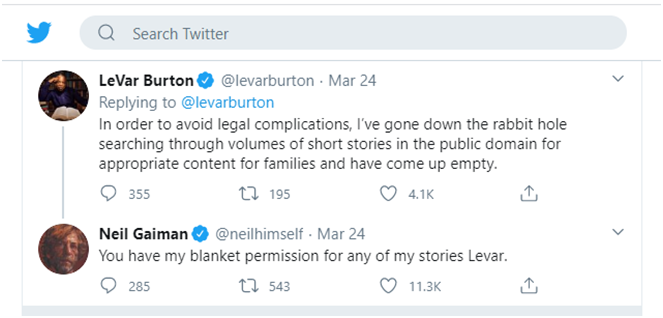
Educators and Librarians are not the only people who bring stories to kids online. For more than 20 years LeVar Burton has been the star of the show “Reading Rainbow.” During this difficult time for families at home, he decided to do a live-streamed version of #LeVarBurtonReads, but as you see in this twitter exchange, he ran into a problem. One of my favourite children’s authors stepped in immediately with a very generous offer. 
10.  Financial Support for Writers and Artists

Finally, we end on something we know is important to all of us who live by our words.  Our financial position has always depended on our ability to work. For many writers, freelance opportunities have vanished. Publishing houses are looking at their already uncertain bottom lines and must be rethinking their coming seasons. Fortunately, there are extraordinary financial supports for businesses and individuals coming from the Government of Canada — the Canada Emergency Response Benefit for example.

For writers, there’s even more help.  The Writers’ Trust of Canada, The Writers’ Union of Canada and RBC launched the Canadian Writers’ Emergency Relief Fund to support writers and visual artists who are suffering substantial income losses during this time. Applications closed on April 9. On April 8, Access Copyright announced a $100,000 donation to ensure the important financial support offered by the Canadian Writers’ Emergency Relief Fund can continue. The second round of applications open April 10 and close April 20.

The Fund provides grants of $1,500 to those who meet the eligibility criteria. Details are on the Writers’ Trust website. And if you’re in the fortunate position to help out a writer in need, details on donating to the fund are here.

10 Signs You Need A Writing Retreat

10 Signs You Need A Writing Retreat

10 on the 10th for March 2020

When your usual source of inspiration has packed up and moved elsewhere or just thinking about sitting down to work on your writing feels more like a chore than a delight, it may be time for you to escape somewhere to write.

Of course, we’d love it if you joined us at our annual writers retreat Spring Thaw this April but there are other options. From renting a cabin in the woods to pitching a tent in the backyard, there are ways to arrange your retreat from the world. No matter your choice, it’s up to you to get inspired once more and put your focus on your work in progress.

Here’s 10 signs that just might be pointing to your need to get away and write:

1. Facebook, Twitter and Pinterest are far more interesting than your current work in progress…even if you fooled yourself into thinking you might find inspiration from other writers posting their success stories.

2. When friends or family ask you how your writing is going, you change the subject. Repeatedly.

3. You spend a lot of time looking up recipes to at least be creative somewhere. That soufflé might be amazing but it won’t look great on your bookshelf three years from now. Your book will.

4. Your day job drains every ounce of creativity you once had and even the days off are lost causes. You yearn for vacation time but then remember that it’s booked up with family events.

5. The name of your main character is hard to remember…or the working title of your book…the name of the antagonist…or why you set a science fiction novel at a seaside resort…it’s all so vague now.

6. You have nightmares about winning the Giller Prize where everyone boos and calls you a hack and they take the cheque back. Really? Doesn’t every writer have that nightmare?

7. You yell “plot hole!” repeatedly at the television and then worry your novel is nothing but plot holes.

8. You can no longer imagine your book being published — in fact, you’ve forgotten why you started the darn thing in the first place.

9. The noise level at home is a constant distraction: kids, pets, neighbours, the dishwasher — you name it, there’s no quiet zone to just reflect.

10. You avoid meeting up with other writers to avoid hearing how well it’s going for them. Not that you don’t care, but really, it is hard to take when you’re in a literary sinkhole of nothingness.

Some of these may be a bit tongue-in-cheek but there’s a ring of truth in all of them. We know, because we’ve experienced them in one form or another. That’s why we offer our escapes.

And for 2020, we’ve opened our country properties to writers who want a self-directed or supported writing escape. Choose from a cozy lakeside home in the Northumberland Hills or a traditional riverside cottage in the Haliburton Highlands. Send us an email at info@writescape.ca for more details.

There are probably 110 signs that a writer needs a writing retreat. Add to our list in your comments.

10 Tips on Book Covers

10 Tips on Book Covers

You can’t tell a book by its cover but you can hint to readers what the story is about. The choice of text, colour, font and images carry messages for potential readers and can either invite or dissuade purchasers from picking up your book. Many authors are choosing to self-publish or publish cooperatively and sometimes they miss the mark with their covers

You can’t control how a reader will react to your story but you can entice them to at least turn the first few pages with a great cover. Once they’re inside, well, the rest is up to you and your story, author.

1. Start by considering your genre: science fiction, fantasy, mystery, memoir, history, self-help, instruction manual — for each genre, readers will respond to clues you plant with your cover about the genre

2. Look at other book covers, especially those in your genre. Remember that traditional publishers don’t always get it right when it comes to book covers so look for books that were bestsellers for debut authors. Covers for established bestsellers don’t have to work as hard as that first cover and for series book covers, they take on a kind of cookie cutter appearance.

3. Think about the overall book structure: is this a standalone book or one of a series. If it’s the first in a series, you are free to establish the “look and feel” of your cover, knowing that you’ll continue that with the subsequent titles. BUT if it’s the second book, everything you do should somehow connect back to the first cover — the same font and title — the overall appearance should echo the series

4. Consider your concept: complex plot or character driven — this will affect the images you choose — character-driven should give us a “person” as the central focus; but if this is a complex plot, intriguing illustrations or images may take the forefront

5. What about the mood of your book: high stakes excitement or slow unfolding discovery — deciding on this will help with colour palette for the background and the fonts. Too many self-published authors choose a colour for their cover text that disappears into background colours. You want readers to notice your title and your name. If they’re squinting before they open the book, they are already in a negative space.

6. Use images that carry an element of your story: pictures, illustrations, and signs can be integral to your book cover. A springtime tree suggests new beginnings, growth. A barren tree suggests an empty life or one about to end. There are images that symbolize just about anything and photos that can evoke all sorts of ideas and emotions.

7. Experiment with fonts — once you found those perfect images, look for the type of font to match. Horror writers will choose a different font from a romance writer. But what if it is a horror with a romance at its heart? It can get tricky to choose the best style of text for your cover. And what looks good in small type can be ghastly in large letters plastered on the front of your book. Keep going back to existing book covers in your genre and look at the fonts they chose.

8. Mock up your cover — place the image(s) on “dummy” book — print out the image in different sizes and move it around on the blank surface. Of course you can do this digitally but it is not the same as seeing it in trade paperback or hard cover size. See how different lights affect the look. Think about high gloss versus matte finishes. It will all make a difference.

9. Print out the cover text with different fonts and font sizes then try out various layouts with the images and colours you choose. Will your name be on the bottom? Will the title fit on one line? Or is breaking it into two lines more eye-catching? Remember, this is experimentation and will take time until you feel you’ve got the final cover. But this a huge part of your marketing plan: your book title and your author name.

10. Many readers go to the back cover before reading anything inside. So open up that mock up to create the back cover and the spine. Again, you can do this all digitally but what’s the fun in that if you don’t have a tactile connection with your cover? You’ll need to spend some time deciding on what compelling text you’ll add to that back cover. Often, it’s a variation of your pitch, your logline, your #pitmad golden egg that you slaved over to help promote your book.

10 Silent Energy Zappers

10 Silent Energy Zappers

Your story may be dynamite, but stylistically these energy zappers could be undermining it. They’re subtle but can do damage nonetheless. Avoid them to add energy, or use them to dampen when you want to.

  • Negative constructions 

“Is not” and “do not” sap energy, because readers prefer to hear about what something is or what someone does. Often negative construction is paired with weak verb choices too.

Ralph did not like the way Bill treated Liza. 
Better: Bill’s treatment of Liza disturbed/disgusted/horrified Ralph.
  • Wishy-washy constructions

Be confident about what you write. Is your character walking or not? Is the baby crying or not? Did Jimmy understand or not? Using started to/began to/seemed to constructions weaken the action.

Tom started to get up and close the door.
Better: Tom jumped up and closed the door.
  • Unnecessary tags in internal dialogue

When we are “in the character’s thoughts” seeing, feeling and hearing what the character sees, feels and hears, using “I see”or “I hear” or “I feel” is unnecessary, and distances the reader and lowers energy.

I hear a phone ring in the telephone booth.
Better: A phone rings in the telephone booth.
  • Nominalization

Avoid turning an action word into the subject of the sentence i.e.  using the noun equivalent of a verb. To up the energy, re-order the sentence to let the verb do the work.

They had a discussion about .
Better: they discussed
  • Verb weakeners

Re-order the sentence to eliminate these “weakeners”: need to; should; might; could

You need to get motivated.  
Better: Motivate yourself.
  • Neutrality – non-human references.

Readers feel close to people not things. So whenever you refer to a person in a non-human way, you distance the reader.

If you're the type of individual who likes luxury, Gateway Spa is for you.  
Better: If you love luxury, Gateway Spa is for you.
  • Redundancies

So easy to do. How often do we hear about the new baby; or joining together. By default, babies are “new”; joining things results in them being “together”.  Restating the obvious sucks energy.

Sam kneeled down to examine the sword 
Better: Sam kneeled to examine the sword
  • Passive construction /Grammar expletives

No, we aren’t talking swear words here. In grammar circles, a grammar expletive is any word or phrase that does not contribute meaning. The most common culprits are: It is; there are; there is; etc.at the beginning of a sentence.

It is two hours before the sun rises.  
Better: The sun rises in two hours.
  • Meaningless intensifiers.

Really, very, so.What is the difference between a tasty dinner and a really tasty dinner? If you want a degree more of tastiness, use a stronger verb rather than an intensifier. A delicious dinner.

He knew Dana was very smart.
Better: He knew Dana was brilliant.
  • Latinate vs. Anglo-saxon words

Latinate words (those ending in -ate. -ite. -ation and other Latin bases) usually refer to areas of law, administration; government and abstraction. It’s a throw-over from the days when England was governed by Rome and later by France. Anglo Saxon words were the tongue of the governed, the workers – words to do with farming and labouring. That’s why they carry a more earthy energy.

He excavated a cavity. (Latinate)
He dug a hole. (Anglo-Saxon)
10 Gift Ripples in the Social Media Pond

10 Gift Ripples in the Social Media Pond

Tis the season and time to think about gifts for writing friends. Last year we gave you a list of 10 Meaningful Gifts that cost little or nothing, and were environmentally friendly. This year we thought we’d dig a little deeper into one suggestion on that list:

Help promote a writer on social media.

This is a gift that can give all year long. Devoting just one hour a month to help eight writers in that hour will mean you take nearly 100 actions to help your writing friends.

So what can you do?

  • Support existing social media marketing

This is perhaps the easiest thing you can do. Like, follow and share other writers’ posts, pins and pages. Since friends often share common interests, when someone likes your page, they expose it to their friends who may expose it to their friends and on and on. And it’s likely targeted exposure because friends usually have similar preferences.

Adding an intro line when you share is even more valuable. “My friend Alice is launching her memoir this weekend. Her book is amazing.”

  • Write a review

That intro line in #1 above is a mini review. But what about doing a full review on Goodreads or Amazon or genre specific sites?

  • Subscribe to a writer’s blog

Yes, we know, we all get enough email as it is, but remember, you are in helping mode here. The number of people subscribed to a writer’s blog is a direct indication of their engaged target audience, and a great stat for query letters.  Engaged is the optimum word here. Take the time to comment and share.

  • Interview a writer on your blog

Most bloggers have a target audience and a general content niche. Brainstorm with a writer you want to help about how your goals intertwine. Perhaps you are a horror writer and your friend is a romance writer. Could your friend answer some questions or do a guest blog about basic romantic principles that cross all genres? Win-win promotion for both of you.

  • Spread the word

Before anyone can support blogs and social pages, they need to know they exist! At networking groups or writerly gatherings, talk up favourite blogs and author websites, swap URLs and encourage others to do the same. Perhaps even propose a formal online “marketing swap” through a group you belong to.

  • Attend launches

Hopefully, you’ll also buy the book, but even if you can’t always do that, show up. When the author posts pictures later, the larger crowd will say volumes.

  • Involve non-writers
Haliburton Writers

Ultimately, a writer wants to sell books. If the only people they can rely on are family and friends, the book has a short shelf life. Do your part by introducing the book to a wider audience. Suggest it to your book club. Call up several friends who read in that genre and suggest you all attend a launch together and socialize afterwards. Buy a book to donate to a silent auction for a favourite charity you support.

  • Tech support

In the decade or more that Writescape has had a website, we’ve learned a lot about the back-end workings. How to create posts, schedule blogs, maintain subscription lists etc. etc. For many writers, the technical side of things is a frightening abyss. Can you help a fellow writer learn a trick or two of the “trade”?

  • Build supporting others into your life

Busy lives. We all have them. Often we start things with a bang and they fizzle out. Better to help consistently in a small way—constant pebbles making ripples in the marketing pond. Whatever strategies you chose to help fellow writers, build them into your existing life. If scheduling works for you, set aside an hour a month. If you are a Facebook addict, make a habit of sharing a writerly post once or twice a week. If you attend a number of launches, commit to taking a non-writer friend to each one.  If you aren’t on social media, write a review.

  • Ask what help writers need

Writers are generally an introverted lot and not given readily to asking for help. Start by choosing a handful of writer friends who you would like to help and send them a message something like this:

This holiday season I’ve decided to gift some of my writing friends increased social media promotional support. I am active on (insert social media platforms you use) and am happy to (insert what you are prepared to do:  like, share, review, interview. follow blog etc). Please tell me what 3 top actions I can take to best help you.

Last Word

We, Gwynn and Ruth, would like to thank all of you for subscribing to Writescape’s blog, and commenting on and sharing the posts. Also for your interaction with our Facebook and Twitter posts. It means a lot.

  • www.writescape.ca
  • @writescape_
  • www.facebook.com/writescape

10 Important Tasks for Dialogue

10 Important Tasks for Dialogue

Dialogue is not filler, nor is it secondary. For readers, dialogue is the illusion of active listening, of ‘looking’ from person to person as the conversation unfolds. There are technical effects from dialogue that support and enhance your story. The following 10 on the 10th blog shares some examples of the important work of dialogue:

1. Develop Plot: To ensure you’re not writing “filler”, give your characters dialogue that moves the plot forward, develop scenes.

"Pete, meet me at Crawley's barn at sunset. I'll bring Billy." 
"Want me to bring a gun?"
"Nah. If I find Billy before sunset, we won't need one."

2.  Move in Time:  When the story needs to shift into a new scene, or you want to cover a period of time without going into detail about that period of time, offer a line that sets up the new scene:

“Good then. I’ll see you next week." 
 or “So it's settled, we leave at dawn.”
or "Give me an hour or two and I'll call you back."

3.  Reveal underlying tensions:  Characters, like real people, have emotional baggage and secrets. Dialogue can give a clue that a character has something they’re hiding.

“Just what did you mean by that?” she asked. 
He shrugged. “Nothing. Now let’s just move on, okay?”

4.  Enrich themes/mood:    Characters can help readers pick up on the mood of a piece by what they say.      

“I hate this damp and cold. And those dark clouds can only mean
we're in for more rainfall.”
or "Come on, Charlie. Let's jump in every puddle we see."

5.  Echo time/era/culture: Dialogue can add authentic details to bring out the story’s genre, culture or time period.  

“Ach, lass. Will you no be gettin’ down from there?”
or “My lady, 'tis unseemly to be about at this late hour.”
or "Golly. Is that one of them new tellyvisions?"

6.  Establish setting:  Setting a scene through description alone can turn into a laundry list of what can be seen. Let dialogue do some of that work so that readers get enough detail to fill in the rest. More importantly, let dialogue help readers to stay connected to characters by “seeing” what they see and with the emotion they see it.

"Zargon! Power up the hyperchute—enter that wormhole!”
or "Bring me that beautiful leather bound volume from the top shelf."
or "Careful now! Mind you don't step in that stinking muck." 

7.  Imagine geography: Not all stories need large scale world-building but many fantasy, science fiction or quest stories will involve creating a world that readers can believe in. Dialogue helps to make it real because it’s real to the characters.

“Wait. I think I see a body of water through the trees.” 
or "This map doesn't show......."
or "That desert's got to be five day's walking or more. And not even
 stones or scrub for cover."

8.  Reveal facets of character: Dialogue is an active way to reveal character emotions, backstory and motivations.

"Please don't leave me alone with him; I can't go through that again.” 
or “How amusing. You dare to speak. Guard—kill him.”
or "I'm going to tell you a secret...."

9.  Focus on dynamics: How chracters talk to each other reveals not only clues about each character but also about their relationship with one another.

“You just can’t leave me alone, can you?"
“Ah, but if I did, you’d start to hate me all the more.”

10.  Show don’t tell: Dialogue is one of the easiest ways to give tired prose an energy lift, and turn “Tell” into “Show”. And that includes the body language and action beats in between the words. It’s dramatization that the reader can be immersed in, can “hear”, “see” and therefore feel.

Tell: Her father was abusive, but she had long since stopped caring.
Show:"Jesus girl. What's this slop ya call dinner?" Pa swiped the dish from
the table. Ma's best china plate shattered against the door. "And look
what ya made me done now, ya good-for-nothing..."
Mary scooped up a shard and turned to face him, looked  Pa square in the
eyes. "You can break me all ya want, Old Man, but ya'll never touch another
thing what belonged to Ma."


10 Places Writers Should Visit

10 Places Writers Should Visit

The world is richer for its artists, not the least of which are the writers. In every country, indeed in every nook and cranny of Planet Earth, you’ll find storytellers, word spinners and scene makers. For many writers, there are places on the planet that will forever be associated with them. The following list offers you 10 writers with whom place has a connection — whether they wrote in that place, or wrote about that place — the connection is clear.

As with all our 10 on the 10th lists, this one is not complete by any means. But it is, we hope, an interesting list.


1 Havana, Cuba — ERNEST HEMINGWAY; The Nobel Prize winning author wrote seven books during the 30+ years he lived in Cuba. Among them: The Old Man and the Sea; A Moveable Feast; Islands in the Stream. Ten miles east of Havana, his island home, Finca Vigía (Lookout Farm/House), is now a museum and a place to imagine his inspiration.

2 Huron County, Ontario — ALICE MUNRO; Nobel Prize for Literature winner, Munro’s short stories are most often grounded in Huron County, Ontario, Canada. The fall is a lovely time to drive through Huron County and visit Wingham where her childhood home is still standing. Dozens of small towns are scattered throughout the rich farmland and it is the ordinary lives of those ordinary people Munro writes about in the most extraordinary way.

3 London, England — CHARLES DICKENS. Take a literary pub crawl through London Town with Dickens (as portrayed by an actor/tour guide) and glean inspiration and literary tibits. Tourists are invited to visit the public houses and taverns frequented by great writers. They promise you’ll meet Dylan Thomas, Virginia Woolf, George Orwell, Anthony Burgess, T.S. Eliot and others. And support new London writers! (We really liked that last bit.)

Jeff Turl/Bay Today

4 North Bay, Ontario — GILES BLUNT. Thinly disguised as Algonquin Bay, the detectives in Blunt’s wildly successful crime novels travel streets with familiar names for anyone who knows North Bay. His Detective Cardinal series of books and now a 3-season television series is set (and mostly filmed) in the city perched on the shores of Lake Nipissing, 2 hours north of Algonquin Park. Blunt’s characters are believable and the dynamic between Detective John Cardinal and Detective Lise Delorme adds spice to the rising tension in each mystery. Blunt, also a screenwriter and poet, was born in Windsor, Ontario and raised in North Bay. Lucky for readers, even after he moved away, he recognized how ideal it was for setting a murder mystery there.

5 Georgia, USA  — FLANNERY O’CONNOR; The childhood home of O’Connor is in Savannah, the heart of which boasts some of the finest restored urban antebellum mansions. The South is the heart of O’Connor’s stories and she is unflinching in her tales of what some called “Southern Gothic” and even, “grotesque.” O’Connor said: “anything that comes out of the South is going to be called grotesque by the northern reader, unless it is grotesque, in which case it is going to be called realistic.” She lived out the last 12 years of her too-short life in Milledgeville, Georgia.

6 Trinidad — RABINDRANATH MAHARAJ; Born and raised in George Village, Tableland, Maharaj came to Canada because he wanted to attend a masters program in creative writing. But he found that the distance from Trinidad gave him a new perspective with which to write his novels and short stories. His award-winning novel, The Amazing Absorbing Boy, captured the view of Canadian life through the eyes of an immigrant Trinidadian teenager. So while some of Maharaj’s stories and novels are set in the lush tropics of Trinidad, beautifully described so that readers will want to visit, the island flavours even his books set in Canada.

7 Montreal, Quebec — MORDECAI RICHLER with a dash of LEONARD COHEN; Montreal is a city of creatives. Artists, poets and novelists have made this cosmopolitan city their own. Chief among them, Mordecai Richler, one of Canada’s best known writers who has left a legacy of literature. Like the vivid energy of his hometown, Richler was never a background player and spoke his mind freely. That same energy was found in his characters and storylines. His award-winning novels have been made into films — The Apprenticeship of Duddy Kravitz and Barney’s Version — and Richler’s books remain in bookstores today.  In 2015, Richler was posthumously made a “citizen of honour” in the city of Montreal and a library in the neighbourhood he portrayed in The Apprenticeship of Duddy Kravitz, was given his name.

8 Ameliasburgh, Prince Edward County, Ontario. AL PURDY; In 1957, poet Al Purdy with his wife and father-in-law constructed the now famous A-frame.(Al tells the story in Reaching for the Beaufort Sea.). There he wrote poems about the area published as Poems  for All the Annettes . The following year The Cariboo Horses won the first of Al’s Governor General’s Awards. Even while the A-frame was being built, it became a meeting place—for poets, for poetry lovers, for those aspiring to be poets. The list of people who travelled to the A-frame reads like a who’s who of Canadian letters—Margaret Atwood, Michael Ondaatje; Earle Birney, George Bowering, Margaret Laurence, Jack McClelland, …. The legacy continues through the A-Frame Residency Program.

9 Lakefield, Ontario — MARGARET LAURENCE; One of Canada’s finest writers, Laurence’s novels, short stories and essays were framed by the many places she called home. Born and raised in, a small town well west of Winnipeg, Laurence set her books in Western Canada, Somaliland and Nigeria, Africa. In 1973, she settled permanently in small town Lakefield in the Peterborough/Kawartha Region.  On the shores of the Otonobee River, she crafted scenes for her final and brilliant novel The Diviners. The town of Lakefield honours Laurence every July (her birthday month) with a literary festival.

10 Neepawa, Manitoba. MARGARET LAURENCE Yes. That’s two places for one writer and why not? Laurence’s childhood home in Neepawa is a museum dedicated to her and her writing. Purchased the year before her death, Margaret Laurence House hosts writers’ workshops and book launches. As an inspiring mentor to several young writers, Margaret would surely be pleased to know she continues to encourage writers to explore their craft.

10 Instructional Writing Quotes

10 Instructional Writing Quotes

Inspirational quotes are great for lifting the mood or motivating us to get back into our writing. But today, we give you 10 quotes from creative people that resonate for the craft of writing.

  • Details, details

Good writing is remembering the detail most people want to forget. Don’t forget things that were painful or embarrassing or silly. Turn them into a story that tells the truth.―Paula Danziger

  • Dimensional Characters
Image by HartmutStein

Dimension means contradiction: either within deep character (guilt-ridden ambition) or between characterization and deep character (a charming thief). These contradictions must be consistent. It doesn’t add dimension to portray a guy as nice throughout a film, then in one scene have him kick a cat.—Robert McKee

  • Theme vs. Message

Theme is also not the same as message. A message, by my definition, is a political statement. It is a principle that concerns people in a particular situation and is not universally applicable to any member of the audience.—Michael Hauge

  • Get out of your own way

It took time to learn that the hard thing about writing is to let the story write itself, while one sits at the typewriter and does as little thinking as possible. It happened over and over again, and the beginner learned—when you start puzzling over an idea, and slowing down on the keys, the writing gets worse and worse.—Richard Bach

  • Foreshadowing
Image by Logga Wiggler

When you insert a hint of what’s to come, look at it critically and decide whether it’s something the reader will glide right by but remember later with an Aha! That’s foreshadowing. If instead the reader groans and guesses what’s coming, you’ve telegraphed.—Hallie Ephron

  • Get right in there

…if you’re intruding too much on a character or the voice of a character, [or] if you find that you’re stepping back from that character and that situation and you’re commenting on it–you’re not doing your job. You need to be as true and as empathic to that moment as possible. You can’t be at a remove.—David Margulies

  • Realism vs. Verisimilitude

Is realism what people read novels for? No. A novel must have verisimilitude, that is, the appearance of reality, within the context of the world created by the book. —William Bernhardt

Image by prettysleepy1
  • Adverbs

The road to hell is paved with adverbs.—Stephen King

  • Strong Ending

Readers should have such complete understanding of what is going on, where and why, that they could finish the story themselves, should cockroaches eat the last few pages.—Kurt Vonnegut

  • Writing Like No One is Looking

…write without looking over [your] shoulder. Write it as if no one is going to read it. That’s what frees you. If you can stop thinking about critics, and your editor, and whether your book’s going to make it into the Times, and how long it is going to be on the list, I mean, that can totally free you up.—Terry McMillan

10 Questions for Great Character Arcs

10 Questions for Great Character Arcs

July 10, 2019

Every successful story involves either a change in character or a reason why they haven’t changed. It’s the difference between cardboard and real life.

The arc of a character involves their internal growth, on such qualities as morals or values, emotional strength and conflicting beliefs. A character’s growing awareness of themselves is more powerful if it involves a struggle, such as situations that test your character on all levels.

So, it is important to establish who your character is on an emotional and moral basis at the beginning of the story. This creates a benchmark and their arc can progress from there.

Here are ten questions writer can ask themselves to check on the arc of a character throughout their story:

1. At the beginning of the story, what are your character’s flaws (lack of confidence, arrogance, ignorance, etc.)

2. What is your character’s emotional wound (abandonment, witness to trauma, least favourite child, etc.)

3. What is her world view and what does it prevent her from doing?

4. How will your character’s knowledge of himself change throughout the story? In increments with each struggle? All at once in a defining moment when he loses everything?

5. How often are your character’s flaws tested or challenged? To increase tension, remember to escalate her challenges. Make them active scenes, not simply internal struggles.

6. In what ways will the character resist change? Remember to vary the intensity and circumstance.

7. How does the character’s world view change? Allow your reader to see this change in action. Does she receive information? Does he observe something with fresh eyes?

8. At what point does your character gain some insight into his own personality or makeup? (usually occurs just after the mid-point.)

9. At what point does your character act on that insight? (should be close to the climax or be part of what leads to that climax)

10. How is the change demonstrated in the story? Or, if there is no change in your character, is there a clear decision not to change?

These are great questions for all writers and can be applied to both main and secondary characters. Use the questions at the early stages of plotting your novel or thinking about your story. After your first draft, review again and look for places where you can make scenes more active or increase your character’s internal struggle as needed.

Just like you, the people in your story must experience growth on a variety of levels. And as a writer, it’s your job to create characters who live and breathe for your readers.

10 Peeks into a Writers’ Retreat

10 Peeks into a Writers’ Retreat

We are here at Spring Thaw, on the shores of Rice Lake at this year’s annual writers’ retreat. The sun is shining, the coffee is hot and everyone is tucked away in cottages, writing. And we don’t worry when they might need some inspiration, because we always plan our program to meet the diverse needs of our participants. From those just starting out to seasoned and published authors, writers at our retreats know two things:

1. Gwynn and Ruth are always available for support. And 2. They have their themed retreat handbook full of tips, prompts and resources.

Here are 10 snippets from 10 of our past retreat handbooks:

#1  From Up Close and Personal:

Write like a movie camera.

Start close up, focused on one detail, then draw back and reveal the larger scene. Don’t make it all description. Bring it alive with action, reaction and dialogue—and don’t forget about evoking emotion.

#2 From Myths & the Stories We Tell

Being Vulnerable

In life, if you want to become closer with someone it’s necessary to be open and vulnerable. The same can be said of the relationship with the reader.

Revisit an emotional scene you have written and find ways to be more open, honest, vulnerable. Write as if it will never be read. You don’t have to use the scene you write, but practice writing what you REALLY feel and want to say rather than what you think you SHOULD say.

Switch it up: Write a dream or daydream where a character experiences the situation they have long hoped for.

#3 From Q is for

To craft your one-sentence pitch, try one of these two methods:

Best-selling authors share their one-sentence pitches, 25 words or less, using the What If or So What method.

The elements of the “What if . . . So What?” pitch include:

  • the major conflict (plotline) of the story.
  • the protagonist.
  • the answer to the question, “So What?”

Kathleen Antrim’s one-sentence “what if” pitch for her novel Capital Offense

What if the first lady (PROTAGONIST) is plotting (CONFLICT) to overthrow the president? (SO WHAT) 

#4 From Bridging Your Words

Links to 6 Continents & 6 Lit Journals accepting international submissions

This image has an empty alt attribute; its file name is umbrella.jpg


Africa—South Africa: New Contrast
Asia—China: Cha
Australasia—New Zealand: Takahē
Europe—Spain:  The Barcelona Review
North America—Canada: The Malahat Review
South America—Argentina: The Buenos Aires Review

#5 From Secrets:

A whisper of words.

Secrets can be big or small, important or silly, even funny. Some have grave consequences if divulged. Others are just an embarrassment. Some secrets hurt, some protect, some exclude, some are a lie. Hmmm……

In your story: What is the secret? Who is keeping the secret and from whom?Who are the people involved? Why does it need to be kept? What will happen if it is uncovered? Is someone digging to figure it out? Why? How are they involved? What are the risks and rewards of discovering the secret?

#6 From Linking Ideas and Inspiration

Tap into your creativity and make connections in surprising ways.

Work as fast as you can to escape your internal editor. Without thinking or stopping, make a vertical list of  whatever word is suggested to you from the one above. Try for at least 25 words.

Use your own word or add to this list if you like…

join
club
weapon

Use the last word to spark a new piece. Or write something that uses these words in the order in which they appear, beginning with the first one you added.

Use several words in one sentence or only one every other sentence. Whatever works for you.

#7 From Voice:

Wise words

“A voice cannot carry the tongue and the lips that gave it wings. Alone must it seek the ether.  And alone and without his nest shall the eagle fly across the sun.”           ― Kahlil Gibran

“Words are the voice of the heart.”   ― Confucius

Let your muse go where it wants to…No holding back… just write…For last year’s words belong to last year’s language. And next year’s words await another voice. ― T.S. Eliot, Four Quartets

#8 From Shadow and Light:

#9 From Both Sides Now:


“Every family has a story that it tells itself, that it passes on to the children and grandchildren. The story grows over the years, mutates, some parts are sharpened, others dropped, and there is often debate about what really happened. But even with these different sides of the same story, there is still agreement that this is the family story. And in the absence of other narratives, it becomes the flagpole that the family hangs its identity from.” (A.M. Homes)

A.M. Homes

# 10 From Then and Now:

When is Lying in Memoir Acceptable? 3 Key Issues

An abridged version of a post by Tracy Seeley, author of My Ruby Slippers. tracyseeley.com

Last Word:

So there you have it. If you would like to join us on our next annual Spring Thaw Retreat in 2020, mark your calendars for April 17, 2020. Come for 3 or 5 days as we’ve offered before, or try the new option: 7 days!—whatever fits your needs, your budget and your time. Registration opens on June 1, 2019.