Can You Hear Me?

Can You Hear Me?

Ruth E. Walker

Listen. I’ve got something to tell you but first, close your eyes. Ready? Now, imagine you’re in a dark room, so dark you can’t even see your hand in front of your face. Okay. Now pay attention to the sounds around you. Tell me about them.

For example, I can tell you that three cars just drove past my house. My office is in the front and we’re close to our street. And the windows are old so I can hear quite a bit. Here comes another car, tires sizzling on the wet asphalt, engine whirring, the whoosh of air so clear as it passes right in front and now all the whoosh, whirr and sizzle fading, fading, fading…gone. It’s silent again.

So what about your sounds? Did you default to reportage: three cars just drove past? Or did you work to recreate the sounds around you? Sizzle, whirr, whoosh.

Sounds like fiction

There is a time and place for good old narrative in any story. It’s a shortcut to convey information without getting bogged down in too many details. Narrative is useful to bridge between scenes, or transition time and place, or give readers a break after a busy action scene.

For example: She stopped when she heard the sound of a shotgun in the distance.

This is basic narration giving readers an important detail and setting up the scene to follow. But if you don’t need narration and instead, you want your reader to be closer to your character’s POV, to feel their reaction, to hear what they heard, it’s wise to move from narration into action.  Bring the reader in closer.

Closer:             She stopped when a shotgun fired in the distance.

Even Closer:    Bang! She held still and listened. Was that a shotgun?

In the Even Closer example, we are much more inside the character’s POV, the sound followed by the physical reaction followed by the internal thought “Was that a shotgun?”

Run your own soundboard

Just like sizzle, whirr and whoosh, Bang! is a use of figurative language: it is onomatopoeia, or when a word mimics or recreates the actual sound. Traditionally, onomatopoeia should be in italics but that rule, like many others, has loosened. The main point is that writers need to be consistent throughout the whole story. Personally, I prefer not to use italics for onomatopoeia.

Similarly, how sounds are introduced is a matter of choice. There is nothing wrong with using the phrase “the sound of” to set up a noise. But like good old narrative, too much of it becomes repetitive, slows down the pacing and does little to engage your reader’s imagination.

For example:

First, he heard the sound of a door opening and then he heard the sound of footsteps and he held his breath. Then he heard the sound of bricks falling.

Instead:

Something – the door? – creaked. A scrape of shoe leather on the floorboards, once, twice, three times, coming closer. He kept his own breaths small and then a clattering thump of falling bricks and dust washed over him.

Notice in this last example how the sound and the dust both “washed over” the character. Sounds create vibrations that our ears hear but also that our bodies feel – sometimes on a subconscious level and sometimes, like stomping feet in a packed stadium, the sound rattles our bones.

A wise writer appeals to the full range of senses, leaving room for a full body experience for the character and consequently, for the reader.

Sound check

The type of sound you are working with will dictate how it needs to show in your story.

Natural sounds are the most obvious because they are the sounds that fit into the scene of the story. The roar of a lion on safari or at the zoo; the revving of engines at a car race; the plink-plinking of rainfall on leaves in a forest.

Sounds with meaning express the perception of characters and the mood of the scene. So the whimpering of a baby can evoke nurturing responses “Oh, Hassan, our sweet baby is waking at last” versus “Is that thing going to cry all night?” So, if that whimper is to irritate, your character needs to react to the sound, imagining it increase in pitch and intensity.

Similarly, pounding on the door, shattering glass, rapid-fire tapping of toes, drumming of fingers, grinding of gears – these are sounds meant to express a mood and to raise tension. And what about the swish of silk, popping of a champagne cork, the crackle of a fireplace? Depending on how you use it, sound can create a warm sexy moment or a sinister seduction. You’re the sound technician and you need to create that choice.

Finally, what about imagined sounds? Like sounds that carry meaning, these are noises that only your character can hear and are part of their perception of their world. Held in their thoughts, these sounds relate directly to who your character is. An egotist may hear applause from her co-workers every time she makes a point in the boardroom. A self-conscious introvert might imagine snickers when he’s forced to offer an opinion. And some over-imaginative characters could hear non-existent sounds all the time.

But like any action/reaction, remember to crosscheck your character’s imaginary sounds with their wants and, more importantly, their needs. That introvert wants to have others value his opinion but he needs to first gain confidence. So as the story moves forward and your character stiffens his spine, that imagined snickering should fade away and eventually, be replaced with real approval from others.

Watch the volume

Sound, like the four other senses (taste, touch, smell, sight) needs to be balanced. Writers should consider where and when sound is best used. Here are some questions to ask when you are editing that first or second draft:

  • Do you want background sound or is it important for readers to hear it loud and clear?
  • Is the sound revealing something, hiding something or simply part of the expected scenery?
  • Would another sense be stronger to convey the mood or intention of the scene?
  • Is this sound logical — i.e., could it truly be heard, is it a sound that fits the location, is it a sound that would actually be noticed by the characters?

Earlier this month, I wrote about using the sense of smell in writing. Look for future posts on taste, touch and sight. Well, that sounds like a wrap. Thanks for listening.

Ragged Company

Ragged Company

Today we invite guest blogger, poet Kathryn MacDonald, to share some thoughts on Ragged Company by Richard Wagamese and his take on how everyone has a story to tell. Kathryn (Kate) reviews books and poetry collections and also blogs on poetry and related topics at her website kathrynmacdonald.com where today’s blog first appeared.

Guest blogger: Kathryn MacDonald

Ragged Company by Richard Wagamese

…the day that’s all around you, is inside you too, and you think that it’s a perfect fit. But you go outside and you walk in your woe. You take it to the streets or the fields or wherever and you walk in it.

This is what you do with yearning.

A book is powerful when it captures emotion, when it stirs memory buried so deep you’re surprised when it surfaces. Ragged Company by the late Ojibway author Richard Wagamese is a powerful story.

The memory Wagamese stirred in me is rooted in a downtown neighbourhood of Ottawa around 25 years ago. Every morning as I walked the few blocks to my office along the river, I passed a man sitting on a worn grey blanket, his back to a wall. In winter, icy wind tunneled through the street. In summer, dust and debris blew relentlessly. I respected his diligence. Some mornings—not every morning—I dropped change into his hat, but whether I did or not, we nodded. Gradually over time, I think we looked for each other.

One morning, he beckoned me to squat down as he unfolded a newspaper. There on his lap was a feather. “A peregrine feather,” he told me. A man had found it—a pair were nesting high on one of the city’s hotel towers—and had given it to him. A hawk feather. A simple, thoughtful act. A smile crinkled his eyes. I felt deeply honoured to be sharing his joy.

A Hard Story

Ragged Company is a hard story told in stark language through the voices of five narrators—four “rounders” of the streets and one “Straight John.” Everyone has a story, and none are as soft as mine. One of the characters, One For the Dead (they each have street names), explains to the “Straight John” the importance stories play in our lives:

“We’re all storytellers, Granite,” I said. “From the moment we’re graced with the beginnings of language, we become storytellers. Kids, the first thing they do when they learn to talk is tell you all about what they’re doing, what they’re seeing. They tell you stories about their little lives. Us, too. When we get together after not seeing each other for a while, the first thing we do is tell each other a story about what we’ve been up to. What we’ve seen, what we did, what we felt and went through. Guess we kinda can’t help ourselves that way. It’s who we are.

I won’t go into the plot line of Ragged Company, you can check the cover copy for that, but the themes of loss and yearning and the importance of friendship and respect are particularly interesting as explored by Wagamese.

Although Granite is a retired journalist who knows something about stories, he learns more about others and about himself. He comes to realize a truth:

Beggary. It’s not the sole property of the street people or the ill defined. It’s part of all of us, part of everyone who has ever suffered loss. A handout. It meant something more suddenly. It meant more than the image and the idea of a dirty, wrinkled, weakened hand stretched outward to accept nickels and dimes. It meant every hand extended across the galaxy of separation that exists between all of us.

This is a story about loss of culture, loss of family, loss of love, and loss of self. It is also a story about finding those things within and through the company of others. It is course and tender, brutal and poetic. The sixth narrator—perhaps the voice of Wagamese—is reflective and appears sparingly in offset italic type. It is this voice that introduced the novel and the thread of movies that runs throughout creating insight, magical, empathetic insight.

For the writers among us:

  1. Movies become open doorways to understanding unspoken realities and dreams, catalysts for feeling and for discussion among the unlikely friendships. Whether you write prose or poetry, think about how you open windows and doors for your characters and readers?
  2. We write our myths and legends into our work, sometimes directly as Wagamese does with Ojibway stories, and sometimes subtly written between the lines. Think about your awareness of the stories layered in your writing and what they add to (or distract from) your theme.

Meet Kathryn MacDonald

Photo by Alber Hernandez, Cuba

Kathryn’s poems have appeared in literary journals in Canada, the U.S., Ireland, and England. Her poem “Duty / Deon” won Arc Award of Awesomeness (January 2021).  “Seduction” was shortlisted for the Freefall Annual Poetry Contest edited by Gary Barwin. “Seduction” was published in Freefall (Fall 2020). She has poems forthcoming in The Beauty of Being Elsewhere, an anthology edited by John B. Lee. Her collection, published in 2011, is titled A Breeze You Whisper.

Scent to Engage

Scent to Engage

Ruth E. Walker

The other day, I was in the spare room, organizing some bedding when I brushed up against the jewellery armoire that belonged to my mother-in-law. It’s a treasure trove of costume jewellery – some high-end, some vintage and some just-fun pieces. Since her death in 2005, we’ve been slowly working through a lot of her belongings. Some were easy to move along. Some, like this cherry wood oversized chest still has a hold on me.

As I brushed past it, the front door popped open. Immediately, I was swept into a maelstrom of memories. It wasn’t the jangle of chains and beads that hung on the inside of the door. Nor was it the turquoises and greens and brilliant blues of those assorted beads. None of that.

It was the smell, the scent of her favourite perfume still clinging like flowering vines to each and every piece in there. After more than 15 years, I could hear her voice, her laugh, the whoosh of breath as she would collapse into a chair. It reminded me of the incredible of power that the senses, and in particular, the sense of smell, has for us human beings.

A writer’s power tool

Anyone who has taken a Writescape workshop, attended a Writescape retreat or received a substantive Writescape edit will have heard or seen how we emphasize the five senses in all forms of writing. We call it a power tool in all writers’ kits of technique and craft. Beyond sight – writers need to engage readers’ senses: taste, touch, sound…and the most powerful one? Yeah. You know it, don’t you. Smell.

Smell is the most evocative sense for triggering memories and connections. I suspect it has something to do with our hardwiring from when we first stepped down from the trees and stood upright in the savannah, raising our nostrils to the air, seeking food and water, avoiding things that smell “off” and staying alert for the whiff of sabre-toothed tigers, cave bears, and massive, roaming bison.

It smells like science

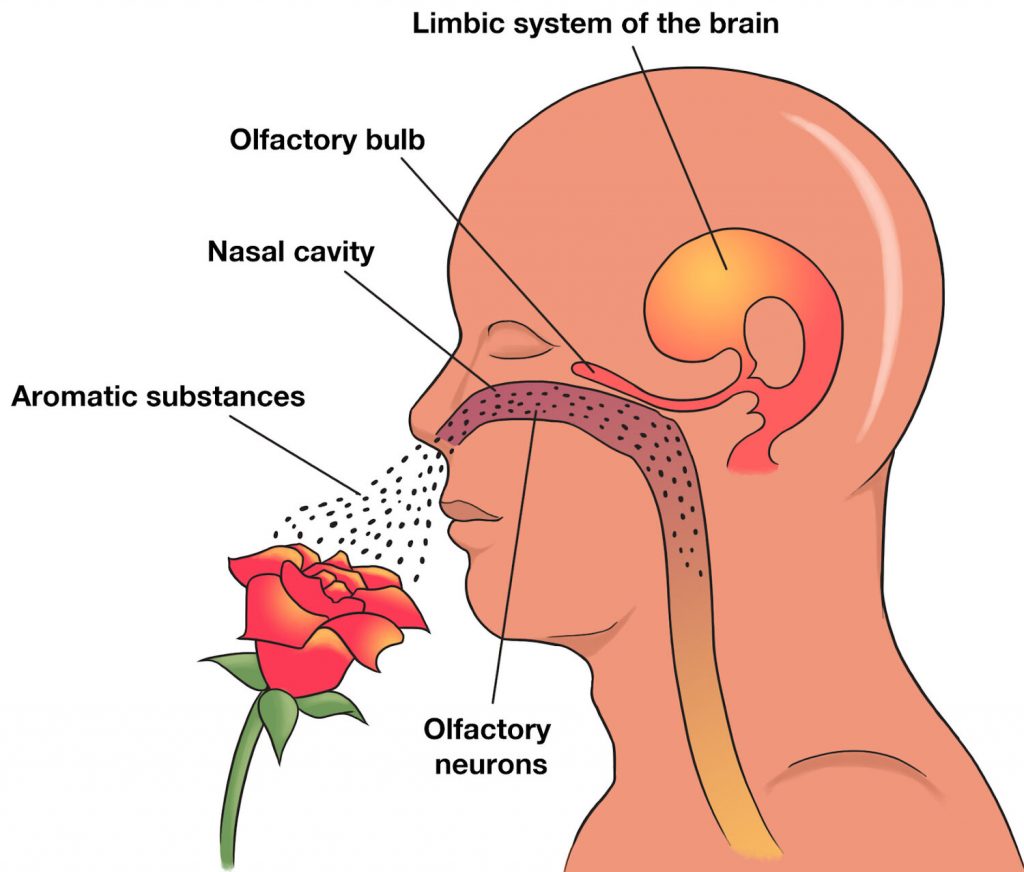
Scientific research affirms that our sense of smell is different from the rest of the senses. All the others – taste, touch, sound and sight – they get processed in the brain through our thalamus – the info relay station. In turn, the thalamus sends those sensations to the hippocampus (our memory manager) and the amygdala (our emotion processor.) But smell, it’s a bit of snob. It bypasses that trusty old thalamus and takes a direct path to the olfactory bulb which, in turn, has its own direct link to the hippocampus and amygdala.

Did you know that human beings have at least 1,000 different types of smell receptors but only four types of light sensors for sight and about four types of receptors for touch?

(Thanks discovery.com for helping me make sense of the human brain.)

Apply often

So that, dear writers, is why this sense is supercharged and ready to ignite your stories. If you want to read more about how the olfactory bulb stores our long-term memories that influence our behaviours, the above-noted link to discovery.com will take you there. On the other hand, if you want a complete tour of the olfactory system, Wikipedia offers a dump truck load of scientific illustrations, terms and definitions.

Applying any sense in your writing works best when it:

  • Is in the logical place (but sometimes the illogical place works best)
  • Fits with your character (or maybe surprises your character)
  • Fits with your setting (whoa! Where did that stink in my flower shop come from?)
  • Fits with your story (a bakery should always smell like…rotting meat?)

The writer has several choices when incorporating a physical sense into a scene. As noted in the above “absolutes”, turning things around can be an effective tool for raising intensity in a scene.

Subvert the normal world

For example, your calm, cool and buttoned-down accountant might surround herself with comfort scents – a faint whiff of sandalwood in her study, an understated sniff of cedar in her walk-in closet, the dry musk of leatherbound account ledgers on her desk.

How can you shake up the predictable safety of her world?

What if she finds a street person perched on her desk, a decidedly unwashed individual with a preference for beans and cheap beer? Upside down goes her ordered world – and not just because of the surprise of the desk squatter, but the lovely scents you’ve surrounded her with up to this point fade from this nasal onslaught.

How can adding the street person to the story be logical? What if the accountant unknowingly holds the key to how the intruder lost everything: his job, reputation, wife and kids, home. Falsely accused and convicted, he’s finally out of prison. Our squatter is determined to restore his original life. The “stink” he brings into the room is a metaphor for all the terrible things that still cling to him.

Will she wash them away?

Apply with subtlety

On the other hand, when you want to be subtle with an emotional scene, tug at heartstrings or allude to themes in your story, you can use smell to underscore the moment. It’s easy to use the overpowering odour of flowers to evoke the floral perfumes so prevalent at funerals. But can we be more understated?

For example, a scene about dying could include something that doesn’t smell but hints at it. A painting of lilies or of mixed blooms. Silk or plastic flowers. A carpet with a chrysanthemum motif. A scented candle still wrapped in plastic. A bottle of hand sanitizer, so antiseptic…so embalming fluid-like.

Or a wooden jewellery armoire, tucked in the corner of your spare room.

Over to you. What are the scents that send your memories and emotions on a trip far away and long ago? Share them in the comments. Meanwhile, happy and slightly scented writing to you all.

10 lists to spark creativity

10 lists to spark creativity

In last week’s blog on jumpstarting your creativity with a playful artist’s date, one of the activities mentioned was creating a bucket list. The first image below is a fun, creative way to do that.

The image was so inspiring to us, that we went searching the internet for similar creative list images that could be used as jumping off points for nudging your imagination. Be creative in designing your own list to work from, or use one of these.

Let us know in the comments below what these lists inspired in you.

Bucket list for any age
I can’t image life without…
Unusual grocery list
I am….
A list of lists
Looking back I wish I’d known,,,
Me from A to Z
Things I want to learn
Christmas list for Santa
Things I cannot stand
Take yourself on a date

Take yourself on a date

Gwynn Scheltema

When I read Julia Cameron’s seminal book The Artists’s Way, she introduced me to the concept of an Artist’s Date: a block of time set aside to nurture your creative inner artist.

This is how Julia Cameron describes it:

The Artist Date is a once-weekly, festive, solo expedition to explore something that interests you. The Artist Date need not be overtly “artistic” — think mischief more than mastery. Artist Dates fire up the imagination. They spark whimsy. They encourage play. Since art is about the play of ideas, they feed our creative work by replenishing our inner well of images and inspiration. When choosing an Artist Date, it is good to ask yourself, “what sounds fun?” — and then allow yourself to try it.

Different times

In normal times, Artist Dates were small adventures pursued by yourself outside your normal environment: poking around in a thrift shop, visiting a museum or art gallery, or trying a new restaurant. COVID has changed our choices, but definitely not eliminated them. You just have to be imaginative and remember what is at the core: fun; new to you; sensory and solo.

Because our creative brain is a sensory brain, anything that stimulates the senses or fires up the imagination will work.  Have an adventure; push yourself out of your comfort zone. We all accept play is crucial for a child’s development, it is also beneficial for adults. Play can add joy to life, relieve stress, supercharge learning, and connect you to others and the world around you. Play can also make work more productive and pleasurable.

As a writer, be mindful and consider how you might describe what you experience in words. Notice physical details and the emotions that stir within you. Make notes of your discoveries to use later.

Listen and move

Try listening to music you don’t usually listen to or you’ve never listened to before. A new instrument, a new singer, a new cultural sound. a podcast that seems “too frivolous”. Spotify is your friend.

Or go down memory lane. Dig out old CDs that haven’t seen the light of day since your youth. Go online and find songs of a particular decade. Create a playlist of old favourites. Listen to your parents’ era music, or your children’s or your character’s.

Dance like no one’s watching. Sing like no one’s listening. Whistle.

Take a walk or a hike in a new place and listen for as many sounds as you can: birds, falling water, rustling leaves, chattering squirrels—or clang of garbage cans being collected, sirens, traffic, people, dogs…

Do something that involves physical movement that you’ve never tried or haven’t done in years: jump rope, whirl like a dervish, dig out the old hula hoop, do a new yoga sequence, balance-walk along a raised structure, make snow angels, go tobogganing, hug a tree.

Make something

Try a new dinner recipe, make a favourite soup from scratch, or bake bread. Get really adventurous and make yogurt or sauerkraut or preserves.

Attempt a simple carpentry project, try beading or macramé. Join an online paint night.

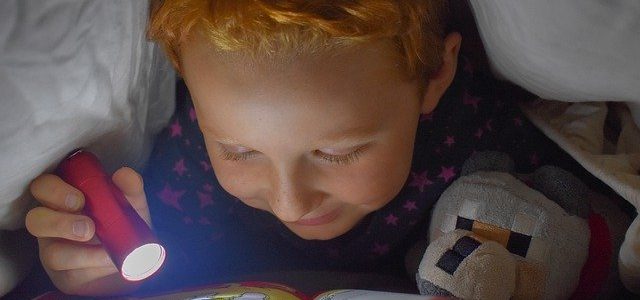
Play with LEGO or play dough or wax crayons. Make a blanket fort and read a book in it. How does that feel? Silly? Good!

Colour some pictures. What memories does that bring up?

Make a vision board, or an inspiration board, or a collage of the way you feel today. Try a craft, not because it has purpose, but because it’s fun.

Treat yourself

Do something, anything, that is usually considered a waste of time or an indulgence: lie on your back and watch clouds; take a bath with scented candles or scented soaps or exploding bath bombs or bubbles; re-read a favourite children’s book.

Pop open your favourite beverage or drink that third coffee without guilt. Mindfully cream your hands and feet or experiment with new hairstyles. Dress up in your favourite colour—all over, all in—just for a day. Dress down in your most favourite rattiest outfit with no judgement. Purge your closet. Guys, don’t bother shaving for the day.

Binge watch a new TV series or a movie you’ve been meaning to watch. Watch a movie you want to watch that you wouldn’t admit to anyone you wanted to watch it.

Have a tech-free afternoon. Sleep in a hammock. Snoop on virtual house tours on the real estate sites. Eat a whole bar of chocolate.

Expand your mind

Sign up for a course in a new genre or poetry or stamp collecting or genealogy. Randomly follow a writer in another genre on Twitter and engage to learn new perspectives, or join a group on Facebook that is totally new to you, like astronomy.

Make a list of 100 things that make you happy. Start a journal of the 50 things you want your grandchildren to know about you. Write a bucket list and illustrate it or scrapbook it.

Take virtual museum tours, watch virtual opera or ballet. Use apps to walk the Camino or Cabot’s trail.

Last words

Artist’s dates break the routine and unlock creativity and optimism. In these times they can give us a sense of fun to help fight the confinement many of us may be feeling. I did a quick count, and I’ve listed over 50 things you could try. You could no doubt come up with 50 more.

Artist Dates are not high art. They are meant to be fun. Ask yourself, “What sounds playful? What does my inner child want to do? What am I drawn to that others might label a waste of time, too silly, too frivolous?” Try doing that.

These three greats say it best:

“The intuitive mind is a sacred gift and the rational mind is a faithful servant. We have created a society that honors the servant and has forgotten the gift.” Albert Einstein

“We don’t stop playing because we grow old; we grow old because we stop playing.” George Bernard Shaw

“The creation of something new is not accomplished by the intellect but by the play instinct.” Carl Jung

Fire Up the Intensity

Fire Up the Intensity

Ruth E. Walker

For the past few weeks, I’ve been hunkering down at our Haliburton County cottage. It’s beautiful up here; deep mounds of white snow contrasted against our mixed forest. Despite the snapping cold temperatures, we’ve been pretty snug with our woodstove and propane heater.

The view outside our cottage

Sitting next to that woodstove fire got me thinking about the way that fire and flame can pull out all sorts of emotions in me. Given that those emotions often fuel (no pun intended) my creativity, it nudged my thoughts to fire’s central role for human beings long before our written words.

After all, it would have been sitting around fires that long-ago storytellers captured imaginations and sowed the seeds for our ingrained need for story.

A prehistoric essential

Of course, fire was a huge part of our early ancestors’ ability to survive and thrive. From keeping their bodies warm, to drying and preserving fish and fauna, to cooking fresh foods, building and maintaining a fire was the difference between life and death. But it was far more than a survival tool. It was key to deepening our creative expressions.


A bull painting, made with ochre, discovered in Lubang Jeriji Saléh cave, East Kalimantan, Borneo, Indonesia, dated 40 ka (more than 40,000 years ago).

Some of the most stunning art from tens of thousands of years ago has been found inside caves in Europe, South America and Indonesia. Most of those caves run so deep that if you just travel a few steps inside, natural light vanishes.

So how did they manage to create paintings in the dark? Perhaps some art was created in the dark. But the artists left behind evidence of light sources: carved stone lamps that still hold the residue of oil and soot. So it was fire – or, at least, a flickering flame – that lit the stone canvas. It’s hard not to imagine prehistoric artists travelling deep within, carrying carving stones or pots of red ochre in one hand and a precious lamp in the other, making their way to fresh walls on which to record their stories.

An artistic depiction of a group of rhinoceros, was completed in the Chauvet Cave 30,000 to 32,000 years ago.

I travel in time


Skeletal cast of “Lucy.” (H. Lorren Au Jr/ZUMA Press/Corbis)

In another life, I might have followed my love of all things ancient and unexplained into the field of archeology. As part of my English and Cultural Studies degree – eked out over two decades of part-time studies – I had the opportunity to hold an australopithecine finger bone cast from none other than the famous Lucy. The poem “Lucy’s Bones from Afar” arrived almost fully formed that same evening and was soon after published in The Science Creative Quarterly in 2006. One of my first poetry credits.

Anyone who knows me, understands my math-challenged brain would never have let me follow my Indiana Jones dreams. But I’ve found other ways to keep the passion going with books and magazine articles and the endless rabbit holes found online.

On Twitter, I follow @Jamie_Woodward_, a geography prof at the University of Manchester, UK. He offers the most amazing Ice Age tweets that so often tickle my muse. For example, a rare clay sculpture of two bison found in a French cave led to yet another poem: Here, there be Bison.


Musée d’Archéologie nationale in France

The prehistoric cave art in Tuc d’Audoubert in France, plasters the walls in carvings and etched stone. There’s even ancient footprints hardened in the clay deposits, from which the bison were formed. I’m certain the bison artist was female and I wrote the poem from her perspective. For me, it is a solid connection to a creative soul who existed in 13,000 BC.

Burning questions

But if flame is the source of survival of our species and for first allowing creativity to deepen, flourish and, in the case of the cave art, to be preserved, it’s also been a source of terror and destruction. Beyond natural disaster, humanity has managed to harness flame as a weapon. From igniting gunpowder and cannon shot, we’ve managed to evolve the level of burn to horrific weapons of mass destruction.

pixabay.com

Maybe that’s why much of my creative focus has lately looked forward, to the future of this world or others, as imagined in science fiction.

And yes, dystopian tales hold a strong interest because they move me to ask questions. Questions like: why, when capable of so much beauty in art and creativity in science (didn’t they just land the latest rover on the surface of Mars?) why is the urge to burn it all down still out there?

Well writer? Maybe that illogical human predilection is of interest to you as well. Maybe it drives your muse and “fires up” your pen. I hope it’s good to know you are not alone.

A poem

Lucy’s Bones from Afar

Gracile Australopithecus: November 1974
 
Offered in atonement
these few small bones
meant nothing
but salvation: a kind
of anthropological grace
held in a trembling hand.
 
Mired in a bed of river dust
pillowed between rocks
and sheets of clay
ancestral arthropods led us on.
 
Before the fire
we danced and drank
and repeated the music
each rote word a triumph
in our mind
each note ingrained.
 
Under the brilliant carpet of heaven
deep in the musk of canvas
sweat and kerosene
we leaped with the flame
our shadows racing home
our footprints close behind.
 
On Chapbooks

On Chapbooks

Gwynn Scheltema

Covid messed with my creative mind back in April, bringing work on my mystery novel to a grinding halt. But the old adage of “when one window closes, another opens” proved to be creatively true for me. I dove back into poetry, which had been languishing somewhere in the back of the closet for some time.

Perhaps this short form was less overwhelming, or poetry was manageable in smaller chunks of time, but I suspect that it was more a case of emotions running higher than usual, and poetry being able to capture that state and be productive. Whatever the reason, the result is a file of 100 finished poems and a second file of about 60 poems in progress. Yay me!

My mission this year is to get an organized submission plan in play while I put together a full-length poetry collection ms. In my researching of current poetry markets, I was surprised at the number of presses that considered chapbooks. Hmmm… a chapbook would be quicker, but how would putting out a chapbook affect my ultimate goal of a full-length collection?

First Book Status

In poetry circles, you only get one “debut” book and there are contests and prizes that “debut” poetry collections qualify for. Fortunately, because chapbooks are considered not-quite-books by the publishing world, they don’t affect this status. Your first full -length collection is considered your debut book.

What makes a chapbook?

One Ticket Five Rides – anthology

Depending on the publisher, the general length runs from 15 to 30 pages of poems. Full manuscripts by comparison run on average between 40 to 80 pages of poems, but can be much longer. Full collections carry an ISBN and are marketed like any other trade book. Chapbooks can be trade books too, but often are part of the zine world, micro presses and self-published. As such, they seldom make it into the usual distribution channels.

Why publish a chapbook?

  • For the unpublished poet, it’s a chance to get publishing creds.
  • The process will prepare you for putting together a full collection.
  • A chapbook is a “safe” way to publish, because the work is not lost. You can publish it again in your collection.
  • You can take risks with a chapbook – give a chance to a new publisher, publish it yourself, create an artpiece.
  • A chapbook can keep you in the public eye in the time between publishing full poetry collections.
  • You need a home for perfectly good orphan poems that didn’t make it into a collection.

What goes into a chapbook?

If you think of a full collection as a bracelet of pea-sized red glass beads, a chapbook is not a ring-sized circle of miniature red beads; a chapbook is one magnificent red glass bead in all its glory, an orb of refracting light admired for its own beauty, whether or not it becomes part of a bracelet another time.

One poet friend embarked on a full-length collection project about a relationship in a particular Ontario locale. Although each poem stands alone, when read in order they tell the story of a summer and the growth and demise of the relationship. However, for a chapbook, she has extracted 15 poems that don’t focus on the relationship and don’t tell the relationship story, but which shed a spotlight on the geographic locale instead.

Another friend entered a chapbook suite in a contest and placed. Subsequently, he included the chapbook suite as one long poem in his full-length collection.

Yet another friend put together a chapbook of poems to raise money to help with her mother’s medical expenses. She wrote in her forward “I thought this chapbook was about my mom. It wasn’t until I put nearly everything together that I realized … it‘s about my experience of mourning the loss of my mother.”

A work of art

Given their small size and tight focus, chapbooks also lend themselves to becoming works of physical art. The chapbook I mentioned earlier about mourning the loss of a mother contained family photos, original artwork by the poet and was handstitched with red thread.

Container Books produce amazingly unique chapbooks that represent the contents: chapbooks as a View-Master reel and viewer toy, as a series of cross-stitch pillow kits, as tincture bottles with the text on the bottle labels. Other publishers offer special papers and bindings as varied and beautiful as the poems themselves.

Small but mighty

I’ve gained a new respect for chapbooks. I always thought of them as a trailer for the main event, but they are an event unto themselves. I think I’ll give it a try.

10 Chocolate Inspirations

10 Chocolate Inspirations

With Valentine’s around the corner, we’re exploring 10 ways that chocolate can inspire us. The cacao bean grows inside pods that are harvested and then the beans removed. From those beans comes the chocolate that so many of us love. But we’re also offering some facts about the little bean that might surprise you. Don’t you love surprises? We thought so.

Chemical Love

Chocolate contains a chemical called phenylethylamine which releases pleasure endorphins in the brain. Love potion? Chemical manipulation? Love substitute? How could this phenomenon be adapted to story?

Let Myths and Legends inspire you

Myths and legends are always great inspiration for writing or indeed actions of many kinds. Ancient Mayan calendars led many to believe that the world would end in 2012. It didn’t, but Qzina Specialty foods were inspired to create a 9-ton replica of the Kukulkan temple in Chichen Itza, Mexico. It took the company’s pastry chef 400 hours to build and beat the previous Guinness World Record for the largest chocolate sculpture.

A smoking hot bean

Since 1500 BC, cacao was a staple in Central American diets. Mayans served chocolate drinks as a mealtime staple, creating chocolate concoctions with chili peppers, honey or simply water. That tradition continues. Today’s savvy cooks add a touch of unsweetened chocolate, or cocoa powder, to their bubbling pots of chili. Why? Because cocoa enriches the flavours of the peppers and spices in a yummy pot of chili. But just like any flavour-booster, that chocolate is a tiny addition to the whole pot. Otherwise, it will overwhelm the rest of the flavours bubbling away. Use the chocolate-in-chili concept in your writing: a teaspoon of effective description is much better than a page of every little detail that overwhelms your reader.

Happy Accidents

Surprises keep stories fresh, especially when the outcome seems inevitable. The surprise serves double duty when it surprises the characters as well. It really happened to Percy Spence, a scientist working on WWII radar and weapons projects. Percy noticed that being near a magnetron melted the chocolate bar in his pocket. The idea that magnetrons might heat food at incredibly fast rates, gave birth to the microwave oven.

Story starters

  • Zeus stared at me. “I hate chocolate. It’s only for weak mortals.”
  • When Cindy opened her eyes, the world was made of chocolate…
  • I’ll have a hot chocolate please- double whipped cream…
  • Brad skied up to the kiosk at the end of Dragon Run and ordered two hot chocolates…

Chocolate movie inspiration

The Mexican love and social drama Like Water for Chocolate is set prior to the revolution of 1910. Director Alfonso Araus’ film is based on the novel Como agua para chocolate (1989) written by his wife, Mexican writer Laura Esquivel Valdés. Great movie for studying family relationships.

Chocolat – One Taste is all it Takes is based on the novel Chocolat from British writer Joanne Harris (1999). This fairy tale for adults set in the French countryside towards the tail end of the 1950’s stars Juliette Binoche and Johnny Depp. ’Nuff said.

Ignorance is not always bliss

While cacao beans were first harvested in Mexico and Central America, 60% of cacao bean harvest comes from the west coast of Africa, specifically Ghana and Cote d’Ivoire. So, there must be lots of chocolate there too, right? Guess again. Imagine what it must be like to taste sweet chocolate for the first time. In 2014, a news crew from VPRO Metropolis filmed a farmer and his family and labourers tasting chocolate for the first time. Their delight and amazement is humbling to watch. For many of us, we have hundreds of ways to enjoy chocolate. But for many of the people who grow and harvest that lowly bean, few have ever had that sweet confection melt in their mouths. Why? They’re paid very little for this labour-intensive crop. What can your story introduce as a first-time moment?

Favourite Things

Chocolate makes it to many people’s list of favourite things. What’s on your character’s list of favourites? Why? What does that tell you about that character? Try this exercise with villains, side-kicks—any character that needs fleshing out.

Prescription: Chocolate

Oh yes! Something delicious that is also good for you: chocolate has flavanols, which, besides being rich in antioxidants also can lower blood pressure. But before you devour that caramel-butternut chocolate confection, you need a few more facts. Processed chocolate – milk chocolate or Dutch-processed cocoa powder – loses most, if not all, of those lovely flavanols. So choose dark chocolate and remember that even that choice can be a highly processed product. Ah, choice. It’s one of the best ingredients in any plot. When a character has to make a choice, much can be revealed about who they are and it ups the tension which, as readers will tell you, that’s a very sweet thing to have happen. Does your story have enough choice?

Show me the (Chocolate) Money

The Aztec culture believed cacao beans were a gift from their god. So valued that Aztecs used the beans as currency for trade and religious ceremonies. Consider how something ordinary could be transformed into a sacred item. Look around your home and imagine one lowly object being a gift from a god. A vacuum cleaner? Crystal vase? Magnifying glass? Write a scene where a character begins to doubt the belief.

Rearranging The Bookshelf

Rearranging The Bookshelf

Ruth E. Walker

A recent exchange of ideas on Facebook in a writers’ group page caught my interest. In short, a post from a writer was asking other writers if they felt “pressured” into including “LGBTQ” and “mixed race” characters into their stories.

The writer went on to suggest that the immensely popular (and rather sexy) Bridgerton series on Netflix was an example of political correctness because, despite being set in 1815 England, it included persons of colour among the aristocracy and upper classes. Oh my.

For me, it was a bit of head-scratcher. Casting on Bridgerton is, among other things, meant to challenge viewers to rethink history and imagine what might have been. It was a delightful binge watch and, frankly, it didn’t take too long for me to absorb the fiction of the tale and just sit back and enjoy the story.

No pressure here

I don’t feel pressured to include characters of colour or of indigenous heritage or those who are LGTBQIA2S+ any more than I feel pressured to write in a particular genre or narrative tense. I write the stories I’m meant to write with the characters who show up.

And isn’t that the role of fiction? To entertain, yes. But also to hold up the mirror and see us as we are? And what better way to remind us what we have lost over the years of separation and “difference” versus inclusion and shared visions? Bridgerton was refreshing.

I do know that books by marginalized authors are sorely underrepresented on mainstream bookshelves. So it makes sense to me that, as an understanding of an underserved market dawns on agents, publishers and booksellers, the demand for those books will increase. Rightly so.

But they are not books being written for any underrepresented groups. They are for everyone. Remember that those books will show us who we are. Those writers will hold up the mirror for us to see ourselves — ALL of us who make up our country. High-quality books will arrive on the bookshelves, some will be made into films or inspire television programs or win prestigious literary prizes. But more importantly, they will be read by a diverse, engaged audience.

It’s Black History Month in Canada

Black History Month in Canada was proclaimed nationally in December 1995, when the House of Commons officially recognized February as Black History Month. There’s more than a proclamation needed to create understanding. But it was part of a journey we’re all still on and there’s lots to learn.

For example, this week I learned that the church that Harriet Tubman attended in St. Catharines, Ontario, while tirelessly rescuing others through the Underground Railroad, still stands. The Salem Chapel counted Harriet “Moses” Tubman as a congregant from 1851 to 1862, at which point she returned to the United States.

According to the the church’s website: the majority of her clandestine Underground Railroad rescue missions started and ended in this British Canadian town. In 1868, when asked where and why she guided the freedom seekers, Harriet Tubman said, “I would’t trust Uncle Sam with my people no longer; I brought them all clear off to Canada.”

Want to learn more about Harriet Tubman? Cornell University features a selection of several biographies. She may soon appear on the US $20 bill, but this courageous woman left a lasting influence on Canada and our history. And I, for one, didn’t even know that much. Clearly, I need to expand my reading choices.

Back to writing

So what does diversity in publication mean for non-marginalized writers? You must still craft the stories you are inspired to write. But it’s time for the majority of us to make room for those who have had fewer opportunities to have their words heard.

And if you want to expand your reading library, check out 49th Shelf online, a curated resource of Canadian books with a wide range of categories to choose from. From diversity and inclusion in Young Adult to African-American fiction, 49th Shelf is open for readers to discover a treasure trove of homegrown writers.

Moving Foward

Moving Foward

Guest blogger – Christopher Cameron

“I write for the same reasons I run: not for expiation but for exaltation; not to pull myself up from the depths, but to fly higher. I cherish the whole endless, chaotic process of writing, from first spark of inspiration to final revision.”

So says author and editor, Christopher Cameron on his website, and today, with permission, we repost his blog about running that originally appeared on January 1, 2021 on the Northumberland Festival of the Arts blog  A Journal in Time of Pandemic and Lockdown.

Moving Forward

Some runners wear headphones and listen to music or audiobooks, but I love hearing the sound of my shoes hitting the road as I run through the hills of Northumberland. Different sounds for different roads: pat-pat on pavement; critch-critch on gravel; and a kind of a wash-wash on dirt roads.

It isn’t unusual for me to run for several hours, and some people are amazed that I actually enjoy this. My reward is the peaceful contentment that comes from moving myself forward from one place to another under my own power. In the years since I moved to Meyers Island, south of Campbellford, I’ve run all of these pathways countless times, and most are as familiar to me as my own driveway.

Yet somehow, each run is slightly different, each path finds something new to throw in my way, and it is those differences that keep me guessing and engaged. Every step forward adds to my knowledge and experience for the next time.

You don’t have to go out and run for hours to know that some things are hard. Home-schooling children is hard; trying to run a storefront retail business is hard; isolating yourself from loved ones is hard. They were hard during what people are calling the “before-time.” They’ve been even harder this year. There have been more hills to climb, more trees fallen across the path.

People seem to like lamenting the loss of the good old days, and everybody is looking forward to a return to normalcy. Some on social media have been billing 2021 as some kind Elysian fields, where we can all go back to the wonderful life we led before the bad old days of 2020.

It reminds me of a Facebook group I followed for a while: a lot of people wondered why life couldn’t be like it once was, when ice cream was only five cents. I suspect that if Facebook had been around back when it “once was,” there would have been a group wondering why life couldn’t be like it was when ice cream was only one cent.

There were no good old days, unless you count Carly Simon’s maxim that they are happening today. There are just days, one after another, like steps along a path. We move forward, by running, walking, wheeling, or simply by living. We clear the hurdles any way we can and we keep going. When needed, we stop to help a fellow traveller along.

I think we should congratulate ourselves at the end of this year. It’s good to see how far we’ve come and to collate what we’ve learned so we can use it on the road ahead.

I used to have a mantra I repeated in the tough parts of a very long endurance event, when the night had settled over me and all my energy was gone: I’m alive and I’m moving forward. As long as these two things are true, nothing else can stop us.

It’s probable that 2021 will throw stuff at us we can’t even imagine yet. As the late Gilda Radner reminded us, “It’s always something.” Who knows? Maybe someday we will look back on 2020 and sigh wistfully, remembering when all we had to do was wear a mask. But we will have our experience, our vision, and our humanity to help us navigate our way home.

And isn’t it marvellous that we still have ice cream?

Meet Chris

Christopher Cameron enjoyed a long and successful career as a professional opera singer, performing on opera and concert stages across Canada. In 2009, he began a career as a freelance writer and certified copy editor.

His first book, a witty, irreverent memoir of his singing years, Dr. Bartolo’s Umbrella and Other Tales from my Surprising Operatic Life (Seraphim Editions), was published in 2017.

Chris lived in Toronto for most of his life until he and his wife Karen relocated to the banks of the Trent River in Campbellford in June 2017. Chris is also an ultramarathon runner, long-distance cyclist, and seven-time Ironman triathlon finisher. He blogs about reading, writing, and athletics on his website.